%20.png)



Estimated reading time: 8 minutes
An ADHD treatment plan focuses not only on symptoms but also on nervous system regulation, emotional health, and executive functioning support.
Many parents tell me they’ve received conflicting advice about medication, therapy, accommodations, or behavioral support and aren’t sure where to begin.
I’m Dr. Roseann Capanna-Hodge, and for more than three decades I’ve helped families create personalized ADHD treatment plans that support both the brain and body. One thing I’ve consistently seen is that children make the greatest progress when treatment addresses emotional regulation, daily functioning, and confidence—not just behavior alone.
In this guide, I’ll show you how to build a calm-first ADHD treatment plan without medication. You’ll learn what science says works best and practical steps you can start using this week.
This way, your child can feel more in control, and you can finally breathe easier.
How To Build and ADHD Treatment Plan Without Meds?
Start simple: Regulate → Connect → Correct.™ We calm the nervous system, create emotional safety, then layer skills and structure. Behavior is communication—and a dysregulated brain can’t learn.
Core Building Blocks
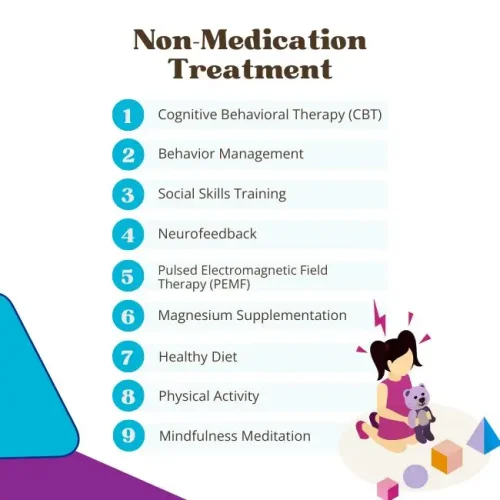
- Parent training/behavior therapy to give you scripts, routines, and reinforcement that work in real life (first-line for preschoolers per the AAP).
- Skills therapies include CBT, social skills training, and executive function coaching.
- Brain-based supports (e.g., neurofeedback as an adjunct, sensory strategies) when appropriate.
- Lifestyle pillars (sleep, nutrition, movement, environment) to keep the brain steady.
Parent Story: Oscar, age 7. Impulsivity and disorganization derailed his day. We began with co-regulation, a points plan, and movement breaks every hour. Once calmer, we layered visual checklists. Six weeks later, disruptions fell and completed work rose.
Takeaway: When you regulate first, skills finally “stick.”
What Does “Regulate First” Look Like Day to Day?
Think small, repeatable actions that soothe the nervous system. This way, attention and self-control come online.
Daily regulation menu (pick 2–3 per part of the day)
- Morning: 3–5 slow belly breaths, protein-rich breakfast, sunlight + brisk movement.
- After school: “sensory snack” (heavy work, swing, trampoline), hydration, 10-minute body break.
- Evening: warm bath or PEMF session, low-light wind-down, consistent sleep window.
- Parent scripts: “I’m calm; let’s breathe together.” “Body break, then we try again.”
Parent story: Riza, mom of a 10-year-old with ADHD + anxiety. Mornings were meltdowns. She added a 2-minute breath + wall push routine and a visual schedule on the fridge. Two weeks later, transitions were smoother.
Takeaway: co-regulation + predictability lowers stress for everyone.
Which Non-Medication Therapies Have the Strongest Research?
Here’s what the evidence says, so you can choose confidently.
Well-Supported Options
- Parent training/behavior therapy: The American Academy of Pediatrics recommends parent training as first-line for preschoolers and as part of care for older kids.
- Cognitive Behavioral Therapy (CBT): An RCT in medication-treated adolescents found CBT significantly improved symptoms vs. waitlist. (Sprich et al., 2016).
- Neurofeedback (as adjunct): Evidence is mixed. A recent JAMA Psychiatry meta-analysis found no meaningful benefit as a stand-alone treatment on probably-blinded outcomes. Small effects appeared only under tightly defined protocols. (Westwood et al., 2025).
Pro tip: Use neurofeedback, if chosen, alongside behavior therapy, school supports, sleep, and movement rather than as the only tool.
You can’t teach a dysregulated brain. Regulate, connect, then correct.
“Parent training in behavior management should be first-line for preschool-aged children.” — American Academy of Pediatrics, 2019
Lifestyle Changes That Move The Needle Fastest
Little hinges swing big doors. Keep it simple and consistent.
High-Impact Basics
- Sleep: Aim for 9–11 hours (school-age)—same bedtime/wake time; dim lights 60 minutes before bed.
- Movement: 60 minutes/day mixing cardio + heavy work (carry, push, climb).
- Nutrition: Protein at every meal; steady blood sugar; omega-3s; watch individual food triggers.
- Environment: Decluttered homework station; timers; one-step instructions; visual schedules.
Parent story: Mark, dad of a 7-year-old. He added an after-school bike ride and protein-first snack. Homework time was reduced from 90 minutes to 35 minutes.
Takeaway: movement + blood-sugar steadiness improve focus.

How To Partner With School To Make Plan Effective
Home gains stall if the school isn’t aligned. Bring your team together.
School Collaboration Essentials
- One-page support plan: Triggers, “what helps,” movement breaks, calm corner, cueing language.
- Accommodations: Flexible seating, chunked work, visuals, extended time, check-outs.
- Data loop: Two goal behaviors, weekly 0–3 ratings, adjust every 2–3 weeks.
Want a customized roadmap you can start this week? Explore our (QEEG-guided neurofeedback as an adjunct, CALM PEMF, parent coaching, and at-home tools) to regulate first. This way, learning and behavior change can follow. Regulate. Connect. Correct.™
Should You Avoid Medication In Children Under 6?
For children under 6, the AAP recommends behavior therapy/parent training before medication. For 6 and older, behavior therapy, school supports, and other holistic therapy approaches remain essential. Some families may add medication if needed. (Wolraich et al., 2019).
Why This Matters
- Young brains learn self-regulation best through routines, modeling, and play.
- Early parent training can reduce home stress and improve classroom behavior.
How To Know The Plan Isn’t Working?
Track two behaviors and one well-being metric for 3–4 weeks.
Mini Progress Dashboard
- On-task minutes (before/after movement breaks).
- Transitions without meltdown (count per day).
- Child stress rating (faces scale 1–5 at dinner).
Adjust if there are no gains after 4 weeks, school data conflict, or sleep/mood worsen. Tighten routines, add CBT/coaching, consider adjuncts, and reset goals with your clinician.
What A Realistic Week Looks Like
Monday–Friday (sample)
- Morning (10 min): breath + stretch → protein breakfast → visual plan review.
- School: movement pass each hour; chunked assignments; targeted praise.
- After school (20–30 min): snack + body break → 25-minute focus block → play.
- Evening: screen downshift → warm bath or PEMF → read + lights out.
Weekend reset
- Nature walk, simple meal prep with your child, lay out next week’s visual schedule.
Before You Go: Hope, Not Blame, Is the Key to Change
When you build an ADHD treatment plan around regulation first, everything shifts. Small steps—like better sleep, movement breaks, or parent coaching—become powerful. It's because the brain is finally calm enough to learn.
Remember: It’s not bad parenting—it’s a dysregulated brain. Your child doesn’t need perfection; they need steady, loving support and science-backed tools.
Start where you are. Choose one habit, track one small win, and build from there. With time, consistency, and compassion, your child will gain the focus, confidence, and calm they deserve.
You’re not alone. Let’s calm the brain first—and trust me, it’s gonna be OK.
FAQs
What should an ADHD treatment plan include?
An ADHD treatment plan should include emotional regulation support, school accommodations, behavior strategies, and lifestyle interventions.
How do parents create an effective ADHD treatment plan?
Parents can create an effective ADHD treatment plan by identifying challenges, setting goals, and working with trusted professionals.
Can ADHD treatment plans change over time?
Yes, ADHD treatment plans often change as children grow and their academic, emotional, and social needs evolve.
What therapies are commonly used in ADHD treatment plans?
Common ADHD therapies include behavioral therapy, neurofeedback, executive functioning coaching, and parent support strategies.
Should schools be part of an ADHD treatment plan?
Yes, schools play an important role by providing accommodations, communication, and support for learning challenges.
How does emotional regulation fit into ADHD treatment?
Emotional regulation is a key part of ADHD treatment because many children struggle with frustration, stress, and impulsivity.
Can lifestyle habits support an ADHD treatment plan?
Healthy sleep, nutrition, exercise, and stress reduction can strengthen an ADHD treatment plan and improve daily functioning.
Why is an individualized ADHD treatment important?
Individualized ADHD treatment helps address each child’s unique symptoms, strengths, and nervous system needs.
How fast will we see changes after an ADHD treatment plan?
Many families notice small wins (smoother transitions, faster start) in 2–3 weeks; bigger gains build with consistency over 6–12 weeks.
Can we combine therapies as part of my child's ADHD treatment plan?
Yes, you can combine therapies as part of your child's ADHD treatment plan. Start with parent training, then layer CBT or executive function coaching. Consider neurofeedback only as an adjunct, given mixed evidence.
Terminology
- Co-regulation: A caregiver’s calmness helps the child’s brain calm down.
- Executive function: Planning, organizing, starting tasks, and staying with them.
- Parent training: Coaching for parents to use positive behavior strategies at home.
- Neurofeedback: Computer-guided brain training; current evidence does not support it as a stand-alone ADHD treatment.
Citations
Wolraich, M. L., Hagan, J. F., Allan, C., Chan, E., Davison, D., Earls, M., Evans, S. W., Flinn, S. K., Froehlich, T., Frost, J., Holbrook, J. R., Lehmann, C. U., Lessin, H. R., Okechukwu, K., Pierce, K. L., Winner, J. D., & Zurhellen, W. (2019). Clinical practice guideline for the diagnosis, evaluation, and treatment of attention-deficit/hyperactivity disorder in children and adolescents. Pediatrics, 144(4), e20192528. https://doi.org/10.1542/peds.2019-3997
Sprich, S. E., Safren, S. A., Finkelstein, D., Remmert, J. E., & Hammerness, P. (2016). A randomized controlled trial of cognitive behavioral therapy for ADHD in medication-treated adolescents. Journal of Child Psychology and Psychiatry, 57(11), 1218–1226. https://europepmc.org/article/MED/26990084
Westwood, S. J., Aggensteiner, P.-M., Kaiser, A., et al. (2025). Neurofeedback for attention-deficit/hyperactivity disorder: A systematic review and meta-analysis. JAMA Psychiatry, 82(2), 118–129. https://doi.org/10.1001/jamapsychiatry.2024.3702
Always remember... “Calm Brain, Happy Family™
Disclaimer: This article is not intended to give health advice, and it is recommended to consult with a physician before beginning any new wellness regimen. The effectiveness of diagnosis and treatment varies by patient and condition. Dr. Roseann Capanna-Hodge, LLC does not guarantee specific results.
Are you looking for SOLUTIONS for your struggling child or teen?
Dr. Roseann and her team are all about science-backed solutions, so you are in the right place!
©Roseann Capanna-Hodge