


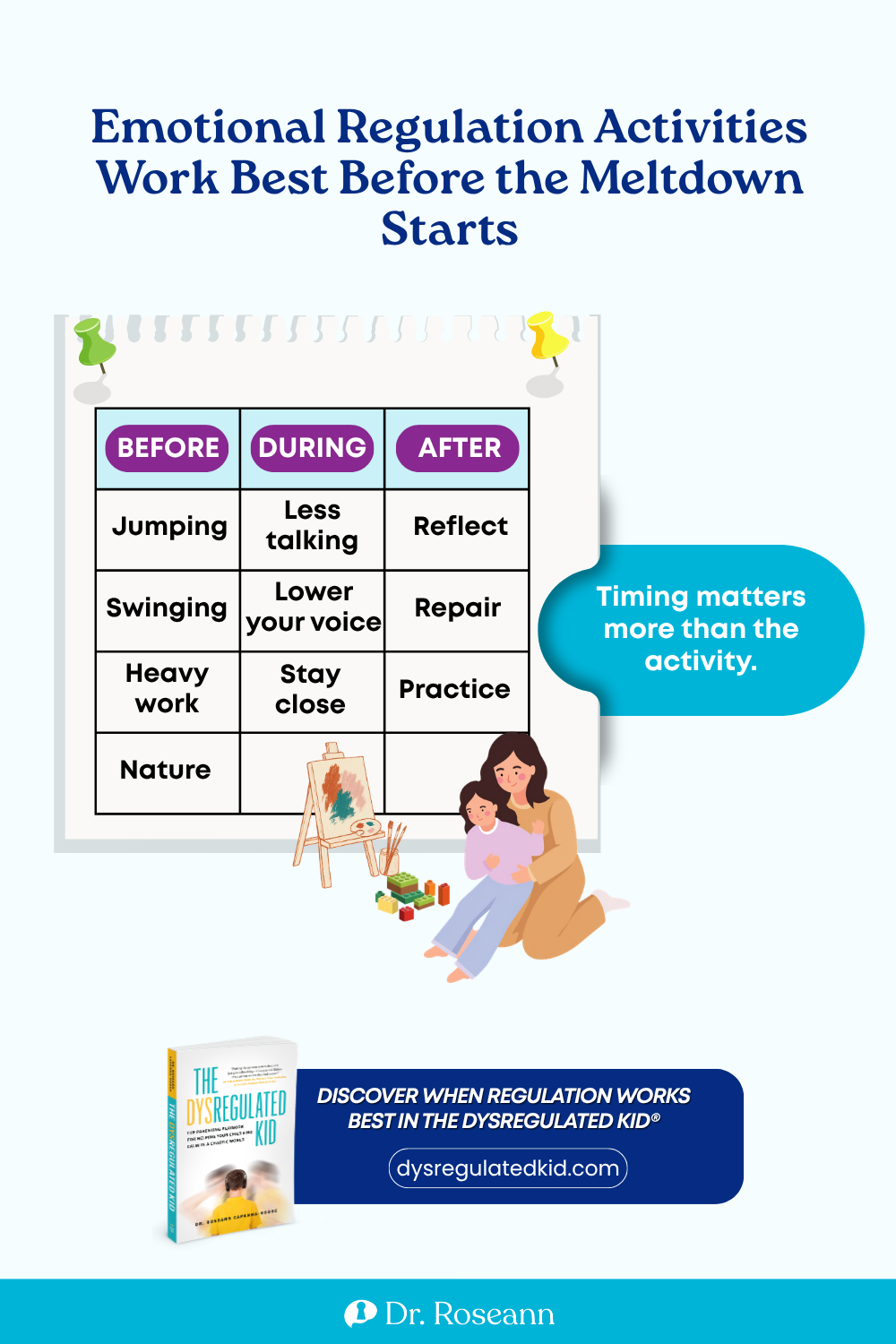
When your child melts down over what seems like a small thing, it’s easy to feel stuck and unsure what actually helps. Emotional regulation activities are one of the most effective ways to help your child calm down, reset, and build real coping skills—not just in the moment, but over time.
These emotional regulation activities don’t just stop the meltdown—they teach your child how to find calm again and build lasting emotional strength.
What You’ll Learn From This Article
- Emotional regulation activities that actually calm meltdowns
- How to choose the right activities for your child
- Simple ways to build emotional regulation skills daily
Why is Emotional Regulation Important for Kids?
Children and teens are said to be emotionally regulated when they recognize and control their emotions and respond appropriately to varying social settings. They are self-regulated and that shows up in their actions.
When Do Children Learn About Emotional Regulation?
Children learn about emotional regulation and self regulation in a variety of ways.
- Watching how others react and behave
- Engaging in activities designed to teach emotional regulation
There are a lot of fun activities that can help improve your child’s emotional regulation while keeping them engaged.

What are the benefits of emotion regulation skills in kids?
Helping kids manage emotions matters just as much as school or making new friends.
- More prepared to handle whatever life brings
- Able to navigate challenges with more ease
- Improved ability to stay focused
- More connected friendships begin to form
- Bouncing back becomes quicker after tough moments
- A growing sense of confidence shines through
Once they figure out how to keep their cool, that’s when the real growth begins.
Emotional Regulation at Every Developmental Level
Emotional regulation is the ability to control one's emotions in response to some stimuli. According to child development experts, this is something children (and even adults!) are continually learning.Emotional regulation activities for kids can easily be incorporated into family fun for young children, school-aged kids, or teens. Whether building skills at home or supporting self regulation skills for students, emphasis should be given importance on:
- Identifying and labeling emotions
- Practicing problem-solving
- Building stress tolerance
- Developing coping skills
- Adding in brain calming methods
- Explicit reinforcement of desired emotional regulation behaviors
What are Examples of Self-regulation in Toddlers?
With emotional skills regulation activities for toddlers, think about playful activities that teach young children how to pump the brakes.Goal: Learn to “pump the brakes” through play
- Get off screens and into playful, movement-based activities
- Use pretend play to model calming actions
- Try deep belly breathing (pretend to blow up a balloon)
- Focus on simple feeling words (mad, sad, happy, scared)
What are Self Regulation Activities for Preschoolers?
When it comes to emotion regulation activities for kids who are school-aged, there is a two-pronged focus. The focus should continue on feelings identification, but they need more practice with problem-solving. Helping kids build an emotional vocabulary allows them to express themselves better and understand what they’re feeling. This makes it easier to avoid frustration and helps them connect with others.
What are Emotional Regulation Activities for Teens?
Teens who struggle with emotional regulation often have a situational stressor, a clinical issue, or never developed good self-regulation. Encourage journaling to reflect on their emotions and identify patterns in their triggers and responses.Emotional regulation activities for teens need to occur at home, but also they may need support in school, where counseling, mindfulness programs, or regular check-ins with teachers can be really helpful.Working with a licensed therapist can give them the extra guidance they need to develop stronger emotional control and more effective coping strategies.
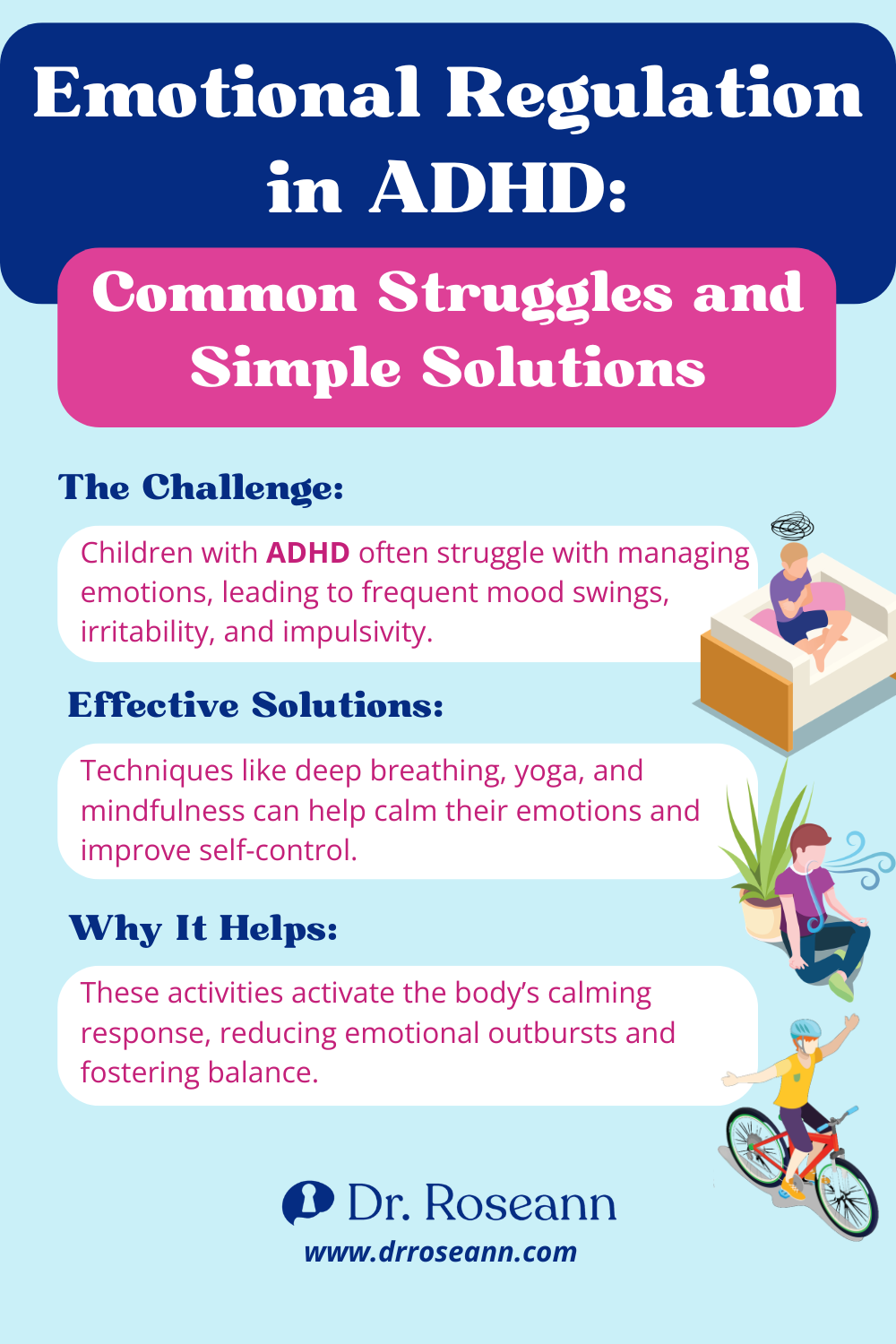
ADHD and Emotional Regulation Skills
Children with attention deficit hyperactivity disorder or ADHD usually experience emotional dysregulation, a challenge not officially listed in the standard diagnostic criteria but it is actually still common and troubling. Some of its symptoms like explosive anger, mood swings, irritability, and intense feelings can really disrupt their daily lives. Treating ADHD can help with focus and some emotional issues but it doesn't fully restore balance. Emotional resilience makes a huge difference in their progress. Kids with ADHD need strategies to cope, good health habits, and sometimes professional support. A clinical psychologist can help develop skills like emotional intelligence and executive functioning. These skills are key to effectively managing impulses and handling social situations better.
What are Activities that Promote Emotional Regulation?
Teaching emotion regulation skills may feel like a full-time job when your kid has emotional control issues and you lack proper guidance to support those “big emotions.”There is a way to support the development of positive emotions. It is important that we set clear expectations based on your kid's age and their social skills since these factors influence their ability to manage emotions at their developmental stage.
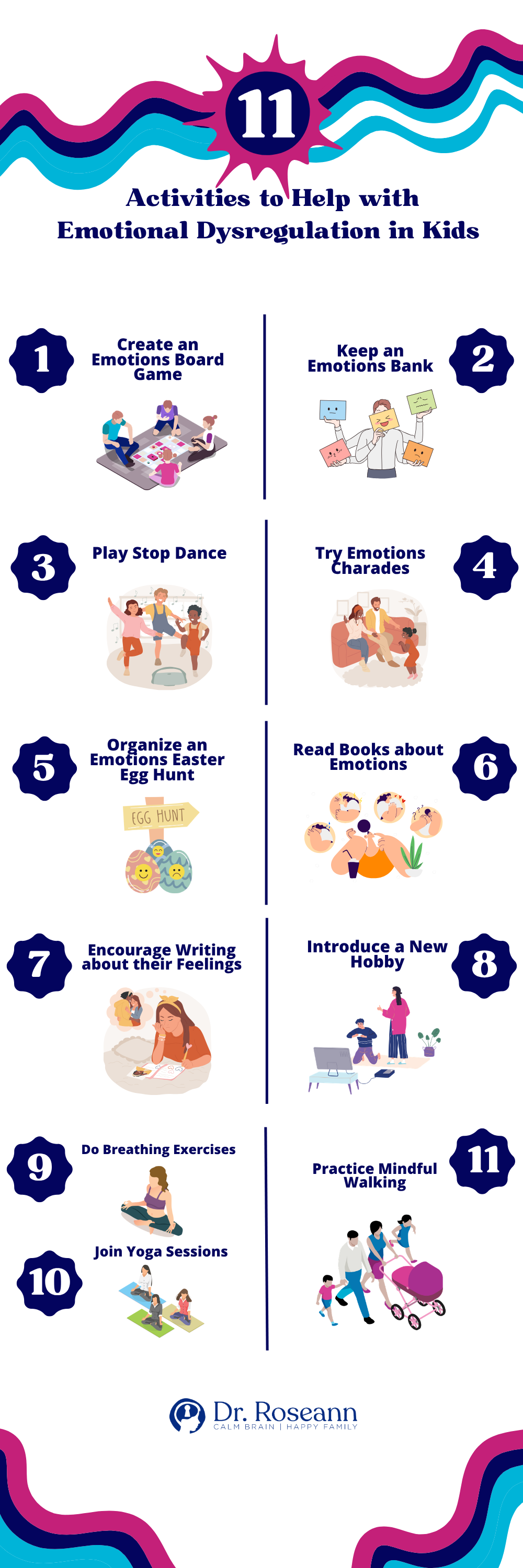
Let me give you some play therapy activities aimed at emotional regulation that can help young kids work through their emotions while having fun! These emotion regulation strategies are essential for helping kids understand and navigate a new emotion and the big feelings they may encounter for the first time.By teaching kids how to process these emotions, we can counter negative behavior and promote emotional balance.
1. Create an Emotions Board Game
The first step is to create a board full of feelings and emotions for kids to use as reference. You'll need a symbol or small photo to correspond with each feeling or emotion on the board.
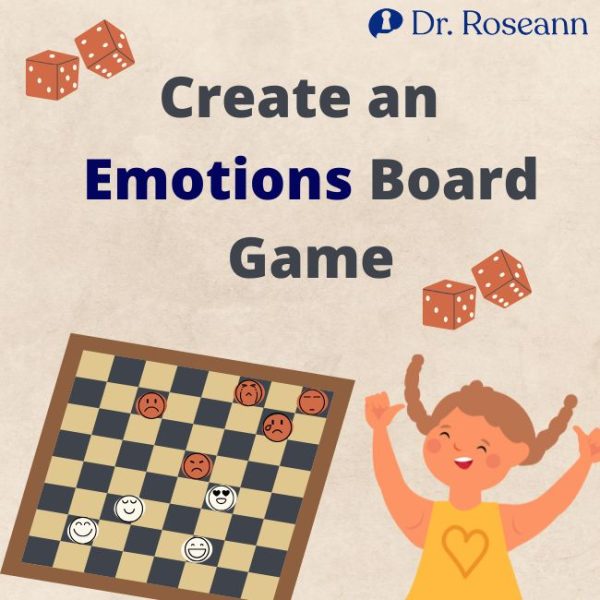
The general idea is for the child to visualize each feeling or emotion you're trying to teach them. Your child may find it difficult to recognize certain emotions, so include them in varying intensities on the board.For example, the board can include different anger or sadness levels if your child has trouble coping with or recognizing these emotions. Display the board somewhere visible during playtime to reinforce learning!Examples of emotions to put on the board are:
- Happiness
- Excitement
- Anger
- Annoyance
- Nervousness
- Anxiousness
- Embarrassment
- Frustration
- Loneliness
- Confusion
- Boredom
- Overwhelm
The next step is to create a stack of cards containing different situations. Each card must describe a variety of situations that require specific emotional reactions.Use questions like:
- “How would you feel if your toy broke?”
- “What do you do when someone takes your turn?”
- “How do you feel when you’re left out?”
What are the benefits of creating an emotions board game?
- Doing so will help them relate to these feelings, especially when they experience emotional outbursts. Kids learn fast when they're enjoying what they're doing.
- This teaches kids to recognize feelings and which emotional states require particular responses.
2. Keep an Emotions Bank
When your child is calm, have them write down every emotion they felt. No feeling should be overlooked, even if it's something your child might not typically discuss.After your child has listed each emotion, have them list all physical sensations associated with each.
Discuss each emotion, especially the emotions your child has problems regulating. This means you'll have to pay attention to their challenging behavior and reactions.Show them alternative ways to act. Put that list somewhere they'll often see it and be reminded of the appropriate way to act.
What are the benefits of keeping an Emotions Bank?
- These practices will help them identify feelings and manage their emotions, especially big emotions, and develop lifelong social-emotional skills.
- The more consistently they see and use these, the more naturally self-regulation becomes part of their daily routine.
3. Play Stop Dance
Self-control is also closely related to emotional regulation, like managing one's physical or emotional state. Physical activity is a safe and effective way to counter an activated limbic brain. Emotion regulation exercise allows children to improve their emotional regulation skills in a fun and healthy way, even if they play it only for several minutes. What seems to be a simple game can help emphasize how important it is to control their bodies and even their emotions.Exercise also builds executive functioning skills and supports neurotransmitters. You only need music that can be paused and restarted frequently.All participants should dance or move when the music is playing. But as soon as the music stops, they should freeze and be quiet. Young children may find this game more enjoyable if they play with their siblings or parents with whom they feel comfortable.Play fast-tempo and slow songs and ask the players to increase or decrease their pace of movement accordingly. Doing so exposes a child to stimuli in a fun way. It is an excellent game for regulating big emotions.
What are the benefits of Play Stop Dance?
- This game emphasizes the contrast between acting silly when dancing and being serious while in freeze mode.
- It will further help them address the differences between emotional states and practice impulse control and strong emotional reactions in different scenarios.
- This game improves their gross motor skills. It also teaches them to control their emotions and self-regulate as they switch from dancing to freezing.
To control emotions, a child must react to external inputs and triggers, such as movement breaks. That's where this game can help.
4. Try Emotions Charades
Charades is one of my favorite emotion regulation games. It not only is fun but helps kids in a non-defensive way to identify and role play emotions. This can be very helpful when your deeply feeling kid is very sensitive.
- Choose a Player: Someone has to act out different emotions for the child.
- Decide on Silent or Sound Mode: This game can be played silently or with sound effects. However, starting the game in silent mode allows the child to focus harder on identifying the physical markers associated with emotions and feelings.
What are the benefits of Emotions Charades?
- Observing other people's emotions is also essential to improve your ability to regulate them. The easiest way to do this is to watch the people around you. You will get the same impact by modifying the classic games of charades, where emotions are acted out with visual cues for older children to identify.
- As the child enjoys guessing the different emotions, it also reinforces the physical attributes of these emotions.
5. Organize an Emotions Easter Egg Hunt
This is a fun self regulation activity for kids, especially during the holidays.
- Make Emotion Eggs: Add eyes and a mouth to Easter eggs to make various faces. Use plastic toys with interchangeable parts.
- Hide and Hunt: Like a real Easter egg hunt, hide the plastic eggs in certain areas. Give them clues as to where they can find them.
- Sort the Feelings: When your child finds an egg, let them determine which emotion is shown on it. Help them identify which negative emotions they are comfortable expressing or having problems regulating by using the chart of negative emotions.
Then, group the eggs into two baskets:
- Emotions I understand
- Emotions I need help with
What are the benefits of organizing an Emotions Easter Egg Hunt?
- Interchanging the parts to make different facial expressions helps children learn about different emotions, as well as builds fine motor skills.
- The child also learns problem-solving alongside emotion regulation skills.
6. Read Books about Emotions
Your child can learn about different feelings and emotions by reading them books.
What are the benefits of reading books about emotions?
- One study shows that children with higher language proficiency had better emotional competency test results (Kumschick et al., 2014).
- You can find books that teach children how to recognize specific emotions.
7. Encourage Writing about their Feelings
A daily journal is a great way for children to write about and reflect on their day. Journaling daily is an excellent method for children to write about and reflect on their day.
What are the benefits of writing about feelings?
- It's a wonderful way for them to comprehend a particular emotion and practice positive self-talk.
- Aside from emotional regulation, this activity can also teach children time management and improve their working memory.
- One study shows that journaling is a great tool that can reduce mental distress, improve well-being, and enhance physical functions. Adding it to a person's daily medical care can help improve their quality of life (Smyth et al., 2018).
8. Introduce a New Hobby
Older kids with emotional regulation issues can benefit greatly from a new hobby. You should introduce your child to a new creative endeavor.
What are the benefits of having hobbies?
- The arts, music, and dance are some of the best ways to express and share emotions in tangible ways.
- According to one study, music and dance can trigger aesthetic and emotional responses (Dieterich-Hartwell, 2019). Arts and crafts are a great way to improve executive function skills and are fun activities that you can do with your kid.
9. Do Breathing Exercises
As an essential part of emotional regulation, breathing exercises help calm and center oneself. Stress, anxiety, and anger cause a person's breathing to become shallow and rapid.
What are the benefits of breathing exercises?
- Children can benefit from basic breathing exercises to help them regulate their strong emotions. Deep breathing exercises can calm your child down if they feel overwhelmed quickly.
- Taking deep breaths and having them focus on their breath can reduce the intensity of most emotional situations. In addition, one study shows slow breathing helps synchronize brain waves, improving communication (Saha, 2023).
10. Join Yoga Sessions
Teaching kids calming poses in yoga shows them how to regulate their intense emotions.
What are the benefits of yoga sessions?
- Aside from increasing oxygen flow to their brains, yoga activities also reduce the production of stress hormones and improve one's mood. Additionally, they boost resilience and self-confidence.
- A growing body of research shows the positive effects of yoga on increasing one's emotional self-esteem, self-regulation, and emotional awareness. It also improves physical well-being by decreasing stress, anger, anxiety, and depression (Janjhua et al., 2020).
11. Practice Mindful Walking
Daily mindful walks are an excellent way to incorporate mindfulness and build self awareness. So make sure to encourage your kids to walk with you around the neighborhood.
What are the benefits of mindful walking?
- This exercise will help kids stay focused.
- It will also clear their minds and get them up and moving. Encourage your kids to walk with you around the neighborhood.
- One study on mindfulness practice revealed that mindful walking for four weeks could reduce psychological distress compared to no intervention. Stress reduction can be achieved through mindfulness training and physical exercise (Teut et al., 2013).
Emotional Regulation Activities and The Developing Brain
There are many reasons why a child may struggle with emotional regulation:
- Temperament
- How emotions are modeled at home
- Low emotional intelligence
- Underlying mental health issues (e.g. ADHD, autism, learning disabilities, OCD, mood disorder, anxiety, PANS/PANDAS, etc.)
The good news is emotional regulation can be taught – and it starts with us parents. These tools work when we use them with intention. So show up calmly, pick one activity, and stay present as your child learns to calm and regulate.
Parent Action Steps:
- Model calm behavior during stressful moments
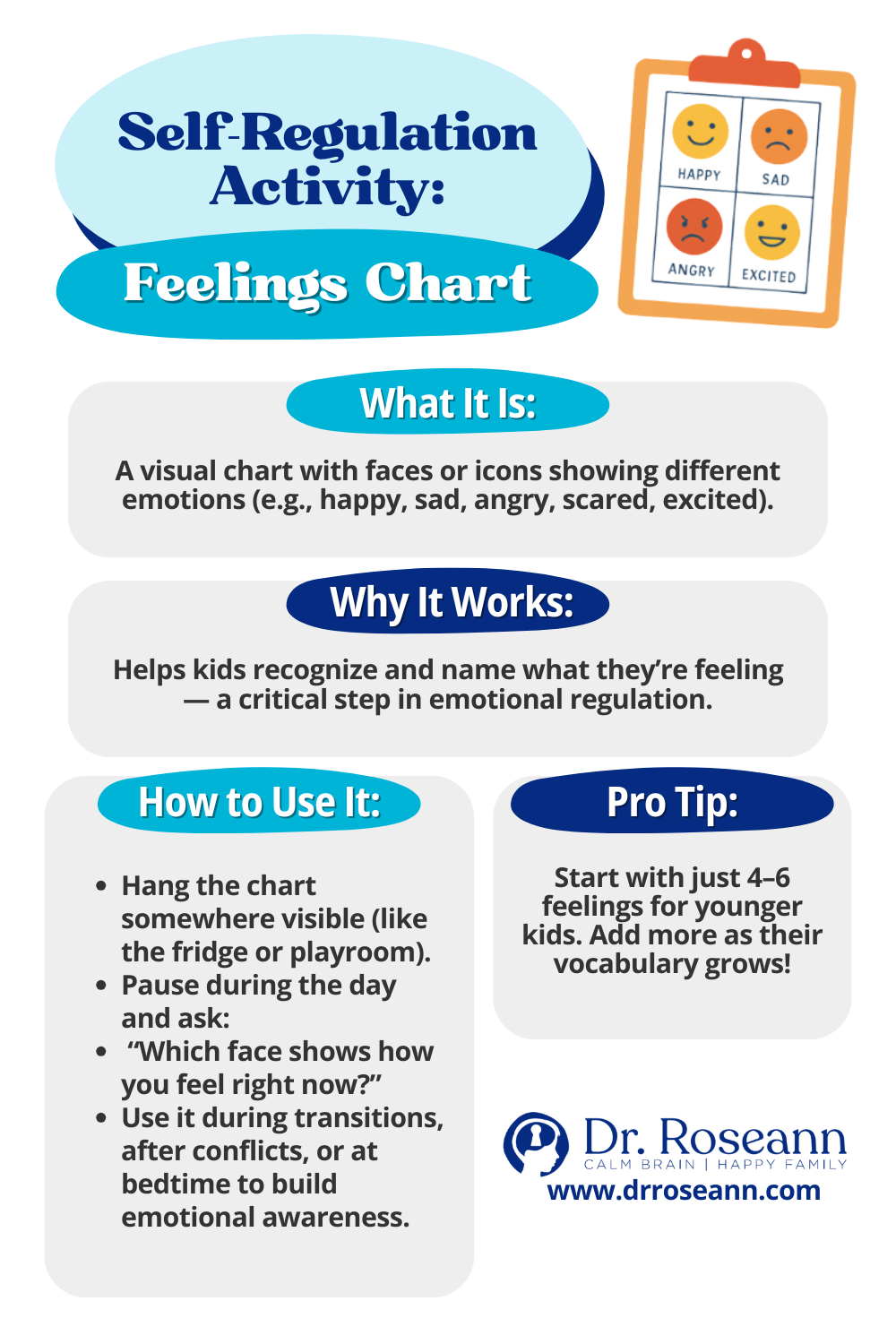
- Use a feelings chart to help your child name emotions
- Build a simple calming routine (deep breaths, sensory tools)Praise efforts to self-regulate, even small ones
- Stay consistent—your calm creates their calm
- You’ve got this! Keep showing up, stay consistent, and trust the process—because every little step counts.Ready to address your child’s or teen’s dysregulated behavior? Explore our Brain Behavior Reset™ Program
- Use our solution matcher or tune in to my It’s Gonna Be OK! Podcast for parents to find the right approach. If you need more support, join my Dysregulation Solution program for easy and practical strategies to help your child self-regulate.
FAQs
What toys help promote emotional regulation in kids?
Toys that promote emotional regulation—like stress balls, fidget cubes, weighted stuffed animals, and sensory bins—help kids calm their bodies and focus their minds. These emotional regulation toys support self-regulation skills by giving kids safe, hands-on ways to release stress and reset.
What are the Zones of Regulation and how do they help kids?
The Zones of Regulation help kids identify and manage emotions by grouping feelings into four zones (blue, green, yellow, red).
- Blue Zone: Low energy, feeling upset (feel sad, tired).
- Green Zone: Calm and focused (ready to learn).
- Yellow Zone: Heightened emotions (anxious, excited).
- Red Zone: Intense emotions (angry, out of control).
Using Zones of Regulation activities, kids learn emotional regulation skills by recognizing their state and practicing ways to return to calm.
Can play therapy help children with Autism Spectrum Disorder (ASD)?
Yes, play therapy helps children with Autism Spectrum Disorder (ASD) build emotional regulation, communication, and social skills through structured play. Play therapy supports emotional regulation by meeting kids at their level in a safe, engaging way.
What are effective emotional regulation activities for kids?
Effective emotional regulation activities for kids include deep breathing, movement breaks, sensory play, and co-regulation with a parent. These activities for emotional regulation help calm the nervous system and teach kids how to manage big feelings.
How can I help my child calm down during a meltdown?
To help your child calm down during a meltdown, focus on co-regulation first—stay calm, get close, and use simple soothing strategies like deep breathing or a quiet space. Calming a meltdown starts with helping your child feel safe before teaching emotional regulation skills.
What are signs that a child struggles with emotional regulation?
Signs that a child struggles with emotional regulation include frequent meltdowns, intense reactions, difficulty calming down, and impulsive behavior. These emotional regulation challenges often reflect a dysregulated nervous system, not defiance.
How do sensory activities support emotional regulation?
Sensory activities support emotional regulation by helping the brain and body feel more organized and calm. Activities like swinging, squeezing, or playing with textured materials can improve emotional regulation by reducing overwhelm.
Can breathing exercises improve emotional regulation in children?
Yes, breathing exercises improve emotional regulation in children by calming the nervous system and reducing stress. Simple breathing exercises are powerful emotional regulation tools that help kids slow down and regain control.
Citations:
Dieterich-Hartwell, R. M. (2019). Music, movement, and emotions: an inquiry with suggestions for the practice of dance/movement therapy. Body, Movement and Dance in Psychotherapy, 1–15. https://doi.org/10.1080/17432979.2019.1676310
Janjhua, Y., Chaudhary, R., Sharma, N., & Kumar, K. (2020). A study on effect of yoga on emotional regulation, self-esteem, and feelings of adolescents. Journal of Family Medicine and Primary Care, 9(7), 3381. https://doi.org/10.4103/jfmpc.jfmpc_153_20K
umschick, I. R., Beck, L., Eid, M., Witte, G., Klann-Delius, G., Heuser, I., Steinlein, R., & Menninghaus, W. (2014). READING and FEELING: the effects of a literature-based intervention designed to increase emotional competence in second and third graders. Frontiers in Psychology, 5. https://doi.org/10.3389/fpsyg.2014.01448
Pratt, R. R. (2004). Art, dance, and music therapy. Physical Medicine and Rehabilitation Clinics of North America, 15(4), 827–841. https://doi.org/10.1016/j.pmr.2004.03.004
Saha, N. (2023, January 13). Review and meta-analysis suggest breathwork may be effective for improving stress and mental health. News-Medical.net.
https://www.news-medical.net/news/20230113/Review-and-meta-analysis-suggests-breathwork-may-be-effective-for-improving-stress-and-mental-health.aspx?mibextid=Zxz2cZ
Smyth, J. M., Johnson, J. A., Auer, B. J., Lehman, E., Talamo, G., & Sciamanna, C. N. (2018). Online Positive Affect Journaling in the Improvement of Mental Distress and Well-Being in General Medical Patients With Elevated Anxiety Symptoms: A Preliminary Randomized Controlled Trial. JMIR Mental Health, 5(4), e11290. https://doi.org/10.2196/11290
Teut, M., Roesner, E. J., Ortiz, M., Reese, F., Binting, S., Roll, S., Fischer, H. F., Michalsen, A., Willich, S. N., & Brinkhaus, B. (2013). Mindful Walking in Psychologically Distressed Individuals: A Randomized Controlled Trial. Evidence-Based Complementary and Alternative Medicine.
Grab your complimentary copy of
©Roseann Capanna-Hodge
If you're raising a child with frequent meltdowns or intense emotional reactions, The Dysregulated Kid offers practical strategies to help you understand your child's nervous system and create lasting regulation.
Always remember… “Calm Brain, Happy Family™”
Disclaimer: This article is not intended to give health advice and it is recommended to consult with a physician before beginning any new wellness regime. The effectiveness of diagnosis and treatment vary by patient and condition. Dr. Roseann Capanna-Hodge, LLC does not guarantee certain results.
Are you looking for SOLUTIONS for your struggling child or teen?
Dr. Roseann and her team are all about science-backed solutions, so you are in the right place!
Meet the Expert
Licensed Therapist | Certified School Psychologist
Board Certified in Neurofeedback (BCN) | 30+ Years Clinical Experience
Expert in Emotional Dysregulation in Children and Nervous System Regulation
Host, Dysregulated Kids Podcast | Author, The Dysregulated Kid
Dr. Roseann Capanna-Hodge is a licensed therapist, certified school psychologist, and leading expert in emotional dysregulation in children and nervous system regulation. With over 30 years of clinical experience and having analyzed more than 10,000 brain maps, she helps families understand what behavior is really signaling—and how to calm the nervous system first so real change can happen.
She is the creator of Regulation First Parenting® and the CALMS Protocol™, host of the top 1% podcast Dysregulated Kids, and author of The Dysregulated Kid.