


Estimated reading time: 25 minutes
What Is It Like Parenting a Dysregulated Child?
Parenting a dysregulated child is one of the most emotionally exhausting experiences a parent can face. It feels like you are constantly on edge, walking on eggshells, and fighting an uphill battle that no amount of love, consistency, or discipline can win.
The truth is, you are not failing. Your child is not being difficult on purpose. A dysregulated child is operating from a nervous system that is stuck in survival mode — their thinking brain has reduced access to impulse control, flexibility, and reasoning. Until the nervous system feels safe and regulated, behavior correction and discipline strategies will have limited effectiveness.
Common Challenges Parents Face When Parenting a Dysregulated Child
- Constant emotional flooding that interrupts daily routines, meals, and family life
- Social isolation because public meltdowns feel embarrassing and stressful
- Self-blame and questioning whether you are a bad parent or made a mistake having this child
- Strained partnerships or family relationships due to chronic stress and differing parenting approaches
- Exhaustion from never feeling like you can truly rest, even when the house is quiet
- Conflicting advice from family, friends, and professionals that leaves you more confused than when you started
Key Mindset Shifts for Parenting a Dysregulated Child
- Your child is not giving you a hard time — they are having a hard time: This reframing reduces blame and opens the door to solutions
- Behavior is communication: Every tantrum, shutdown, or defiant moment is your child's nervous system saying I am overwhelmed and I do not know how to handle it
- You can not regulate a child through force: No consequence, timeout, or threat can calm an overwhelmed nervous system. Regulation comes first; behavior follows
- Progress is not linear: Even with the right approach, there will be good days and bad days. Setbacks are part of the process, not a sign of failure
What Is Regulation First Parenting®?
For decades, parenting advice has centered on behavior control.
Be consistent.
Set firmer boundaries.
Follow through with consequences.
Use rewards more effectively.
Yet many parents discover that even when they do all of that correctly, the meltdowns continue. The anxiety persists. The explosive reactions return. The shutdowns deepen.
When this happens, the issue is not effort.
It is regulation capacity.
A dysregulated child is not refusing to behave. A dysregulated child is operating from a stress response state in which the thinking brain has reduced access to impulse control, flexibility, and reasoning.
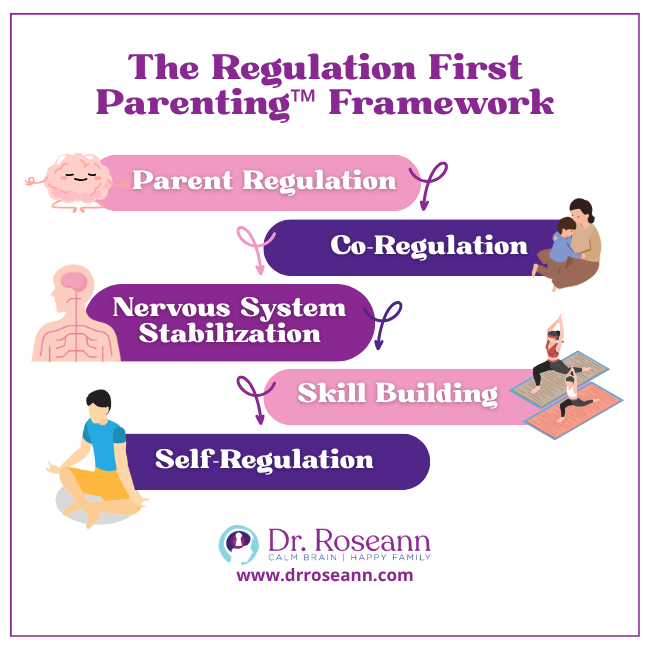
Regulation First Parenting® is a neuroscience-informed parenting framework that prioritizes nervous system stabilization before behavior correction. It recognizes that behavior improves most reliably when the brain is regulated.
Instead of asking:
“How do I stop this behavior?”
It asks:
“What is happening in this nervous system right now?”
That question shifts parenting from reaction to regulation.
Definition of Regulation First Parenting®
Regulation First Parenting® is a neuroscience-based parenting approach developed by Dr. Roseann Capanna-Hodge that prioritizes calming the nervous system before connecting, correcting behavior, or teaching skills. Instead of focusing first on discipline or consequences, this approach emphasizes building nervous system capacity and emotional regulation through co-regulation, stabilization, and skill development. By helping the brain return to a regulated state, children become more able to learn, cooperate, and develop lasting self-regulation.
A Capacity-Building Model, Not a Compliance Model
Traditional discipline models are primarily compliance-based. Their focus is immediate behavioral control.
Regulation First Parenting® is capacity-based. Its focus is long-term nervous system flexibility and emotional regulation skills.
When children experience chronic stress, overstimulation, or under-supported regulation, their nervous system remains on high alert. In that state:
- Emotional intensity rises quickly
- Frustration tolerance decreases
- Transitions become difficult
- Small problems trigger large reactions
Regulation First Parenting® addresses the physiological state first, creating the neurological conditions necessary for learning.
Boundaries still exist. Accountability still exists. Expectations still exist.
They are simply delivered after the nervous system is stable enough to absorb them.

Why Regulation Comes Before Correction
The prefrontal cortex — responsible for impulse control, emotional regulation, and decision-making — functions optimally when the nervous system feels safe.
When a child shifts into fight, flight, freeze, or shutdown:
- Cortisol increases
- The amygdala signals threat
- Executive functioning decreases
- Behavioral intensity increases
Correction delivered in this state often escalates stress.
Regulation delivered first reduces threat perception and restores access to higher-order thinking.
This sequencing is the foundation of Regulation First Parenting®.
When a Child Is Dysregulated
Regulation First Parenting® Compared to Other Parenting Models
Parenting advice can feel overwhelming because many approaches focus on managing behavior rather than understanding what drives it. Regulation First Parenting® offers a different starting point.
Instead of correcting behavior first, it recognizes that a child must be regulated before they can listen, learn, or change their actions. This shift changes how parents interpret difficult moments and how they respond to them.
Regulation First Parenting® does not reject structure or boundaries. It strengthens them by sequencing them correctly.
Calm first.
Connection second.
Correction third.
What Does Emotional Dysregulation Look Like in Children?
Understanding emotional dysregulation in children is the foundation of everything we do at Dr. Roseann. When a child's emotional responses don't match the situation, it is not defiance, poor parenting, or a lack of willpower — it is a neurological event. The brain's emotional center (the amygdala) becomes overactivated while the thinking center (the prefrontal cortex) goes temporarily offline.
Here is what emotional dysregulation looks like in real life:
- Emotional flooding: Your child goes from calm to overwhelmed in seconds
- Physical symptoms: Headaches, stomachaches, rapid breathing, or muscle tension
- Behavioral shifts: Sudden aggression, withdrawal, or shutting down
- Recovery challenges: It takes much longer to calm down than other children
- Sleep disruption: Trouble falling asleep or staying asleep due to racing thoughts
- Social impacts: Difficulty maintaining friendships or managing school transitions
When to Seek Help for Emotional Dysregulation
Some emotional ups and downs are normal childhood development. However, seek professional support if your child experiences:
- Emotional outbursts that last more than 20 minutes and occur multiple times daily
- Meltdowns triggered by minor events (changed routine, small requests)
- Self-harm behaviors during emotional moments (head-banging, biting, scratching)
- Complete withdrawal from activities they used to enjoy
- Inability to complete age-appropriate tasks due to emotional overwhelm
Meltdowns in Children: What Every Parent Needs to Know
Meltdowns are not Tantrums—and knowing the difference is the first step toward helping your child calm down. A meltdown in children occurs when the nervous system becomes overwhelmed and the brain's thinking center goes offline. Unlike a tantrum, which is a goal-directed behavior, a meltdown is a stress response that the child cannot control.
- Meltdowns are involuntary nervous system reactions triggered by overwhelm
- Tantrums are often goal-directed behaviors aimed at getting something
- Meltdowns happen even when the child wants to stop—they physically cannot
- After a meltdown, the child may need extended recovery time in a quiet space
Common Signs a Meltdown Is Approaching
When you learn to recognize early warning signs of meltdowns in children, you can intervene before the nervous system reaches the breaking point:
- Increased pacing, fidgeting, or rocking
- Becoming unusually quiet or withdrawn
- Complaints about sounds being "too loud" or clothes being "too scratchy"
- Rapid breathing or appearing to "short-circuit"
- Repeating phrases or questions without response to answers
Why Nervous System First Parenting™ Changes Everything
Many parenting approaches focus on correcting behavior first.
But behavior is often the final signal in a chain reaction that begins in the nervous system.
When a child becomes overwhelmed, the brain shifts into a stress response—fight, flight, or freeze. In this state, the thinking brain that supports listening, impulse control, and emotional regulation goes offline.
This is why traditional discipline often fails during meltdowns or explosive reactions.
The child’s nervous system is operating in survival mode, not learning mode.
Nervous System First Parenting™ teaches parents to calm the nervous system before trying to correct behavior. When the brain begins to regulate, children regain access to the skills they already have—flexibility, problem solving, and emotional control.
When the nervous system stabilizes, behavior becomes much easier to guide.
This is the foundation behind Regulation First Parenting® and the strategies parents will learn throughout this guide and in The Dysregulated Kid.
Emotional Dysregulation in Children
Emotional dysregulation in children is one of the most misunderstood behavioral patterns in modern parenting.
It is often labeled as:
- Defiance
- Overreacting
- Disrespect
- Manipulation
- Laziness
- “Too sensitive”
But emotional dysregulation is not a personality flaw.
It is a nervous system state.
When a child’s stress response becomes activated — whether by frustration, social pressure, transitions, sensory overload, or internal anxiety — the brain shifts into survival mode. In this state, regulation capacity decreases.
This is why meltdowns in children often feel disproportionate to the trigger.
The reaction is not about the event.
It is about the nervous system.

What Emotional Dysregulation Looks Like
Emotional dysregulation in children is not a single behavior. It is a pattern of difficulty modulating emotional intensity and returning to baseline after stress.
Every child gets upset. Dysregulation becomes apparent when reactions are:
- Disproportionate to the trigger
- Difficult to interrupt once started
- Slow to resolve
- Recurrent across similar situations
The outward behavior depends on how the child’s nervous system responds to perceived threat.
Externalizing Patterns: Fight Responses
Some children respond to stress with activation. Their nervous system shifts into a fight-based state.
This can look like:
- Explosive anger
- Yelling or screaming
- Physical aggression toward siblings
- Refusal or oppositional behavior
- Escalating arguments
- Blaming others
In these moments, the child’s system is mobilized. Energy increases. Emotional intensity rises. The reaction often feels immediate and overpowering.
Internalizing Patterns: Freeze or Flight Responses in Children
Other children respond by withdrawing or shutting down. Their nervous system shifts toward freeze or avoidance.
This can look like:
- Emotional shutdown
- Silence or blank staring
- Avoidance of tasks
- Tearfulness without clear explanation
- Somatic complaints such as stomachaches or headaches
- Retreating to a bedroom or isolating
These children are often misunderstood because the distress is quieter, but the nervous system activation is still present.
ADHD and Emotional Dysregulation
Children with ADHD are especially vulnerable to emotional dysregulation because executive functioning and impulse control are already taxed.
Common patterns include:
- Rapid emotional shifts
- Low frustration tolerance
- Strong reactions to correction or perceived criticism
- Difficulty shifting out of disappointment
- Extended recovery time after conflict
In ADHD, emotional reactivity is often tied to regulation capacity, not intentional defiance.
Anxiety-Driven Dysregulation
When anxiety drives the stress response, dysregulation may appear as rigidity or overcontrol rather than explosion.
Children with anxiety may:
- Become inflexible about routines
- Resist transitions
- Avoid tasks that feel uncertain
- Interpret minor stressors as significant threats
- React strongly to perceived mistakes
In these cases, the nervous system is scanning for danger. The reaction is protective, not oppositional.
Emotional dysregulation in children reflects a capacity issue, not a character issue.
What looks different on the outside — explosion, shutdown, avoidance, rigidity — shares a common root:
The nervous system is struggling to maintain balance under stress.
Understanding these patterns is the first step in Regulation First Parenting®, because we cannot respond effectively until we understand what the behavior represents.
Regulated vs Dysregulated Nervous System
Timing matters. Correction and teaching requires regulation.
Why Meltdowns Are a Capacity Issue, Not a Character Issue
Parents often ask:
“Why does my child overreact to small things?”
Overreaction is usually a signal of low available regulation capacity.
Capacity can be lowered by:
- Sleep deprivation
- Sensory overload
- Academic stress
- Social anxiety
- Chronic device stimulation
- Unprocessed emotional stress
When regulation capacity is depleted, small triggers create large reactions.
This is not permissiveness. It is physiology.
Understanding this distinction reduces shame — for both parent and child.
The Escalation Loop
Here is a common pattern in homes experiencing frequent meltdowns:
- The child becomes overwhelmed.
- The parent attempts to correct or discipline.
- The child escalates further.
- The parent raises intensity to regain control.
- Both nervous systems activate more strongly.
This loop is not a failure of consistency.
It is a collision between two activated stress responses.
When a dysregulated child receives correction, the nervous system may interpret it as additional threat. Cortisol rises further. Emotional intensity increases. The prefrontal cortex becomes even less accessible.
What begins as a small conflict can quickly become a power struggle.

Co-Dysregulation Between Parent and Child
Children are highly responsive to adult nervous system states.
When a parent becomes tense, reactive, or frustrated, the child’s nervous system detects it. Emotional intensity increases on both sides.
This is co-dysregulation.
It is not weakness. It is neurobiology.
When both systems are activated, neither brain is operating from regulation. Communication narrows. Flexibility drops. Conflict becomes more likely.
Regulation First Parenting® interrupts this pattern by stabilizing the adult nervous system first.
Not to excuse behavior — but to restore access to teaching.
Read about: 7 Signs You’re a Dysregulated Parent
Why Consequences Don’t Build Regulation Capacity
Consequences can modify behavior temporarily.
They do not directly strengthen:
- Emotional regulation
- Frustration tolerance
- Stress recovery
- Nervous system flexibility
If a child lacks the capacity to regulate under stress, repeated consequences may increase shame or defensiveness without increasing skill.
Skill-building requires:
- Access to the thinking brain
- Emotional stability
- Repetition under regulated conditions
This is why timing matters more than intensity.
Behavior Control vs Capacity Building inChildren and Teens
This difference is foundational.
Regulation First Parenting® does not remove accountability.
It sequences it correctly.
Calm first. Teach second. Correct third.

How a Parent’s Nervous System Shapes a Child’s Regulation
Children do not learn regulation through lectures.
They learn regulation through experience.
A child’s nervous system is constantly scanning for cues of safety or threat. These cues come not only from the environment — but from the adults around them.
Your tone of voice.
Your facial expression.
Your breathing pattern.
Your posture.
Your emotional intensity.
All of these communicate safety or danger before a single word is processed.
When a parent is regulated, the child’s nervous system receives signals of stability.
When a parent is dysregulated, the child’s system detects activation and adjusts accordingly.
This is not theory . It is neurobiology.

Co-Regulation Is the Bridge to Self-Regulation
Co-regulation is the process through which a regulated adult helps stabilize a child’s activated nervous system.
Before children can consistently self-regulate, they rely on external regulation. Over time, repeated experiences of calm support strengthen neural pathways responsible for emotional control and stress recovery.
In practical terms, this means:
- A calm adult reduces perceived threat.
- A steady voice lowers arousal.
- Predictable responses increase nervous system safety.
- Emotional containment builds internal regulation skills.
Self-regulation develops through repetition of co-regulation.
It is built — not demanded.
Co-Regulation vs Co-Dysregulation
This table illustrates why adult regulation is not optional in moments of dysregulation — it is foundational.
Emotional Contagion and Mirror Neurons
Children are biologically wired to mirror the emotional states of caregivers. Through mirror neuron systems and attachment-based wiring, they internalize patterns of response.
If conflict consistently involves raised voices and heightened intensity, the nervous system encodes that pattern.
If conflict consistently involves stabilization followed by clear boundaries, the nervous system encodes that pattern instead.
Over time, the repeated experience of regulated responses strengthens:
- Frustration tolerance
- Emotional flexibility
- Recovery speed after stress
- Impulse control
Regulation is contagious.
So is dysregulation.
Why Staying Calm Changes the Outcome
Staying calm does not mean allowing inappropriate behavior.
It means stabilizing the nervous system first so correction can be absorbed.
When a parent remains regulated during a child’s escalation:
- The stress response resolves faster.
- The thinking brain returns online sooner.
- The child is more receptive to boundaries.
- Shame is reduced.
- Learning increases.
This sequencing is central to Regulation First Parenting® and is explored in greater depth in The Dysregulated Kid: The Parenting Playbook for Helping Your Child Find Calm in a Chaotic World, where the progression from co-regulation to independent self-regulation is mapped clearly.
Co-regulation is not permissiveness.
It is neurological leadership.

Increasing Regulation Capacity Over Time
If emotional dysregulation reflects limited regulation capacity, the goal is not to eliminate stress entirely.
The goal is to increase capacity.
Regulation capacity is the amount of stress a nervous system can tolerate before shifting into fight, flight, freeze, or shutdown. Some children have a naturally wider capacity window. Others operate within a narrower window due to temperament, neurodivergence, chronic stress exposure, or environmental demands.
Capacity is not fixed.
It expands through repetition, safety, and skill-building.

What Regulation Capacity Means
Regulation capacity determines:
- How quickly a child escalates
- How intensely they react
- How long recovery takes
- How flexible they remain under stress
A child with higher available capacity can experience frustration and still access problem-solving.
A child with lower capacity may interpret the same frustration as threat.
This explains why two children can respond so differently to identical situations.
Capacity is about available nervous system bandwidth — not effort.
Read about: How to Break the Cycle of Parental Burnout and Find What Actually Works
Why Some Children “Overreact”
Overreaction is often misinterpreted as exaggeration.
From a nervous system perspective, it is threshold-based.
When stress accumulates throughout the day — academic demands, social tension, transitions, noise, hunger, sleep deprivation — regulation capacity narrows. A seemingly small request becomes the final stressor that pushes the system beyond its limit.
The reaction is not about the request.
It is about the accumulated load.
Read about: The Stress Cup: Why Your Child (And You) Are Melting Down
Stress Load and Capacity
This is why timing matters in parenting. The same correction delivered in the morning may land differently than the same correction delivered after a long day.
Expanding the Window of Tolerance
Capacity grows when children repeatedly experience:
- Predictable routines
- Emotional safety
- Calm adult responses
- Opportunities to recover
- Gradual exposure to manageable stress
Each regulated interaction strengthens neural pathways associated with emotional regulation and stress recovery.
Over time, recovery becomes faster. Flexibility increases. Reactions soften.
This is not an overnight shift.
It is a capacity-building process.

Regulation First Parenting® focuses on strengthening this window over time.
In The Dysregulated Kid: The Parenting Playbook for Helping Your Child Find Calm in a Chaotic World, this progression is mapped as a predictable growth pattern — from reactive cycles to increased resilience — through structured nervous system practices.
Capacity, not character, determines reaction.
When we increase capacity, behavior follows.
Practical Starting Points for Calmer Parenting
Understanding nervous system regulation is foundational.
But awareness alone does not change patterns.
Regulation First Parenting® translates neuroscience into daily action. The goal is not perfection. The goal is interruption of automatic escalation.
Small, consistent regulation shifts create measurable change over time.
Pause Before You React
The first intervention in any escalation is not a consequence.
It is a pause.
When a child’s behavior activates your stress response, your nervous system prepares to match intensity. Voice rises. Muscles tighten. Speed increases.
Interrupting that activation changes the trajectory.
A brief, intentional pause:
- Slows physiological arousal
- Reduces emotional contagion
- Prevents escalation
- Preserves authority
The pause is not passive. It is strategic.
The structured version of this interruption process is explored in depth in The Love Pause, where parents learn how to create a regulation buffer before responding.
The goal is not silence.
The goal is stability.
Regulate During a Crisis
Once escalation begins, the priority shifts to nervous system stabilization.
During an active meltdown:
- Reasoning is limited
- Teaching is ineffective
- Consequences may intensify threat perception
Instead, the focus becomes:
- Reducing environmental intensity
- Lowering vocal tone
- Minimizing verbal volume
- Maintaining physical steadiness
Crisis stabilization is not permissiveness. It is sequencing.
A structured 5-step framework for crisis regulation is outlined in RESET to Regulate, which walks parents through stabilizing themselves and co-regulating their child during peak activation.
In moments of high stress, clarity reduces chaos.
Repair After Escalation
Even with strong regulation skills, conflict will happen.
Repair is what builds resilience.
After both nervous systems return to baseline:
- Acknowledge intensity
- Clarify expectations
- Reinforce boundaries
- Restore connection
Repair communicates safety.
Children do not need perfect parents.
They need regulated parents who repair consistently.
Repair strengthens emotional regulation more effectively than punishment alone.
Reaction vs Regulation
This table reflects sequencing, not softness.
Regulation increases authority by stabilizing delivery.
These starting points are expanded throughout The Dysregulated Kid: The Parenting Playbook for Helping Your Child Find Calm in a Chaotic World, where practical nervous system resets are mapped into daily routines rather than crisis-only strategies.
Regulation First Parenting® is not about eliminating boundaries.
It is about delivering them from stability.
2: Breaking Generational Patterns and Building Generational Emotional Wealth™
Every family has emotional patterns.
Some are calm and steady.
Some are reactive and intense.
Some avoid conflict entirely.
Some escalate quickly and repair slowly.
Most parents are not consciously choosing their reactions.
They are repeating what was modeled to them — especially under stress.
Regulation First Parenting® interrupts automatic inheritance.
It shifts parenting from reaction-based to nervous-system-informed.

Read more about: Generational Emotional Wealth™
How Dysregulation Becomes Generational
When stress responses are repeated over years, they become encoded patterns.
Children internalize:
- How conflict is handled
- How anger is expressed
- How repair happens (or doesn’t)
- Whether emotions are safe
- Whether mistakes lead to shame or guidance
If emotional intensity was met with more intensity, that pattern becomes normalized.
If feelings were minimized or punished, suppression becomes learned.
These are not moral failings.
They are nervous system templates.
Without awareness, they transfer forward.
Regulation as Legacy Work
When a parent chooses regulation first, something shifts beyond the immediate moment.
The child learns:
- Big emotions are manageable
- Conflict can resolve without damage
- Boundaries and calm can coexist
- Recovery is possible
- Repair strengthens connection
Repeated regulated interactions rewire expectation.
Over time, emotional stability becomes the baseline rather than the exception.
This is what building emotional wealth looks like.
It is not about raising compliant children.
It is about raising resilient nervous systems.
The Long-Term Impact
When regulation capacity increases across years, the outcomes compound:
- Faster recovery from stress
- Greater academic flexibility
- Reduced anxiety intensity
- Improved peer relationships
- Lower shame responses
- Increased self-awareness
Regulation shapes adulthood long before adulthood begins.
Parenting is not only about today’s meltdown.
It is about tomorrow’s coping skills.
Short-Term Control vs Long-Term Capacity in Children
What we reinforce repeatedly becomes internal structure.
Where to Begin
If you see your child in these patterns — or yourself — you are not behind.
You are becoming aware.
And awareness changes trajectories.
Regulation First Parenting® is not about becoming endlessly patient.
It is about understanding the nervous system well enough to lead it.
If this framework resonates, the next step is not to try harder.
It is to learn the structure.
Go Deeper with The Dysregulated Kid
This guide introduces the core ideas behind Regulation First Parenting®.
But understanding the framework is only the first step.
Parents often ask:
- How do I interrupt meltdowns in real time?
- What do I say during escalation?
- How do I build regulation capacity over weeks and months?
- What if my child has ADHD, anxiety, or sensory sensitivity?
Those answers require a complete system.
That system is laid out in The Dysregulated Kid: The Parenting Playbook for Helping Your Child Find Calm in a Chaotic World.
The book expands this framework into a practical roadmap that shows parents how to:
- interrupt escalation cycles
- build regulation capacity in daily routines
- repair after conflict
- reduce emotional reactivity
- strengthen long-term self-regulation
Instead of reacting to behavior, parents learn how to reshape the nervous system environment that produces behavior.
If this article helped you see your child differently, the book shows you how to move from insight to transformation.
Learn more about the book →
The Dysregulated Kid: The Parenting Playbook for Helping Your Child Find Calm in a Chaotic World
A Personal Invitation for all Parents
If you are tired of:
- Walking on eggshells
- Bracing for the next meltdown
- Questioning whether you’re “doing this wrong”
- Feeling like discipline only makes things worse
- Wondering why your child reacts so intensely
You are not alone.
And your child is not broken.
The Dysregulated Kid: The Parenting Playbook for Helping Your Child Find Calm in a Chaotic World was written for parents who want more than behavior management.
It was written for families who want:
- Fewer explosive cycles
- Faster recovery after conflict
- Practical nervous system tools
- Clear sequencing for correction
- A roadmap from chaos to capacity
This book does not promise overnight transformation.
It provides a science-backed progression.
From dysregulation to stability.
From reactivity to leadership.
From survival mode to emotional resilience.
If you are ready to move from managing behavior to building capacity, this is your starting point.
Your child does not need a different personality.
They need a regulated leader.
And that begins with you.

Frequently Asked Questions About Regulation First Parenting®
What is Regulation First Parenting®?
Regulation First Parenting® is a neuroscience-informed approach that prioritizes calming the nervous system before correcting behavior.
Instead of focusing first on stopping emotional outbursts, it asks whether the brain is regulated enough to learn. When the stress response is active, teaching and discipline are less effective.
By stabilizing the nervous system first, parents increase emotional regulation capacity and improve long-term outcomes.
Who is the founder of Regulation First Parenting®?
I, Dr. Roseann Capanna-Hodge, developed Regulation First Parenting® after more than three decades of working as a licensed therapist, certified school psychologist, and children’s mental health expert. Over the years, I’ve supported thousands of children struggling with ADHD, anxiety, emotional dysregulation, OCD, PANS/PANDAS, and other behavioral challenges.
Through that experience, I created the Regulation First Parenting® framework, which brings together neuroscience, nervous system regulation, and practical parenting strategies to help families move out of reactive cycles and toward emotional stability.
I also outline this framework in detail in my book, The Dysregulated Kid: The Parenting Playbook for Helping Your Child Find Calm in a Chaotic World.
How does a parent’s nervous system affect a child?
Children are highly responsive to adult nervous system states. Tone, posture, breathing, and emotional intensity all signal safety or threat.
When a parent is calm and steady, a child’s nervous system is more likely to stabilize. When a parent becomes reactive, escalation often increases.
Regulation is contagious. So is dysregulation.
Why doesn’t traditional discipline work for my child?
Traditional discipline assumes behavior is fully voluntary.
When a child is dysregulated, the stress response limits access to impulse control and reasoning. Consequences delivered during peak activation may escalate intensity rather than build skill.
Regulation First Parenting® sequences discipline after stabilization, making correction more effective.
How can I help my child calm down during a meltdown?
During a meltdown:
- Reduce verbal input
- Lower your voice
- Decrease environmental stimulation
- Avoid reasoning until calm returns
- Stay physically steady
The goal is stabilization, not debate.
Once regulation is restored, teaching and boundaries can follow.
What causes emotional dysregulation in children?
Emotional dysregulation can be influenced by:
- ADHD
- Anxiety
- Sensory processing challenges
- Sleep disruption
- Chronic stress
- Environmental unpredictability
- High stimulation from devices
Dysregulation reflects reduced nervous system capacity under stress, not a character flaw.
Is emotional dysregulation a sign of ADHD?
Emotional dysregulation is common in children with ADHD, especially when executive functioning is taxed.
Rapid emotional shifts, low frustration tolerance, and intense reactions to correction are frequently reported.
However, not all dysregulated children have ADHD. Nervous system capacity can be influenced by many factors.
Can emotional regulation be taught?
Yes.
Emotional regulation is a skill that develops through repetition, modeling, and co-regulation.
Children strengthen regulation capacity when they experience:
- Predictable routines
- Calm adult responses
- Safe repair after conflict
- Gradual exposure to manageable stress
Regulation is built through experience, not lectures.
How long does it take to see change?
Change is gradual and capacity-based.
Parents often notice:
- Shorter meltdowns
- Faster recovery
- Slightly softer reactions
- Increased flexibility in small moments
These incremental shifts compound over time.
Regulation development is a strengthening process, not a quick fix.
What’s the difference between a tantrum and a dysregulation episode?
A tantrum is often goal-directed and stops when the goal is achieved.
A dysregulation episode is stress-driven and continues even when consequences are applied.
Dysregulation reflects nervous system overload, not negotiation strategy.
Where can I learn the full Regulation First Parenting® framework?
The complete framework, including nervous system sequencing, crisis stabilization tools, and long-term capacity building strategies, is outlined in:
The Dysregulated Kid: The Parenting Playbook for Helping Your Child Find Calm in a Chaotic World.
The book walks parents step-by-step through moving from reactive cycles to regulation-based leadership.
Is there a Regulation First® book?
Yes. The Regulation First Parenting® framework is fully outlined in The Dysregulated Kid: The Parenting Playbook for Helping Your Child Find Calm in a Chaotic World by Dr. Roseann Capanna-Hodge.
The book provides a step-by-step roadmap for:
- Understanding emotional dysregulation
- Calming the nervous system before correcting behavior
- Interrupting escalation cycles
- Increasing regulation capacity over time
- Building long-term emotional resilience
Rather than focusing solely on consequences or behavior management, the book explains how to stabilize the brain first — making discipline more effective and sustainable.
If you’re looking for a structured, science-based parenting approach grounded in nervous system regulation, The Dysregulated Kid is the complete guide.
Dr. Roseann Capanna-Hodge
The Connection Between Parenting a Dysregulated Child and Teaching Self-Regulation Skills for Children
As you learn to parent a dysregulated child through a regulation-first lens, you will gradually shift your focus from managing your child's immediate behavior to teaching long-term self-regulation skills for children. This is the core mission: helping your child build the internal capacity to recognize, manage, and recover from emotional overwhelm independently.
This shift does not happen overnight. It is a multi-year developmental journey that begins with co-regulation (you regulating your child's nervous system) and gradually transitions to self-regulation (your child regulating their own). The skills we teach in later chapters of this guide are specifically designed to support that transition.
Dr. Roseann Capanna-Hodge is a leading expert in emotional and behavioral dysregulation in children.
- Emotional Dysregulation & Nervous System Repair Podcast Everyday Wellness with Cynthia Thurlow ™
- NRBS Emotional Dysregulation with Roseann Capanna-Hodge
- The Experience Miracles (Podcast) Why Traditional Discipline Fails Dysregulated Kids (And What Actually Works)
Citations:
Alen, N. V., Shields, G. S., Nemer, A., D'Souza, I. A., Ohlgart, M. J., & Hostinar, C. E. (2022). A systematic review and meta-analysis of the association between parenting and child autonomic nervous system activity. Neuroscience and biobehavioral reviews, 139, 104734. https://doi.org/10.1016/j.neubiorev.2022.104734
Goldberg H. (2022). Growing Brains, Nurturing Minds-Neuroscience as an Educational Tool to Support Students' Development as Life-Long Learners. Brain sciences, 12(12), 1622. https://doi.org/10.3390/brainsci12121622
Gioia, F., Rega, V., & Boursier, V. (2021). Problematic Internet Use and Emotional Dysregulation Among Young People: A Literature Review. Clinical neuropsychiatry, 18(1), 41–54. https://doi.org/10.36131/cnfioritieditore20210104
Karreman, A., van Tuijl, C., van Aken, M. A. G., & Deković, M. (2006). Parenting and self-regulation in preschoolers: A meta-analysis. Infant and Child Development, 15(6), 561-579. https://doi.org/10.1002/icd.478
Lavi, I., Ozer, E. J., Katz, L. F., & Gross, J. J. (2021). The role of parental emotion reactivity and regulation in child maltreatment and maltreatment risk: A meta-analytic review. Clinical psychology review, 90, 102099. https://doi.org/10.1016/j.cpr.2021.102099
Lin, S. C., Kehoe, C., Pozzi, E., Liontos, D., & Whittle, S. (2024). Research Review: Child emotion regulation mediates the association between family factors and internalizing symptoms in children and adolescents - a meta-analysis. Journal of child psychology and psychiatry, and allied disciplines, 65(3), 260–274. https://doi.org/10.1111/jcpp.13894
Moffitt, T. E., Arseneault, L., Belsky, D., Dickson, N., Hancox, R. J., Harrington, H., Houts, R., Poulton, R., Roberts, B. W., Ross, S., Sears, M. R., Thomson, W. M., & Caspi, A. (2011). A gradient of childhood self-control predicts health, wealth, and public safety. Proceedings of the National Academy of Sciences of the United States of America, 108(7), 2693–2698. https://doi.org/10.1073/pnas.1010076108
Montroy, J. J., Bowles, R. P., Skibbe, L. E., Mc Clelland, M. M., & Morrison, F. J. (2016). The development of self-regulation across early childhood. Developmental psychology, 52(11), 1744–1762. https://doi.org/10.1037/dev0000159
Paulus, F. W., Ohmann, S., Möhler, E., Plener, P., & Popow, C. (2021). Emotional Dysregulation in Children and Adolescents With Psychiatric Disorders. A Narrative Review. Frontiers in psychiatry, 12, 628252. https://doi.org/10.3389/fpsyt.2021.628252
Porges S. W. (2022). Polyvagal Theory: A Science of Safety. Frontiers in integrative neuroscience, 16, 871227. https://doi.org/10.3389/fnint.2022.871227
Zimmer-Gembeck, M. J., Rudolph, J., Kerin, J., & Bohadana-Brown, G. (2022). Parent emotional regulation: A meta-analytic review of its association with parenting and child adjustment. International Journal of Behavioral Development, 46(1), 63-82. https://doi.org/10.1177/01650254211051086
© Roseann-Capanna-Hodge, LLC 2026
Always remember… “Calm Brain, Happy Family™”
Disclaimer: This article is not intended to give health advice and it is recommended to consult with a physician before beginning any new wellness regime. The effectiveness of diagnosis and treatment vary by patient and condition. Dr. Roseann Capanna-Hodge, LLC does not guarantee certain results.
Are you looking for SOLUTIONS for your struggling child or teen?
Dr. Roseann and her team are all about science-backed solutions, so you are in the right place!
Meet the Expert
Licensed Therapist | Certified School Psychologist
Board Certified in Neurofeedback (BCN) | 30+ Years Clinical Experience
Expert in Emotional Dysregulation in Children and Nervous System Regulation
Host, Dysregulated Kids Podcast | Author, The Dysregulated Kid
Dr. Roseann Capanna-Hodge is a licensed therapist, certified school psychologist, and leading expert in emotional dysregulation in children and nervous system regulation. With over 30 years of clinical experience and having analyzed more than 10,000 brain maps, she helps families understand what behavior is really signaling—and how to calm the nervous system first so real change can happen.
She is the creator of Regulation First Parenting® and the CALMS Protocol™, host of the top 1% podcast Dysregulated Kids, and author of The Dysregulated Kid.