%20.png)


Estimated reading time: 9 minutes
Many parents worry about repeating the patterns they grew up with.
Maybe you experienced yelling, emotional shutdowns, or constant tension in your home growing up. Maybe feelings weren’t talked about. Maybe stress was handled through criticism, avoidance, or silence.
And now, as a parent, you sometimes catch yourself reacting in ways that feel uncomfortably familiar.
This is one of the most painful fears many parents carry:
"What if I pass this on to my child?"
But here’s the hopeful truth.
Families don’t just pass down traditions, values, and memories.
They also pass down nervous systems.
Children learn how to handle stress, emotions, and conflict by watching the nervous systems around them.
When parents learn how to regulate their own stress response, they’re doing something incredibly powerful.
They’re not just changing a moment.
They’re changing the emotional inheritance of the entire family.
This is what I call Generational Emotional Wealth™.
And it’s built through something I call Regulation First Parenting™—because when you calm your own nervous system first, you stop reacting from old patterns and start creating new ones your child can carry forward.
Just like financial wealth can be passed from one generation to the next, emotional health can be passed down too.
Families who build Generational Emotional Wealth™ don’t pass on perfection.
They pass on regulated nervous systems, emotional resilience, and the ability to recover from stress.
And those skills shape a child’s life in ways that last far beyond childhood.
What Is Generational Emotional Wealth™
When people hear the word wealth, they often think about money.
But there’s another kind of wealth that shapes a child’s life just as deeply.
Emotional wealth.
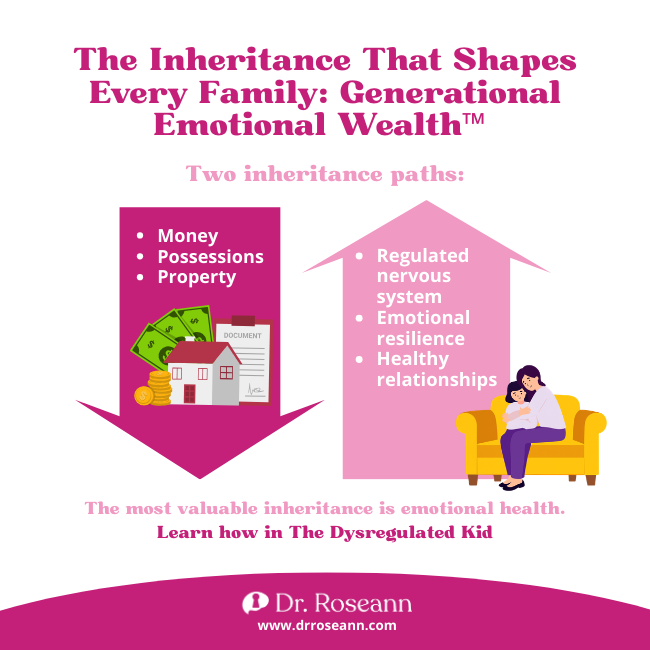
Generational Emotional Wealth™ refers to the emotional and nervous system strengths that parents pass down to their children over time.
These strengths aren’t material possessions.
They’re skills.
They include things like emotional regulation, resilience, and the ability to recover from stress.
Families who build Generational Emotional Wealth™ help children learn how to:
• handle frustration
• regulate big emotions
• navigate conflict
• return to calm after stress
These abilities become part of a child’s internal foundation for life.
And unlike financial wealth, emotional wealth grows through everyday moments—through how stress is handled, how emotions are supported, and how repair happens after difficult interactions.
Two Types of Wealth Families Pass Down
| Financial Wealth | Emotional Wealth |
|---|---|
| Money and assets | Emotional regulation |
| Property and inheritance | Resilience under stress |
| Investments | Healthy relationships |
| Financial knowledge | Emotional awareness |
| Security through resources | Security through connection |
Financial wealth can create opportunity.
But emotional wealth creates stability.
Children who grow up with strong emotional foundations often carry those skills into friendships, school challenges, future careers, and their own parenting.

Many parents worry about whether they’re doing everything “right.”
But building Generational Emotional Wealth™ doesn’t require perfection.
It happens through consistent regulation, repair, and connection over time.
These everyday moments gradually teach children how to manage stress and emotions in healthy ways.
I explore this idea much more deeply in The Dysregulated Kid, where I explain how parents can strengthen emotional regulation skills in ways that shape a child’s future well beyond childhood.
Why Emotional Patterns Pass Through Families
Have you ever noticed how quickly children pick up the emotional tone of a room?
If a parent is calm, the room often settles.
If a parent becomes tense, children often react almost instantly.
That’s not coincidence.
It’s how nervous systems work.
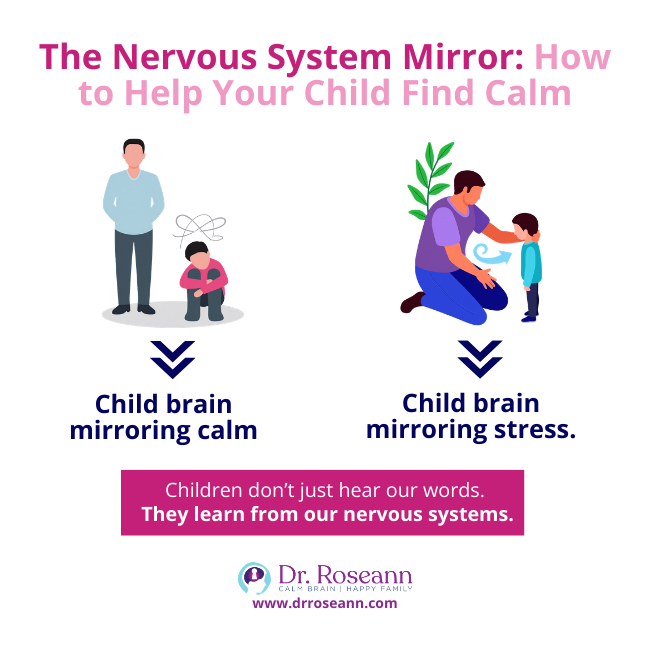
Children learn how to handle stress by watching the nervous systems around them. Long before kids can explain their feelings with words, their brains are constantly observing how adults respond to frustration, conflict, and overwhelm.
Over time, these repeated experiences form what psychologists call emotional patterns.
These patterns shape how a child’s brain learns to respond to stress.
Children who regularly experience calm responses to difficult moments begin to internalize that regulation. Children who experience constant emotional intensity may learn to react quickly to stress because their nervous system becomes used to that level of activation.
This isn’t about blaming parents.
Every family carries emotional patterns that were learned somewhere along the way.
But the hopeful truth is that these patterns are not permanent.
When a parent begins regulating their own stress response, the nervous system environment of the entire household begins to shift.
Children don’t just listen to what parents say.
They absorb what parents regulate.
How Emotional Patterns Are Learned
| What Children Experience | What They Learn |
|---|---|
| Calm responses to stress | How to slow down and regulate |
| Emotional support during big feelings | Emotions are safe to express |
| Repair after conflict | Relationships can recover |
| Consistent regulation from adults | Stress can be managed |
Over time, these experiences become part of a child’s internal blueprint for handling life’s challenges.
Many parents are surprised to realize that one regulated moment can influence a child more than dozens of lectures about behavior.
When children experience a calm, regulated adult during stressful moments, their nervous system gradually learns how to return to calm too.
This is one of the most powerful ideas behind Regulation First Parenting™, and it’s something I explore in greater depth in The Dysregulated Kid, where parents learn how everyday interactions shape their child’s long-term emotional resilience.
The Moment Parents Become Cycle Breakers
There’s a quiet moment many parents experience.
It usually doesn’t happen during a calm afternoon.
It happens in the middle of a hard moment.
Maybe your child is yelling. Maybe you feel your patience slipping. Maybe you hear the exact tone or words coming out of your mouth that you remember hearing growing up.
And something inside you pauses.
Not perfectly. Not instantly.
But just enough to think:
"I want something different for my child."
That moment matters more than most parents realize.
Because that’s the moment a parent becomes a cycle breaker.
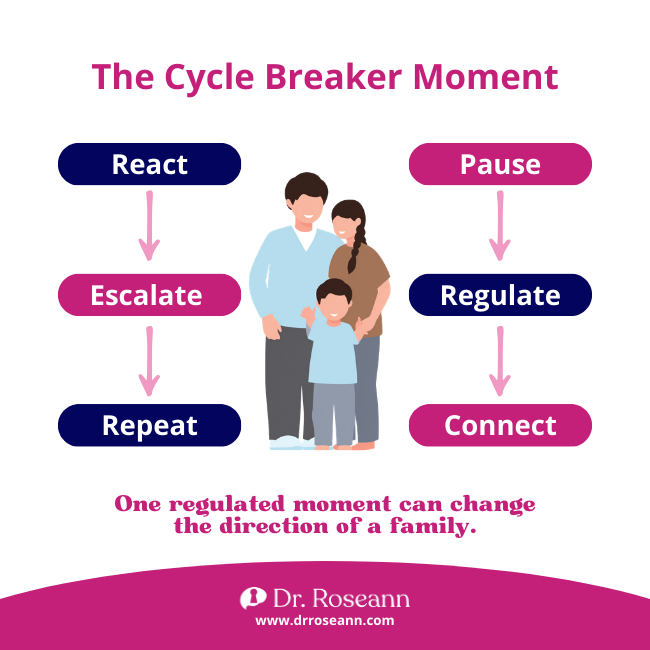
Cycle-breaking parenting doesn’t mean erasing the past or doing everything flawlessly. It means becoming aware of the patterns that shaped you—and choosing, little by little, to respond differently.
Instead of reacting automatically, you begin to pause.
Instead of escalating stress, you begin to regulate it.
Instead of repeating patterns, you start creating new ones.
And children notice those shifts.
When parents regulate their own nervous systems, children experience something powerful:
A model of what emotional safety looks like.
Not perfection.
But repair, regulation, and resilience.
Over time, those experiences become the emotional blueprint children carry into their own lives.
That’s how Generational Emotional Wealth™ begins.
Not with a perfect parent.
But with a parent who is willing to pause, regulate, and try again.
The Regulation Ripple Effect
When a parent regulates their nervous system, the impact rarely stops with that one moment.
Children feel it.
The emotional tone of the home shifts.
Stress settles faster.
Over time, these regulated responses become the emotional environment children grow up in.
Instead of learning that stress leads to yelling or shutdown, children begin to experience something different:
Stress → pause → recovery.
That pattern becomes part of their emotional foundation.
And one day, they carry it into their own relationships, their own stress, and eventually their own families.
This is how emotional health travels across generations.
Not through lectures.
Through modeled regulation.
What Emotionally Wealthy Families Teach
Families who build Generational Emotional Wealth™ don’t eliminate stress.
They teach children how to move through it.
| Emotional Skill | Long-Term Benefit |
|---|---|
| Naming emotions | Emotional awareness |
| Returning to calm | Stress resilience |
| Repair after conflict | Healthy relationships |
| Handling frustration | Problem-solving confidence |
These skills quietly shape how children navigate school, friendships, work, and future parenting.
The Nervous System Legacy You’re Creating Right Now
Parents often wonder if the small things they do every day really matter.
The answer is yes.
Every time a parent pauses instead of reacting…
Every time repair happens after conflict…
Every time a child experiences calm after stress…
Something powerful is happening.
A new emotional pattern is forming.
Over time, those patterns become part of a child’s internal wiring for handling stress, relationships, and challenges.
That’s the heart of Generational Emotional Wealth™.
Not perfection.
But building emotional strength that carries forward long after childhood.
In The Dysregulated Kid, I explore how nervous system regulation helps families shift from constant stress to greater calm, connection, and resilience.
Because when parents support regulation today, they aren’t just helping their child through a difficult moment.
They’re helping shape the emotional legacy their child will carry into the future.
FAQ: Breaking Generational Parenting Patterns
How can I become a cycle breaker parent?
Cycle-breaking parenting begins with awareness.
When parents notice emotional patterns from their past and choose to respond differently, they begin creating a new path for their family.
Even small changes in how stress is handled can shift the emotional environment children grow up in.
Can parenting really change generational trauma?
Yes. Research in family systems and child development shows that supportive, emotionally responsive parenting can help children develop resilience even when earlier generations experienced stress or trauma.
Consistent regulation and emotional support help children build stronger coping skills.
What if I didn’t learn emotional regulation growing up?
Many parents didn’t.
Learning regulation as an adult is incredibly common. The good news is that nervous systems remain adaptable throughout life.
When parents develop regulation skills themselves, children benefit from those changes too.
Dr. Roseann Capanna-Hodge is a leading expert in emotional and behavioral dysregulation in children.
- Emotional Dysregulation & Nervous System Repair Podcast Everyday Wellness with Cynthia Thurlow ™
- NRBS Emotional Dysregulation with Roseann Capanna-Hodge
- The Experience Miracles (Podcast) Why Traditional Discipline Fails Dysregulated Kids (And What Actually Works)
Citations:
Karreman, A., van Tuijl, C., van Aken, M. A. G., & Deković, M. (2006). Parenting and self-regulation in preschoolers: A meta-analysis. Infant and Child Development, 15(6), 561-579. https://doi.org/10.1002/icd.478
Lavi, I., Ozer, E. J., Katz, L. F., & Gross, J. J. (2021). The role of parental emotion reactivity and regulation in child maltreatment and maltreatment risk: A meta-analytic review. Clinical psychology review, 90, 102099. https://doi.org/10.1016/j.cpr.2021.102099
Lin, S. C., Kehoe, C., Pozzi, E., Liontos, D., & Whittle, S. (2024). Research Review: Child emotion regulation mediates the association between family factors and internalizing symptoms in children and adolescents - a meta-analysis. Journal of child psychology and psychiatry, and allied disciplines, 65(3), 260–274. https://doi.org/10.1111/jcpp.13894
Moffitt, T. E., Arseneault, L., Belsky, D., Dickson, N., Hancox, R. J., Harrington, H., Houts, R., Poulton, R., Roberts, B. W., Ross, S., Sears, M. R., Thomson, W. M., & Caspi, A. (2011). A gradient of childhood self-control predicts health, wealth, and public safety. Proceedings of the National Academy of Sciences of the United States of America, 108(7), 2693–2698. https://doi.org/10.1073/pnas.1010076108
Porges S. W. (2022). Polyvagal Theory: A Science of Safety. Frontiers in integrative neuroscience, 16, 871227. https://doi.org/10.3389/fnint.2022.871227
Zimmer-Gembeck, M. J., Rudolph, J., Kerin, J., & Bohadana-Brown, G. (2022). Parent emotional regulation: A meta-analytic review of its association with parenting and child adjustment. International Journal of Behavioral Development, 46(1), 63-82. https://doi.org/10.1177/01650254211051086
Always remember... “Calm Brain, Happy Family™”
Disclaimer: This article is not intended to give health advice and it is recommended to consult with a physician before beginning any new wellness regime. *The effectiveness of diagnosis and treatment vary by patient and condition. Dr. Roseann Capanna-Hodge, LLC does not guarantee certain results.
Are you looking for SOLUTIONS for your struggling child or teen?
Dr. Roseann and her team are all about science-backed solutions, so you are in the right place!
© Roseann-Capanna-Hodge, LLC 2026