
%20.png)


%20Are%20Melting%20Down%20and%20How%20to%20Build%20a%20Bigger%20Cup.png)
Estimated reading time: 11 minutes
Many parents have had this moment.
Your child melts down over something that seems small.
A sock feels uncomfortable.
Homework becomes impossible.
A simple request turns into a full emotional storm.
Parents often walk away wondering:
"Why was that such a big reaction?"
But what many families discover is that the meltdown wasn’t really about the sock, the homework, or the request.
It was about the stress that had already filled the cup.
One of the simplest ways to understand emotional regulation is through what I call the Stress Cup.
Imagine that every person carries an invisible cup that fills with stress throughout the day. Each challenge, frustration, demand, and emotional experience adds a little more to that cup.
When the cup has room, we can handle things.
But when the cup fills too high and spills over, the nervous system reacts.
That overflow is what many parents see as meltdowns, shutdowns, or big emotional reactions.
And here’s the important part:
Children aren’t the only ones with stress cups.
Parents have them too.
Understanding how these cups fill — and how to empty them — can change how families navigate stressful moments together.
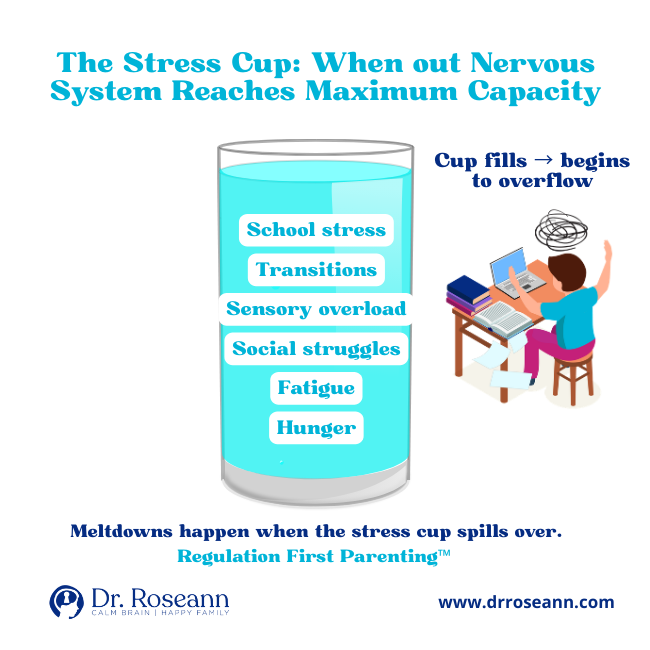
What Is the Stress Cup?
The Stress Cup is a simple way to understand how the nervous system handles stress.
Imagine that every person carries an invisible cup that fills throughout the day. Every challenge, demand, or uncomfortable experience adds a little more to that cup.
When the cup still has room, the brain can handle frustration, disappointment, and problem solving.
But when the cup becomes too full, the nervous system struggles to manage any additional stress.
That’s when reactions get bigger.
Children may cry, yell, shut down, or refuse to cooperate.
Parents may feel overwhelmed, irritable, or reactive.
The moment the cup overflows is what many families experience as a meltdown.
This metaphor helps parents shift their thinking from:
"Why are they acting like this?"
to
"How full is their stress cup right now?"
That simple shift can completely change how a parent responds to difficult moments.
What Fills a Stress Cup
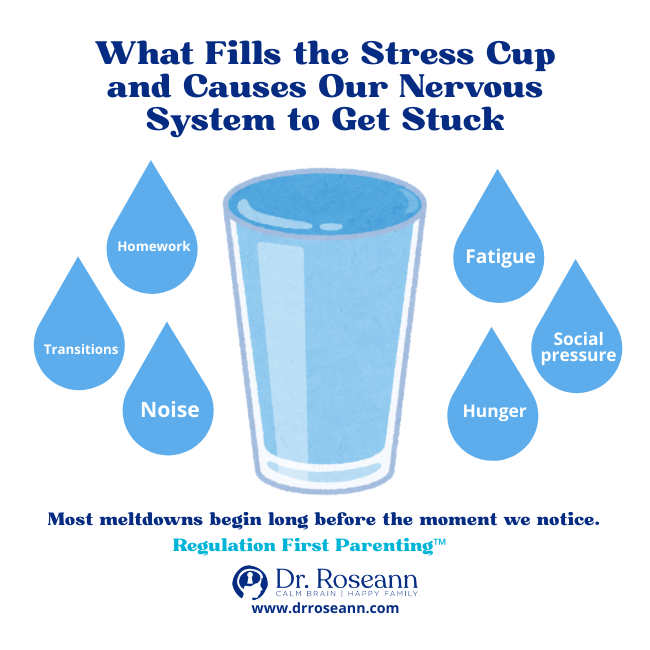
Stress doesn’t usually come from one big event. More often, it builds slowly throughout the day.
| What Fills a Child’s Stress Cup | What Fills a Parent’s Stress Cup |
|---|---|
| School demands | Work pressure |
| Social challenges | Household responsibilities |
| Sensory overload | Mental load and decision fatigue |
| Transitions between activities | Time pressure |
| Hunger or fatigue | Emotional caregiving |
By the time a difficult moment happens, the cup may already be close to overflowing.
The meltdown we see is often the final drop, not the whole story.
Why Some Kids Melt Down More Often
One of the biggest questions parents ask is:
"Why does my child melt down more than other kids?"
The answer often comes down to nervous system capacity.
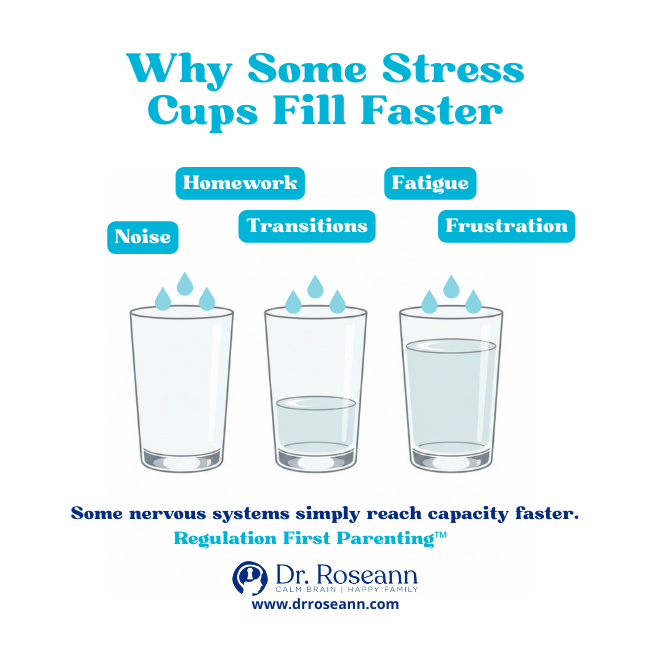
Some children have a nervous system that processes stress differently. Their stress cup may:
• Fill faster
• Overflow sooner
• Take longer to empty
This doesn’t mean something is “wrong” with the child.
It means their nervous system needs more support for regulation.
Children who struggle with regulation often experience stress more intensely. Everyday experiences that may seem manageable for other children can quickly fill their cup.
That’s why many parents notice their child reacting strongly to situations that appear small on the surface.
But when you look at the full cup, the reaction starts to make sense.
Why Some Stress Cups Fill Faster
| Factor | How It Affects the Stress Cup |
|---|---|
| Sensitive nervous system | Stress registers more intensely |
| Sleep challenges | Cup starts the day already partly full |
| Sensory sensitivity | Noise, textures, or crowds add stress quickly |
| Academic pressure | Learning demands increase mental load |
| Emotional intensity | Feelings fill the cup rapidly |
When several of these factors stack together, a child’s cup can reach the top very quickly.
This is why behavior often looks unpredictable.
But from a nervous system perspective, it’s actually very logical.
Parent Insight About The Nervous System
When parents understand the Stress Cup, they often feel relief.
Instead of seeing their child as difficult or defiant, they begin to recognize a nervous system that has reached its limit.
And once you understand what fills the cup, you can begin learning how to help empty it.
I explore this shift in much more detail in The Dysregulated Kid, where I break down how nervous system capacity shapes behavior and what parents can do to support regulation before stress spills over.
The Parent Stress Cup
Parents often focus on their child’s stress cup.
But there’s another cup in the room that matters just as much.
The parent’s cup.
Between work, responsibilities, constant decision-making, and emotional caregiving, many parents start the day with a cup that is already partly full.
Then real life adds more.
Morning routines.
School struggles.
Sibling conflict.
Homework battles.
Bedtime exhaustion.
By the time a difficult moment happens, a parent’s stress cup may already be near the top.
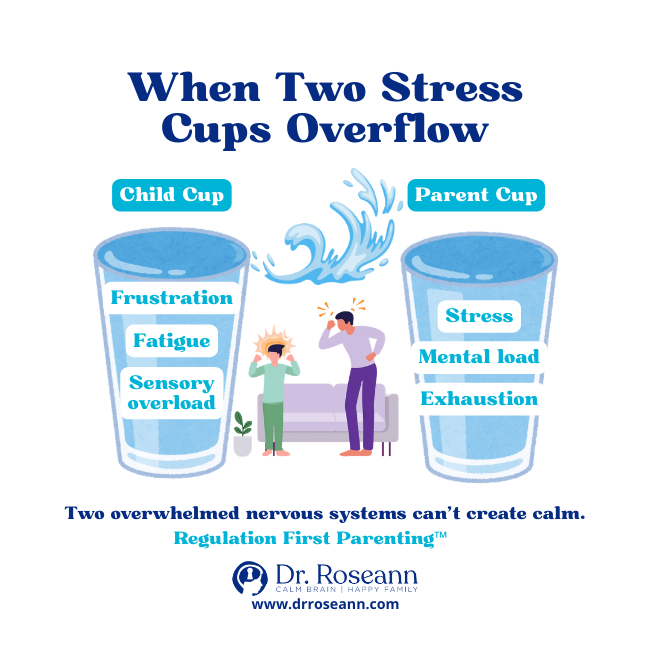
When two nearly full cups collide, reactions become bigger on both sides.
This is how many families unintentionally end up in what I call co-dysregulation.
The child’s stress spills over.
The parent’s stress spills over.
And suddenly a small moment becomes a much bigger storm.
Understanding this dynamic isn’t about blaming parents.
It’s about recognizing that two nervous systems are interacting in real time.
When Two Stress Cups Meet: How Co-Dysregulation Makes Nervous System Activation Worse
| Child Experience | Parent Experience |
|---|---|
| Feels overwhelmed | Feels frustrated |
| Struggles to regulate emotions | Struggles to stay patient |
| Reacts with meltdown or shutdown | Reacts with raised voice or urgency |
| Needs support regulating | Needs a pause to reset |
When both cups are full, it becomes harder for either nervous system to settle.
This is why many parents say:
"I knew I should stay calm… but I just couldn’t."
That’s not a parenting failure.
It’s a nervous system signal.
This is one of the most important shifts families can make.
Instead of asking:
"How do I control this behavior?"
Parents begin asking:
"How do we lower the stress in the room?"
When stress drops, regulation becomes possible.
I teach parents how to shift these moments in The Dysregulated Kid, where we focus on helping families calm the nervous system first so problem-solving can actually happen.

How Stress Cups Empty
If stress fills the cup throughout the day, the next question becomes:
How does the cup empty?
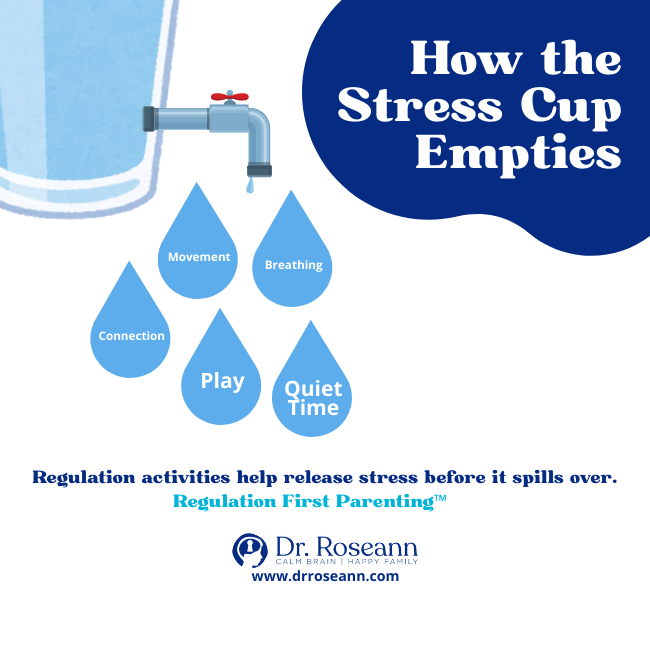
The nervous system releases stress through regulation activities — things that help the brain shift out of stress mode and back into balance.
This is why children often calm down after certain experiences, even if nothing about the problem itself changed.
The nervous system simply released enough stress for the brain to think clearly again.
Some activities empty the cup faster than others because they work directly with the body’s regulation systems.
Movement, breathing, connection, and sensory input all help the brain settle.
When these happen regularly, the stress cup doesn’t reach the overflow point as often.
Everyday Ways Stress Cups Empty: How to Reset the Nervous System
| Regulation Support | Why It Helps the Nervous System |
|---|---|
| Movement (walking, jumping, stretching) | Releases built-up stress energy |
| Deep breathing | Signals safety to the brain |
| Physical connection (hug, sitting close) | Activates calming social circuits |
| Quiet sensory breaks | Reduces stimulation |
| Laughter and play | Releases tension and resets mood |
Small moments of regulation throughout the day help keep stress from building too high.
Read about: The Love Pause™: The 3-Second Technique That Stops Reactive Parenting Before It Starts
Without them, the cup continues filling until the nervous system simply can’t hold any more.
Many parents try to solve behavior first.
But behavior often improves naturally once the nervous system has had a chance to release stress.
This is why regulation-first strategies are so powerful.
They address the stress inside the cup before trying to fix what spilled out.
I explain how these nervous system patterns shape behavior in much more depth in The Dysregulated Kid, where parents learn simple ways to help their child regulate before stress reaches the tipping point.
How Families Build Bigger Stress Cups
If stress fills the cup and regulation helps empty it, there’s another powerful question parents can ask:
Can the cup itself grow bigger?
The answer is yes.
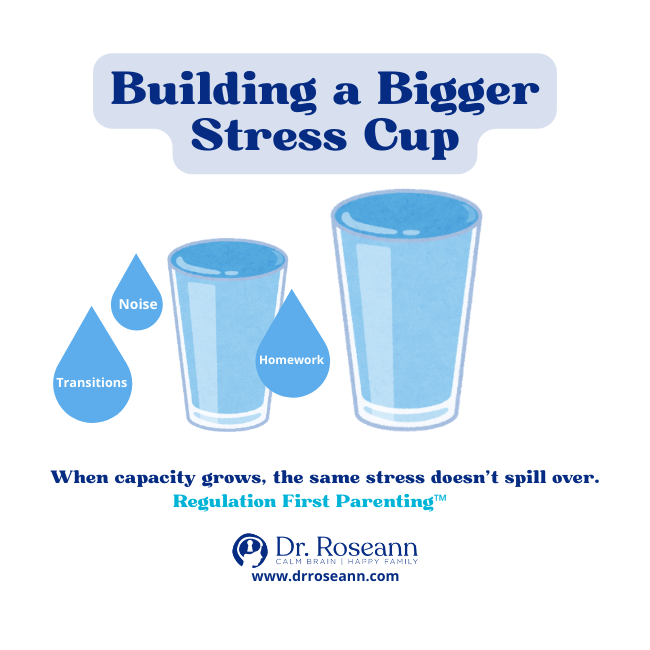
Over time, the nervous system can build greater capacity to handle stress. When that happens, everyday challenges don’t push the system into overload as quickly.
This is why some children can handle disappointment, frustration, or transitions more easily than others. Their nervous system has learned how to hold more stress without spilling over.
Capacity grows through repeated experiences of regulation, safety, and connection.
When children regularly experience calming routines, supportive relationships, and predictable environments, the brain gradually becomes better at managing stress.
Parents build capacity in themselves the same way.
Small, consistent regulation habits help the nervous system become more resilient over time.
What Helps Build a Bigger Stress Cup
| Capacity Builder | How It Supports Regulation |
|---|---|
| Predictable routines | Reduces uncertainty for the brain |
| Sleep and recovery | Restores nervous system balance |
| Movement throughout the day | Releases accumulated stress |
| Supportive connection | Signals safety to the brain |
| Regulation practice | Strengthens emotional skills |
Capacity doesn’t grow overnight.
But with consistent support, many families notice that meltdowns become less frequent, less intense, and shorter in duration.
One of the most hopeful things parents discover is that stress capacity can change.
Children who once reacted quickly to frustration can learn how to tolerate more stress, recover faster, and return to calm.
That process doesn’t happen through punishment or pressure.
It happens when families learn how to support the nervous system first.
In The Dysregulated Kid, I walk parents through the science of nervous system capacity and the practical tools that help families build stronger stress cups together.
A New Way to Understand Family Meltdowns
When parents first learn about the Stress Cup, many feel a sense of relief.
Suddenly, difficult moments begin to make more sense.
Instead of seeing behavior as defiance or stubbornness, parents begin to see what’s happening underneath:
A nervous system that has reached its limit.
This shift changes everything.
Instead of trying to control behavior after stress spills over, parents learn how to support regulation before the cup fills too high.
That’s the heart of Regulation First Parenting™.
And it’s one of the key ideas I unpack in my upcoming book, The Dysregulated Kid.
In the book, I show parents how nervous system stress shapes behavior — and how simple shifts in how we respond can help families move from constant overwhelm to greater calm and connection.
Stress Cup FAQs
How do you explain the Stress Cup to a child?
The Stress Cup is actually a great tool to help children understand their emotions.
You can explain it like this:
"Everyone has an invisible cup inside their body that fills with stress during the day. When the cup gets too full, big feelings spill out."
This helps children understand that meltdowns aren’t about being “bad,” but about their body needing support to calm down.
Many families even draw a cup together and talk about:
• what fills the cup
• what helps empty it
• how to notice when it’s getting close to the top
Over time, children begin to recognize their own stress signals and ask for help earlier.
What are some ways to empty a child’s Stress Cup?
Children release stress through activities that help the nervous system reset.
Some common ways include:
• movement like jumping, running, or stretching
• quiet sensory breaks
• breathing exercises
• time outdoors
• connection with a parent or trusted adult
Different children benefit from different supports, which is why it helps to pay attention to what consistently helps your child settle.
The goal isn’t to eliminate stress — that’s impossible.
The goal is to help the nervous system release stress before the cup overflows.
How can parents increase their own stress capacity?
Parents often focus entirely on their child’s regulation, but their own nervous system matters just as much.
Simple habits can help parents lower stress and increase their capacity to handle difficult moments:
• short regulation breaks during the day
• movement or stretching
• slow breathing
• stepping away briefly during heated moments
• supportive conversations with other adults
When parents have more capacity, they are better able to help their child regulate too.
Citations:
Karreman, A., van Tuijl, C., van Aken, M. A. G., & Deković, M. (2006). Parenting and self-regulation in preschoolers: A meta-analysis. Infant and Child Development, 15(6), 561-579. https://doi.org/10.1002/icd.478
Lavi, I., Ozer, E. J., Katz, L. F., & Gross, J. J. (2021). The role of parental emotion reactivity and regulation in child maltreatment and maltreatment risk: A meta-analytic review. Clinical psychology review, 90, 102099. https://doi.org/10.1016/j.cpr.2021.102099
Lin, S. C., Kehoe, C., Pozzi, E., Liontos, D., & Whittle, S. (2024). Research Review: Child emotion regulation mediates the association between family factors and internalizing symptoms in children and adolescents - a meta-analysis. Journal of child psychology and psychiatry, and allied disciplines, 65(3), 260–274. https://doi.org/10.1111/jcpp.13894
Zimmer-Gembeck, M. J., Rudolph, J., Kerin, J., & Bohadana-Brown, G. (2022). Parent emotional regulation: A meta-analytic review of its association with parenting and child adjustment. International Journal of Behavioral Development, 46(1), 63-82. https://doi.org/10.1177/01650254211051086
Dr. Roseann Capanna-Hodge is a leading expert in emotional and behavioral dysregulation in children.
- Healthline Understanding Self-Regulation Skills
- Scary Mommy What Is Self-Regulation In Children, And How Can You Help Improve It?
- HomeschoolOT Therapy Services Understanding Nervous System Dysregulation in Children: A Guide for Homeschool Parents
Always remember... “Calm Brain, Happy Family™”
Disclaimer: This article is not intended to give health advice and it is recommended to consult with a physician before beginning any new wellness regime. *The effectiveness of diagnosis and treatment vary by patient and condition. Dr. Roseann Capanna-Hodge, LLC does not guarantee certain results.
Are you looking for SOLUTIONS for your struggling child or teen?
Dr. Roseann and her team are all about science-backed solutions, so you are in the right place!
© Roseann-Capanna-Hodge, LLC 2026