

Estimated reading time: 14 minutes
It’s Not Defiance. It’s Dysregulation.
For many parents, the hardest moments happen when their child reacts in ways that feel confusing or overwhelming.
A simple request turns into a meltdown.
Transitions become battles.
Emotions escalate faster than anyone expected.
Parents often ask themselves:
Why does my child react so strongly to things that seem small?
In many cases, the answer isn’t defiance.
It’s dysregulation.
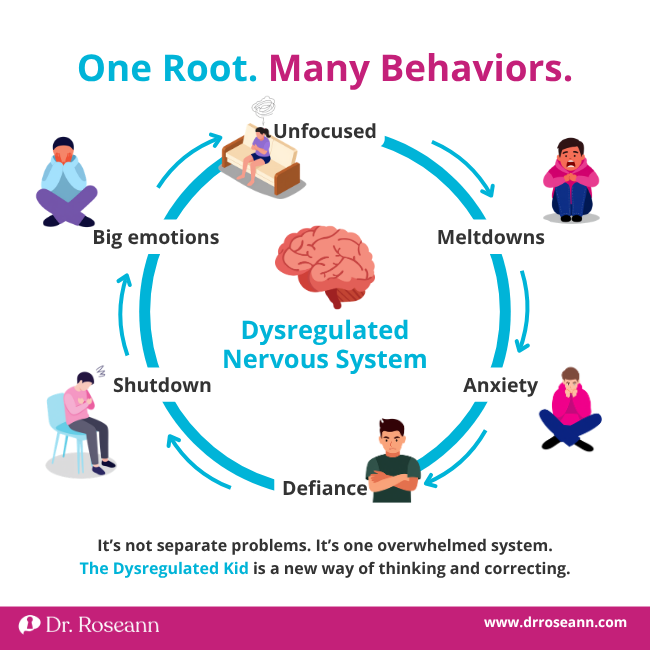
Emotional dysregulation in children happens when the brain becomes overwhelmed by stress and struggles to return to calm, which is why many parents see sudden meltdowns, shutdowns, or explosive reactions. When this happens, the nervous system shifts into survival mode, and behaviors like yelling, refusal, shutdown, or emotional outbursts appear.
From the outside, it can look like misbehavior. What many parents call misbehavior is often dysregulated child behavior, meaning the nervous system is overwhelmed and the brain cannot access thinking and problem-solving skills.
But inside the brain, something very different is happening.
The nervous system is overloaded.
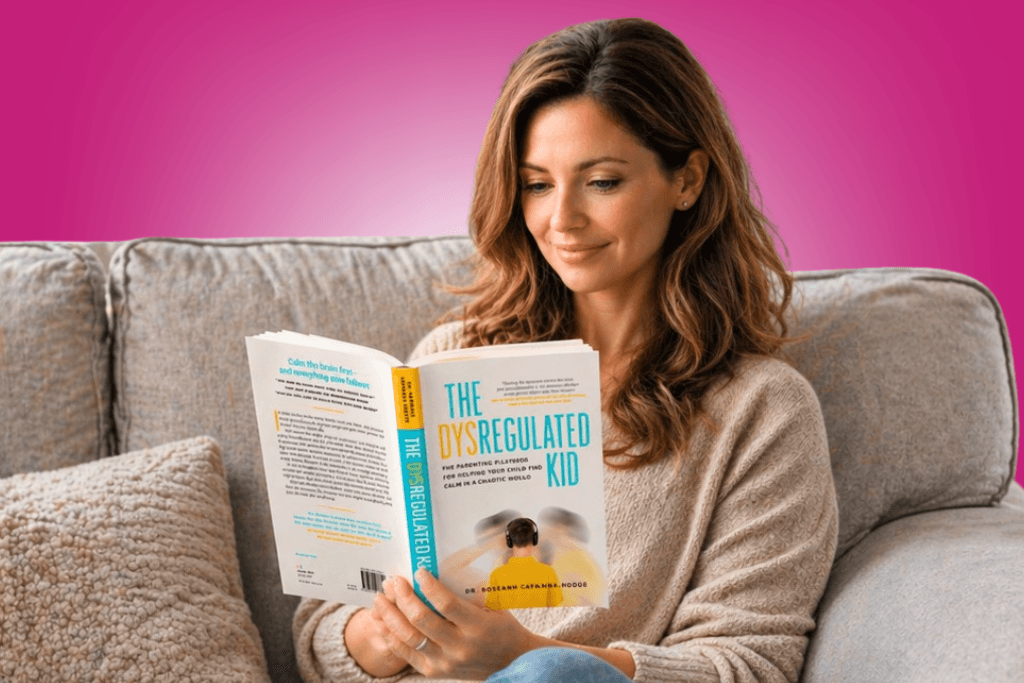
This is the core message of The Dysregulated Kid, the bestselling book by child mental health expert Dr. Roseann Capanna-Hodge.
In the book, I help parents understand why so many children today struggle with emotional regulation—and what families can do to support a dysregulated child in practical, science-based ways.
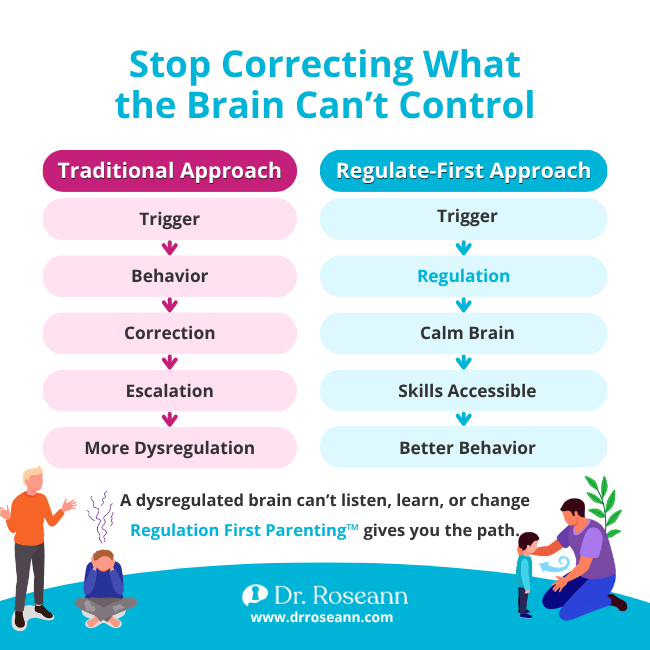
At the heart of the book is one powerful shift in perspective:
When the brain is calm, the behavior follows.
Instead of focusing only on correcting behavior after it appears, The Dysregulated Kid shows parents how to support nervous system regulation first (Regulation First Parenting™ )so children can actually access the skills they need to cooperate, learn, and recover from stress.
For parents searching for parenting books for dysregulated kids, this approach offers something many families have been missing:
A clear, compassionate roadmap for helping children regulate their emotions and build resilience over time.
A parent recently told me,
“I love my child, but every day feels like a battle. I’m exhausted, and nothing seems to work.”
This is the reality for families living with emotional dysregulation.
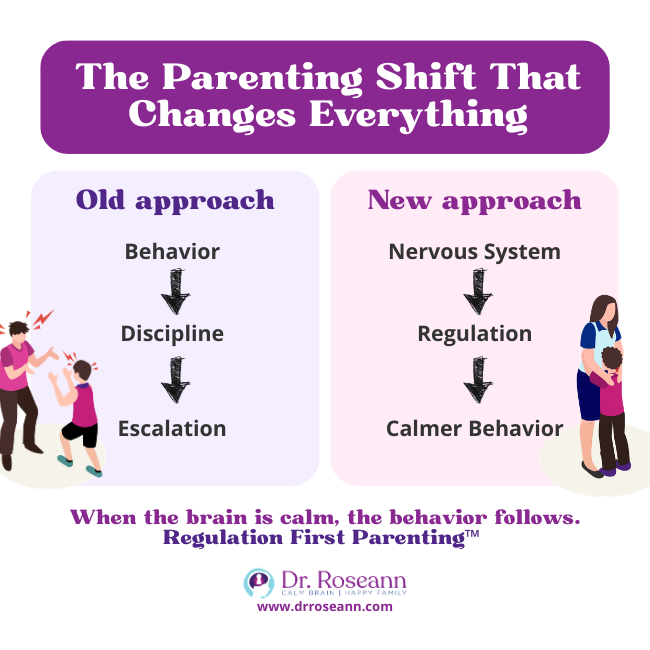
When a child’s nervous system is constantly overloaded, traditional parenting strategies fail because the brain simply isn’t ready for learning or problem solving.
The Dysregulated Kid helps parents understand what’s really happening beneath the behavior—and how to respond in ways that actually calm the brain.
Why Parents Are Searching for The Dysregulated Kid Book
Most parents don’t start their search by looking for a book.
They start by searching for answers.
Late at night, after another difficult day, parents type questions into Google like:
- Why does my child have meltdowns over small things?
- How do I calm a dysregulated child?
- Why does my child overreact to small things?
- What causes emotional dysregulation in children?
Behind these questions is usually the same feeling:
Something isn’t working, and I don’t know what to do next.
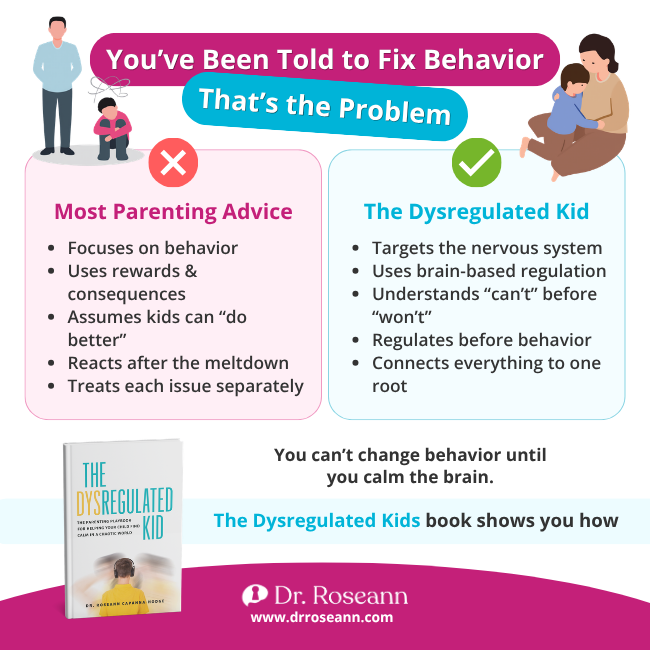
Many parents have already tried behavior charts, consequences, reward systems, therapy, or different parenting approaches. Sometimes those strategies help temporarily—but the same patterns keep returning.
That’s often because the real issue isn’t behavior.
It’s the nervous system.
When a child’s nervous system is overwhelmed, the brain shifts into survival mode. In that state, the thinking part of the brain struggles to access skills like flexibility, impulse control, and emotional regulation.
This is why a dysregulated child may seem calm one moment and completely overwhelmed the next.
The Dysregulated Kid helps parents understand what’s actually happening in those moments—and how to respond in ways that help the brain return to calm.
Instead of focusing only on stopping behavior, the book shows parents how to support nervous system regulation for kids first so children can access cooperation, learning, and emotional recovery.
For many families, that shift is the turning point.
What Looks Like Misbehavior Is Often Dysregulation
| What Parents Notice | What May Be Happening in the Brain |
|---|---|
| My child melts down over small things | The nervous system is overloaded |
| I can’t calm them during a meltdown | The brain needs regulation first |
| My child won’t listen | Stress is blocking access to thinking skills |
| Parenting feels completely exhausting | Both parent and child may be dysregulated |
When parents learn how the nervous system works, they begin to understand how to calm a dysregulated child rather than escalating stress in difficult moments. And when parents understand what’s happening beneath the surface, difficult moments begin to make much more sense.
Common Signs of a Dysregulated Child
Many parents assume dysregulation only shows up as meltdowns.
But emotional dysregulation in children can appear in many different ways. Some signs are loud and obvious, while others are quieter and easier to miss.
When the nervous system becomes overwhelmed, children often lose access to the thinking and problem-solving parts of the brain. What parents see instead are behaviors that signal stress overload.
Recognizing these signs can help parents understand what their child’s nervous system may be experiencing.
Emotional Signs
Some children show dysregulation through intense emotional reactions.
Parents may notice:
- sudden meltdowns over small frustrations
- difficulty calming down once upset
- extreme reactions to disappointment or change
- crying or emotional shutdown during stressful moments
These responses often reflect a nervous system that is struggling to return to calm.
Behavioral Signs
Other children show dysregulation through behavior.
This can look like:
- refusing simple requests
- arguing or pushing back frequently
- difficulty transitioning between activities
- explosive reactions when limits are set
While these behaviors may appear defiant, they are often the result of a nervous system that is overwhelmed.
Read more: Behavioral Signs of a Dysregulated Nervous System
Physical Signs
The body often shows stress signals before behavior does.
Parents may notice:
- restlessness or constant movement
- trouble settling at bedtime
- headaches or stomachaches during stressful periods
- frequent fatigue or irritability
These physical responses are part of the brain’s stress response system.
Read more: Physical Signs of a Dysregulated Nervous System
Social and School Signs
Dysregulation can also show up in relationships and learning environments.
Common patterns include:
- difficulty focusing on tasks
- frustration with schoolwork
- challenges managing peer conflict
- feeling easily overwhelmed in busy environments
When the nervous system is overloaded, children often struggle with the demands of school and social interactions.
How Dysregulation Often Appears in Children and Teens
| Area | Possible Signs |
|---|---|
| Emotional | Frequent meltdowns, big reactions to small problems |
| Behavioral | Refusal, arguing, difficulty with transitions |
| Physical | Restlessness, sleep struggles, fatigue |
| Social/School | Focus challenges, overwhelm in busy settings |
Seeing these patterns together can help parents recognize when their child may be experiencing nervous system dysregulation rather than simple misbehavior.
Many families feel relief when they begin to recognize these signs.
What once looked like stubbornness or attitude often turns out to be a child whose nervous system is overwhelmed.
Understanding dysregulation is the first step toward helping children build stronger emotional regulation skills.
In The Dysregulated Kid book, I explain why these patterns happen and how parents can support their child’s nervous system in ways that lead to calmer behavior and greater resilience over time.
Is This Book for You? A Checklist for Overwhelmed Parents
Many parents who pick up The Dysregulated Kid have one thing in common:
They feel like they’ve already tried everything.
If you’ve ever wondered whether this book is right for you, see how many of these experiences feel familiar.
You may benefit from The Dysregulated Kid if…
- Your child has frequent meltdowns or emotional outbursts
- Small frustrations quickly turn into big reactions
- Transitions (morning routines, homework, bedtime) feel like daily battles
- Your child struggles with focus, anxiety, or emotional regulation
- You feel like you’re constantly walking on eggshells
- You’re tired of yelling and power struggles but don’t know what to do instead
- Your child has a diagnosis like ADHD, anxiety, OCD, or sensory challenges, but you still feel like you don’t have a clear plan
Many parents arrive at this point feeling exhausted, confused, and worried that they’re somehow failing.
But the truth is, most families were never taught how the nervous system shapes behavior.
Once parents understand dysregulation, things begin to make much more sense.
And when parents know how to support regulation first, the entire dynamic of parenting can start to shift.
Parenting a Dysregulated Child Can Feel Like This
For many families, parenting a dysregulated child can feel confusing and exhausting because traditional behavior strategies don’t address the nervous system driving those reactions.
| What Many Parents Are Experiencing | What They’re Hoping For |
|---|---|
| Constant power struggles | More cooperation |
| Frequent meltdowns | Emotional regulation |
| Confusing behavior | Clear understanding |
| Feeling overwhelmed | A practical plan |
The Dysregulated Kid was written to help parents move from survival mode to a clearer path forward.

A Look Inside The Dysregulated Kid
Many parenting books focus on managing behavior after problems appear.
The Dysregulated Kid takes a different approach.
Instead of asking parents to react to behavior, the book helps families understand the nervous system patterns that drive behavior in the first place.
When parents learn how regulation works in the brain, everyday challenges—meltdowns, refusal, anxiety, emotional outbursts—start to make more sense.
Inside the book, I introduce several practical frameworks that help parents shift from reacting to regulating.
These tools give parents a way to navigate difficult moments while helping children gradually build stronger emotional skills. Together, these frameworks introduce practical child emotional regulation strategies that parents can apply in everyday situations.
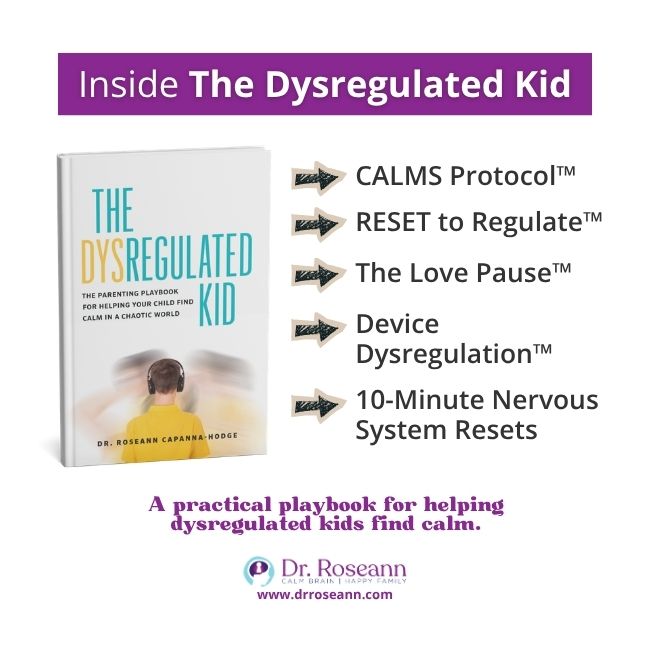
The CALMS Protocol™
At the center of the book is the CALMS Protocol™, a step-by-step approach that helps parents respond to dysregulation with calm, clarity, and connection.
Rather than escalating stress during difficult moments, the framework helps parents guide the nervous system back toward regulation so children can regain access to thinking, learning, and cooperation.
RESET to Regulate™ & The Love Pause™
Parents also learn simple in-the-moment tools for when emotions rise quickly.
RESET to Regulate™ helps parents pause and shift their own stress response during challenging interactions, while The Love Pause™ introduces a brief moment of regulation before reacting to a child’s behavior.
These small shifts can dramatically change how stressful moments unfold.
Device Dysregulation™
One of the most eye-opening sections of the book explores how screens and digital stimulation affect a child’s nervous system.
I explain how device use can contribute to overstimulation and emotional volatility—and how families can create healthier technology boundaries without constant conflict.
Read more about: Device Dysregulation™: How Screens Are Overloading Your Child's Nervous System
The 10-Minute Resets
One of the most encouraging ideas in The Dysregulated Kid is that meaningful change doesn’t require hours of complex routines.
The book introduces 10-Minute Resets, short daily practices that help families support nervous system regulation in small, manageable ways.
Over time, these simple resets can help children build stronger emotional regulation skills and reduce the frequency and intensity of meltdowns.
What Parents Discover Inside the Book
| Inside The Dysregulated Kid | What Parents Learn |
|---|---|
| CALMS Protocol™ | A clear framework for responding to dysregulation |
| RESET to Regulate™ | How parents calm themselves during stressful moments |
| The Love Pause™ | A quick pause that prevents reactive parenting |
| Device Dysregulation™ | How screens impact the nervous system |
| 10-Minute Resets | Small daily practices that support emotional regulation |
These tools work together to help families move from constant stress toward calmer, more connected interactions.
What Parents Are Saying About The Dysregulated Kid
For many parents, the most powerful part of reading The Dysregulated Kid is the feeling of finally being understood.
Instead of being told to try harder, be stricter, or add another behavior strategy, parents discover an explanation that actually makes sense of what they’ve been experiencing at home.
Here’s what families are saying after reading the book.
“This book finally explained my child in a way no professional ever did. Once I understood dysregulation, everything started to make more sense.”
“For the first time, I feel like I have a plan instead of just reacting to meltdowns all day.”
“Dr. Roseann takes neuroscience and turns it into practical tools parents can actually use.”
“I stopped blaming my child—and myself—and started focusing on regulation first. That shift changed everything in our home.”
Many parents searching for parenting books for dysregulated kids are looking for something that goes beyond surface-level advice.
What they often discover in The Dysregulated Kid is a framework that helps them understand the deeper patterns driving behavior—and how to respond in ways that create lasting change.

Frequently Asked Questions About The Dysregulated Kid
Parents often have a few important questions before deciding whether a parenting book is the right fit for their family. Here are some of the most common ones.
What is The Dysregulated Kid book about?
The Dysregulated Kid helps parents understand the connection between behavior and the nervous system.
Instead of viewing meltdowns, emotional outbursts, and resistance as simple misbehavior, the book explains how emotional dysregulation in children develops and how parents can support regulation before behavior escalates.
Dr. Roseann combines neuroscience, clinical experience, and practical parenting strategies to help families move from constant conflict to calmer, more connected interactions.
Who should read The Dysregulated Kid?
This book was written for parents who feel overwhelmed by their child’s behavior and want a clearer way forward.
It may be especially helpful if you are parenting a child who:
- struggles with emotional regulation
- has frequent meltdowns or emotional outbursts
- experiences anxiety, ADHD, OCD, or sensory challenges
- becomes easily overwhelmed by stress or transitions
Many parents searching for books on emotional regulation for parents discover this book because it offers both understanding and practical tools.
Will this book work for toddlers, school-age kids, or teenagers?
Yes. The principles in The Dysregulated Kid apply across different ages because they focus on how the nervous system functions.
The book includes examples and strategies that parents can adapt for younger children, school-age kids, and teens.
While the behaviors may look different at different ages, the underlying regulation patterns are often similar.
Do I need to read the book from beginning to end?
No. Many parents read The Dysregulated Kid straight through, while others start with the chapters that address their most immediate concerns.
The book is designed so families can return to different sections as new challenges arise.
Is The Dysregulated Kid worth reading if I’ve already tried other parenting books?
Many parents who read this book say they had already tried multiple parenting approaches before discovering the concept of dysregulation.
What makes The Dysregulated Kid different is its focus on nervous system regulation as the foundation for behavior change.
Once parents understand that relationship, many strategies that once felt frustrating begin to make more sense.
Ready to Transform Your Family?
If parenting has started to feel like constant firefighting—meltdowns, power struggles, emotional exhaustion—you’re not alone.
Many families are navigating the challenges of raising children whose nervous systems are overwhelmed by modern stressors.
The Dysregulated Kid offers a new way to understand these challenges and a practical path forward. Many parents discover the book while searching for child meltdown solutions, only to realize the real answer begins with understanding the nervous system.
Instead of reacting to behavior, parents learn how to support regulation first—creating calmer interactions, stronger connection, and greater resilience over time.
Dr. Roseann Capanna-Hodge is a leading expert in emotional and behavioral dysregulation in children.
- Emotional Dysregulation & Nervous System Repair Podcast Everyday Wellness with Cynthia Thurlow ™
- NRBS Emotional Dysregulation with Roseann Capanna-Hodge
- The Experience Miracles (Podcast) Why Traditional Discipline Fails Dysregulated Kids (And What Actually Works)
Citations:
Goldberg H. (2022). Growing Brains, Nurturing Minds-Neuroscience as an Educational Tool to Support Students' Development as Life-Long Learners. Brain sciences, 12(12), 1622. https://doi.org/10.3390/brainsci12121622
Karreman, A., van Tuijl, C., van Aken, M. A. G., & Deković, M. (2006). Parenting and self-regulation in preschoolers: A meta-analysis. Infant and Child Development, 15(6), 561-579. https://doi.org/10.1002/icd.478
Lavi, I., Ozer, E. J., Katz, L. F., & Gross, J. J. (2021). The role of parental emotion reactivity and regulation in child maltreatment and maltreatment risk: A meta-analytic review. Clinical psychology review, 90, 102099. https://doi.org/10.1016/j.cpr.2021.102099
Lin, S. C., Kehoe, C., Pozzi, E., Liontos, D., & Whittle, S. (2024). Research Review: Child emotion regulation mediates the association between family factors and internalizing symptoms in children and adolescents - a meta-analysis. Journal of child psychology and psychiatry, and allied disciplines, 65(3), 260–274. https://doi.org/10.1111/jcpp.13894
Moffitt, T. E., Arseneault, L., Belsky, D., Dickson, N., Hancox, R. J., Harrington, H., Houts, R., Poulton, R., Roberts, B. W., Ross, S., Sears, M. R., Thomson, W. M., & Caspi, A. (2011). A gradient of childhood self-control predicts health, wealth, and public safety. Proceedings of the National Academy of Sciences of the United States of America, 108(7), 2693–2698. https://doi.org/10.1073/pnas.1010076108
Montroy, J. J., Bowles, R. P., Skibbe, L. E., Mc Clelland, M. M., & Morrison, F. J. (2016). The development of self-regulation across early childhood. Developmental psychology, 52(11), 1744–1762. https://doi.org/10.1037/dev0000159
Paulus, F. W., Ohmann, S., Möhler, E., Plener, P., & Popow, C. (2021). Emotional Dysregulation in Children and Adolescents With Psychiatric Disorders. A Narrative Review. Frontiers in psychiatry, 12, 628252. https://doi.org/10.3389/fpsyt.2021.628252
Porges S. W. (2022). Polyvagal Theory: A Science of Safety. Frontiers in integrative neuroscience, 16, 871227. https://doi.org/10.3389/fnint.2022.871227
Zimmer-Gembeck, M. J., Rudolph, J., Kerin, J., & Bohadana-Brown, G. (2022). Parent emotional regulation: A meta-analytic review of its association with parenting and child adjustment. International Journal of Behavioral Development, 46(1), 63-82. https://doi.org/10.1177/01650254211051086
© Roseann-Capanna-Hodge, LLC 2026
Always remember… “Calm Brain, Happy Family™”
Disclaimer: This article is not intended to give health advice and it is recommended to consult with a physician before beginning any new wellness regime. The effectiveness of diagnosis and treatment vary by patient and condition. Dr. Roseann Capanna-Hodge, LLC does not guarantee certain results.
Are you looking for SOLUTIONS for your struggling child or teen?
Dr. Roseann and her team are all about science-backed solutions, so you are in the right place!
Meet the Expert
Licensed Therapist | Certified School Psychologist
Board Certified in Neurofeedback (BCN) | 30+ Years Clinical Experience
Expert in Emotional Dysregulation in Children and Nervous System Regulation
Host, Dysregulated Kids Podcast | Author, The Dysregulated Kid
Dr. Roseann Capanna-Hodge is a licensed therapist, certified school psychologist, and leading expert in emotional dysregulation in children and nervous system regulation. With over 30 years of clinical experience and having analyzed more than 10,000 brain maps, she helps families understand what behavior is really signaling—and how to calm the nervous system first so real change can happen.
She is the creator of Regulation First Parenting® and the CALMS Protocol™, host of the top 1% podcast Dysregulated Kids, and author of The Dysregulated Kid.