%20.png)


Estimated reading time: 12 minutes
Why Behavior-First Parenting Often Fails
If you’re parenting a child who melts down easily, shuts down under pressure, or reacts intensely to small frustrations, you’ve probably heard some version of the same advice:
Be firmer.
Follow through with consequences.
Take away privileges.
Don’t “give in.”
And yet many parents quickly discover something frustrating.
Those strategies may work for some kids.
But for dysregulated kids, they often make things worse.
You might notice patterns like:
- the meltdown escalates after consequences
- your child becomes more oppositional
- the argument gets bigger instead of smaller
- everyone ends up overwhelmed
Parents start wondering:
- Why does my child have meltdowns over small things?
- Why won’t my child calm down even when I stay consistent?
- Why does discipline seem to backfire in my home?
The answer often isn’t about parenting skill.
It’s about the nervous system.
When a child’s nervous system is dysregulated, the brain shifts into a stress response state. In that state, access to the thinking brain—the part responsible for impulse control, flexibility, and reasoning—is reduced.
That’s why a dysregulated child may seem:
- Irrational
- explosive
- stubborn
- overly sensitive
- impossible to reason with
But what’s actually happening is physiological.
The brain is prioritizing survival over learning.
And when the brain is in survival mode, traditional discipline strategies often fail because the child literally cannot process them yet.
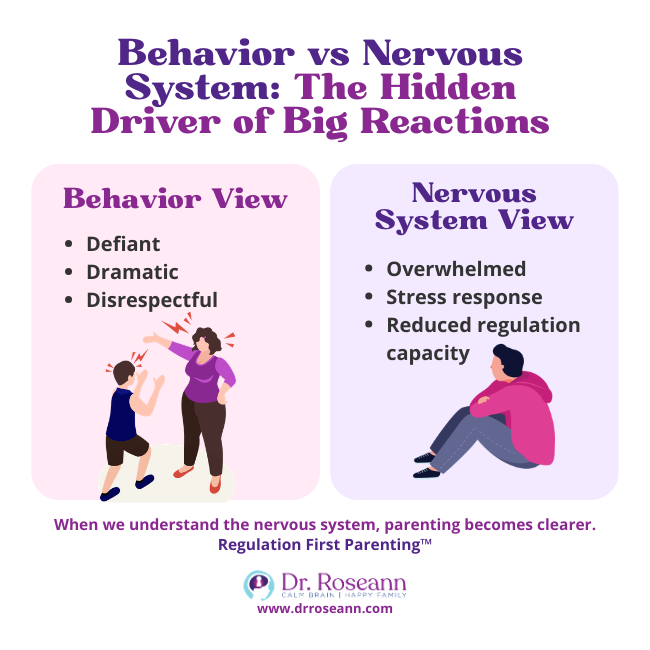
What Looks Like Misbehavior Is Often Nervous System Overload
| What Parents See | What’s Happening in the Nervous System |
|---|---|
| “They’re overreacting.” | The stress response has been activated. |
| “They won’t listen.” | The thinking brain has reduced access. |
| “They’re being defiant.” | The nervous system is overwhelmed. |
| “They should know better.” | Regulation capacity is temporarily low. |
When we understand behavior through a nervous system lens, parenting shifts from trying to control behavior to stabilizing the system that produces the behavior.
This shift is the foundation of Nervous System First Parenting™.
Instead of asking:
“How do I stop this behavior?”
Parents begin asking:
“What is happening in my child’s nervous system right now?”
That one question can completely change how we respond to meltdowns, emotional outbursts, and shutdowns.
Because when the nervous system becomes regulated…
behavior almost always improves.
One of the biggest shifts I see in families happens when parents realize something powerful:
Your child is not giving you a hard time.
Your child is having a hard time.
That doesn’t mean boundaries disappear.
It means we sequence things differently.
Calm the nervous system first.
Then teach.
Then correct.
This biological understanding is the foundation for both Nervous System First Parenting™ and the practical framework I teach called Regulation First Parenting™, which helps parents turn this science into everyday strategies.
What Is Nervous System First Parenting™
Nervous System First Parenting™ is a parenting approach that prioritizes nervous system regulation before behavior correction.
Instead of focusing first on stopping behavior, it focuses on stabilizing the brain that produces the behavior.
When a child’s nervous system is calm and regulated, the brain can access:
- impulse control
- flexible thinking
- emotional regulation
- problem solving
- cooperation
When the nervous system is overwhelmed, those skills become much harder to access.
That’s why a child who is normally thoughtful and kind can suddenly seem completely irrational during a meltdown.
It isn’t that the child forgot everything you taught them.
It’s that their thinking brain is temporarily offline.
At the heart of Nervous System First Parenting™ is a simple but powerful principle:
The nervous system must stabilize before learning or discipline can work.
Many parenting approaches focus primarily on behavior management.
Nervous System First Parenting™ focuses on brain state first.
Instead of asking:
“How do I stop this behavior?”
Parents begin asking:
“What does this nervous system need right now?”
That shift changes everything.
Behavior-First vs Nervous System-First Parenting
| Parenting Approach | First Priority | What Happens During Meltdown | Long-Term Focus |
|---|---|---|---|
| Traditional discipline | Stop behavior | Apply consequence | Compliance |
| Reward systems | Motivate behavior | Offer reward or remove privilege | External motivation |
| Emotional validation | Acknowledge feelings | Focus on emotional expression | Emotional awareness |
| Nervous System First Parenting™ | Stabilize the nervous system | Reduce stress response first | Regulation capacity |
This doesn’t mean boundaries disappear.
It simply means timing changes.
Instead of correcting behavior during the height of emotional escalation, parents first help the nervous system settle.
Once the brain is regulated again, children are far more able to:
- listen
- reflect
- repair
- learn new skills
Why This Matters for Dysregulated Kids
Many of the children I work with struggle with emotional regulation challenges connected to:
- ADHD
- anxiety
- OCD
- sensory processing differences
- PANS/PANDAS
- chronic stress
- nervous system overload
These kids often experience lower available regulation capacity.
That means their nervous system reaches a stress threshold more quickly.
Small frustrations can trigger big reactions because the nervous system is already operating close to its limit.
Parents often describe this pattern as:
“Everything seems fine and then suddenly there’s a meltdown.”
But meltdowns are rarely random.
They’re usually the result of an overloaded nervous system.
Understanding this helps parents move from feeling confused or blamed to feeling clear and empowered.
Read about: The Stress Cup: Why Your Child (and You) Are Melting Down and How to Build a Bigger Cup
Where Regulation First Parenting™ Fits
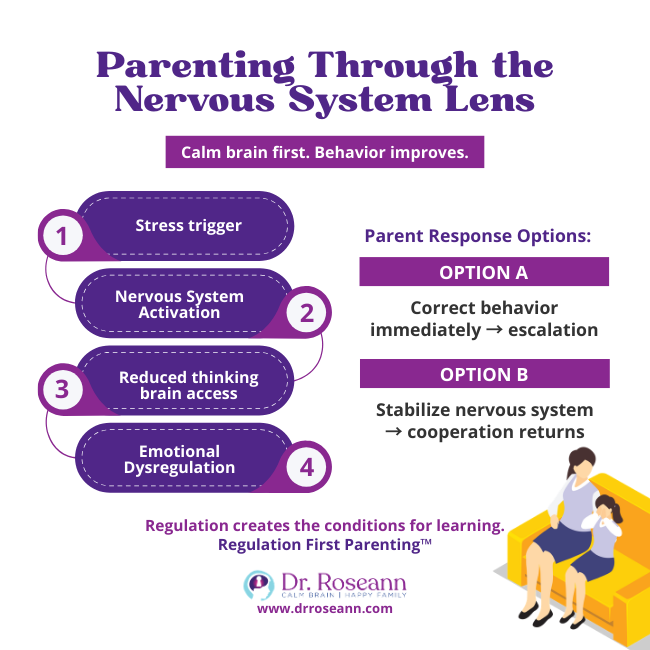
Nervous System First Parenting™ explains the science.
Regulation First Parenting™ is the framework that helps parents apply that science in everyday life.
Regulation First Parenting™ teaches parents how to:
- stabilize their own nervous system
- co-regulate their child during stressful moments
- increase regulation capacity over time
- teach emotional regulation skills when the brain is ready
Together, these ideas shift parenting from reaction to regulation.
And when parents begin responding through a nervous system lens, something powerful often happens.
Meltdowns become more predictable.
Recovery becomes faster.
And families begin moving out of constant survival mode.
Parents often tell me something like this:
“I thought my child was just difficult.”
But once they understand the nervous system, they realize something important:
Their child isn’t trying to be difficult.
Their child’s nervous system is trying to cope with more stress than it can currently handle.
And when we help kids build regulation capacity, behavior becomes easier for everyone.

What Happens in a Dysregulated Child’s Brain
When a child becomes overwhelmed, the change is not just emotional.
It is neurological.
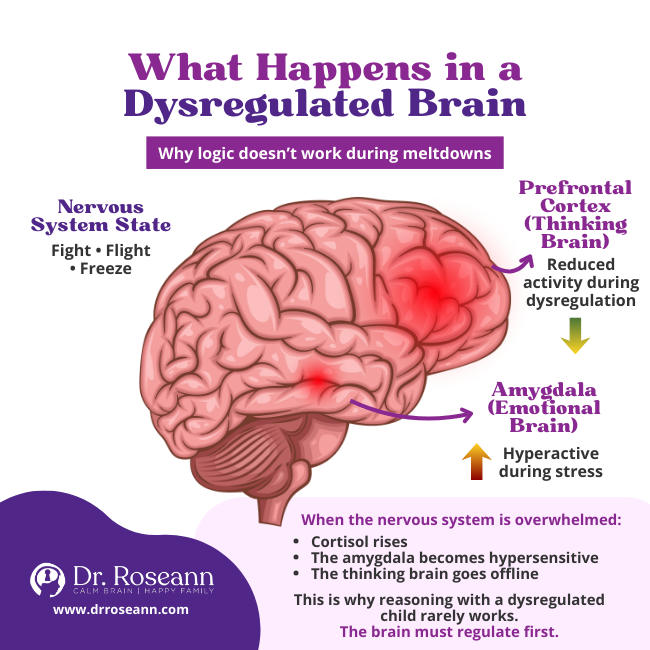
The brain shifts into a stress-response state designed for survival.
This response is automatic. It happens in milliseconds and is controlled by the autonomic nervous system, which constantly scans the environment for signals of safety or danger.
When the brain detects stress, the amygdala, the brain’s threat detector, activates.
The body prepares to react.
Heart rate increases.
Breathing changes.
Muscles tighten.
Stress hormones rise.
At the same time, activity in the prefrontal cortex — the part of the brain responsible for thinking, planning, and impulse control — decreases.
This explains something many parents notice:
During a meltdown, their child suddenly seems like a completely different person.
A child who is normally thoughtful and cooperative may suddenly appear:
- irrational
- explosive
- stubborn
- unable to listen
- unable to calm down
This isn’t a character issue.
It’s a brain state issue.
When the nervous system shifts into fight, flight, freeze, or shutdown, the brain prioritizes safety over reasoning.
And that means logic, lectures, and consequences often don’t land the way parents expect them to.
Regulated Nervous System vs Dysregulated Nervous System
| Brain Function | Regulated Nervous System | Dysregulated Nervous System |
|---|---|---|
| Emotional intensity | Proportionate to situation | Amplified or unpredictable |
| Impulse control | Accessible | Reduced |
| Problem solving | Flexible | Rigid thinking |
| Response to correction | Able to learn | Escalates stress |
| Recovery after stress | Relatively quick | Slow or prolonged |
This is why parents often say things like:
“They know better than this.”
And they’re right.
When the brain is regulated, children do know better.
But during nervous system activation, access to those skills temporarily disappears.
Why Kids Can’t “Just Calm Down”
Parents are often told to ask their child to calm down.
But the truth is, children can’t access calm when the stress response is fully activated.
The brain must first feel safe enough to shift out of survival mode.
That’s why yelling, lecturing, or threatening consequences during a meltdown usually escalates the situation.
The brain interprets increased intensity as more threat.
And when threat increases, the nervous system pushes even further into fight, flight, or freeze.
What Parents Often Misinterpret About Kid’s Big Emotions
Many behaviors that appear intentional are actually stress responses.
| Behavior Parents See | Possible Nervous System Response |
|---|---|
| Yelling or aggression | Fight response |
| Running away or refusing | Flight response |
| Shutdown or silence | Freeze response |
| Avoidance of tasks | Stress avoidance |
Understanding these patterns can completely change how parents interpret difficult moments.
Instead of asking:
“Why is my child being so difficult?”
Parents begin asking:
“What triggered this nervous system response?”
That shift allows parents to move from reacting to behavior to responding to the nervous system.
And that’s where real change begins.
Many parents tell me the most surprising moment in this process is realizing:
Their child is not trying to control them.
Their child’s nervous system is trying to protect them.
Once we understand that, parenting becomes less about punishment and more about helping the brain return to regulation.
And when the brain is regulated again, the child can once again access the skills they already have.
Signs Your Child’s Nervous System Is Dysregulated
Parents often ask:
“Why does my child melt down over small things?”
In many cases, the answer is nervous system dysregulation.
When the stress response activates, the brain temporarily shifts out of its thinking state and into survival mode. In that state, emotional reactions intensify and recovery takes longer.
Dysregulation doesn’t always look the same. Some kids become explosive, while others withdraw or shut down.
But the underlying pattern is the same:
the nervous system is struggling to regulate under stress.
Common Signs of Nervous System Dysregulation In Children
| What Parents Notice | What May Be Happening |
|---|---|
| Explosive anger or yelling | Fight response |
| Refusal or avoidance | Flight response |
| Silence or shutdown | Freeze response |
| Intense reactions to small problems | Low regulation capacity |
| Long recovery after conflict | Nervous system still activated |
These reactions can feel confusing because the response often seems larger than the situation.
But dysregulation is rarely about a single moment.
It’s usually the result of accumulated stress throughout the day.
The Small Trigger, Big Reaction Pattern
Many dysregulated kids follow a predictable pattern:
| Small Trigger | Big Reaction |
|---|---|
| Homework request | Meltdown |
| Turning off a device | Explosive anger |
| Minor mistake | Tears or shutdown |
| Transition between activities | Refusal or avoidance |
When regulation capacity is low, small stressors can overwhelm the system.
The reaction may look dramatic, but biologically it’s the nervous system reaching its limit.
Recognizing these patterns helps parents move from asking:
“Why is my child acting this way?”
to asking the more helpful question:
“What might have overloaded my child’s nervous system today?”
That shift is the first step in Nervous System First Parenting™.
Why Regulation Must Come Before Discipline
One of the biggest shifts parents make when they begin using a nervous system lens is understanding this:
Discipline works best when the brain is regulated.
When a child is in the middle of a meltdown, their nervous system is operating in fight, flight, or freeze. In that state, the brain is focused on survival—not learning.
The thinking brain—the prefrontal cortex—has reduced access to skills like:
- impulse control
- flexible thinking
- perspective taking
- problem solving
That’s why consequences or lectures during a meltdown often escalate the situation instead of resolving it.
The brain interprets increased intensity as additional threat.
What Happens When We Discipline Too Early Before the Nervous System is Regulated
| Parent Action | Nervous System Response |
|---|---|
| Lecture during meltdown | Stress increases |
| Raise voice to gain control | Fight response escalates |
| Apply consequences immediately | Child feels more threatened |
| Push for explanation | Brain cannot process yet |
The result is often a cycle many families know well:
Child escalates → Parent intensifies → Child escalates more.
This isn’t a parenting failure.
It’s a nervous system collision.
Two activated nervous systems cannot create calm.
The Regulation-First Sequence for Parenting Dysregulated Kids
Nervous System First Parenting™ simply changes the order of operations.
- Stabilize the nervous system
- Reconnect and co-regulate
- Teach or correct behavior
Once the brain returns to a regulated state, children can access the skills they already have.
That’s when conversations about behavior actually land.
This sequencing doesn’t remove boundaries.
It makes them more effective.
Because children learn best when the nervous system feels safe enough to think.
How Regulation First Parenting™ Applies Nervous System Science
Understanding the nervous system changes how we interpret behavior.
But parents also need to know what to do differently in real life.
This is where Regulation First Parenting™ comes in.
If Nervous System First Parenting™ explains the biology, Regulation First Parenting™ provides the practical framework for applying that biology during everyday parenting moments.
Instead of reacting immediately to behavior, parents learn to focus on regulation first.
The sequence looks like this:
| Step | What the Parent Focuses On | Why It Matters |
|---|---|---|
| 1 | Parent regulation | Children mirror adult nervous systems |
| 2 | Co-regulation | Helps stabilize the child’s stress response |
| 3 | Nervous system calming | Restores access to the thinking brain |
| 4 | Teaching or correction | Now the child can process it |
| 5 | Skill building | Builds long-term self-regulation |
This shift often feels subtle, but it dramatically changes how conflicts unfold.
For example, imagine a child who explodes when asked to stop playing a video game.
A behavior-first response might look like:
“Turn it off right now or you lose it for a week.”
A regulation-first response might look like:
“I can see this is really frustrating. Let’s pause for a moment and reset.”
The boundary still happens.
But the nervous system stabilizes first.
That stability helps the brain move back into a state where listening, flexibility, and cooperation are possible.
Learn more: The Love Pause™: The 3-Second Technique That Stops Reactive Parenting Before It Starts
Why Parent Regulation Matters So Much
Children’s nervous systems are deeply responsive to the emotional state of the adults around them.
When a parent becomes tense, loud, or reactive, the child’s nervous system detects that change almost instantly.
Stress spreads quickly between nervous systems.
So does calm.
| Parent Nervous System | Likely Child Response |
|---|---|
| Calm and steady | Gradual de-escalation |
| Reactive or loud | Escalation increases |
| Withdrawn or tense | Child becomes more anxious or defensive |
This is why one of the most powerful interventions in dysregulated moments is parent regulation.
Children borrow calm before they build it themselves.
Over time, repeated experiences of co-regulation help strengthen the brain circuits responsible for emotional regulation.
The Long-Term Goal: Regulation Capacity
The goal of Nervous System First Parenting™ is not simply stopping meltdowns.
The deeper goal is building regulation capacity.
Regulation capacity is the amount of stress a nervous system can handle before shifting into fight, flight, or freeze.
As regulation capacity grows, children become better able to:
- tolerate frustration
- recover from disappointment
- manage transitions
- regulate emotional intensity
When regulation capacity improves, behavior improves naturally.
Not because children are forced to behave—but because their nervous system has more flexibility and resilience.
Practical Ways Parents Can Support Nervous System Regulation
Once parents begin viewing behavior through a nervous system lens, the next question is usually:
“What can I actually do in the moment?”
The good news is that small shifts can make a meaningful difference. Nervous system regulation doesn’t require perfect parenting—it requires consistent regulation leadership.
Here are a few starting points that help stabilize the nervous system during difficult moments.
| Strategy | What It Looks Like | Why It Helps |
|---|---|---|
| Pause before reacting | Take a slow breath before responding | Prevents co-dysregulation |
| Lower intensity | Reduce voice volume and verbal input | Signals safety to the nervous system |
| Simplify the moment | Focus on calming first, not explaining | Restores access to the thinking brain |
| Repair afterward | Revisit expectations once calm returns | Builds regulation and learning |
These small adjustments may seem simple, but they change the entire trajectory of escalation cycles.
Over time, children begin to experience more co-regulation, which strengthens the brain pathways responsible for emotional regulation and stress recovery.
But understanding the concept is only the first step.
Parents often ask questions like:
- What do I say during a meltdown?
- How do I calm my child without reinforcing the behavior?
- How do I build regulation capacity over time?
- What if my child has ADHD, anxiety, OCD, or PANS/PANDAS?
Those answers require a clear roadmap, not just theory.
That roadmap is outlined in The Dysregulated Kid: The Parenting Playbook for Helping Your Child Find Calm in a Chaotic World.
In the book, I walk parents step-by-step through how to:
- interrupt escalation cycles
- calm the nervous system during meltdowns
- build emotional regulation skills over time
- reduce reactivity in both parent and child
- create lasting regulation capacity
If this article helped you see your child differently, the book will show you exactly how to apply these ideas in everyday parenting moments.
Frequently Asked Questions About Nervous System First Parenting™
What is Nervous System First Parenting™?
Nervous System First Parenting™ is a parenting approach that prioritizes regulating the child’s nervous system before correcting behavior.
Instead of assuming a child is being defiant or manipulative, parents recognize that many difficult behaviors are actually signs of nervous system overload. When the brain is in a stress response—fight, flight, or freeze—children cannot access the thinking part of the brain that supports listening, reasoning, and self-control.
By calming the nervous system first, parents help restore the brain’s ability to regulate emotions and behavior.
Why does my child have meltdowns over small things?
Meltdowns are often a sign that a child’s stress capacity has been exceeded.
Think of the nervous system like a cup that slowly fills with stress throughout the day. School pressure, sensory input, social challenges, transitions, and lack of sleep can all add to that load.
When the cup overflows, even a small trigger—like being asked to turn off a video game or brush teeth—can cause a big emotional reaction.
The meltdown isn’t about that moment alone. It’s about accumulated nervous system stress.
How do you calm a dysregulated child?
The most effective way to calm a dysregulated child is through co-regulation.
This means using your own calm nervous system to help stabilize your child’s nervous system. Practical strategies include:
- lowering your voice and slowing your speech
- offering physical proximity or comfort when appropriate
- reducing stimulation in the environment
- focusing on calming before explaining or correcting
Once the nervous system settles, children regain access to the thinking brain and can better process guidance or boundaries.
Can nervous system dysregulation be linked to mental health conditions?
Yes. Emotional dysregulation is often associated with conditions such as:
- ADHD
- anxiety disorders
- OCD
- autism spectrum differences
- trauma-related stress
- mood disorders
- PANS/PANDAS
But it’s important to understand that nervous system dysregulation can show up across many mental health conditions.
In many cases, these diagnoses reflect differences in stress regulation capacity within the brain and nervous system. When the nervous system is supported and regulated, emotional stability often improves alongside behavior.
What are the best ways to build nervous system regulation in kids?
Building regulation capacity happens through consistent experiences of safety, connection, and recovery from stress.
Helpful supports include:
- predictable routines
- emotional coaching and co-regulation
- adequate sleep and nutrition
- movement and sensory regulation activities
- reducing chronic stress triggers
Over time, these experiences help strengthen the brain circuits responsible for emotional regulation.
Where can I learn the full system for helping a dysregulated child?
If your child struggles with frequent meltdowns, emotional reactivity, anxiety, or attention challenges, understanding the nervous system is a powerful starting point.
In The Dysregulated Kid: The Parenting Playbook for Helping Your Child Find Calm in a Chaotic World, I walk parents step-by-step through how to:
- calm the brain during emotional storms
- interrupt escalating behavior cycles
- build emotional regulation skills
- strengthen nervous system capacity
- create calmer, more connected family relationships
The book brings together decades of clinical experience helping families move from chaos to calm using nervous system–based parenting strategies.
Dr. Roseann Capanna-Hodge is a leading expert in emotional and behavioral dysregulation in children.
- Emotional Dysregulation & Nervous System Repair Podcast Everyday Wellness with Cynthia Thurlow ™
- NRBS Emotional Dysregulation with Roseann Capanna-Hodge
- The Experience Miracles (Podcast) Why Traditional Discipline Fails Dysregulated Kids (And What Actually Works)
Citations:
Alen, N. V., Shields, G. S., Nemer, A., D'Souza, I. A., Ohlgart, M. J., & Hostinar, C. E. (2022). A systematic review and meta-analysis of the association between parenting and child autonomic nervous system activity. Neuroscience and biobehavioral reviews, 139, 104734. https://doi.org/10.1016/j.neubiorev.2022.104734
Karreman, A., van Tuijl, C., van Aken, M. A. G., & Deković, M. (2006). Parenting and self-regulation in preschoolers: A meta-analysis. Infant and Child Development, 15(6), 561-579. https://doi.org/10.1002/icd.478
Lavi, I., Ozer, E. J., Katz, L. F., & Gross, J. J. (2021). The role of parental emotion reactivity and regulation in child maltreatment and maltreatment risk: A meta-analytic review. Clinical psychology review, 90, 102099. https://doi.org/10.1016/j.cpr.2021.102099
Lin, S. C., Kehoe, C., Pozzi, E., Liontos, D., & Whittle, S. (2024). Research Review: Child emotion regulation mediates the association between family factors and internalizing symptoms in children and adolescents - a meta-analysis. Journal of child psychology and psychiatry, and allied disciplines, 65(3), 260–274. https://doi.org/10.1111/jcpp.13894
Moffitt, T. E., Arseneault, L., Belsky, D., Dickson, N., Hancox, R. J., Harrington, H., Houts, R., Poulton, R., Roberts, B. W., Ross, S., Sears, M. R., Thomson, W. M., & Caspi, A. (2011). A gradient of childhood self-control predicts health, wealth, and public safety. Proceedings of the National Academy of Sciences of the United States of America, 108(7), 2693–2698. https://doi.org/10.1073/pnas.1010076108
Montroy, J. J., Bowles, R. P., Skibbe, L. E., McClelland, M. M., & Morrison, F. J. (2016). The development of self-regulation across early childhood. Developmental psychology, 52(11), 1744–1762. https://doi.org/10.1037/dev0000159
Paulus, F. W., Ohmann, S., Möhler, E., Plener, P., & Popow, C. (2021). Emotional Dysregulation in Children and Adolescents With Psychiatric Disorders. A Narrative Review. Frontiers in psychiatry, 12, 628252. https://doi.org/10.3389/fpsyt.2021.628252
Porges S. W. (2022). Polyvagal Theory: A Science of Safety. Frontiers in integrative neuroscience, 16, 871227. https://doi.org/10.3389/fnint.2022.871227
Zimmer-Gembeck, M. J., Rudolph, J., Kerin, J., & Bohadana-Brown, G. (2022). Parent emotional regulation: A meta-analytic review of its association with parenting and child adjustment. International Journal of Behavioral Development, 46(1), 63-82. https://doi.org/10.1177/01650254211051086
Always remember... “Calm Brain, Happy Family™”
Disclaimer: This article is not intended to give health advice and it is recommended to consult with a physician before beginning any new wellness regime. *The effectiveness of diagnosis and treatment vary by patient and condition. Dr. Roseann Capanna-Hodge, LLC does not guarantee certain results.
Are you looking for SOLUTIONS for your struggling child or teen?
Dr. Roseann and her team are all about science-backed solutions, so you are in the right place!
© Roseann-Capanna-Hodge, LLC 2026