



Estimated reading time: 14 minutes
Parenting is full of moments when emotions rise faster than we expect.
Your child refuses to listen.
A meltdown erupts over something small.
A sibling conflict escalates into yelling.
Before you realize it, your voice is louder than you intended and the moment spirals.
Most parents don’t react this way because they lack love or good intentions.
They react because their nervous system is overwhelmed.
More about: 7 Signs You’re a Dysregulated Parent
When a child is dysregulated, it often pulls the parent’s nervous system into the same state. This creates what experts call co-dysregulation, where both parent and child escalate together.
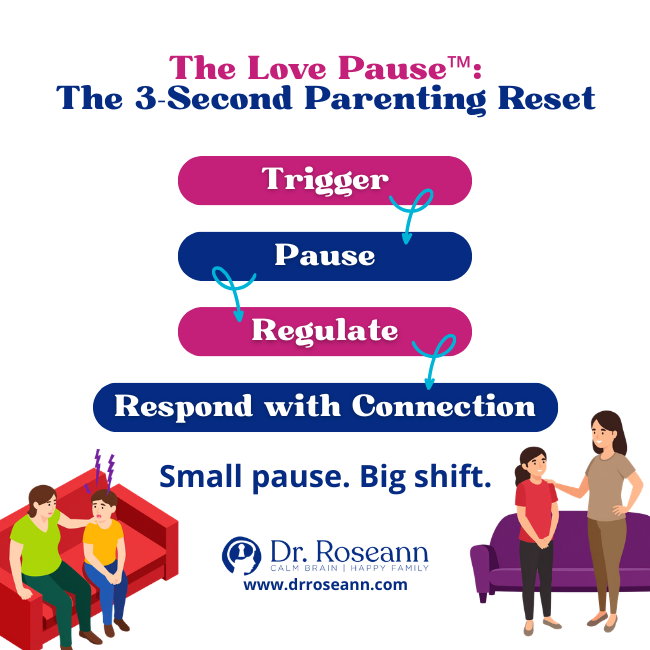
The Love Pause® is a simple tool designed to interrupt that cycle.
Instead of reacting automatically, you pause long enough for your nervous system to settle so you can respond with connection, clarity, and calm.
It may only take a few seconds.
But those seconds can completely change the outcome of the moment.
When parents regulate first, children feel safer. And when children feel safe, they can begin learning the self-regulation skills they will carry with them for life.
The Love Pause® is one of the simplest tools in Regulation First Parenting®, the neuroscience-based approach I, Dr. Roseann Capanna-Hodge, to help families move from chaos to calm.
What Is The Love Pause®
The Love Pause® is your chance to break the cycle of reactive parenting and shift a stressful moment into connection.
When emotions run high, both parents and children can become overwhelmed quickly. A dysregulated child often triggers a dysregulated parent, creating a pattern where both nervous systems escalate together.
This is called co-dysregulation.
The Love Pause® interrupts that pattern.
It is a brief, intentional moment where you pause before reacting to your child’s behavior so your nervous system has time to settle.
Instead of responding from frustration, anger, or urgency, you respond from regulation and connection.
This pause may only last a few seconds, but it changes everything about the interaction.
Why a Pause Changes Everything
When the brain feels threatened or overwhelmed, the body moves into a fight-flight-freeze stress response.
During this state:
- the emotional brain becomes dominant
- the thinking brain goes offline
- reactions become faster and more intense
This happens to children.
And it happens to parents too.
More about: How to Break the Cycle of Parental Burnout
The Love Pause® gives the brain just enough time to shift out of stress mode so you can access the part of your brain responsible for empathy, reasoning, and problem-solving.
Reactive Parenting vs Regulated Parenting
| Reactive Parenting | Regulation-First Parenting |
|---|---|
| Yelling or escalating voice | Calm, steady tone |
| Immediate punishment | Connection before correction |
| Power struggles | Collaborative problem solving |
| Emotional flooding | Nervous system regulation |
| Short-term compliance | Long-term self-regulation skills |
Why The Love Pause® Works for Dysregulated Children
Children learn emotional regulation through co-regulation.
That means they borrow calm from the nervous systems around them.
When a parent pauses, regulates, and responds calmly, the child’s nervous system receives a powerful signal of safety.
Safety allows the brain to relax.
And a relaxed brain can learn.
This is why tools like The Love Pause® are so powerful for families raising children with:
- emotional dysregulation
- ADHD and emotional reactivity
- anxiety
- executive functioning challenges
- frequent meltdowns
Instead of escalating the moment, the parent becomes the stabilizing force.
The Goal of The Love Pause®
The goal of The Love Pause® is not to ignore behavior or eliminate boundaries.
The goal is to create the nervous system conditions where learning can happen.
When children feel safe, seen, and supported, they can begin developing the emotional regulation skills they need to manage frustration, disappointment, and stress.
The Love Pause® turns difficult parenting moments into opportunities for connection and growth.
And sometimes it starts with something as simple as three seconds.
A pause.
A breath.
A reminder that love can stay bigger than the moment.
Why Parents Become Reactive (Even When They Don’t Want To)
Most parents don’t plan to yell.
They don’t wake up thinking, “Today I’m going to lose my patience.”
Yet many loving, committed parents find themselves reacting in ways they later regret.
The truth is that reactive parenting isn’t a character flaw.
It’s a nervous system response.
When a child melts down, argues, refuses, or pushes limits, it can activate a parent’s stress response. In that moment, the parent’s brain may interpret the situation as a threat—not a simple parenting challenge.
The body reacts instantly.
Heart rate rises.
Muscles tighten.
Frustration spikes.
The thinking part of the brain temporarily steps aside while the emotional brain takes control.
This is why parents often say:
- “I didn’t mean to yell.”
- “It just came out.”
- “I reacted before I even realized what I was doing.”
These reactions are not intentional. They are automatic stress responses.
Understanding this is the first step to changing it.
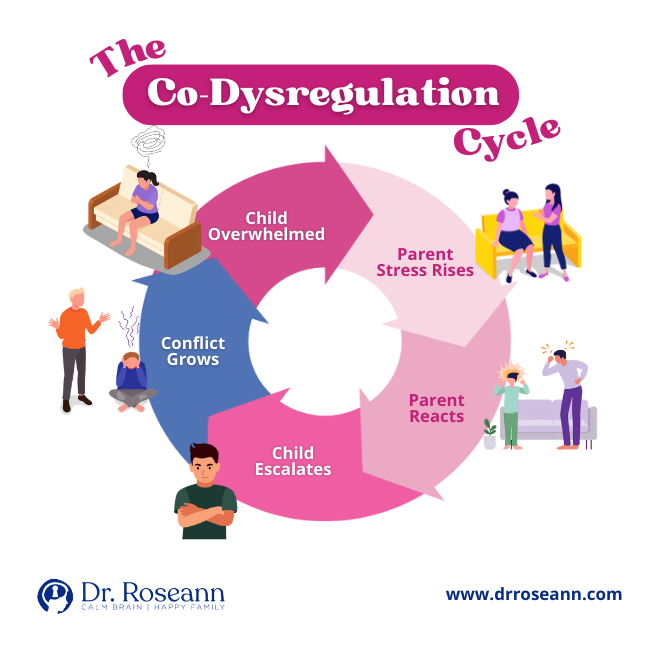
The Hidden Cycle of Co-Dysregulation
Many difficult parenting moments follow the same pattern.
A child becomes dysregulated.
The parent becomes overwhelmed.
Both nervous systems escalate together.
This pattern is called co-dysregulation.
Instead of one nervous system calming the other, both systems amplify stress.
The Co-Dysregulation Cycle
| Step | What Happens |
|---|---|
| Child becomes overwhelmed | Meltdown, arguing, refusal, crying |
| Parent interprets behavior as defiance | Frustration or anger rises |
| Parent reacts quickly | Yelling, threats, harsh tone |
| Child feels less safe | Emotional escalation increases |
| Both nervous systems intensify | Conflict grows instead of resolving |
Without intervention, this cycle can repeat many times a week in families raising dysregulated kids.
The Love Pause® is designed to interrupt this pattern.
The Parenting Triggers Most Families Experience
Certain situations are more likely to trigger reactive parenting because they activate stress quickly.
Common triggers include:
- children ignoring repeated instructions
- sibling conflict or fighting
- bedtime battles
- homework resistance
- public meltdowns
- disrespectful tone or backtalk
- chronic lateness or rushing
These moments often happen when parents are already depleted.
Fatigue, work stress, sensory overload, and emotional exhaustion all reduce a parent’s ability to stay regulated.
This is why even the most patient parents sometimes reach their limit.
Parent Triggers vs Nervous System Response
| Parenting Situation | Nervous System Reaction |
|---|---|
| Child ignores directions | Fight response (anger, yelling) |
| Child refuses tasks | Control response (power struggle) |
| Child melts down | Overwhelm response (panic or shutdown) |
| Repeated conflict | Chronic stress activation |
| Parenting exhaustion | Reduced regulation capacity |
The problem isn’t that parents don’t care.
The problem is that two stressed nervous systems are trying to solve a problem at the same time.
Why Willpower Alone Doesn’t Fix Reactive Parenting
Many parenting books focus on discipline strategies, communication techniques, or behavior systems.
Those tools can help.
But they often fail when both the parent and child are already dysregulated.
When the nervous system is activated:
- logic becomes harder to access
- emotional reactions intensify
- problem-solving ability decreases
- patience drops dramatically
In those moments, the brain isn’t looking for a strategy.
It is looking for safety.
This is why Regulation First Parenting® focuses on calming the nervous system before addressing behavior.
The Love Pause® is one of the simplest ways to begin that process.
The Moment Everything Can Shift Parenting
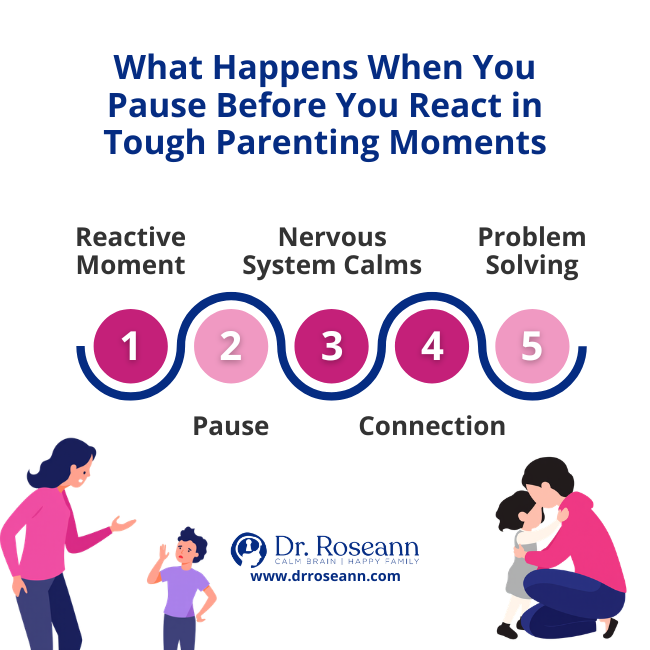
A reactive moment can escalate in seconds.
But it can also shift in seconds.
When a parent pauses, takes a breath, softens their voice, or slows their response, something powerful happens:
The nervous system begins to settle.
The child senses the change.
The conflict stops accelerating.
This is the power of The Love Pause®.
It doesn’t require perfect parenting.
It just requires one small interruption in the stress cycle.
And sometimes, that interruption is enough to transform the entire moment.
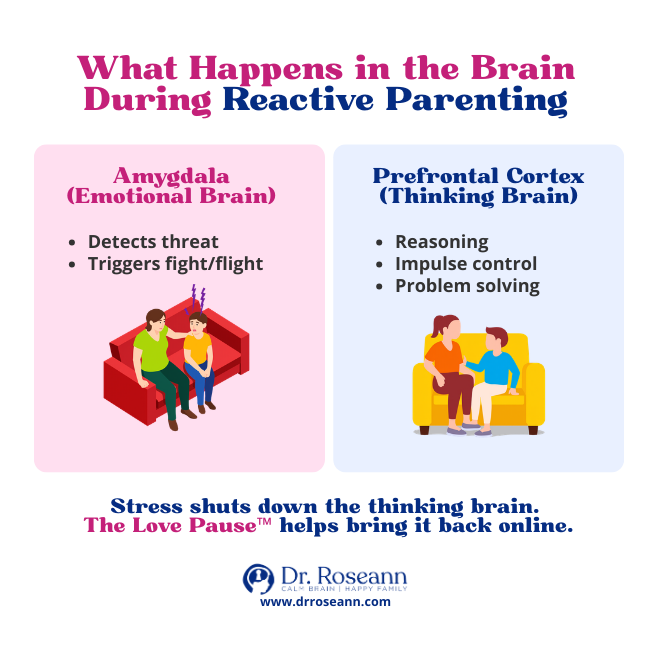
What Happens in the Brain During Reactive Parenting
Graphic type: simple brain diagram
Two brain areas highlighted:
Amygdala (emotional brain)
• detects threat
• triggers fight/flight
Prefrontal Cortex (thinking brain)
• reasoning
• impulse control
• problem solving
Add caption:
Stress shuts down the thinking brain.
The Love Pause® helps bring it back online.
The Brain Science Behind Reactive Parenting
When parenting moments escalate quickly, many people assume it’s a behavior problem.
But often what’s happening is a brain state problem.
In stressful moments, both children and parents can experience what psychologists call an amygdala hijack—when the brain’s emotional center temporarily overrides the thinking brain.
The amygdala is responsible for detecting threats and activating survival responses. When it senses danger or intense stress, it signals the body to prepare for action.
This response is helpful when facing real danger.
But it can also activate during everyday parenting situations like:
- a child screaming during a meltdown
- repeated refusal to follow directions
- sudden defiance or disrespect
- sibling conflict that escalates rapidly
When the brain enters this stress response, it becomes harder to think clearly, stay patient, or problem-solve calmly.
This happens to children.
And it happens to parents too.
What Happens in the Brain During a Reactive Moment
| Brain System | What Happens | What It Looks Like in Parenting |
|---|---|---|
| Emotional brain activates | Threat detection increases | Child meltdown or parent frustration |
| Stress hormones rise | Body prepares for action | Raised voice, urgency, tension |
| Thinking brain becomes less active | Logical reasoning decreases | Difficulty staying calm or patient |
| Emotional intensity increases | Reactions become faster | Arguments escalate quickly |
When both parent and child are in this state, communication breaks down.
Neither brain is fully able to access the calm, reflective thinking needed to resolve the moment.
This is why simply telling a child to “calm down” rarely works.
And it’s why parents sometimes react in ways they later wish they hadn’t.
Why Even a Few Seconds Can Change the Brain and Change Behavior
The brain is highly responsive to signals of safety.
When a parent pauses—even briefly—it sends a message to the nervous system that the situation may not be as threatening as it initially seemed.
Small shifts can begin to calm the brain:
- slowing the breath
- relaxing the shoulders
- softening facial expression
- lowering the tone of voice
These signals help the brain move away from survival mode and back toward regulation.
The Love Pause® creates the space for those signals to happen.
It interrupts the automatic reaction and allows the parent to access the part of the brain responsible for empathy, reflection, and thoughtful response.
Why Children Borrow Regulation from Parents
Children develop emotional regulation through co-regulation, which means they learn to calm themselves by first experiencing calm with a trusted adult.
When a parent stays regulated:
- the child’s brain receives cues of safety
- emotional intensity decreases
- problem-solving becomes possible
Over time, these repeated experiences strengthen the child’s ability to regulate their own emotions.
This is why the calmest nervous system in the room often becomes the stabilizing force for everyone else.
The Love Pause® helps parents become that stabilizing force.
The Power of a Micro-Moment
The most powerful parenting shifts don’t always come from long strategies or complex systems.
Sometimes they begin with a very small change in the moment.
A breath.
A pause.
A softer response.
Those few seconds can interrupt a reactive pattern and open the door to connection.
And cnnection is where regulation—and learning—actually begins.
What The Love Pause® Looks Like in Real Parenting Moments
The Love Pause® is simple, but that doesn’t mean it’s always easy.
Parenting moments often move fast.
A child refuses to get dressed.
A meltdown erupts at bedtime.
Homework turns into a power struggle.
Before you realize it, frustration builds and the situation escalates.
The Love Pause® is designed for exactly these moments.
Instead of reacting immediately, the parent pauses long enough to shift their own nervous system before responding to the child.
This pause may only last a few seconds.
But those seconds change the entire tone of the interaction.
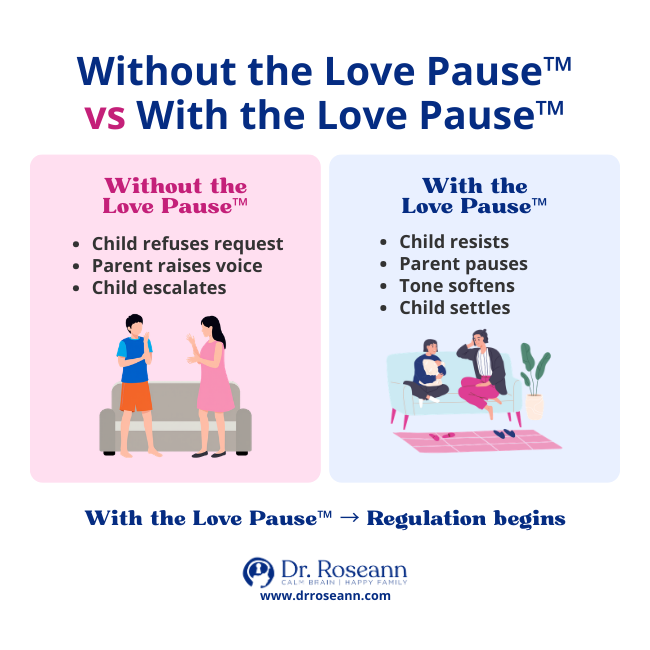
A Typical Reactive Parenting Moment
| Situation | What Often Happens |
|---|---|
| Child refuses a request | Parent repeats the demand louder |
| Child escalates emotionally | Parent becomes more frustrated |
| Parent raises voice | Child feels less safe |
| Conflict intensifies | Both become dysregulated |
This cycle happens in countless homes every day.
And most parents leave these moments feeling discouraged, thinking:
“Why does this keep happening?”
What Changes When Parents Use The Love Pause®
When a parent interrupts the moment with The Love Pause®, the entire interaction can shift.
| Situation | With The Love Pause® |
|---|---|
| Child resists a request | Parent pauses before reacting |
| Parent regulates first | Tone remains calm |
| Child senses safety | Emotional escalation slows |
| Parent responds intentionally | Problem-solving becomes possible |
Instead of escalating the conflict, the parent becomes the stabilizing force.
And when one nervous system settles, the other often begins to follow.
Read about: Generational Emotional Wealth®
Why Parents Find This Technique So Powerful
Many parents try to stay calm through willpower alone.
But willpower isn’t enough when stress rises quickly.
The Love Pause® works because it gives parents a practical way to interrupt the stress cycle before it spirals.
It helps parents:
• stop reactive parenting in the moment
• prevent yelling or escalating conflict
• create emotional safety during stressful interactions
• model calm emotional regulation for their child
Over time, these small pauses begin to change the emotional climate of the home.
Parents feel less reactive.
Children feel safer.
And difficult moments become opportunities for connection instead of conflict.
Where to Learn the More About The Love Pause® Method
The Love Pause® is one of the foundational tools in Regulation First Parenting®, the neuroscience-based approach developed by Dr. Roseann Capanna-Hodge.
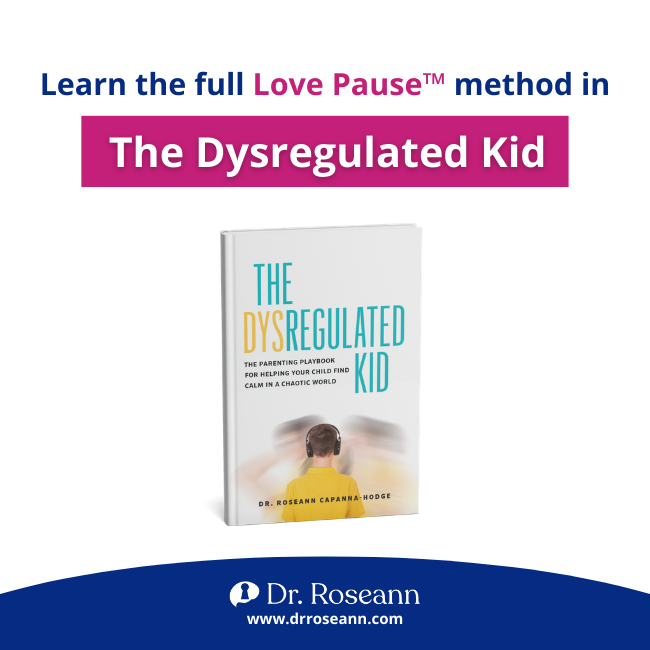
In my upcoming book,
The Dysregulated Kid: The Parenting Playbook for Helping Your Child Find Calm in a Chaotic World
I walk parents through the complete Love Pause® method, including:
- how to stop reactive parenting in the moment
- how to regulate yourself when emotions spike
- how to reconnect with your child after difficult moments
- how to prevent co-dysregulation from escalating
These small shifts can transform everyday parenting interactions and help children build the emotional regulation skills they need for life.
If you’ve ever found yourself reacting faster than you intended, you are not alone.
And you are not stuck.
The path to calmer parenting often begins with something surprisingly simple.
A pause.
A breath.
And the reminder that connection can always come first.
Frequently Asked Questions About The Love Pause®
What is The Love Pause® in parenting?
The Love Pause® is a short moment where a parent pauses before reacting to a child’s behavior so their nervous system can settle. This pause helps parents respond calmly instead of reacting from frustration or stress.
How can I stop reacting emotionally to my child?
The most effective way is to pause before responding. Taking even a few seconds to breathe and regulate your own nervous system can interrupt reactive parenting and allow you to respond more intentionally.
Why do parents react so quickly during conflicts with children?
When a child is upset or defiant, it can activate the parent’s stress response. The emotional brain becomes dominant, making reactions faster and more intense before the thinking brain has time to engage.
Does pausing actually help parenting?
Yes. Research on co-regulation shows that when parents remain calm, children’s nervous systems often begin to settle as well. A regulated parent can help stabilize a dysregulated child.
Citations:
Goldberg H. (2022). Growing Brains, Nurturing Minds-Neuroscience as an Educational Tool to Support Students' Development as Life-Long Learners. Brain sciences, 12(12), 1622. https://doi.org/10.3390/brainsci12121622
Montroy, J. J., Bowles, R. P., Skibbe, L. E., Mc Clelland, M. M., & Morrison, F. J. (2016). The development of self-regulation across early childhood. Developmental psychology, 52(11), 1744–1762. https://doi.org/10.1037/dev0000159
Paulus, F. W., Ohmann, S., Möhler, E., Plener, P., & Popow, C. (2021). Emotional Dysregulation in Children and Adolescents With Psychiatric Disorders. A Narrative Review. Frontiers in psychiatry, 12, 628252. https://doi.org/10.3389/fpsyt.2021.628252
Dr. Roseann Capanna-Hodge is a leading expert in emotional and behavioral dysregulation in children.
- Emotional Dysregulation & Nervous System Repair Podcast Everyday Wellness with Cynthia Thurlow ™
- NRBS Emotional Dysregulation with Roseann Capanna-Hodge
- The Experience Miracles (Podcast) Why Traditional Discipline Fails Dysregulated Kids (And What Actually Works)
© Roseann-Capanna-Hodge, LLC 2026
Always remember… “Calm Brain, Happy Family™”
Disclaimer: This article is not intended to give health advice and it is recommended to consult with a physician before beginning any new wellness regime. The effectiveness of diagnosis and treatment vary by patient and condition. Dr. Roseann Capanna-Hodge, LLC does not guarantee certain results.
Are you looking for SOLUTIONS for your struggling child or teen?
Dr. Roseann and her team are all about science-backed solutions, so you are in the right place!
Meet the Expert
Licensed Therapist | Certified School Psychologist
Board Certified in Neurofeedback (BCN) | 30+ Years Clinical Experience
Expert in Emotional Dysregulation in Children and Nervous System Regulation
Host, Dysregulated Kids Podcast | Author, The Dysregulated Kid
Dr. Roseann Capanna-Hodge is a licensed therapist, certified school psychologist, and leading expert in emotional dysregulation in children and nervous system regulation. With over 30 years of clinical experience and having analyzed more than 10,000 brain maps, she helps families understand what behavior is really signaling—and how to calm the nervous system first so real change can happen.
She is the creator of Regulation First Parenting® and the CALMS Protocol™, host of the top 1% podcast Dysregulated Kids, and author of The Dysregulated Kid.