

Join the Dysregulation Insider get free calm parenting tips straight to your inbox!
YES, I'M IN!Regulation First Parenting: The Secret Every Stressed Parent Needs to Hear | Regulation-First Parenting | E344





Estimated Reading Time: 6 Minutes
Parenting a dysregulated child can leave you exhausted, frustrated, and constantly second-guessing yourself. If you're dealing with meltdowns, backtalk, emotional outbursts, or daily power struggles, the missing piece may not be another parenting strategy—it may be regulation. That's why Regulation First Parenting® is the secret every stressed parent needs to hear.
Many traditional parenting approaches focus on correcting behavior before addressing what's happening in the nervous system. But when a child is dysregulated, teaching, consequences, and even connection often don't land the way we hope.
It's not bad parenting.
It's a dysregulated brain.
In this episode, I explain why Regulation First Parenting® works, how co-regulation helps children build self-regulation skills, and what you can do today to create more calm, connection, and cooperation at home.
Why does my child melt down even when I try to connect?
One of the most confusing experiences for parents is offering empathy, validation, and support only to watch their child become even more upset.
The reason is simple:
Connection without regulation often isn't enough.
When children are stuck in fight, flight, or freeze, their brains are operating in survival mode.
In that state:
- Learning decreases
- Emotional regulation weakens
- Problem-solving becomes harder
- Connection feels less accessible
- Stress responses take over
Your child may hear your words, but their nervous system isn't able to fully receive them.
What Regulation First Parenting® Teaches
Before connection can work, the nervous system needs safety.
Before correction can work, the brain needs regulation.
Before learning can happen, the stress response must settle.
That's why the sequence matters:
Parent Regulation → Co-Regulation → Connection → Correction
When parents reverse this process, frustration often grows.
When they follow it, change becomes possible.
Real-Life Example
A child comes home from school and immediately melts down over homework.
The parent tries validating feelings, offering encouragement, and reasoning.
Nothing works.
Why?
Because the child's nervous system is overloaded.
What the child needs first is regulation—not discussion.
Behavior is communication.
And every meltdown is a signal that the nervous system needs support.
What is Regulation First Parenting®?
Regulation First Parenting® is a nervous-system-first approach to behavior.
Instead of focusing immediately on consequences, discipline, or correction, it starts by helping the child feel safe enough to regulate.
Core Principles of Regulation First Parenting®
- Calm the brain first
- Connection before correction
- Co-regulation before self-regulation
- Behavior is communication
- Focus on nervous system needs before expectations
This approach recognizes that children cannot consistently access higher-level thinking when they're overwhelmed.
A dysregulated brain can't learn.
A regulated brain can.
How can I help my child regulate during difficult moments?
Children learn regulation through co-regulation.
Your nervous system becomes the model their nervous system follows.
That's why your calm matters so much.
Practical Co-Regulation Strategies
Pause Before Reacting
Take a breath before responding.
Even a few seconds can prevent escalation.
Use Your Body as a Tool
Children respond to:
- Facial expressions
- Tone of voice
- Breathing patterns
- Body posture
Your calm sends powerful safety signals.
Practice Mindfulness
Simple regulation tools can help both parent and child:
- Deep breathing
- Butterfly tapping
- Grounding exercises
- Stretching
- Rhythmic movement
Use the Traffic Light Model
One of the easiest ways to understand regulation is through traffic light zones.
Red Zone
Your child is in survival mode.
This is not the time for teaching.
Focus on safety and regulation.
Yellow Zone
Stress is beginning to decrease.
Co-regulation is helping.
Stay present and supportive.
Green Zone
The brain is calm enough to learn.
Now connection, reflection, and teaching become effective.
Real-Life Example
A child throws a toy during a meltdown.
Instead of immediately discussing consequences, the parent focuses on helping the child regulate first.
Once calm returns, the lesson becomes much more effective.
🗣️ "Parenting is full of challenges, but remember: you're not failing—you were simply never taught a nervous-system-first approach." — Dr. Roseann
Want to stay calm when your child pushes every button?
Become a Dysregulation Insider VIP and get the FREE Regulation Rescue Kit, packed with practical tools and scripts to help you navigate meltdowns, reduce oppositional behavior, and create more peace at home. Get your free kit here: www.drroseann.com/newsletter
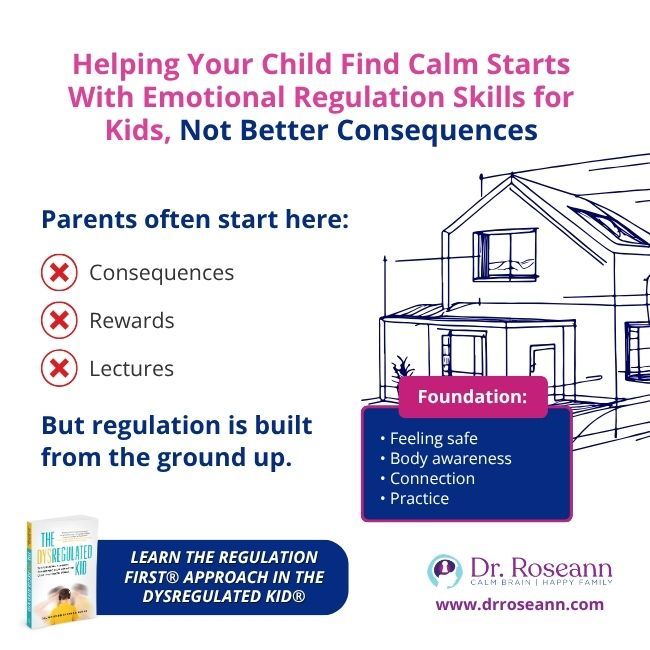
Why don't discipline systems and sticker charts change behavior?
Many parenting systems focus on rewards and consequences.
The problem is that they often ignore nervous system state.
Why Traditional Systems Often Fail
If a child feels overwhelmed:
- Rewards lose effectiveness
- Consequences increase stress
- Learning slows down
- Emotional regulation decreases
This is why parents often feel stuck.
They keep increasing consequences, but behavior doesn't improve.
What Actually Creates Lasting Change?
Lasting change happens when children:
- Feel safe
- Experience regulation
- Practice skills repeatedly
- Build emotional awareness
- Develop self-regulation over time
Consistency creates new neural pathways.
Not punishment.
Not shame.
Not fear.
Regulation first.
Does focusing on regulation mean ignoring feelings?
Absolutely not.
One of the biggest misconceptions about Regulation First Parenting® is that it minimizes emotions.
In reality, regulation makes emotions easier to process.
Regulation Creates Emotional Safety
When children feel safe:
- They can tolerate difficult feelings
- Emotional awareness increases
- Coping skills strengthen
- Resilience develops
Co-Regulation Is Non-Judgmental
You don't have to fix feelings.
You don't have to eliminate emotions.
You simply create enough safety for your child to experience them without becoming overwhelmed.
Long-Term Benefits
Children who learn regulation develop:
- Stronger coping skills
- Better emotional awareness
- Greater resilience
- Healthier relationships
- More flexible thinking
Families often notice fewer power struggles and more cooperation over time.
Why does Regulation First Parenting® change everything?
When parents focus on regulation first:
- Meltdowns become less intense
- Recovery happens faster
- Connection deepens
- Learning improves
- Confidence grows
Most importantly, children begin developing the skills they need to regulate themselves.
That's the goal.
Not perfect behavior.
Not compliance.
Real emotional regulation.
Takeaway & What’s Next
If you're exhausted from trying everything and still feeling stuck, know this:
You're not failing.
Your child isn't giving you a hard time.
They're having a hard time.
Behavior is communication.
When you stop focusing solely on behavior and start supporting the nervous system underneath it, everything changes.
That's the power of Regulation First Parenting®.
Calm the brain first.
Connection follows.
Teaching sticks.
And lasting change becomes possible.
It's gonna be OK.
When traditional parenting strategies aren’t working, changing the order can change everything. The Dysregulated Kid® shows you how to stop leading with correction and start with Regulation First Parenting® so your child’s brain is actually available for connection, learning, and change. Get the book at dysregulatedkid.com.
FAQs
What is Regulation First Parenting®?
Regulation First Parenting® is a nervous-system-first approach that prioritizes regulation before connection, correction, and teaching. It helps children feel safe enough to learn and develop self-regulation skills.
Why doesn't traditional parenting advice work for my child?
Many parenting strategies focus on behavior without addressing nervous system regulation. A dysregulated brain cannot effectively learn from rewards, consequences, or correction.
Is Regulation First Parenting® too permissive?
No. Regulation is not the absence of boundaries. It creates the conditions where boundaries, expectations, and teaching can actually be effective.
How do I regulate myself before helping my child?
Start with a pause. Take a breath, soften your body, and use simple regulation tools like grounding exercises or butterfly tapping. Your calm becomes the foundation for co-regulation.
How long does it take to see results?
Many families notice improvements in recovery time, connection, and emotional regulation before major behavioral changes occur. Consistency is key.
Every child's journey is different.
Take the free Solution Matcher Quiz and get a customized path to support your child's emotional and behavioral needs. Start here: www.drroseann.com/help
Dr. Roseann Capanna-Hodge is a licensed therapist, certified school psychologist, and leading expert in emotional dysregulation in children. With over 30 years of experience, she helps parents understand the root causes of meltdowns, anxiety, ADHD, and challenging behavior through the lens of nervous system regulation. Dr. Roseann teaches practical, science-backed strategies for co-regulation and how to calm a dysregulated child using her Regulation First Parenting® approach. She is the host of the Dysregulated Kids Podcast and author of The Dysregulated Kid.
Dr. Roseann Capanna-Hodge
Emotional Dysregulation in Children & Nervous System Expert
Regulation First Parenting® | CALMS Protocol™
Host of the Dysregulated Kids Podcast (Top 1% Globally)
Author of The Dysregulated Kid

Find this helpful? Leave us a review!
Your feedback helps more overwhelmed parents find calm, clarity, and the proven tools that make everyday life easier.
Dr. Roseann Capanna-Hodge: Helping Families of Dysregulated Kids Thrive Through Regulation First Parenting®
As the creator of Regulation First Parenting®, she’s helping families of dysregulated kids discover a compassionate, brain-based path forward. Through The Dysregulated Kids™ Podcast (top 2% globally), she offers practical strategies that help parents understand their child’s brain and support lasting change.
Through The Global Institute of Children’s Mental Health and Dr. Roseann, LLC, she’s created resources like the Neurotastic® Brain Formulas and the Regulation First Parenting® framework—meeting families where they are and supporting them through challenges like ADHD, anxiety, OCD, PANS/PANDAS, and behavioral struggles.
Recognized by Forbes as “a thought leader in children’s mental health,” Dr. Roseann is changing how we understand emotional dysregulation in children—one family at a time.