%20.png)


Estimated reading time: 12 minutes
Many parents carry a quiet fear they rarely say out loud:
"Maybe I'm just not good at this."
You try strategies from books, podcasts, and social media.
You implement reward charts.
You attempt consequences.
You promise yourself you’ll stay calm next time.
Yet the same difficult moments keep happening.
A meltdown during homework.
A refusal to cooperate at bedtime.
Arguments that spiral faster than expected.
After enough of these experiences, many parents begin to internalize a painful belief:
"Nothing works for my child."
"Other parents seem to handle this better."
"Maybe I'm failing as a parent."
But what many families don't realize is that this feeling of failure often develops from something very different:
parental burnout.
When stress accumulates for too long without relief, the nervous system becomes overloaded. In that state, parenting challenges can feel heavier, reactions happen faster, and even well-intentioned strategies may stop working.
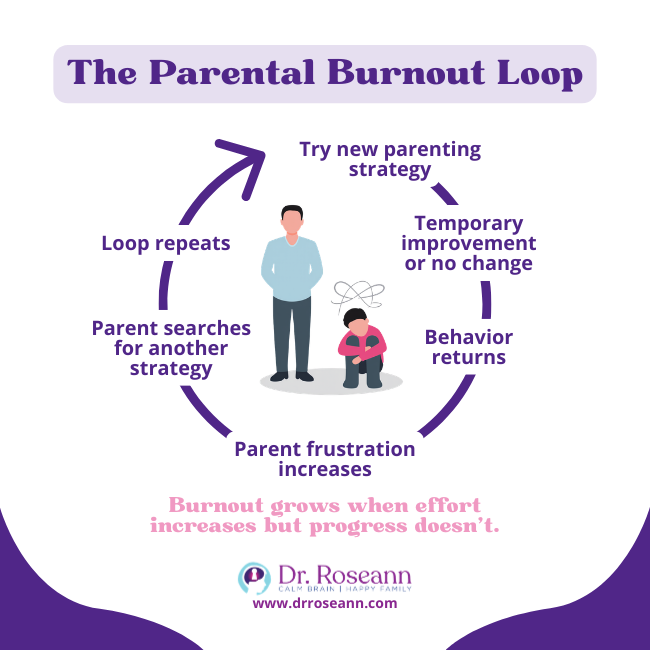
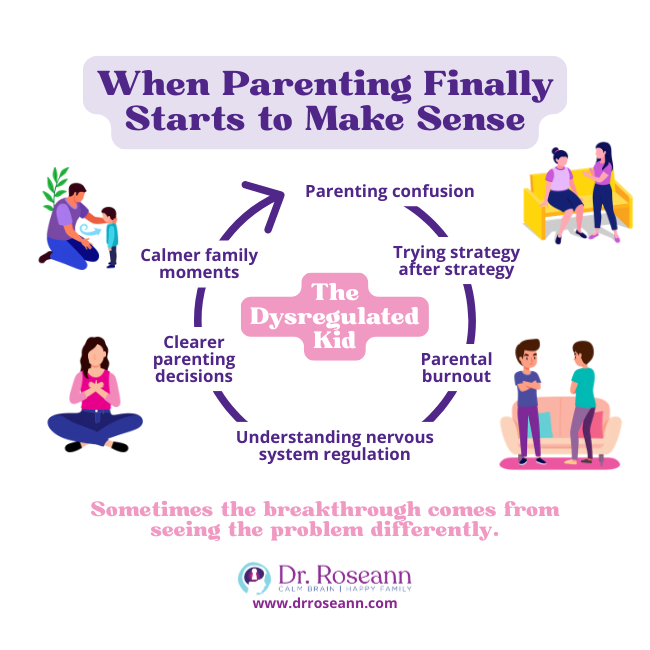
Over time, parents can find themselves stuck in what I call the Parental Burnout & Failure Loop — a cycle where exhaustion, stress, and ineffective strategies reinforce each other.
At the root of this is something I emphasize in Regulation First Parenting™: when the brain is dysregulated, behavior—and parenting—gets harder.
The good news is that this cycle can be interrupted.
And when parents understand what’s actually happening beneath the surface, the path forward often becomes much clearer.
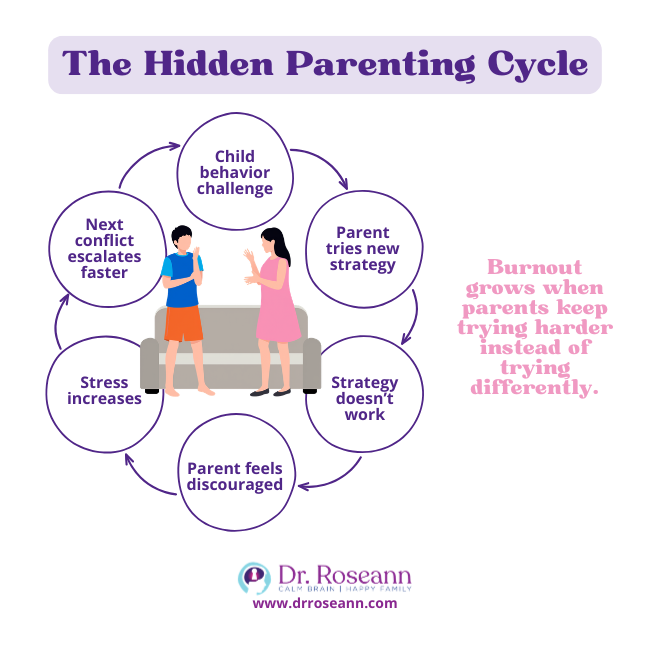
The Hidden Cycle of Parental Burnout
Parental burnout rarely happens overnight.
More often, it develops slowly as parents keep trying to solve the same challenges without seeing lasting improvement.
A difficult behavior shows up.
You try a new strategy.
It works for a short time — or sometimes not at all.
Then the behavior returns, often stronger.
Over time, this pattern can leave parents feeling stuck, exhausted, and discouraged.
What many families experience is a repeating pattern I call the Parental Burnout & Failure Loop — a cycle where stress, ineffective strategies, and self-blame reinforce each other.
The harder parents try to fix the problem, the more exhausting it becomes when nothing seems to work.
Eventually, the focus shifts from solving the challenge to questioning yourself.
Parents start wondering:
- “Why can’t I figure this out?”
- “Why does this keep happening?”
- “What am I doing wrong?”
But the truth is that many parents aren’t failing.
They are simply caught in a cycle that keeps increasing stress without addressing the underlying problem.
Read about: The Stress Cup: Why Your Child (and You) Are Melting Down and How to Build a Bigger Cup
Recognizing the cycle is the first step toward breaking it.
The Parental Burnout & Failure Loop
| Stage | What Happens | How Parents Often Feel |
|---|---|---|
| Parenting challenge appears | Child behavior escalates or repeats | Concerned and determined to fix it |
| Parent tries a new strategy | Advice from books, experts, or internet | Hopeful it will work |
| Strategy doesn’t last | Behavior returns or intensifies | Frustrated and confused |
| Parent self-blame increases | “I must be doing something wrong.” | Guilt and discouragement |
| Stress builds | Nervous system becomes more reactive | Exhausted and overwhelmed |
Over time, this loop can make parents feel like they are constantly trying harder but getting nowhere.
Quick Self-Check: Are You Experiencing Parental Burnout?
Many parents don’t recognize burnout until they pause long enough to notice the patterns.
Take a moment to check in with yourself.
You might be experiencing parental burnout if you notice:
✓ You feel emotionally drained by the end of most days
✓ Small parenting challenges trigger bigger reactions than you'd like
✓ You often think, “Nothing I try seems to work.”
✓ You replay difficult parenting moments and feel guilty afterward
✓ You feel constantly on edge or mentally exhausted
✓ You worry you are failing your child
✓ You rarely feel fully relaxed or recovered
If several of these feel familiar, you're not alone.
Many parents reach this point after carrying stress for long periods while trying to solve difficult parenting challenges without the right support or understanding.
Recognizing burnout isn't a sign of weakness.
It's often the moment when parents begin finding a more sustainable way forward.
Burnout vs Temporary Parenting Stress
| Temporary Parenting Stress | Parental Burnout |
|---|---|
| Occasional frustration | Ongoing exhaustion |
| Stress fades after rest | Stress returns quickly |
| Difficult moments feel manageable | Parenting feels overwhelming |
| Emotional recovery happens | Recovery feels slow or incomplete |
Burnout doesn’t mean a parent doesn’t care.
In fact, it often happens to parents who care deeply and have been trying very hard for a very long time.
Why So Many Parenting Strategies Stop Working
Many parents feel frustrated because they’ve tried so many strategies.
Reward charts.
Consequences.
Taking away privileges.
Calm explanations.
Stricter rules.
And sometimes these approaches help — for a while.
But when a child is emotionally overwhelmed, those strategies often stop working the way parents expect.
This happens because many parenting tools focus on changing behavior, but behavior is often the last step in a much deeper process.
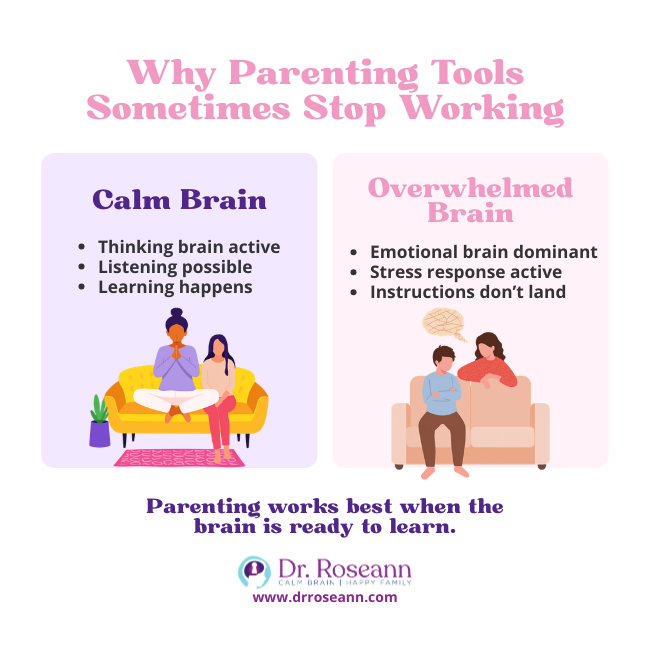
When a child’s nervous system is stressed, the brain shifts into survival mode. In that state, the emotional brain becomes more active while the thinking brain becomes less available.
That means reasoning, consequences, and even good teaching may not land in the moment.
Parents then try harder strategies, believing they just need the right technique.
But if the nervous system is still overwhelmed, the cycle continues.
This is why many families feel like they are constantly trying new parenting advice without seeing lasting change.

Why Some Parenting Strategies Lose Effectiveness
| When the Brain Is Calm | When the Brain Is Overwhelmed |
|---|---|
| Child can listen and think | Child reacts emotionally |
| Instructions make sense | Instructions feel like pressure |
| Consequences are understood | Consequences feel threatening |
| Learning can happen | Survival response takes over |
Read about: Parenting Styles and Their Effects: A Calm-Brain Guide for Overwhelmed Parents
When the brain returns to a calmer state, children are much more capable of cooperating, listening, and problem solving.
This doesn’t mean discipline has no place in parenting.
It simply means timing matters.
Helping the nervous system settle first often makes every other parenting tool far more effective.
The Emotional Weight of Feeling Like a Bad Parent
Few parenting struggles feel as heavy as the belief that you might be failing your child.
Many parents carry this fear quietly.
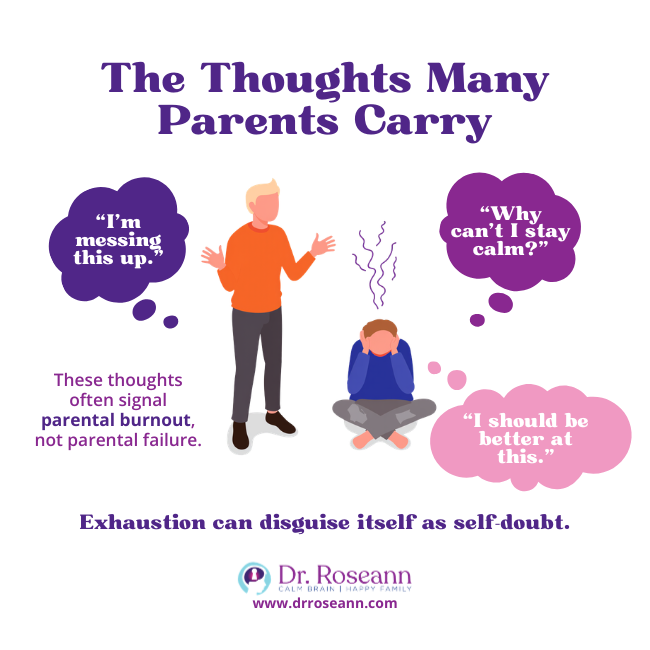
They replay difficult moments in their mind:
"I shouldn't have raised my voice."
"Why couldn't I handle that better?"
"Other parents seem to manage this more easily."
Over time, these thoughts can begin to shape how parents see themselves.
Instead of viewing parenting challenges as difficult moments, many parents begin to see them as personal shortcomings.
But the reality is very different.
Parents who feel this way are often the ones who care the most. They are the ones reading books, searching for answers, and trying new strategies because they desperately want things to improve.
The problem isn’t a lack of effort.
It’s that constant effort without relief can slowly turn into burnout.
When the nervous system has been carrying stress for too long, it becomes harder to access patience, flexibility, and emotional balance. Even loving parents may find themselves reacting in ways that surprise them.
This is one reason parental burnout can feel so confusing.
Parents know the kind of parent they want to be — but their nervous system no longer has the capacity to consistently show up that way.
Recognizing this gap is not a sign of failure.
It’s often the moment when real change becomes possible.
What Parents Often Believe vs. What Is Actually Happening
| What Parents Often Think | What Is Often Happening |
|---|---|
| “I'm a bad parent.” | The nervous system is under prolonged stress |
| “I should be able to handle this.” | Emotional load has exceeded current capacity |
| “Other parents don't struggle like this.” | Many families experience the same challenges privately |
| “Nothing I try works.” | Strategies may not match the child's regulation state |
Understanding this difference can be incredibly relieving for parents.
Because it shifts the focus away from blame and toward understanding.
What Actually Breaks the Parental Burnout Cycle
When parents feel stuck in the burnout–failure loop, the instinct is usually to search for another parenting strategy.
A different discipline approach.
A new reward system.
A stricter consequence.
But many families discover that lasting change doesn’t come from adding more techniques.
It begins when parents start looking at the problem from a different angle.
Instead of focusing only on stopping behaviors, the focus shifts to stabilizing the emotional environment first.
When the nervous system becomes calmer — both for the parent and the child — parenting tools begin working very differently.
Read about: The Love Pause™: The 3-Second Technique That Stops Reactive Parenting Before It Starts
Conversations slow down.
Escalations happen less often.
Repair becomes easier after difficult moments.
Parents also notice something surprising:
When their own stress level decreases, their child’s reactions often soften as well.
This doesn’t happen because parents become perfect.
It happens because emotional regulation changes how stress moves through the family.
Breaking the burnout cycle is less about trying harder and more about changing the starting point of the interaction.
What Changes When the Burnout Cycle Begins to Break
| Before the Shift | After the Shift |
|---|---|
| Parenting feels like constant firefighting | Parenting moments feel more manageable |
| Reactions escalate quickly | Conversations slow down |
| Parent carries most of the emotional stress | Emotional regulation becomes shared |
| Conflicts repeat frequently | Recovery after stress becomes easier |
Small shifts in how parents respond to stress can gradually reshape the emotional tone of the household.
Over time, many families notice that the same situations that once felt overwhelming become easier to navigate.

A New Path for Parents Who Feel Stuck
Many parents reach a point where they feel like they’ve tried everything.
They’ve read the books.
They’ve tested different strategies.
They’ve promised themselves they’ll stay calmer next time.
Yet the same stressful moments keep happening.
Over time, this can create the painful belief that parenting is simply something they’re failing at.
But for many families, the problem isn’t effort.
It’s that they’ve been following advice that focuses only on behavior — without understanding how stress and nervous system regulation shape those moments.
When parents finally learn how emotional regulation influences both parent and child, many describe the experience as finally having a map for parenting challenges that once felt confusing.
Instead of constantly searching for the next strategy, they begin to understand:
- why certain behaviors escalate
- why some parenting advice works for some families but not others
- how emotional regulation changes the direction of difficult moments
I wrote The Dysregulated Kid: The Parenting Playbook for Helping Your Child Find Calm in a Chaotic World for parents who feel exactly this way — exhausted from trying everything and still wondering why nothing seems to work.
Inside the book, I walk parents through the science of emotional dysregulation and how understanding the nervous system can change the way families navigate stress, conflict, and connection.
For many parents, it becomes the first time they realize that the struggles they’ve been facing were never about failure.
They simply hadn’t been given the right path yet.
Read about: Generational Emotional Wealth™: How Your Regulation Today Breaks Cycles for Tomorrow
Parenting Burnout FAQs
What should you do when you feel like you are failing as a parent?
When parents feel like they are failing, it often means they have been carrying too much stress for too long without relief.
Parenting is emotionally demanding, and when strategies don’t seem to work, it’s easy to assume the problem is personal.
But many times the real issue is that parents are trying to solve difficult moments while their own nervous system is already overwhelmed.
Recognizing that stress and burnout are influencing reactions can be the first step toward shifting how those moments unfold.
How do you recover from parental burnout?
Recovery from parental burnout usually begins with reducing nervous system overload.
This can include:
- creating small moments of recovery during the day
- reducing unrealistic expectations
- focusing on emotional regulation before problem solving
- finding support and guidance that matches your child’s needs
When parents begin stabilizing their own stress response, parenting interactions often become calmer and easier to navigate.
Why do I feel like a bad mom or dad?
Many loving parents experience this thought during difficult seasons of parenting.
Feeling like a bad parent is often a reflection of emotional exhaustion, not actual parenting failure.
Parents who care deeply about their children are often the most critical of themselves when things go wrong.
Understanding how stress affects both parent and child can help shift the focus away from blame and toward solutions that actually support the family.
Citations:
Karreman, A., van Tuijl, C., van Aken, M. A. G., & Deković, M. (2006). Parenting and self-regulation in preschoolers: A meta-analysis. Infant and Child Development, 15(6), 561-579. https://doi.org/10.1002/icd.478
Lavi, I., Ozer, E. J., Katz, L. F., & Gross, J. J. (2021). The role of parental emotion reactivity and regulation in child maltreatment and maltreatment risk: A meta-analytic review. Clinical psychology review, 90, 102099. https://doi.org/10.1016/j.cpr.2021.102099
Lin, S. C., Kehoe, C., Pozzi, E., Liontos, D., & Whittle, S. (2024). Research Review: Child emotion regulation mediates the association between family factors and internalizing symptoms in children and adolescents - a meta-analysis. Journal of child psychology and psychiatry, and allied disciplines, 65(3), 260–274. https://doi.org/10.1111/jcpp.13894
Zimmer-Gembeck, M. J., Rudolph, J., Kerin, J., & Bohadana-Brown, G. (2022). Parent emotional regulation: A meta-analytic review of its association with parenting and child adjustment. International Journal of Behavioral Development, 46(1), 63-82. https://doi.org/10.1177/01650254211051086
Dr. Roseann Capanna-Hodge is a leading expert in emotional and behavioral dysregulation in children.
- Emotional Dysregulation & Nervous System Repair Podcast Everyday Wellness with Cynthia Thurlow ™
- NRBS Emotional Dysregulation with Roseann Capanna-Hodge
- The Experience Miracles (Podcast) Why Traditional Discipline Fails Dysregulated Kids (And What Actually Works)
Always remember... “Calm Brain, Happy Family™”
Disclaimer: This article is not intended to give health advice and it is recommended to consult with a physician before beginning any new wellness regime. *The effectiveness of diagnosis and treatment vary by patient and condition. Dr. Roseann Capanna-Hodge, LLC does not guarantee certain results.
Are you looking for SOLUTIONS for your struggling child or teen?
Dr. Roseann and her team are all about science-backed solutions, so you are in the right place!
© Roseann-Capanna-Hodge, LLC 2026