%20.png)


Estimated reading time: 7 minutes
For many families, screens have quietly become one of the biggest triggers for emotional chaos at home.
A child may seem calm while watching a tablet or playing a video game.
But the moment the device turns off, everything changes.
Suddenly there are:
• meltdowns
• yelling
• arguing
• refusal to transition
• emotional shutdown
Parents often say things like:
"My child is totally fine until I turn off the iPad."
"The second screen time ends, everything explodes."
"It’s like a completely different child appears when the game stops."
If this sounds familiar, you’re not imagining it.
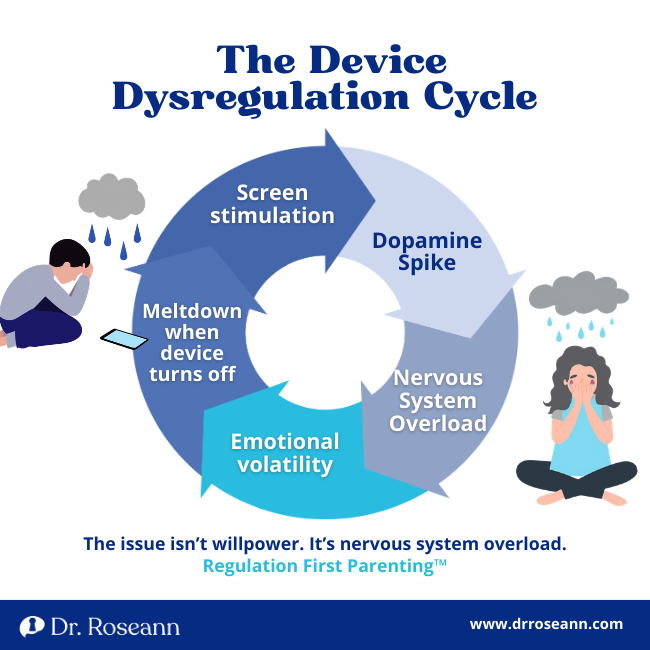
What you may be seeing is Device Dysregulation™ — a pattern where digital stimulation overwhelms a child’s nervous system and disrupts their ability to regulate emotions.
Instead of helping children relax, certain types of screen exposure can push the brain into overstimulation and stress activation.
And when the nervous system becomes overloaded, behavior changes quickly.
Understanding Device Dysregulation™ helps parents shift from blaming behavior to understanding what is happening in the brain.
When we understand the nervous system, parenting suddenly makes much more sense.
What Is Device Dysregulation™
Device Dysregulation™ happens when digital stimulation pushes a child’s nervous system beyond its ability to regulate emotions smoothly.
Children’s brains are still developing the systems responsible for:
• impulse control
• emotional regulation
• frustration tolerance
• attention management
These systems develop gradually throughout childhood and adolescence.
Digital environments, however, move much faster than those systems are ready for.
Many apps, games, and videos are designed to deliver:
• rapid visual changes
• bright colors and sound effects
• constant novelty
• reward loops
• fast-paced interaction
For a developing brain, that level of stimulation can create what I often describe as neural overload.
The nervous system becomes flooded with input and struggles to shift back into calm.
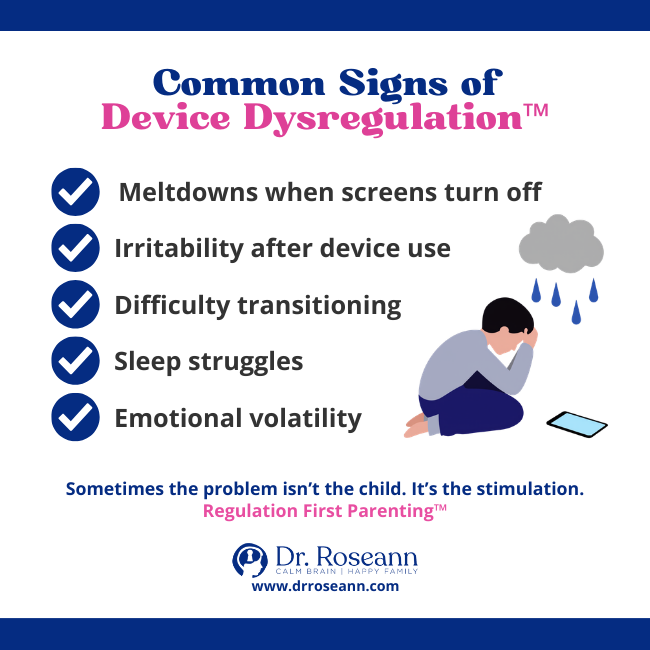
Parents may notice behaviors like:
• irritability after screen time
• emotional crashes
• sudden anger when devices turn off
• difficulty transitioning to other activities
• increased impulsivity
What looks like defiance is often a nervous system that simply cannot shift gears smoothly after intense stimulation.

Why Screens Affect the Nervous System
Screens stimulate several powerful brain systems at once.
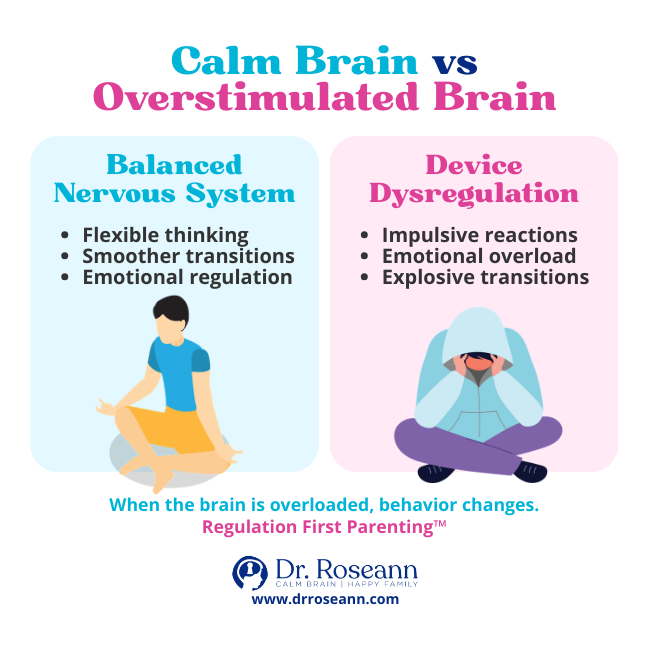
One of the most important is dopamine, the brain’s reward chemical.
Dopamine is associated with pleasure, motivation, and attention.
Many digital platforms are intentionally designed to trigger repeated dopamine bursts through:
• rewards and points
• game levels
• unpredictable outcomes
• fast-paced visuals
• constant novelty
These features keep the brain highly engaged.
But for children, this stimulation can create a cycle that looks like this:
| Screen Experience | Brain Response |
|---|---|
| fast visual stimulation | sensory activation |
| rewards and achievements | dopamine spikes |
| rapid game pacing | attention system overload |
| constant novelty | brain stays highly stimulated |
While the child may appear relaxed while watching or gaming, their brain is actually working hard to process all that stimulation.
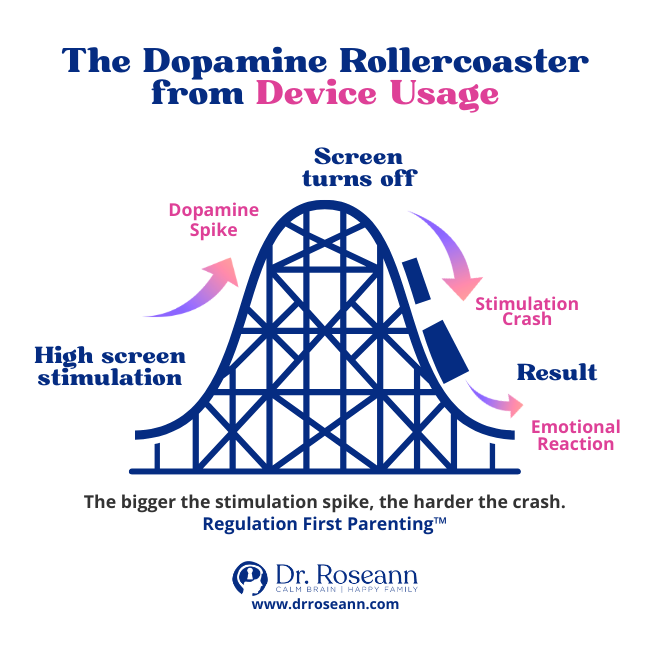
Then when the screen turns off, the nervous system suddenly loses that input.
The brain drops from high stimulation to low stimulation instantly.
For many children, this sudden shift triggers emotional distress.
That is why parents often see their child go from calm to explosive within seconds of turning off a device.
The nervous system is trying to recover.
Signs Your Child May Be Experiencing Device Dysregulation™
Not every child reacts to screens in the same way.
Some children’s nervous systems tolerate digital stimulation fairly well.
Others are much more sensitive.
Parents may start to notice patterns like these.
| After Screen Time You Notice | What May Be Happening |
|---|---|
| intense meltdowns | nervous system overload |
| irritability or mood swings | overstimulation |
| difficulty focusing afterward | attention fatigue |
| trouble settling at bedtime | brain still activated |
| resistance when devices turn off | dopamine reward cycle |
Sometimes the pattern becomes obvious only after parents begin paying attention.
For example:
A child who seemed happy during screen time suddenly becomes extremely emotional when asked to stop.
Another child may struggle to complete homework after gaming.
Some children even become more impulsive or aggressive after long stretches of digital stimulation.
These are not signs of bad parenting.
They are signals that the nervous system may be struggling to recover from overstimulation.
Why Turning Off Screens Triggers Meltdowns
One of the most frustrating parenting moments happens right after screen time ends.
A child who was calm seconds earlier suddenly becomes angry, tearful, or defiant.
Parents often ask:
"Why is turning off the device such a battle?"
The answer often lies in how the nervous system handles transitions.
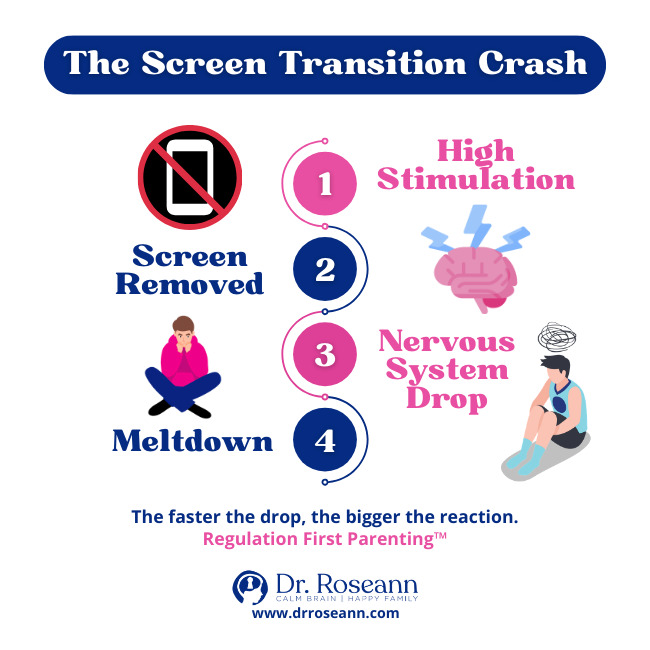
During screen time, the brain is receiving intense stimulation and reward signals.
When the device suddenly stops, the brain experiences a rapid drop in dopamine.
For adults, this drop might feel mildly frustrating.
For children with sensitive nervous systems, it can feel much more intense.
Their brain shifts quickly from excitement to stress.
The emotional brain becomes reactive.
This is why the transition away from screens often becomes the most explosive moment of the day.
The nervous system is trying to regulate again after overstimulation.
How Much Screen Time Is Too Much?
One of the most common questions parents ask is:
How much screen time is too much for kids?
There isn’t a single number that works for every child.
Some children tolerate digital stimulation better than others.
But many families begin to notice dysregulation when screen use becomes:
• long stretches without breaks
• highly stimulating games or videos
• late evening device use
• frequent switching between apps or games
What matters most is how the nervous system responds afterward.
If parents notice:
• frequent meltdowns after screens
• sleep struggles
• irritability
• difficulty transitioning
these may be signals that the brain is receiving more stimulation than it can comfortably regulate.
Paying attention to patterns is often more helpful than focusing on strict time limits.
Read more: How Much Screen Time Is Safe for Dysregulated Kids?
Practical Ways to Reduce Device Dysregulation™
Parents don’t need to eliminate screens entirely to support their child’s nervous system.
But small adjustments can make a significant difference.
Helpful strategies include:
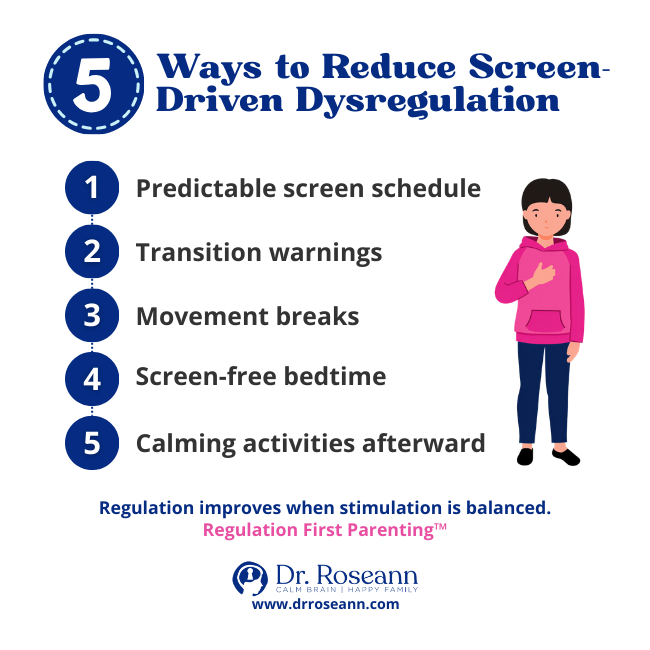
• setting predictable screen schedules
• giving 5–10 minute transition warnings
• avoiding screens close to bedtime
• adding physical movement after screen time
• creating calming routines following device use
These strategies help the nervous system shift more gradually from stimulation back to regulation.
Even small changes can dramatically reduce emotional crashes.
Understanding the Bigger Regulation Picture
Screens are only one piece of the larger regulation puzzle.
Children today are navigating more stimulation than any generation before them.
Busy schedules, academic pressure, social demands, and digital environments all place demands on the nervous system.
When stress accumulates faster than the brain can regulate, children experience dysregulation.
Meltdowns, emotional outbursts, anxiety, and irritability are often signals that the nervous system needs support.
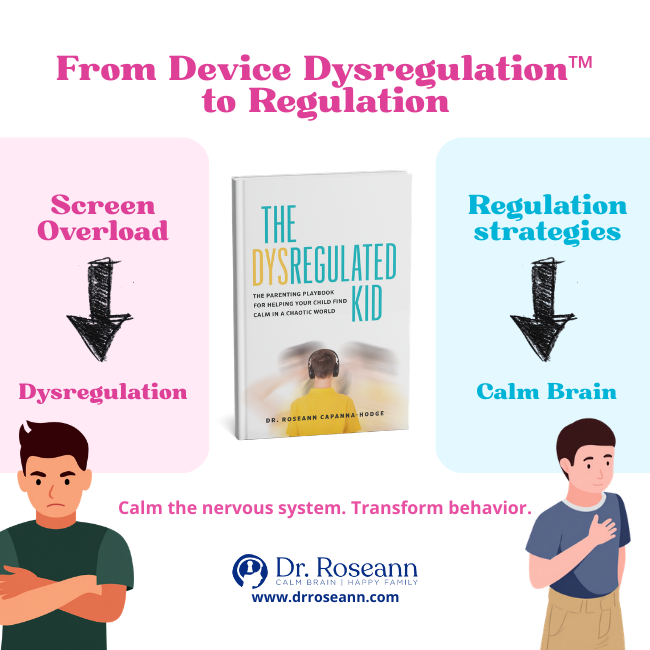
In The Dysregulated Kid, I explain how parents can understand these patterns and respond with strategies that calm the brain first.
Inside the book, families learn:
• why meltdowns happen
• how overstimulation affects the nervous system
• how to calm a dysregulated child
• how to build daily regulation habits for kids
Instead of reacting to behavior after it explodes, parents learn how to support regulation first.
This is the foundation of what I call Regulation First Parenting™—because when you calm the brain first, you create the conditions for behavior to change.
And when the brain is calm, behavior follows.
Frequently Asked Questions
Why does my child melt down when screen time is over?
A child may melt down when screen time is over because screens strongly activate the brain’s reward system. When the device suddenly stops, the brain has to shift quickly from a high-stimulation state to a calmer one, which can overwhelm a sensitive nervous system. In many cases, this reaction reflects a regulation challenge, not defiance.
Can screens dysregulate a child’s nervous system?
Yes, screens can dysregulate a child’s nervous system, especially when the content is fast-paced or used for long periods. Some children—particularly those with ADHD, anxiety, or sensory sensitivity—have a harder time returning to a calm state after intense digital stimulation. This can show up as irritability, emotional outbursts, sleep problems, or trouble focusing.
How do I know if screens are overstimulating my child?
Screens may be overstimulating your child if you notice irritability, emotional outbursts, or difficulty turning devices off after screen time. Some kids appear “wired,” anxious, or unusually reactive instead of calm after using screens. These patterns suggest the nervous system may be struggling to regulate after digital stimulation.
Can screen time make ADHD symptoms worse?
Yes, screen time can make ADHD symptoms worse for some children because digital media delivers constant stimulation and quick rewards. This type of input can make it harder for the ADHD brain to shift attention, tolerate boredom, and regulate emotions when the screen turns off. Clear limits and balanced activities help support better nervous system regulation.
Is my child addicted to screens?
Many parents worry their child is addicted to screens, but most children are responding to the powerful stimulation and rewards built into digital media. However, if screen use interferes with sleep, school, behavior, or family life, it may signal an unhealthy pattern that needs clearer limits. The goal is helping children develop healthy digital habits and a regulated nervous system.
How can I reduce screen time without constant battles?
You can reduce screen time without constant battles by creating predictable routines and giving advance warnings before devices turn off. Gradual limits, consistent rules, and engaging alternatives like movement, outdoor play, or creative activities help the brain transition more smoothly. When kids feel regulated, power struggles around screens usually decrease.
Dr. Roseann Capanna-Hodge is a leading expert in emotional and behavioral dysregulation in children.
- Emotional Dysregulation & Nervous System Repair Podcast Everyday Wellness with Cynthia Thurlow ™
- NRBS Emotional Dysregulation with Roseann Capanna-Hodge
- The Experience Miracles (Podcast) Why Traditional Discipline Fails Dysregulated Kids (And What Actually Works)
Citations:
Alen, N. V., Shields, G. S., Nemer, A., D'Souza, I. A., Ohlgart, M. J., & Hostinar, C. E. (2022). A systematic review and meta-analysis of the association between parenting and child autonomic nervous system activity. Neuroscience and biobehavioral reviews, 139, 104734. https://doi.org/10.1016/j.neubiorev.2022.104734
Gioia, F., Rega, V., & Boursier, V. (2021). Problematic Internet Use and Emotional Dysregulation Among Young People: A Literature Review. Clinical neuropsychiatry, 18(1), 41–54. https://doi.org/10.36131/cnfioritieditore20210104
Lin, S. C., Kehoe, C., Pozzi, E., Liontos, D., & Whittle, S. (2024). Research Review: Child emotion regulation mediates the association between family factors and internalizing symptoms in children and adolescents - a meta-analysis. Journal of child psychology and psychiatry, and allied disciplines, 65(3), 260–274. https://doi.org/10.1111/jcpp.13894
Moffitt, T. E., Arseneault, L., Belsky, D., Dickson, N., Hancox, R. J., Harrington, H., Houts, R., Poulton, R., Roberts, B. W., Ross, S., Sears, M. R., Thomson, W. M., & Caspi, A. (2011). A gradient of childhood self-control predicts health, wealth, and public safety. Proceedings of the National Academy of Sciences of the United States of America, 108(7), 2693–2698. https://doi.org/10.1073/pnas.1010076108
Muppalla, S. K., Vuppalapati, S., Reddy Pulliahgaru, A., & Sreenivasulu, H. (2023). Effects of Excessive Screen Time on Child Development: An Updated Review and Strategies for Management. Cureus, 15(6), e40608. https://doi.org/10.7759/cureus.40608
Always remember... “Calm Brain, Happy Family™”
Disclaimer: This article is not intended to give health advice and it is recommended to consult with a physician before beginning any new wellness regime. *The effectiveness of diagnosis and treatment vary by patient and condition. Dr. Roseann Capanna-Hodge, LLC does not guarantee certain results.
Are you looking for SOLUTIONS for your struggling child or teen?
Dr. Roseann and her team are all about science-backed solutions, so you are in the right place!
© Roseann-Capanna-Hodge, LLC 2026