%20.png)



Estimated reading time: 8 minutes
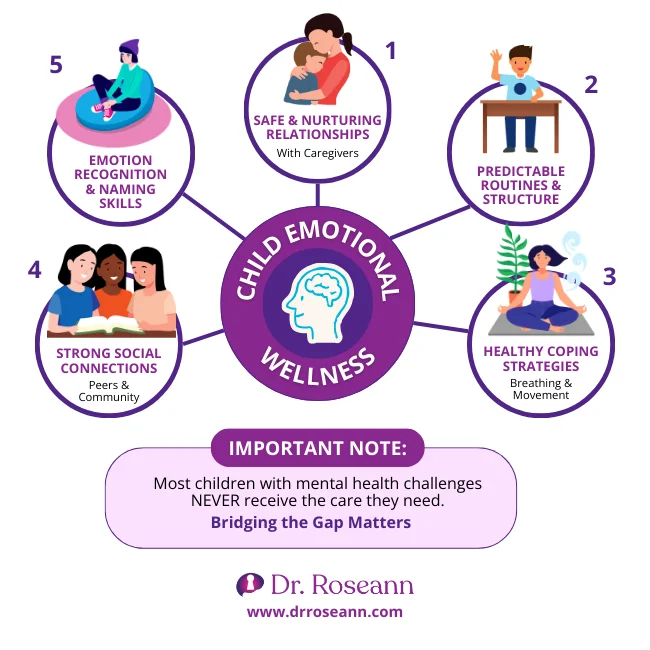
Child emotional wellness is a child's ability to recognize, express, and manage their feelings in healthy ways — and it shapes how they learn, connect, and grow.
Here's what it means in practice:
- Feeling safe and secure in relationships with caregivers
- Managing emotions like frustration, sadness, and fear without shutting down or exploding
- Bouncing back from stress and setbacks (resilience)
- Connecting with peers, family, and teachers in positive ways
- Functioning well at home, at school, and in the community
If your child is struggling with big emotions, frequent meltdowns, or behaviors that seem "too much," you're not alone — and there's a reason it's happening.
According to the World Health Organization, 8% of children and 15% of adolescents worldwide experience a mental health disorder. Yet most of them never get the support they need. And here's the part that's easy to miss: behavior is communication. When a child acts out, shuts down, or seems "difficult," their nervous system is often stuck in a stress response — not defiance.
The good news? Emotional wellness is something that can be built, strengthened, and supported — at any age, starting today.
I'm Dr. Roseann Capanna-Hodge, a children's mental health expert with over 30 years of clinical experience specializing in emotional dysregulation, anxiety, ADHD, and mood challenges — all areas at the heart of child emotional wellness. In this guide, I'll walk you through exactly what emotional wellness looks like, why it matters, and what you can do right now to help your child thrive.
Child emotional wellness terms explained:
- emotional dysregulation test child
- emotional regulation techniques
- the development of emotion regulation and dysregulation
The Foundation of Child Emotional Wellness
At the heart of child emotional wellness is what we call "relational health." This isn't just a fancy clinical term; it's the safe, stable, and nurturing relationships and environments that allow a child’s brain to move out of "survival mode" and into "growth mode." When your child feels truly seen, heard, and safe, their nervous system can regulate.
If a child doesn't have that sense of safety, we often see nervous system dysregulation. This is when the brain's "alarm system" (the limbic system) stays on high alert. Over time, this makes it nearly impossible for a child to sit still, focus, or manage their temper. Building trust with your child is the first step in calming that alarm.
Understanding Risk Factors
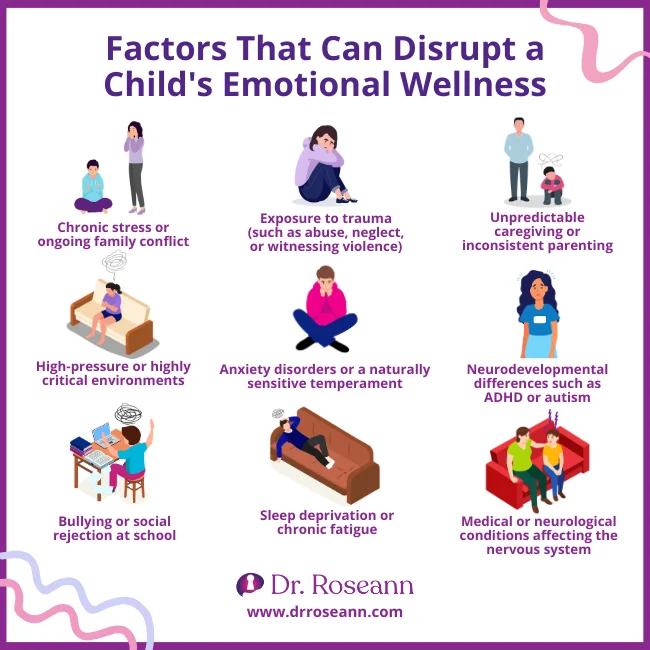
While every child is unique, certain experiences can increase the likelihood of mental health challenges. These early adverse experiences can "program" the brain for hyper-vigilance.
For example:
Supposing we have 6-year-old Liam who grew up in a home where loud arguments were common. Even when things eventually became calmer, his body still reacted as if danger was around the corner. At school, he jumped when chairs scraped the floor and often scanned the room instead of focusing on his work. His brain had learned early on to stay on high alert, making it hard for him to relax—even when he was finally safe.
Common risk factors that make children hypervigilant include:
- Exposure to violence or trauma
- Parental mental illness or substance use
- Chronic bullying or social isolation
- Poverty and housing instability
- Untreated neurodevelopmental issues like ADHD or ASD
Healthy Stress vs. Toxic Stress
Not all stress is bad! In fact, research on the “stress inoculation” effect shows that manageable amounts of stress can actually help children build resilience and coping skills, preparing them to handle future challenges more effectively (Parker et al., 2019; Shapero et al., 2015). But there is a massive difference between the stress of a math test and the stress of a dysregulated environment.
| Feature | Healthy Stress | Toxic Stress |
|---|---|---|
| Duration | Brief, infrequent | Prolonged, frequent |
| Support | Strong caregiver support | Lack of supportive relationships |
| Brain Impact | Builds resilience and coping | Can impair brain architecture |
| Body Response | Quick return to baseline | Stuck in "Fight, Flight, or Freeze" |
Recognizing Signs of a Dysregulated Nervous System
As I always say, behavior is communication. If your child is struggling, they aren't "being bad"; they are "having a hard time." We need to look at the signs and symptoms of a dysregulated nervous system in children to understand what they are trying to tell us.
Symptoms usually fall into two categories:
- Externalized Behaviors: These are the "loud" symptoms—anger, defiance, hyperactivity, and aggression.
- Internalized Symptoms: These are the "quiet" symptoms—withdrawal, excessive worry, stomachaches, or frequent crying.
Parents often ask me, "Is it anxiety?" or is it just a phase? If these behaviors last for weeks and interfere with daily life, it’s time for a comprehensive evaluation. Getting the right diagnosis is the first step toward the right solution.
Promoting Child Emotional Wellness Through Routines
The brain loves predictability. When a child knows what is coming next, their nervous system can relax. This is why the importance of family routines cannot be overstated.
To support child emotional wellness, focus on these three pillars:
- Sleep Hygiene: A tired brain is a dysregulated brain. Consistent bedtimes are non-negotiable for emotional health.
- Healthy Nutrition: Blood sugar crashes look a lot like temper tantrums. Focus on protein and healthy fats to keep the brain fueled.
- Predictable Schedules: Use visual timers or charts so your child knows the transition from play to homework is coming.
While routines provide the structure, co-regulation techniques provide the connection. Co-regulation means using your calm to help settle their storm. You are the thermostat, not the thermometer! By staying regulated yourself, you teach them the self-regulation skills they need for life.
Actionable Strategies to Foster Resilience
Fostering child emotional wellness requires moving from "control" to "coaching." Emotion coaching involves four simple steps: acknowledge the feeling, name it, validate it, and then meet the need. For example, "I see you're frustrated because that Lego tower fell. It's okay to feel mad. Let's take a breath and try again."
Building a toolkit of coping skills activities for kids gives them something to do when the "big feelings" hit. We want to give them "brain hacks" that actually shift their physiology.
Natural Support and Professional Guidance
Sometimes, the brain needs a little extra help to find its balance. We often discuss 7 supplements for anxiety, such as magnesium or inositol, which can help calm a "revved up" nervous system naturally.
It is also vital to stay on top of screening recommendations for anxiety and depression. Early intervention is game-changing. At our center, we provide specialized solutions for ADHD and neurodevelopmental health that look beyond the surface behavior to address the root of the dysregulation. If you're looking for more targeted help, explore our emotionally dysregulated child services.
Teaching Self-Regulation and Child Emotional Wellness
Self-regulation is a muscle that needs exercise. One of the best ways to train this muscle is through play. Play allows children to explore complex emotions and problem-solve in a safe, low-stakes environment (Tuncdemir, 2025).
A 2022 experimental study on cooperative play programs found that play significantly improves emotional stability, prosocial behavior, and problem-solving strategies among children, providing empirical evidence that play supports emotional and social development (Garaigordobil, 2022).
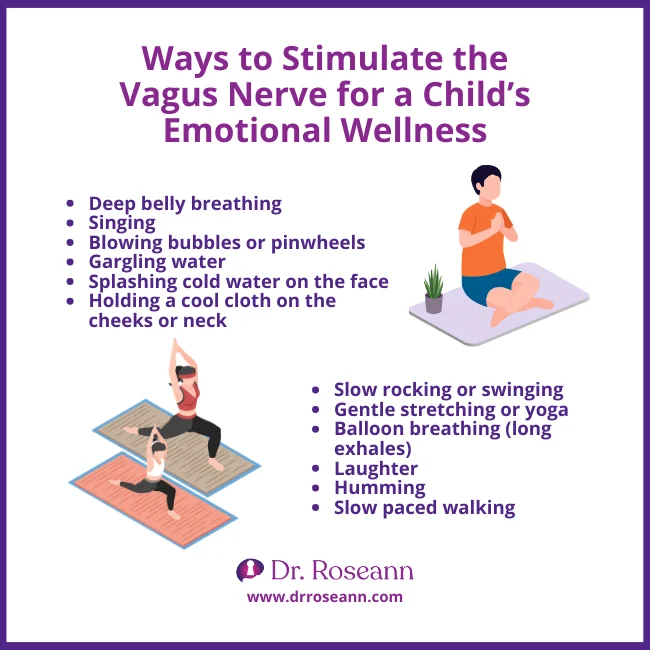
To boost child emotional wellness, try these science-backed techniques:
- Mindfulness and "Box" Breathing: Breathe in for 4, hold for 4, out for 4. This simple rhythm tells the brain the "danger" is over.
- Vagus Nerve Stimulation: The vagus nerve is the "off switch" for stress. Simple vagus nerve exercises for kids, like humming or cold water splashes, can stop a meltdown in its tracks.
- Creative Expression: Drawing, journaling, or even "angry dancing" helps move the energy of an emotion out of the body.
For a deeper dive into these methods, our emotional dysregulation help guide offers step-by-step instructions on how to help children manage emotions effectively.
Dr. Roseann’s Therapist Tip
In my 30+ years of clinical practice, I've learned that children process their biggest feelings through play long before they have the words to explain them.
What I tell parents:
When kids are building, pretending, drawing, or even acting out little stories with toys, they’re actually working through emotions and learning how to solve problems in a safe way. Don’t rush to correct or direct the play—stay nearby, stay curious, and let the process unfold.
Try this today:
Set aside 10–15 minutes of uninterrupted playtime. Let your child lead while you simply observe, join their story, or gently narrate what you see (“It looks like that character is really frustrated”).
Why it works:
Play activates the brain’s emotional and problem-solving centers while keeping the nervous system regulated, allowing kids to explore big feelings without the pressure of getting it “right.”
Remember:
When you protect time for play, you’re not just entertaining your child—you’re helping their brain practice regulation, resilience, and joy.
Frequently Asked Questions
What are the first signs that my child is struggling emotionally?
Early indicators often include changes in sleep or appetite, increased irritability, physical complaints like stomachaches, or withdrawing from friends. Behavior is communication—if your child is acting out, their brain may be stuck in a stress response. Don't wait for a "crisis" to start supporting their child emotional wellness.
How can I help my child calm down during a meltdown?
Let’s calm the brain first. Use co-regulation by staying calm yourself, lowering your voice, and offering a "calm-down space" or deep breathing exercises. Avoid lecturing in the heat of the moment; the "thinking brain" is offline during a meltdown. Wait until the nervous system is regulated to talk about what happened.
When should I seek professional help for my child's mental health?
If symptoms last more than a few weeks, interfere with school or family life, or involve self-harm, it’s time to consult a professional. Early intervention is key to helping your child build the skills they need to thrive. You can learn more about finding the right fit in our guide to child therapy.
How do I know if it's ADHD or just emotional dysregulation?
It's often both! ADHD is fundamentally a disorder of self-regulation. While focus is the most talked-about symptom, many kids with ADHD struggle with "emotional impulsivity." A proper evaluation can help distinguish between anxiety and ADHD so you can target the right brain pathways.
Can diet really affect my child's mood?
Absolutely. The gut-brain connection is powerful. High-sugar diets and processed foods can lead to inflammation and blood sugar instability, which triggers the stress response. Shifting to an anti-inflammatory diet can be a foundational part of supporting child emotional wellness.
Citations
Garaigordobil, M. (2022). Developing children's creativity and social-emotional competencies through cooperative-creative play programs. Frontiers in Psychology, 13, 959002. https://doi.org/10.3389/fpsyg.2022.959002
Ginsburg, K. R. (2019). The importance of play in promoting healthy child development and maintaining strong parent-child bonds. Pediatrics, 142(3), e20182058. https://doi.org/10.1542/peds.2018-2058
Shapero, B. G., Hamilton, J. L., Stange, J. P., Liu, R. T., Abramson, L. Y., & Alloy, L. B. (2015). Moderate childhood stress buffers against depressive response to proximal stressors: A multi-wave prospective study of early adolescents. Journal of Abnormal Child Psychology, 43(8), 1403–1413. https://doi.org/10.1007/s10802-015-0021-z
Tuncdemir, T. B. A. (2025). Integrating social-emotional learning through play in early childhood education. Early Child Development and Care. https://doi.org/10.1080/02568543.2025.2567504
Always remember… “Calm Brain, Happy Family™”
Disclaimer: This article is not intended to give health advice and it is recommended to consult with a physician before beginning any new wellness regime. *The effectiveness of diagnosis and treatment vary by patient and condition. Dr. Roseann Capanna-Hodge, LLC does not guarantee certain results.
Are you looking for SOLUTIONS for your struggling child or teen?
Dr. Roseann and her team are all about science-backed solutions, so you are in the right place!