


Estimated reading time: 8 minutes
Building a support network means identifying the people already in your life, expanding your circle through trusted community connections, and creating simple, reliable ways to give and receive support.
When you have emotional support, practical help, and guidance from others, it reduces stress, strengthens resilience, and makes it easier to stay regulated—even on the hardest days.
When I first met a mom whose child’s meltdowns left her feeling isolated and defeated, I realized building building support network is more than a nice idea, it’s the lifeline families need.
New research shows that children with strong social support systems are far more resilient, even in the face of emotional dysregulation, ADHD, anxiety, or ASD.
In this blog, you’ll discover:
- how to create a nurturing
- practical support network—from trusted mentors to community connections, that empowers you and soothes your child’s brain.
What does “support network” actually mean?
Think of your support network as a circle of people who have your back, understand your needs, listen without judgment, and offer encouragement when the going gets tough, and who, through their steady presence, actually help buffer stress, boost your emotional resilience, and strengthen your family’s well-being.
- Family members or close friends who can help with daily routines or emotional check‑ins
- Parent peer groups or parent-to-parent matching programs (e.g., National Alliance on Mental Illness, Parent Support Network) offering empathy and understanding.
- Educators or therapists trained in emotional dysregulation strategies
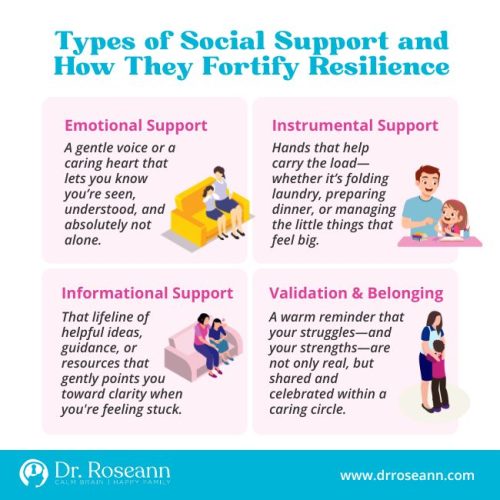
Who should be in your family’s support network?
Your network is a blend of practical helpers and emotional anchors.
- Trusted adults: grandparents, neighbors who “get it,” or your child’s favorite coach or teacher
- Peer parents: someone walking a similar path with a dysregulated child. We have our community “Natural Parenting Solutions”, where you’ll feel seen and heard by parents going through the same situations as you.
- Mental health professionals or advocates: for guidance and early intervention
Parent Peer Specialists and Peer-Led Support Groups
These aren’t just well-intentioned listeners—they bring lived experience and training to the table.
- Parent peer specialists are trained individuals who have walked a similar path and guide families with empathy, real-world strategies, and recovery-informed support. They “assist their peers in articulating goals for recovery…and model effective coping techniques”
- Peer-led support groups—These groups allow you to connect with others who’ve been there. These groups offer understanding, shared wisdom, and a sense you're not going it alone
How Do You Find and Connect with Supportive People?
Start small and reach out where parents already gather.
- Our Natural Parenting Solutions Facebook Community: This safe, supportive group is designed just for parents of dysregulated kids. It’s a space where you can share wins, struggles, and real-world strategies and know that you’re seen and understood. As I said, it’s “a safe space where you don’t have to worry about explaining yourself every time”
Why the Natural Parenting Solutions Facebook Group Works
- Real-time empathy and encouragement from parents on similar journeys—no pressure, just shared understanding.
- Direct access to science-backed guidance from Dr. Roseann and her team of clinical professionals.
- Built-in accountability and belonging, which helps keep you motivated and emotionally steady

When is the “right time” to build your support network?
There’s no perfect moment—it’s most effective as early as possible.
- At diagnosis or first signs of dysregulation, emotional struggles, or behavior challenges
- During transitions: starting school, changes at home, or stressful life events
Parent scenario:
Carlos noticed his daughter’s anxiety rising as school started—and reached out to a mom friend whose child had overcome similar challenges. That connection became a steady anchor.
Where can you find support if in‑person options are limited?
Geography or schedules aren’t barriers in today’s connected world.
- Online support groups and forums—accessible 24/7 for sharing and encouragement
- Virtual workshops or webinars from institutions or mental‑health advocates
- Tele‑therapy or sliding‑scale clinics via universities or community centers

Brain Science Spotlight
Recent research from resilience experts like Suniya Luthar emphasizes that resilience isn’t just inside a child—it grows through relationships. When the brain feels seen and safe by a trusted caregiver, stress hormones decrease and emotional regulation improves.
What this means for your family:
- Prioritize building relationships—not just coping skills
- A heartfelt message or shared laughter can calm the dysregulated brain
Dr. Roseann’s Therapist Tip
In my 30+ years of clinical practice, I’ve learned that connection heals.
Here’s what I tell parents:
"When the overwhelm hits, reach out—even if just for five minutes."
Try this today:
Text or call one trusted person—share a small concern or ask how they are.
Why it works:
It activates your “village,” shifting you from isolation to support.
Remember: Behavior is communication—and you’re not alone.
You now understand that building a support network is your family’s foundation for resilience and emotional regulation.
- Recognize who belongs in your circle
- Reach out where parents gather—online or off
- Keep connections active with small, consistent efforts
You’re building more than a network—you’re nurturing calm brains, happier days, and a family that’s gonna be OK.
FAQs
What if my child rejects adult helpers?
Choose someone your child trusts—like a coach, counselor, or neighbor—and normalize checking in with them when needed.
I’m exhausted—how can I even find time to build a support network?
Building a support network doesn’t have to be big—start small with one weekly check-in or an online group you can access anytime.
Does a support network replace therapy for emotional regulation?
A support network doesn’t replace therapy—it supports emotional regulation in everyday life and helps reinforce what’s learned in sessions.
How do I find a support network for my family?
Finding a support network starts with looking at what’s already around you—friends, school staff, community groups, or even online spaces where parents share similar experiences.
What should a strong family support network actually include?
A strong family support network includes people who offer emotional support, practical help, and consistency—those are key for building resilience and emotional regulation.
Can extended family be part of a support network if they don’t fully understand my child?
Extended family can still be part of a support network—just set clear expectations and guide them on how to support your child’s emotional regulation.
How does a support network help build resilience in kids?
A support network helps build resilience by giving kids multiple safe, supportive relationships where they can practice emotional regulation and feel understood.
What if I don’t have friends or family nearby to support us?
You can still build a support network without nearby family—online communities, parent groups, and school connections can offer real emotional support.
How do I know if my current support system is actually helping my child’s emotional regulation?
A helpful support system supports emotional regulation by reducing stress, increasing predictability, and helping your child feel safe—not overwhelmed.
How do I ask for help without feeling like a burden?
Asking for help is part of building a support network—it models healthy emotional regulation and shows your child that support is something we all need.
Citations
Pallini, S., Chirumbolo, A., Morelli, M., Baiocco, R., Laghi, F., & Eisenberg, N. (2018). The relation of attachment security status to effortful self‑regulation: A meta‑analysis. Psychological Bulletin, 144(5), 501–531. https://doi.org/10.1037/bul0000134
Cooke, J. E., Kochendorfer, L. B., Stuart‑Parrigon, K. L., Koehn, A. J., & Kerns, K. A. (2019). Parent‑child attachment and children’s experience and regulation of emotion: A meta‑analytic review. Emotion, 19(6), 1103–1126. https://doi.org/10.1037/emo0000504
Brumariu, L. E., & Kerns, K. A. (2015). Parent‑child attachment and emotion regulation: Unpacking two constructs. New Directions for Child and Adolescent Development, 2015(148), 31–45. https://doi.org/10.1002/cad.20098
Luthar, S. S. (2021). Resilience rests fundamentally on relationships [As cited in Time]. Emphasizes that resilience in children hinges on strong caregiving and social connections
Dr. Roseann Capanna-Hodge is a licensed mental health expert that is frequently cited in the media:
- Today How to keep your kids physically and mentally afloated
- Little Sleepies How to Practice Mindfulness with Your Kids
- Well + Good The Best Lego Sets for Adults To Unleash Creativity and Practice Mindfulness
Manage Anxiety, reclaim joy and restore peace in your home
©Roseann Capanna-Hodge
For parents who want a deeper understanding of why dysregulation happens—and what actually helps—Dr. Roseann explores these strategies in The Dysregulated Kid.
Always remember… “Calm Brain, Happy Family™”
Disclaimer: This article is not intended to give health advice and it is recommended to consult with a physician before beginning any new wellness regime. The effectiveness of diagnosis and treatment vary by patient and condition. Dr. Roseann Capanna-Hodge, LLC does not guarantee certain results.
Are you looking for SOLUTIONS for your struggling child or teen?
Dr. Roseann and her team are all about science-backed solutions, so you are in the right place!
Meet the Expert
Licensed Therapist | Certified School Psychologist
Board Certified in Neurofeedback (BCN) | 30+ Years Clinical Experience
Expert in Emotional Dysregulation in Children and Nervous System Regulation
Host, Dysregulated Kids Podcast | Author, The Dysregulated Kid
Dr. Roseann Capanna-Hodge is a licensed therapist, certified school psychologist, and leading expert in emotional dysregulation in children and nervous system regulation. With over 30 years of clinical experience and having analyzed more than 10,000 brain maps, she helps families understand what behavior is really signaling—and how to calm the nervous system first so real change can happen.
She is the creator of Regulation First Parenting® and the CALMS Protocol™, host of the top 1% podcast Dysregulated Kids, and author of The Dysregulated Kid.

Want more Regulation First Parenting® guidance from Dr. Roseann? Add us as a preferred source on Google.