
Join the Dysregulation Insider get free calm parenting tips straight to your inbox!
YES, I'M IN!The Stress Cup Parents Can’t See: Why Kids Suddenly Melt Down | Emotional Dysregulation | E403





Why kids suddenly melt down isn’t about the moment—it’s about stress building all day. Learn how emotional dysregulation in children really works and how to calm a dysregulated child before the explosion.
If you’ve ever wondered why kids suddenly melt down over something small, you’re not alone. It can feel confusing, frustrating, even alarming—but what you’re seeing isn’t misbehavior. It’s a nervous system that has simply run out of room.
Let’s shift how you see those big reactions. Because once you understand what’s really happening inside your child’s brain, everything changes—and you’ll know exactly how to respond in a way that actually works.
Why this matters more than you think
You’re doing your best—staying patient, setting limits, trying to “teach the lesson.” But when your child explodes over the wrong snack or a tiny request, it can leave you questioning everything.
Here’s the truth: meltdowns in children don’t come out of nowhere. They’re the result of stress building quietly over time.
When we focus only on behavior, we miss the real issue—the overwhelmed nervous system—so let’s calm the brain first and bring clarity back to what’s really going on.
Why do kids suddenly melt down over small things?
It’s one of the most common parenting questions—and one of the most misunderstood.
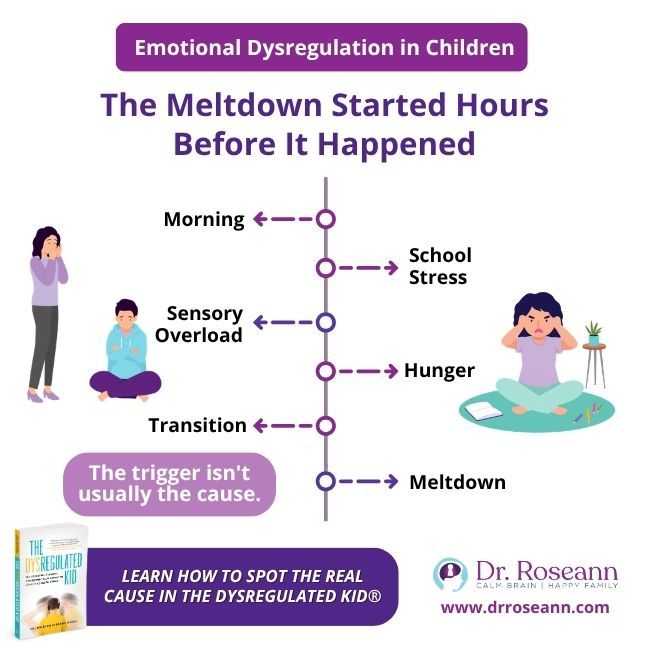
When you see a meltdown over something small, that moment isn’t the cause. It’s the last drop in an already full “stress cup.”
Every demand, emotion, sensory input, or frustration adds to that cup throughout the day. And eventually? It overflows.
Key takeaways:
- Meltdowns are the overflow, not the starting point
- Small triggers aren’t the real problem—they just reveal overload
- Your child’s brain has reached its limit, not lost control on purpose
Real-life example:
Your child holds it together all day at school. Then you ask them to start homework—and they lose it. It’s not about homework. It’s that their stress cup was already full before they even walked in the door.
What causes emotional dysregulation in children?
At the core of emotional dysregulation in children is one simple truth: their nervous system is overwhelmed.
A part of the brain called the amygdala acts like a threat detector. When it senses stress, it activates a survival response—fight, flight, or freeze.
At the same time, the thinking brain (prefrontal cortex) goes offline.
That’s why your child:
- can’t “just calm down”
- can’t think logically
- can’t follow directions in that moment
Key takeaways:
- This isn’t defiance—it’s dysregulation
- The brain shifts into survival mode under stress
- Skills disappear when the nervous system is overwhelmed
Real-life example:
Your child can solve math problems easily—but melts down when asked to change clothes. That’s not inconsistency. That’s a nervous system reacting to stress (often sensory-related).
Why does it seem like my child was “fine a minute ago”?
This is where parents feel the most confused.
Your child looks fine—but inside, stress has been quietly building all day.
Many kids are “holding it together” in structured environments like school. Then they come home and release everything.
This is often called after-school restraint collapse.
Key takeaways:
- Kids can suppress stress temporarily—but not indefinitely
- Home is where they feel safe to release
- The meltdown is a release, not a surprise
Real-life example:
A child behaves perfectly at school but explodes at home. Parents think, “Why only with me?” The answer: because you’re their safe place.
VISUAL: “After-School Stress Cup”
- School demands → + stress
- Social pressure → + stress
- Sensory overload → + stress
- Holding it together → + stress
- Home → overflow
How do I calm a dysregulated child in the moment?
When your child is melting down, logic won’t work. Consequences won’t work. Even rewards won’t work.
Because you can’t teach or correct a brain that’s in survival mode.
This is where nervous system regulation in children becomes the priority.
Key takeaways:
- Calm the brain first—everything else follows
- Connection before correction
- Your calm is the catalyst
What to do instead:
- Lower your voice and energy
- Stay physically close (if tolerated)
- Use simple, reassuring language
- Give space if needed, without abandonment
Real-life example:
Instead of saying, “Stop yelling right now,” try:
“I see this is really hard. I’m right here. Let’s get through it together.”
That’s co-regulation—and it’s powerful.
When your child is dysregulated, it’s easy to feel helpless.
The Regulation Rescue Kit gives you the scripts and strategies you need to stay grounded and in control.
Become a Dysregulation Insider VIP at www.drroseann.com/newsletter and get your free kit today.
What can I do to prevent meltdowns in children before they happen?
Prevention starts by looking at what’s filling your child’s stress cup—not just what spills it. This is the shift that changes everything.
Instead of asking, “Why are they acting like this?”
Ask: “What has been filling their cup today?”
Key takeaways:
- Look for patterns, not one-off behaviors
- Reduce hidden stressors where possible
- Build your child’s capacity to handle stress
What helps empty the stress cup:
- Movement breaks
- Quiet time or downtime
- Predictable routines
- Emotional connection
Real-life example:
A child melts down every night during homework. The solution isn’t stricter rules—it’s recognizing they’re already depleted and need regulation first.
How does parent emotional regulation impact meltdowns?
This is the piece many parents don’t realize—but it’s everything.
Your child is constantly “borrowing” your nervous system.
If you’re escalated, their brain reads that as danger. If you’re calm, their brain feels safer.
Key takeaways:
- Parent emotional regulation is the foundation
- You don’t have to be perfect—just aware
- Your calm helps their brain reset
Real-life example:
You feel yourself getting frustrated during a meltdown. Instead of reacting, you pause, take a breath, and soften your voice. That moment alone can shift the entire interaction.
“Meltdowns rarely come out of nowhere—they come from a nervous system that has run out of room.” — Dr. Roseann
Bringing it all together
If your child has big reactions, it doesn’t mean you’re doing something wrong. It means their nervous system needs support.
This isn’t bad behavior. It’s emotional dysregulation in children—and once you see it through that lens, everything changes.
You stop focusing only on the explosion. You start noticing the buildup. And that’s where real change happens.
Remember:
- Behavior is communication
- Your child isn’t giving you a hard time—they’re having a hard time
- Calm the brain first
If you want to take the next step, explore tools and resources like The Dysregulated Kid and The Regulated Child Summit that help you understand your child’s unique stress patterns and how to support them in real time.
That meltdown over the “wrong” cup probably isn’t about the cup. Your child’s invisible stress load may have been building all day. The Dysregulated Kid® helps you recognize when that stress cup is filling and intervene before one tiny trigger becomes a huge reaction. Get the book at dysregulatedkid.com.
FAQs
How do I help my child regulate emotions?
Start with co-regulation. Stay calm, connect, and help their nervous system settle before teaching or correcting.
Is my child being defiant or dysregulated?
Most of the time, it’s dysregulation. If your child can’t access skills in the moment, their brain is overwhelmed—not choosing to misbehave.
Why do meltdowns happen at home more?
Home is a safe space. Kids release built-up stress where they feel secure, even if it looks like worse behavior.
Tired of not knowing what’s really going on with your child?
The Solution Matcher gives you a personalized recommendation based on your child’s behavior, not just a label.
It’s free, takes just a few minutes, and shows you the best next step.
Go to www.drroseann.com/help
Dr. Roseann Capanna-Hodge is a licensed therapist, certified school psychologist, and leading expert in emotional dysregulation in children. With over 30 years of experience, she helps parents understand the root causes of meltdowns, anxiety, ADHD, and challenging behavior through the lens of nervous system regulation. Dr. Roseann teaches practical, science-backed strategies for co-regulation and how to calm a dysregulated child using her Regulation First Parenting® approach. She is the host of the Dysregulated Kids Podcast and author of The Dysregulated Kid.
Dr. Roseann Capanna-Hodge
Emotional Dysregulation in Children & Nervous System Expert
Regulation First Parenting® | CALMS Protocol™
Host of the Dysregulated Kids Podcast (Top 1% Globally)
Author of The Dysregulated Kid

Find this helpful? Leave us a review!
Your feedback helps more overwhelmed parents find calm, clarity, and the proven tools that make everyday life easier.
Dr. Roseann Capanna-Hodge: Helping Families of Dysregulated Kids Thrive Through Regulation First Parenting®
As the creator of Regulation First Parenting®, she’s helping families of dysregulated kids discover a compassionate, brain-based path forward. Through The Dysregulated Kids™ Podcast (top 2% globally), she offers practical strategies that help parents understand their child’s brain and support lasting change.
Through The Global Institute of Children’s Mental Health and Dr. Roseann, LLC, she’s created resources like the Neurotastic® Brain Formulas and the Regulation First Parenting® framework—meeting families where they are and supporting them through challenges like ADHD, anxiety, OCD, PANS/PANDAS, and behavioral struggles.
Recognized by Forbes as “a thought leader in children’s mental health,” Dr. Roseann is changing how we understand emotional dysregulation in children—one family at a time.