

Join the Dysregulation Insider get free calm parenting tips straight to your inbox!
YES, I'M IN!The Hidden Sensory Triggers Behind Your Child’s Big Reactions, Meltdowns, and Irritability | Emotional Dysregulation in Children | E392





Discover how hidden sensory triggers behind your child’s big reactions, meltdowns and irritability can quietly overwhelm their nervous system, turning everyday moments into chaos. Dr. Roseann Capanna-Hodge, expert in Regulation First Parenting® and childhood emotional dysregulation, guides parents to calm the brain first and restore balance.
Parenting a child who melts down over what feels like “nothing” can be exhausting and confusing. These aren’t random behaviors—they’re your child’s nervous system signaling stress. Understanding sensory processing is the key to prevention, regulation, and lasting calm.
In this episode, I explain how hidden sensory triggers build stress in your child’s nervous system, why some kids overreact while others seek more input, and practical ways to prevent meltdowns before they happen.
Why does my child melt down over small sensory triggers?
Many parents wonder why seemingly minor things—scratchy tags, bright lights, or hallway noise—spark big reactions. These are sensory processing challenges. Some children over-register sensory input, making everything feel overwhelming. Others under-register, seeking constant movement or stimulation.
Tips:
- Observe patterns—when are meltdowns more likely? After school? During transitions?
- Identify environmental triggers like fluorescent lights, loud noises, or new clothing.
Real-Life Example: Max refuses anything with tags. Switching to tagless, soft fabrics and consistent clothing reduced morning battles.
A meltdown isn’t about defiance; it’s a nervous system on overload.
How can sensory overload affect emotional regulation?
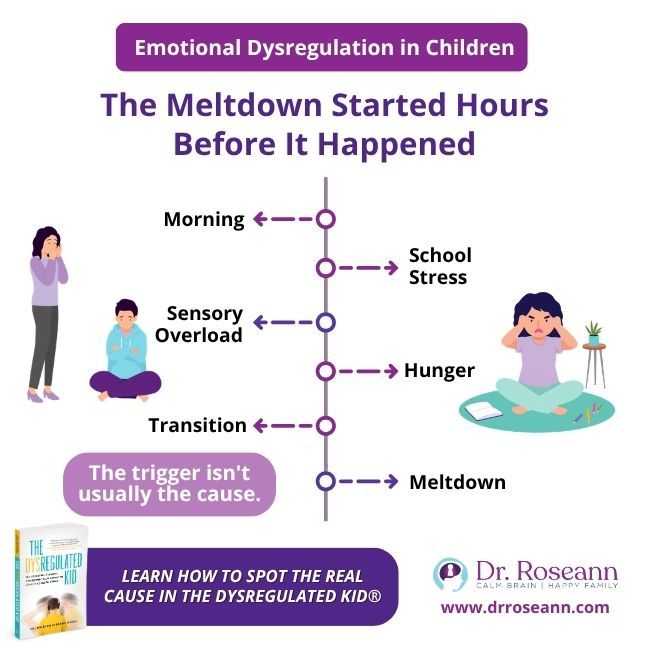
When your child’s nervous system is overloaded, stress hormones rise, prefrontal cortex activity drops, and emotional regulation becomes nearly impossible. This leads to meltdowns, irritability, and anxiety-like behaviors.
Chronic sensory stress can even impact mental health, increasing risk for mood swings, ADHD, or anxiety disorders.
Tips:
- Create decompression routines: quiet space, deep pressure like weighted blankets, or slow movement breaks.
- Track sensory input over the day: noise, light, touch, hunger, and transitions add up in a “stress cup.”
Parent scenario: After a busy school day, a child snaps at homework. The trigger isn’t homework—it’s cumulative sensory overload from the day.
You don’t have to figure this out alone.
Become a Dysregulation Insider VIP and get your FREE Regulation Rescue Kit:
How to Stay Calm When Your Child Pushes Your Buttons and Stop Oppositional Behaviors.
Head to www.drroseann.com/newsletter and start your calm parenting journey today.
What are practical strategies to manage sensory processing issues?
You don’t have to figure this out alone. Regulation comes first.
Before addressing behavior, calm the nervous system: dim lights, slow your pace, and offer predictable routines.
A sensory diet—planned sensory input like movement breaks or vestibular input—can prevent overload.
Tips:
- Use deep pressure, calm PEMF, or slow rocking to support self-regulation.
- Collaborate with an occupational therapist for home sensory strategies.
- Focus on sensory preferences—some kids love peppermint scents, others need quiet spaces.
🗣️ “It’s not bad parenting—it’s a dysregulated brain. When we calm the brain first, behavior starts to make sense.” — Dr. Roseann
Why do sensory challenges sometimes look like ADHD or autism?
Many children, especially those on the autism spectrum disorder or with sensory processing disorder, have mixed profiles, swinging between over- and under-stimulation.
Recognizing these patterns helps differentiate sensory triggers from behavior issues and guides appropriate support.
Tips:
- Observe physical symptoms: covering ears, crashing into furniture, fidgeting—to tailor coping strategies.
- Plan sensory buffers: quiet time, physical compression, or deep breathing exercises.
How do I reduce sensory triggers at home and school?
- Simplify clothing choices; stick to soft, consistent fabrics.
- Dim bright lights or reduce fluorescent exposure.
- Limit loud sounds and provide quiet spaces.
- Implement predictable routines and movement breaks.
- Use tools like Quick CALM for nervous system regulation at home or on the go.
Takeaway & What’s Next
Understanding your child’s sensory profile, tracking patterns, and implementing sensory supports and routines helps prevent overload, promote self-regulation, and make everyday moments calmer and more manageable.
Learn to decode your child’s nervous system and transform meltdowns into calm, connected moments with The Dysregulated Kid.
Join us at the Regulated Child Summit to discover practical tools for emotional regulation and sensory support.
When a scratchy shirt, loud noise, or seemingly small sensory trigger leads to a huge reaction, the behavior isn’t the whole story. In The Dysregulated Kid®, I show you how to recognize what’s overloading your child’s nervous system and what to do to help them find calm. Get the book at dysregulatedkid.com.
FAQs
What is sensory processing in children?
It’s how the brain receives, filters, and responds to sensory information like sound, touch, or light. Dysregulation occurs when the system is over- or under-responsive.
Why does my child overreact to small sensations?
Overly sensitive children feel more sensory input, leading to emotional distress and childhood meltdowns.
What’s a sensory diet?
A plan of structured sensory activities tailored to your child’s sensory profile, helping prevent sensory overload and meltdowns.
When should I seek professional help?
If your child struggles with daily function, irritability, or school participation, consult an occupational therapist or pediatric mental health specialist.
Feel like you’ve tried everything and still don’t have answers?
The Solution Matcher helps you find the best starting point based on your child’s symptoms, behaviors, and history.
It’s fast, free, and based on decades of clinical expertise.
Get your personalized plan now at www.drroseann.com/help
Dr. Roseann Capanna-Hodge is a licensed therapist, certified school psychologist, and leading expert in emotional dysregulation in children. With over 30 years of experience, she helps parents understand the root causes of meltdowns, anxiety, ADHD, and challenging behavior through the lens of nervous system regulation. Dr. Roseann teaches practical, science-backed strategies for co-regulation and how to calm a dysregulated child using her Regulation First Parenting® approach. She is the host of the Dysregulated Kids Podcast and author of The Dysregulated Kid.
Dr. Roseann Capanna-Hodge
Emotional Dysregulation in Children & Nervous System Expert
Regulation First Parenting® | CALMS Protocol™
Host of the Dysregulated Kids Podcast (Top 1% Globally)
Author of The Dysregulated Kid

Find this helpful? Leave us a review!
Your feedback helps more overwhelmed parents find calm, clarity, and the proven tools that make everyday life easier.
Dr. Roseann Capanna-Hodge: Helping Families of Dysregulated Kids Thrive Through Regulation First Parenting®
As the creator of Regulation First Parenting®, she’s helping families of dysregulated kids discover a compassionate, brain-based path forward. Through The Dysregulated Kids™ Podcast (top 2% globally), she offers practical strategies that help parents understand their child’s brain and support lasting change.
Through The Global Institute of Children’s Mental Health and Dr. Roseann, LLC, she’s created resources like the Neurotastic® Brain Formulas and the Regulation First Parenting® framework—meeting families where they are and supporting them through challenges like ADHD, anxiety, OCD, PANS/PANDAS, and behavioral struggles.
Recognized by Forbes as “a thought leader in children’s mental health,” Dr. Roseann is changing how we understand emotional dysregulation in children—one family at a time.