





Estimated reading time: 7 minutes
Setting boundaries with a dysregulated child isn’t about being strict—it’s about creating safety in a way their nervous system can actually handle. The most effective way to set boundaries in relationships with dysregulated kids is to calm first, then guide, keep limits simple and predictable, and follow through with warmth, not force.
When your child is dysregulated, the world feels chaotic and overwhelming. What they need most is a sense of safety—and clear, consistent boundaries provide that. Not as punishment, but as steady, reassuring guidance that says, “I’ve got you.”
Here’s what you’ll learn:
- How to identify and apply boundaries that supports emotional regulation
- Real‑world examples and science‑backed tools
- Practical steps for both parent and child growth
When your child knows what to expect from you, their nervous system can finally start to settle.
What does “setting boundaries in relationships” really mean?
Think of boundaries like invisible safety fences—they’re not about controlling your child, but creating clear edges that help everyone feel secure and understood.
Here’s what that looks like:
- Tell them simply what you expect: “We speak kindly here,” rather than vague rules that leave kids guessing.
- Respect their feelings, but guide their actions: You might say, “I see you’re upset,” then hold firm on a limit like no hitting or yelling.
- Give choices within structure: “You can do homework now or after snack”—this gives them control within clear guidelines.
When your child doesn’t know where the lines are—what’s allowed and what’s not—they feel unsafe. That can lead to meltdowns, testing limits, or big emotional reactions.
Boundaries offer clarity: your child knows the rules, feels heard, and slowly learns self-control.
And because they know your limits are firm but caring, they feel safe enough to trust you—even when you say no.
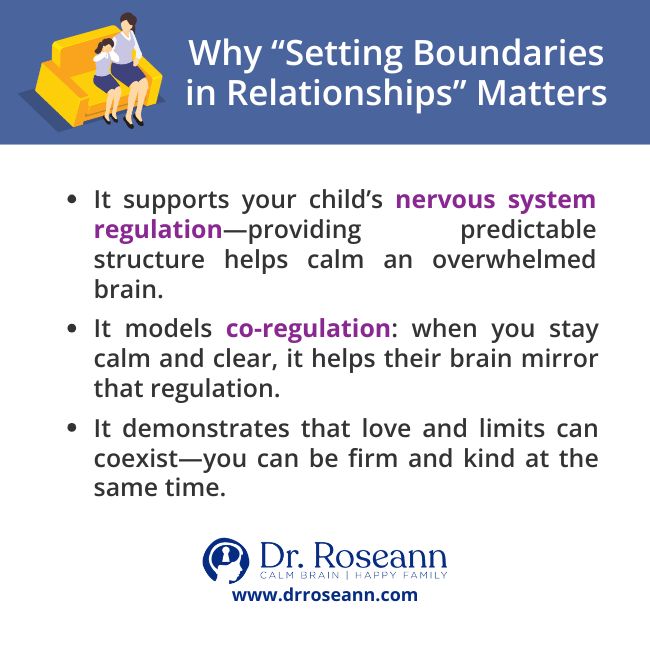
Why are boundaries so important for emotionally dysregulated kids?
Think of boundaries as an external version of the prefrontal cortex, the brain’s control center because young or dysregulated kids often don’t have full access to that part yet.
🔹 Provide predictability and safety
When your home routines and limits stay the same day after day, kids know what to expect. That feeling of safety helps reduce anxiety and meltdowns because a dysregulated brain feels safe in a consistent environment.
🔹 Build emotional intelligence, empathy & self-discipline
By setting clear expectations, kids learn to notice their feelings and others’ feelings too. Over time, they begin to manage frustration, take others into account, and make better choices, even when they’re upset.
🔹 Model regulation through consistency
When you stay calm and stick to your limits—even on tough days—you’re showing your child how to regulate their own brain. That co-regulation process helps them internalize self-control over time.
Some examples:
- Predictability & safety: A bedtime routine (brush teeth, read a book at the same time) signals "this is safe, your brain can relax."
- Emotional intelligence: You say, “You look frustrated. Let’s pause and breathe,” teaching them to recognize and manage emotions.
- Modeling regulation: When your child is upset and you're calm but firm such as repeating "I know it's hard, but the answer is still no", they observe how to stay regulated.
How do I introduce boundaries without triggering conflict?
It’s all about starting with warmth and clarity, then staying consistent.
- Begin with empathy, then state limits
Acknowledge how your child feels before setting the boundary.
For example: “I understand you’re frustrated. Screens turn off at 8pm.”
This helps them feel heard and safe while knowing what to expect. - Offer a “creative yes” instead of a flat no
Give them an acceptable alternative that feels open rather than restrictive.
Example: “You can read a book or draw instead of using the tablet.”
That turns a refusal into a helpful option and teaches flexibility.
- Explain your “why” simply and kindly
Children respond better when they know the reason behind the rule.
Say something like: “We stop screens so your brain can relax before bed.”
Simple explanations help with cooperation instead of resistance.
- Use calm, steady tone every time
Your presence matters as much as your words.
A gentle but clear voice helps your child feel secure, not controlled, no matter how small the rule seems.
- Set clear, predictable routines
When rules and routines are the same every day, kids know where they stand.
That lowers anxiety and fewer emotional outbursts happen because the brain can anticipate what comes next.
- Stay consistent even when tired or busy
Following through even on hard days lets your child know the boundary is real.
That builds trust over time and shows your words have meaning. - Optionally use natural or logical consequences when needed gently
If a boundary is crossed, follow through calmly with a related outcome.
For example: “If you continue shouting, we’ll take a break from TV time.”
This helps kids learn cause and effect safely
When you set clear expectations with warmth and consistency, your child will be less likely to be emotionally dysregulated—and less aggressive, too. But when you're too harsh or rigid, it can make things worse (Rademacher et al., 2025)
What this shows us is simple: kids need boundaries, but they need them delivered with love. That's what helps their nervous system feel safe and start to regulate.

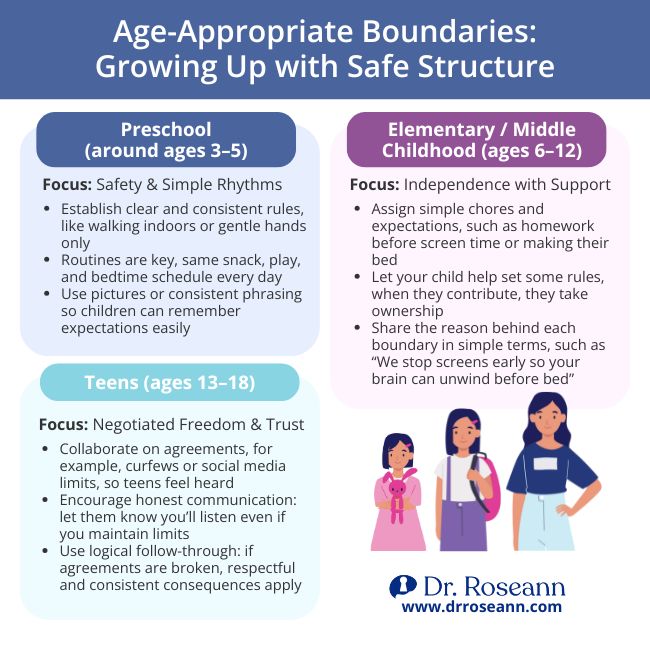
When should boundaries evolve as children grow?
As kids mature, expectations should flex.
- Preschool: limits around safety and simple routines.
- Middle childhood: extend autonomy (e.g. chore responsibilities with structured expectations).
- Teens: negotiate social limits; trust earned through consistent follow-through.
What are common challenges parents face and how to navigate them?
Parents setting boundaries often run into a few familiar hurdles: guilt around limits, inconsistency, and resistance from others. Here’s a deeper dive into each one with practical ways to move forward.
Challenge Why it matters What to do today Guilt over saying "no" Worrying about emotional fallout may dilute your limits Empathize first, then set a firm but caring boundary Inconsistent enforcement Kids get confused when rules change, leading to more dysregulation Keep limits steady; model rules yourself when possible Conflict from other caregivers Mixed messages across environments can destabilize regulation Coordinate routines and rules with caregivers and schools Finding warmth within structure Too soft breeds chaos; too hard breeds disconnection Validate emotions first, then guide behavior with simple structure
How can children learn to set their own boundaries?
Self-advocacy and respect start with modeling, then practicing skills in safe, daily moments. Research shows children develop both emotional intelligence and personal agency at the same time
1. Build empathy and emotional awareness
Guide your child to think about other people’s feelings. Ask questions like: “How do you think your friend felt when you grabbed their toy?” This helps them see that their actions affect others and that their own feelings are valid too
2. Teach simple, clear boundary phrases
Help your child learn short statements like:
- “Please stop”
- “I don’t like that”
- “I need more space”
These empower them to speak up with confidence.
3. Model respectful boundary-setting
Children learn what they see. When you calmly say,
“I’m feeling overwhelmed, so I’m taking a break,” you practice emotional regulation and give them a template to follow for asserting their own needs respectfully
4. Practice real-world problem-solving
Use challenging moments (like a sibling conflict or peer push) to walk them through options:
- Take a break to regroup
- Use a calm-down strategy (drawing, breathing)
- Decide together what they might say next time
This helps build their personal boundary toolkit over time
5. Recognize and praise boundary use in context
When your child notices someone else’s need or says a boundary phrase, celebrate it:
“You did a great job asking your friend to slow down. That shows respect.”
These moments reinforce self-awareness and respectful interaction as natural, positive behaviors
6. Use story-based or scenario practice
Role-playing, storytelling, or structured activities help children internalize boundary language and responses:
- Play out a scenario where one friend touches another’s things without asking
- Ask your child, “What would you say or do?”
These activities gradually build confidence and emotional maturity.
Setting boundaries in relationships with dysregulated kids isn’t about restriction—it’s about offering safety, predictability, and emotional support. Boundaries help calm the brain first, which opens the door to learning, love, and connection.
You’re laying the foundation for regulation, resilience, and emotional intelligence. It’s gonna be OK and it can be transformative.
Parent Action steps:
- Acknowledge your child’s feelings and then clearly state the boundary with warmth and consistency.
- Offer a “creative yes” by suggesting an acceptable alternative instead of an outright “no.”
- Model respectful boundary‑setting in your own relationships so your child learns by watching.
- Praise and reinforce any time your child respects their own or another’s boundary.
- Use calm, firm follow‑through when limits are crossed so your child knows rules are meaningful.
- Fill out our FREE 3-minute Solution Matcher™ survey to get matched to a solution tailored for your child’s needs
FAQs
What if my child rebels against every limit I set?
When your child rebels against every limit, start small and stay consistent. Co-regulate first—validate feelings, then calmly hold the boundary so your child feels both safe and guided.
Can setting boundaries harm my relationship with my child?
Setting boundaries won’t harm your relationship when boundaries are paired with warmth. When you address the behavior—not your child—and stay connected, you actually build more trust.
How do I handle boundary violations by relatives or other adults?
Handling boundary violations by others starts with clear communication and calm follow-through. When you hold firm boundaries with relatives, you’re modeling respect and safety for your child.
When should I ease boundaries with my dysregulated child?
You can ease boundaries when your dysregulated child shows more emotional control and responsibility. Keep expectations clear while gradually offering more independence.
How do I set boundaries with a dysregulated child without triggering a meltdown?
Setting boundaries without triggering a meltdown starts with calming the nervous system first. When you co-regulate and stay steady, your child is more likely to accept the boundary without escalating.
What are examples of healthy boundaries for dysregulated kids at home?
Healthy boundaries for dysregulated kids at home include consistent routines, clear screen time limits, and expectations around respectful behavior. Predictable boundaries help your child feel safe and more regulated.
What are appropriate consequences when a dysregulated child breaks a boundary?
Appropriate consequences for a dysregulated child should be calm, predictable, and connected to the behavior—not reactive or harsh. When consequences are consistent and paired with regulation, your child learns without feeling unsafe.
How do I stay calm when enforcing boundaries with my dysregulated child?
Staying calm when enforcing boundaries starts with regulating your own nervous system first. When you pause, breathe, and ground yourself, you model the calm your child’s brain is still learning to access.
Citations:
Rademacher, A., Zumbach, J. & Koglin, U. (2025). Parenting style and child aggressive behavior from preschool to elementary school: the mediating effect of emotion dysregulation. Early Childhood Educ J (53):63–72. https://doi.org/10.1007/s10643-023-01560-1.
©Roseann Capanna-Hodge
When a child's nervous system is overwhelmed, the best interventions start with co-regulation. This principle is central to The Dysregulated Kid.
Related reading: set supportive boundaries with a dysregulated child.
Always remember… “Calm Brain, Happy Family™”
Disclaimer: This article is not intended to give health advice and it is recommended to consult with a physician before beginning any new wellness regime. The effectiveness of diagnosis and treatment vary by patient and condition. Dr. Roseann Capanna-Hodge, LLC does not guarantee certain results.
Are you looking for SOLUTIONS for your struggling child or teen?
Dr. Roseann and her team are all about science-backed solutions, so you are in the right place!
Meet the Expert
Licensed Therapist | Certified School Psychologist
Board Certified in Neurofeedback (BCN) | 30+ Years Clinical Experience
Expert in Emotional Dysregulation in Children and Nervous System Regulation
Host, Dysregulated Kids Podcast | Author, The Dysregulated Kid
Dr. Roseann Capanna-Hodge is a licensed therapist, certified school psychologist, and leading expert in emotional dysregulation in children and nervous system regulation. With over 30 years of clinical experience and having analyzed more than 10,000 brain maps, she helps families understand what behavior is really signaling—and how to calm the nervous system first so real change can happen.
She is the creator of Regulation First Parenting® and the CALMS Protocol™, host of the top 1% podcast Dysregulated Kids, and author of The Dysregulated Kid.

Want more Regulation First Parenting® guidance from Dr. Roseann? Add us as a preferred source on Google.