%20.png)


Contents

As parents, we often juggle many roles. If your child is struggling with missed school activities, late homework, and unfinished tasks, you might need to add another hat to your collection: teaching your kids executive functioning or EF skills.You, as a parent, have the power to teach new habits and equip your child with the right tools to improve task initiation, manage time and improve executive functions. With the right amount of patience, consistency, and perseverance, you can help your child develop strong self-regulation skills, enhance their executive functions, and set them up for success.https://www.youtube.com/watch?v=43pHVz3w9Sg
What is Executive Function Coaching?
Executive functioning coaching is an approach that helps individuals strengthen their capacity to get things done. An executive function coach can ensure a personalized and effective approach to their development.A typical coaching session involves active participation where individuals practice various tools and techniques in real-time, such as breathing exercises and task prioritization, while also collaborating with parents to develop actionable plans for achieving goals. It focuses on empowering individuals to improve essential skills through consistent practice, such as setting deadlines, organizing assignments, and using timers. This collaborative approach aims to improve a person’s executive functions and capacity to achieve successful outcomes in both work and life.Executive function coaching can also help people who are facing challenges like ADHD (attention deficit hyperactivity disorder) and in some cases, OCD (obsessive compulsive disorder)
Executive Functioning is a Teachable Skill
It's never too late to learn to improve executive functions. Whether you have a 2-year old or 20-year old child, you can learn how to enhance executive function.Executive functioning is a teachable skill that plays a crucial role in our ability to manage tasks and set goals. However, executive function challenges can significantly impact individuals on their journey to success—whether in school, at work, or in life. These basic skills, which include planning, organization, time management, and self-regulation, are not innate for everyone but can be developed with guidance and practice.As a parent, you can play a vital role in teaching and improving executive function skills and functioning skills to your child, and you really don’t need to have a master’s degree to do it. Your patience, love, and commitment to improving your child’s well-being are keys to better executive function skills. Think about how you manage your daily tasks—creating to-do lists, using a planner, or breaking tasks into smaller steps. By modeling these behaviors, you show your child practical ways to stay organized and on track.If you are ready step up and finally understand your kid’s lack of executive skills and teach them new behaviors that will set them up for success, you can get my expert tips and strategies with my Executive Functioning Parent Toolkit, click here to learn more.
Six Essential Areas to Develop Your Child's Executive Functioning Skills
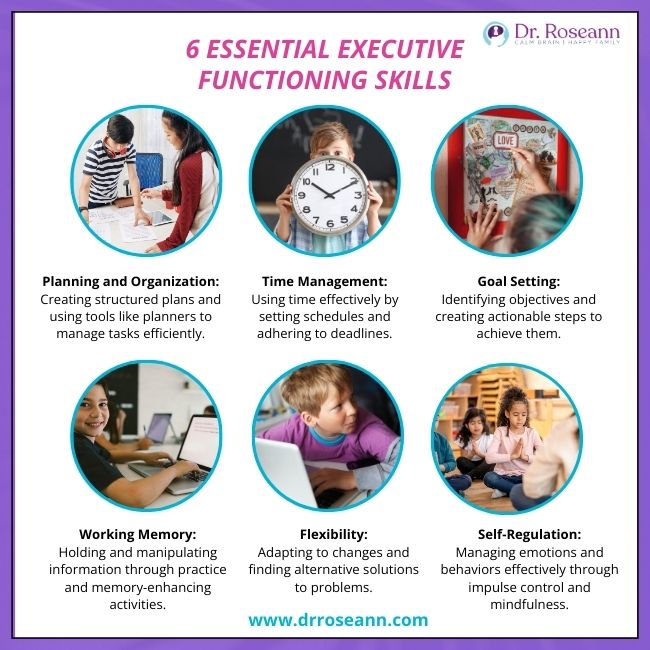
Executive function skills involve focusing on key areas that help them manage their tasks, time, and behavior effectively. Executive function coaches play a crucial role in helping individuals develop these skills by focusing on self-management and personal development. And as a parent, you can teach your kids how to improve their executive functions.
Essential Executive Functions To Teach a Child
1. Planning and Organization
Teaching how to plan and stay organized is the foundation of teaching executive functions. These skills help them manage their tasks efficiently and reduce stress. Executive function support is crucial in helping individuals manage their tasks efficiently.Here’s how you can guide them:
Breaking Down Tasks:
Show them how to divide large tasks into smaller, manageable steps. For example, if your child has a big science project due in two weeks, help them break it down into smaller to-do's:
- Day 1-2: Research the topic and gather information.
- Day 3-4: Create an outline of the project.
- Day 5-6: Write the introduction and first section.
- Day 7-8: Write the second section and conclusion.
- Day 9-10: Create visuals like charts or models.
- Day 11-12: Review and revise the content.
- Day 13: Practice presenting the project.
- Day 14: Finalize and assemble the project.
Explain that by tackling one small step at a time, the project becomes less overwhelming and more manageable. This approach not only helps them stay organized but also ensures steady progress without last-minute stress.
Use Organizational Tools:
Teach them to use planners, calendars, and to-do lists to keep track of assignments and deadlines. Creating a to-do list can help your child manage their tasks efficiently.Here’s how to guide them:
1. List All Tasks: Start by writing down everything they need to accomplish. This can include homework, chores, and any extracurricular activities.
Example: "Math homework, Science project research, Soccer practice, Clean room."
2. Prioritize Tasks: Learning how to prioritize is an essential part of executive functioning coaching. To improve executive function, one should be able to prioritize based on importance and deadlines. Teach them rank the tasks in order of importance or urgency. You can make it more fun by use colored markers or highlighters to color code according to priority.
Example:RED: High Priority: "Science project research (due tomorrow)"GREEN: Medium Priority: "Math homework (due in two days)"YELLOW: Low Priority: "Clean room (weekend task)"
3. Set Deadlines: Assign due dates to each task to help them understand what needs to be done first. Using relative deadlines like "Due tomorrow" or "Due in two days" is more effective for children because it provides clear, immediate timeframes that are easier to understand and relate to than specific dates. This approach reduces confusion, makes the list feel less overwhelming, and helps children develop a better sense of time and urgency.
Example:"Science project research - Due tomorrow""Math homework - Due in two days""Clean room - Due by Saturday"
4. Break Down Tasks: For larger tasks, break them into smaller, manageable steps.
Example:"Science project research
- Read chapter on volcanoes
- Take notes
- Find images online
5. Check Off Completed Tasks: Encourage them to check off tasks as they complete them. This provides a sense of accomplishment and keeps them motivated.Example:
- Science project research
- Math homework
- Clean room
6. Review and Adjust: At the end of each day, review the list and adjust priorities or add new tasks as needed.
By using a planner or calendar, they can also visualize their schedule and deadlines, which further aids in time management and staying organized.
2. Time Management
Set Timers
Use timers to help them focus on tasks for specific periods. The Pomodoro Technique is a time management method developed by Francesco Cirillo in the late 1980s. It involves breaking work into intervals, typically 25 minutes in length, called "pomodoros," separated by short breaks. Here’s how it works:
- Choose a Task: Decide on the task you want to work on.
- Set a Timer: Set a timer for 25 minutes (one pomodoro).
- Work on the Task: Focus on the task until the timer goes off.
- Take a Short Break: Take a 5-minute break to rest.
- Repeat: Repeat the cycle, and after completing four pomodoros, take a longer break of 15-30 minutes.
This technique helps improve focus, productivity and prevents burnout by balancing work and rest periods.
Creating a Schedule
Creating a schedule helps children manage their time effectively and ensures they balance their responsibilities with relaxation. Here’s how to guide them:
- Identify Tasks and Activities: Start by listing all the tasks they need to complete, such as homework, chores, extracurricular activities, and leisure time.
- Example: "Math homework, soccer practice, cleaning their room, and video game time."
- Allocate Time Slots: Assign specific time slots for each activity. Make sure to include breaks and free time to prevent burnout.
- Example:
- 4:00-5:00 PM: Math homework
- 5:00-5:30 PM: Snack and break
- 5:30-6:30 PM: Soccer practice
- 6:30-7:00 PM: Dinner
- 7:00-7:30 PM: Clean room
- 7:30-8:30 PM: Video games or leisure time
- Example:
- Use a Visual Aid: Create a visual schedule using a planner, calendar, or a whiteboard. This helps them see their plan at a glance and stay on track.
- Example: A weekly planner with color-coded sections for each type of activity.
- Set Reminders: Use alarms or notifications to remind them of upcoming tasks or changes in activities.
- Example: Setting a phone alarm for the start of homework time.
- Review and Adjust: At the end of each day or week, review the schedule together and make adjustments as needed based on what worked and what didn’t.
- Example: If they found it hard to concentrate on homework right after school, consider moving homework time to after the snack break.
Sticking to Deadlines
Encourage setting realistic deadlines and adhering to them. Set achievable deadlines. Discuss the amount of time each task will realistically take and set a deadline that allows for unexpected delays.
- Example: If a project is due in a week, plan to have it done two days early to allow for review and any unforeseen issues.
Incorporate Rewards: Encourage adherence to deadlines by offering small rewards for meeting them. This reinforces positive behavior and makes sticking to deadlines more enjoyable.
- Example: "If you finish your homework by 7 PM, you can have an extra 30 minutes of video game time."
Discuss Consequences: Talk about the consequences of missing deadlines, such as increased stress or lower grades, to help them understand the importance of staying on track.
- Parent Script: "If you wait until Saturday morning to clean your room, it will take up your whole day, and you won't have time to play. But if you clean up a little bit each day, you’ll have more free time on the weekend."
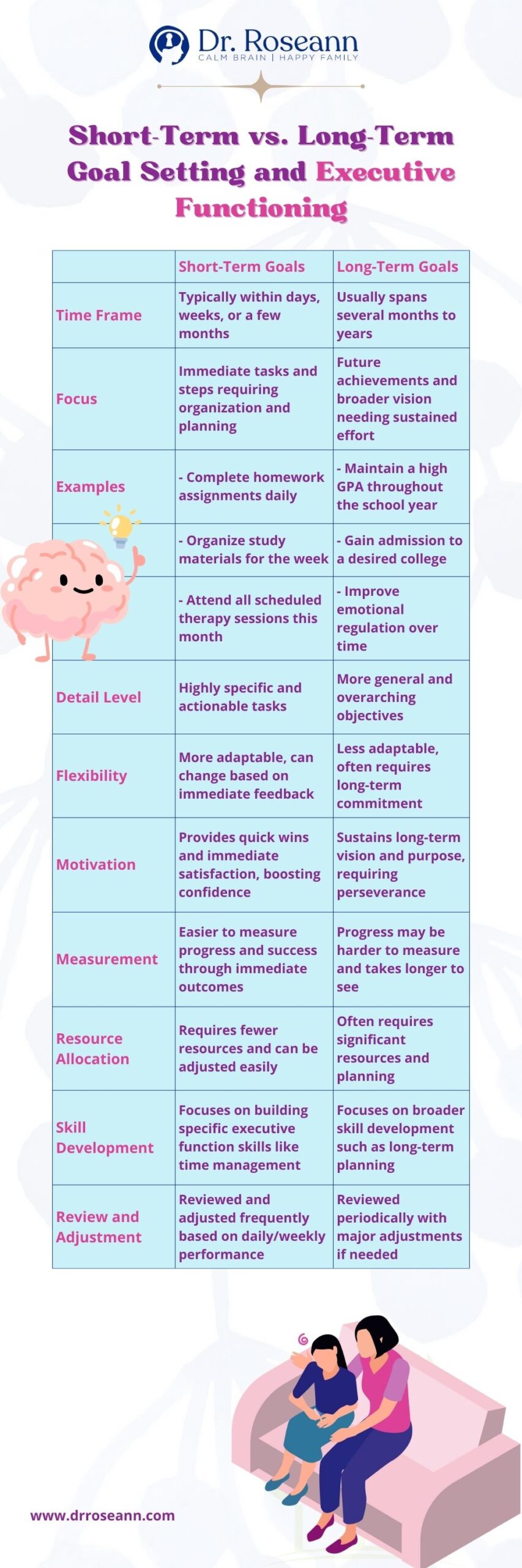
3. Goal Setting
Teaching how to set and achieve goals can build their confidence and help them improve important life skills and strengthen executive functions. Goal setting also helps them juggle multiple tasks successfully, ensuring they manage their responsibilities efficiently.Here’s how to guide them with goal setting:
Short-term Goals
Start with small, achievable goals to build confidence.
- Example: If your child struggles with reading, set a goal to read one chapter of a book daily. This small, daily goal is manageable and helps them see progress quickly, boosting their confidence.
Long-term Goals
Gradually introduce larger goals and break them down into actionable steps.
- Example: If your child wants to improve their grades over the semester, break this goal into smaller steps like:
- Daily: Complete all homework assignments on time.
- Weekly: Review class notes and prepare for quizzes.
- Monthly: Meet with the teacher to discuss progress and areas for improvement.
By breaking a long-term goal into smaller, actionable steps, one can stay focused and motivated, seeing their progress along the way.
Monitoring Goals and Progress
Regularly review and adjust goals as needed to stay on track.
- Example: At the end of each week, sit down with your child and review their progress. Discuss what went well and what was challenging. If a goal is too difficult, adjust it to be more realistic. If a goal is too easy, make it more challenging to keep them motivated.
This process helps your child understand that goals are not set in stone and can be adjusted based on their experiences and progress. Regular monitoring ensures they stay on track and continue to make progress toward their goals.
4. Working Memory
Improving your child’s working memory can help them retain and use information more effectively in everyday tasks and learning. Executive functions play a crucial role in this process by facilitating planning, organization, and self-management. Here are ways to enhance their working memory through games, note-taking, and repetition:
Memory Games
Play games and activities that challenge their memory, like card matching or Simon Says.
- Card Matching: This game involves flipping over pairs of cards to find matches, which helps improve memory and concentration. You can start with a few pairs and gradually increase the number as your child's skills improve.
- Simon Says: This game requires children to remember and follow a sequence of actions, enhancing their ability to hold and process information.
Note-Taking
Encourage taking notes to reinforce memory and understanding of tasks.
- Schoolwork: Teach your child to take notes during lessons or while reading. They can jot down key points, vocabulary words, or important dates. This helps them actively engage with the material and improve recall.
- Daily Tasks: Have them write down their chores or daily tasks. This practice not only aids memory but also improves organizational skills.
Repetition
Repeatedly practice routines and skills to strengthen their working memory.
- Daily Routines: Establish consistent daily routines, such as a morning routine that includes brushing teeth, getting dressed, and packing a school bag. Repetition helps these tasks become automatic.
- Academic Skills: Encourage regular review of school subjects. For example, practice spelling words or math facts daily to reinforce learning.
- Music Practice: If they play an instrument, practicing the same piece regularly can improve memory and mastery of the music.
By incorporating these strategies into daily activities, you and teachers can help your kid develop a stronger working memory, which will benefit their learning and everyday functioning skills.
5. Flexibility
Developing flexibility in children helps them adapt to change, solve problems effectively, and build resilience. Self management skills play a crucial role in helping individuals adapt to change and solve problems effectively. Here’s how you can guide them in these areas:
Adapting to Change
Teach them to be open to changes in plans and find alternative solutions.
- Real-Life Scenarios: Use everyday situations to teach adaptability. For example, if a planned outdoor activity gets canceled due to rain, involve them in choosing a fun indoor activity instead. This helps them understand that change is a part of life and learn how to respond positively.
- Role-Playing: Practice scenarios where plans change unexpectedly. Discuss different ways to handle the situation and find alternative solutions together.
Scenario: An outdoor picnic gets canceled due to rain.Script: "Looks like it’s raining today, so we can’t have our picnic outside. What else could we do for fun? Maybe we could have a picnic indoors or play some board games instead. It’s okay when plans change; we can always find another way to have a great time."
Problem-Solving
Encourage them to think through different ways to solve problems they encounter.
- Ask Guiding Questions: When they face a problem, ask questions like, "What are some ways you could solve this?" or "What do you think would happen if you tried this?" This encourages them to think critically and explore different solutions.
- Brainstorming Sessions: Set aside time to brainstorm solutions to hypothetical problems. This helps them practice thinking creatively and flexibly.
- Step-by-Step Approach: Teach them to break down problems into smaller steps. This makes problems feel more manageable and helps them see that there are multiple ways to approach a solution.
Scenario: Your child is struggling with a difficult science projectScript: "I can tell this project is overwhelming. Let’s brainstorm some ideas together. What’s one way we could make this easier? Could we start with the part you find most interesting or easiest? What are some tools or resources we can use to help us? Remember, it’s okay to ask for help and take it one step at a time."ResilienceFoster a mindset that setbacks are opportunities to learn and grow.
- Model Resilience: Share your own experiences of overcoming challenges and what you learned from them. Show them that setbacks are a normal part of life and an opportunity to improve.
- Positive Reinforcement: Praise their efforts and perseverance, even when things don’t go as planned. Highlight the importance of trying again and learning from mistakes.
- Growth Mindset: Encourage a growth mindset by using phrases like, "What can we learn from this?" or "How can we do it differently next time?" This helps them see failures as valuable learning experiences.
Scenario: Your child didn’t make the soccer team.Parent Script: "I know you’re disappointed about not making the soccer team, and that’s okay. Remember, every setback is a chance to learn and grow. What did you learn from the tryouts? How can we use this experience to improve for next time? I’m proud of you for trying your best, and I know you can keep getting better."By teaching your kid to adapt to change, solve problems effectively, and view setbacks as opportunities, you help them develop the flexibility and resilience needed to navigate life’s challenges confidently.
6. Self-Regulation
Self-regulation involves managing one’s emotions, thoughts, and behaviors effectively. Here are strategies to help your child develop impulse control, emotional management, and mindfulness techniques:Mental health professionals can provide valuable support and referrals, particularly for clients dealing with self-regulation and emotional management challenges.
Impulse Control
Teach them strategies to pause and think before acting.
- Pause and Count: Encourage your child to count to ten before reacting to a situation. This simple technique gives them a moment to think before acting impulsively.
- Example: If your child is about to interrupt someone, remind them to count to ten silently first.
- Think Aloud: Teach them to verbalize their thought process when making decisions. This helps them slow down and consider the consequences.
- Example: "Before you grab that toy, ask yourself if it’s your turn to play with it."
Emotional Management
Help them identify and manage their emotions, particularly when frustrated or overwhelmed.
- Emotion Identification: Teach your child to recognize and name their emotions. Use tools like emotion charts or faces to help them express what they’re feeling.
- Example: "It looks like you’re feeling angry. Can you show me on the chart how big your anger is right now?"
- Coping Strategies: Teach them strategies for managing strong emotions, such as taking deep breaths, counting, or squeezing a stress ball.
- Example: "When you feel upset, try taking three deep breaths to help calm down."
Mindfulness Techniques
Introduce deep breathing or meditation practices to help them stay calm and focused.
- Deep Breathing: Teach your child simple deep breathing exercises to help them relax and focus.
- Mindful Meditation: Introduce short, guided meditations or mindfulness activities to help them develop focus and calmness.
- Body Scan: Guide your child through a body scan to help them become aware of their physical sensations and release tension.
- Mindful Walking: Encourage mindful walking to help your child connect with their surroundings and focus on the present moment.
- Guided Imagery: Use guided imagery to help your child visualize a peaceful and calming place.
- Gratitude Practice: Encourage a daily gratitude practice to help your child focus on positive aspects of their life.
- Mindful Coloring: Provide coloring activities for your child to focus and relax.
These strategies help your child develop better self-regulation by managing their impulses, understanding and handling their emotions, and using mindfulness to stay calm and focused.Executive function coaching can be a game changer for anyone seeking to improve their academics, occupational, and personal growth. By working with an executive function coach, individuals can develop the skills and strategies needed to succeed in all areas of life. But even as a parent, you can help your child thrive if you utilize the tools mentioned above.Your child can overcome common challenges and succeed with perseverance and patience.If you need expert guidance as a parent who doubles as an executive skills coach to help your kids improve executive functions, I have created a program that walks you through the different aspects of executive functioning skills and how you can support your child. Learn more at https://drroseann.com/eftoolkit.
CitationsGibb, R., Coelho, L., Van Rootselaar, N. A., Halliwell, C., MacKinnon, M., Plomp, I., & Gonzalez, C. L. R. (2021). Promoting Executive Function Skills in Preschoolers Using a Play-Based Program. Frontiers in psychology, 12, 720225. https://doi.org/10.3389/fpsyg.2021.720225Dr. Roseann is a mental health expert in Executive Functioning who frequently is in the media:
- Cheddar News Ask A Therapist: Student Mental Health And The Return To School
- Broglie Box A School Psychologist’s Advice For Students On How To Cope During This ‘New Normal’
- Think Inclusive How Families Can Support Twice Exceptional Children
Are you looking for SOLUTIONS for your struggling child or teen?
Dr. Roseann and her team are all about science-backed solutions, so you are in the right place!
Grab your complimentary copy of147 Therapist-Endorsed Self-Regulation Strategies for Children: A Practical Guide for Parents
Dr. Roseann is a Children’s Mental Health Expert and Licensed Therapist who has been featured in/on hundreds of media outlets including The Mel Robbins Show, CBS, NBC, PIX11 NYC, Today, FORBES, CNN, The New York Times, The Washington Post, Business Insider,Women’s Day, Healthline, CNET,Parade Magazine and PARENTS. FORBES called her, “A thought leader in children’s mental health.”

She coined the terms, “Re-entry panic syndrome” and “eco-anxiety” and is a frequent contributor to media on mental health.Dr. Roseann Capanna-Hodge has three decades of experience in working with children, teens and their families with attention-deficit hyperactivity disorder (ADHD), autism, concussion, dyslexia and learning disability, anxiety, Obsessive Compulsive Disorder (OCD), depression and mood disorder, Lyme Disease, and PANS/PANDAS using science-backed natural mental health solutions such as supplements, magnesium, nutrition, QEEG Brain maps, neurofeedback, PEMF, psychotherapy and other non-medication approaches.She is the author of three bestselling books, It’s Gonna Be OK!: Proven Ways to Improve Your Child's Mental Health, The Teletherapy Toolkit, and Brain Under Attack. Dr. Roseann is known for offering a message of hope through science-endorsed methods that promote a calm brain.Her trademarked BrainBehaviorResetⓇ Program and It’s Gonna be OK!Ⓡ Podcast has been a cornerstone for thousands of parents facing mental health, behavioral or neurodevelopmental challenges.She is the founder and director of The Global Institute of Children’s Mental Health, Neurotastic™Brain Formulas and Dr. Roseann Capanna-Hodge, LLC. Dr. Roseann is a Board Certified Neurofeedback (BCN) Practitioner, a Board Member of the Northeast Region Biofeedback Society (NRBS), Certified Integrative Mental Health Professional (CIMHP) and an Amen Clinic Certified Brain Health Coach. She is also a member of The International Lyme Disease and Associated Disease Society (ILADS), The American Psychological Association (APA), Anxiety and Depression Association of America (ADAA) National Association of School Psychologists (NASP), International OCD Foundation (IOCDF).© Roseann-Capanna-Hodge, LLC 2024