%20.png)



Estimated reading time: 8 minutesObsessive-Compulsive Disorder (OCD) is often misunderstood in schools, where the hidden struggles—like intrusive thoughts and mental rituals—can quietly make learning harder for kids.These hidden challenges can impact focus and behavior, but with the right understanding and support, kids can feel calmer and thrive in school.https://youtu.be/t2HRYcuAqIM?si=3rUjDk5y6wSqqWy8
Why is OCD Hard to Identify?
OCD often flies under the radar in kids because it rarely looks like the usual signs most people expect. Instead, they’re battling invisible symptoms no one else can see.Here’s why OCD is often missed in school or at home:
- Symptoms are often invisible.Many kids with OCD seem calm on the outside but silently struggle with intrusive thoughts and intense anxiety.
- Children may appear high-functioning—until they hit a breaking point.You think, “They’re doing fine,” until one day they fall apart. It can feel like it came out of nowhere but it didn't.That pressure can build until it leads to outbursts or shutdowns.
- OCD looks different in every child.Some have symptoms like harm fears or silent mental rituals that are easy to overlook.
- Most professionals aren’t trained to recognize pediatric OCD.Here's something not enough people are talking about: most professionals aren’t trained to recognize pediatric OCD.Without proper training, OCD is often misdiagnosed as ADHD, anxiety, or behavior issues, delaying the right help.
- Lack of public understanding leads to stigma and silence.And because so few people understand OCD, kids stay silent. Kids may feel ashamed or afraid to talk about their thoughts, especially if adults don’t recognize their behavior as part of OCD.
If we want to truly help kids with OCD, we have to stop looking for the “typical” signs and start listening to what their behavior is really telling us.When we give them calm, support, and the right tools, they can feel better.Calm the brain first—everything follows.

Can OCD Affect Attention and Learning?
Yes—OCD can significantly interfere with a child’s ability to focus and learn in school. Here’s how:
- Perfectionism gets in the way. Kids may spend too long trying to get things “just right.”
- Assignments may go unfinished or unsubmitted. Even if they’ve worked hard, the fear of it not being perfect may stop them from handing it in at all.
- Time gets eaten up by mental rituals. Obsessive thoughts and internal checking can slow everything down, leaving little energy or attention for actual learning.
- They may frequently leave class or seem distracted. Extra bathroom trips or zoning out during lessons could be a coping mechanism for managing intrusive thoughts or anxiety (Bubrick, 2023).
- They miss key information. When a child is focused on calming their mind or performing rituals, they may not absorb what’s being taught, creating gaps in understanding.
- The emotional toll adds up. Constant pressure, frustration, and internal distress can lead to sadness, meltdowns, or even school avoidance.
Can OCD Be Misdiagnosed as ADHD?
Yes, and it happens more often than people realize. Many kids with OCD are misdiagnosed with ADHD because both affect focus and emotions but for different reasons.This can cause kids to miss instructions or fall behind in school, so early recognition and support are essential.
What Are OCD Rituals?
Children with OCD aren’t choosing these rituals—they feel driven to do them in order to quiet the fear and worry taking over their brain (Foa et al., 2012). What might look “illogical” on the outside is actually an attempt to prevent something bad they believe could happen (Bouvard et al., 2020; Bucarelli & Purdon, 2015).For example, a child who’s afraid of germs might wash their hands repeatedly, believing something bad will happen if they don’t.These compulsions can quietly take a toll on daily life, including:
- Time and energy are drained
- Schoolwork is delayed or disrupted
- Participation in classroom activities is limited
- Emotional well-being is affected
- Overall quality of life is reduced
What School Accommodations Can Help a Child with OCD?
When a child is struggling with OCD in the classroom, support is available—and it can make a big difference in their success.Schools typically provide this support through one of two plans:
- Individualized Education Plan (IEP)
- Designed for students whose OCD significantly impacts learning
- Includes personalized goals and services tailored to the child's needs
- Provides specialized instruction and progress tracking
- 504 Accommodation Plan
- Offers accommodations without modifying the curriculum
- Examples include:
- Extended time on tests and assignments
- Reduced homework load
- Preferential seating
- Breaks during the day to manage anxiety
- Modified deadlines to ease perfectionism pressure
What Parents Can Do:
- Communicate regularly with teachers and school staff
- Share specific challenges their child is facing due to OCD
- Advocate for appropriate accommodations that support both emotional and academic success
With the right plan and support, children with OCD can thrive in school and beyond.
How Can You Support a Child with OCD at School?
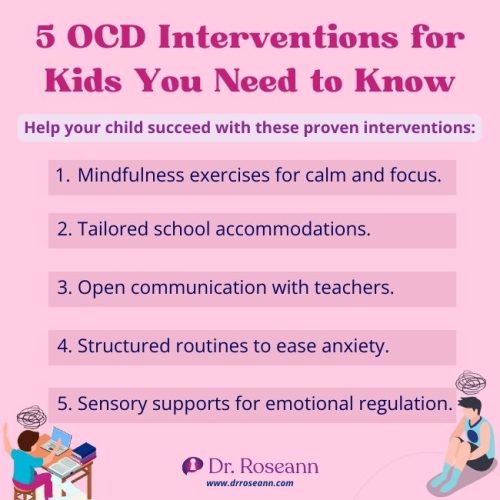
Supporting a child with OCD in school? It takes more than paperwork. You need real connection, teamwork that sticks, and a plan that actually works for your kid.These key strategies can make a big difference:
- Open CommunicationTeachers aren’t mind readers. Regular chats—quick emails, check-ins, little updates—can go a long way. Keep regular contact with teachers and school staff.Help them understand how OCD shows up for your child and how it can impact focus, participation, and learning.
- Tailored AccommodationsWork with the school to design a plan (IEP or 504) that supports your child’s needs—without reinforcing compulsive behaviors.
- Access to ResourcesIntroduce supports like the Natural OCD Thought Tamer Kit, which offers hands-on strategies to help kids manage intrusive thoughts and compulsions.
- Encourage IndependenceEncourage your child to use healthy coping strategies so they don’t become overly dependent on accommodations.
- Monitor ProgressCheck in regularly with your child and their teachers. Adjust the plan as needed to ensure your child is making progress emotionally and academically.
What Role Do Parents and Educators Play in Supporting a Child with OCD?
Parents are the steady anchor for a child with OCD—at home and in school. The first step? Calm the nervous system because until the brain feels safe, change can’t happen.Here’s how parents can help:
- Regulate First – Use tools that support nervous system regulation like magnesium, neurofeedback, CALM PEMF®, and essential oils. These can ease the brain out of a stress state and into a place where healing can begin.
- Coach Thought Reframing – Teach your child to “talk back” to obsessions and compulsions. With guidance, kids can learn that just because they think something scary doesn't make it true.
- Maintain Consistency – Stick with routines that help reduce anxiety and avoid feeding into compulsions. Calm and predictable environments matter.
Here’s how educators can support:
- Get Informed – Learn how OCD shows up in the classroom. It’s not always obvious—it can look like perfectionism, procrastination, or even zoning out.
- Offer Flexibility – Give space for breaks, allow alternate ways to complete tasks, or reduce unnecessary triggers—without reinforcing compulsive behavior.
- Collaborate with Families – Regular check-ins with parents help create a unified support system and ensure strategies stay consistent across settings.
When parents and educators team up with a shared understanding, kids with OCD can move from stuck to steady.Check out Dr. Roseann's website, for support and guidance on dealing with OCD in children and families and our Thought Tamer Kit for effective, science-backed solutions to help your child or teen win the fight against OCD today.

Parent Action Steps
Learn more about OCD by listening to my It’s Gonna Be OK! Podcast and the OCD series.Collaborate with teachers and school staff early and often.Create a consistent routine to reduce your child’s anxiety.Take the OCD Quiz to know possible treatments for your child.Check out our Natural OCD Thought Tamer Kit and break free from OCD.Use the Solutions Matcher to help you find the right treatment pathwaysFAQs
What should I do if my child’s OCD symptoms aren’t obvious to teachers?
Keep communication open with school staff and share specific examples of how OCD shows up for your child. Symptoms can look like perfectionism, procrastination, or zoning out.
Does OCD make it hard to learn?
It can make learning harder, especially when a child’s brain is stuck in a stress state. Until the nervous system is regulated, cognitive resources are often tied up in anxiety and rituals.
What should teachers know about OCD?
OCD can show up as perfectionism, excessive questioning, or even zoning out. It’s not just about visible compulsions. The more educators understand how OCD impacts learning, the better they can support students.
Can my child succeed in school despite OCD?
Absolutely. With nervous system regulation, thought reframing, and school accommodations in place, kids with OCD can move from stuck to steady and thrive in both learning and life.CitationsBouvard, M., Fournet, N., Denis, A., Achachi, O., & Purdon, C. (2020). A study of the Repeated Actions Diary in patients suffering from obsessive compulsive disorder. Clinical Psychology & Psychotherapy, 27(2), 228–238. https://doi.org/10.1002/cpp.2422Bubrick, J. (2023). What does OCD look like in the classroom? Child Mind Institute. https://childmind.org/article/what-does-ocd-look-like-in-the-classroom/Foa, E. B., Yadin, E., & Lichner, T. K. (2012). Exposure and response (ritual) prevention for obsessive compulsive disorder : therapist guide. Oxford University Press.Dr. Roseann is a mental health expert in OCD and Anxiety who frequently is in the media:
- Epidemic Answers
- Cai Grahm: Is it anxiety or OCD?
Always remember... “Calm Brain, Happy Family™”
Disclaimer: This article is not intended to give health advice and it is recommended to consult with a physician before beginning any new wellness regime. *The effectiveness of diagnosis and treatment vary by patient and condition. Dr. Roseann Capanna-Hodge, LLC does not guarantee certain results.
Are you looking for SOLUTIONS for your struggling child or teen?
Dr. Roseann and her team are all about science-backed solutions, so you are in the right place!