
%20.png)


Contents

Estimated reading time: 7 minutesEver feel like your child’s brain just won’t quit? Like they’re stuck in a loop—repeating the same worries, asking the same questions over and over, even after you’ve reassured them a hundred times?You’re not imagining it. And it’s not just typical overthinking either.This could be something called Rumination OCD—a type of OCD that gets kids trapped in their own thoughts. And let me tell you, it’s not just frustrating for them... it’s hard on the whole family.I’ve sat with so many parents in this exact spot, exhausted and wondering what to do next.The good news? There is a path forward—and with the right tools, you can help your child calm their brain and get unstuck.
What Is Rumination OCD?
Rumination OCD is a subtype of Obsessive-Compulsive Disorder characterized by persistent, intrusive thoughts that lead to excessive mental analysis.Unlike other forms of OCD that involve visible compulsions, Rumination OCD primarily involves mental rituals.Children with Rumination OCD may:
- Constantly replay conversations or events in their minds
- Seek reassurance repeatedly
- Struggle to make decisions due to overanalysis
- Experience significant distress over their inability to "let go" of certain thoughts
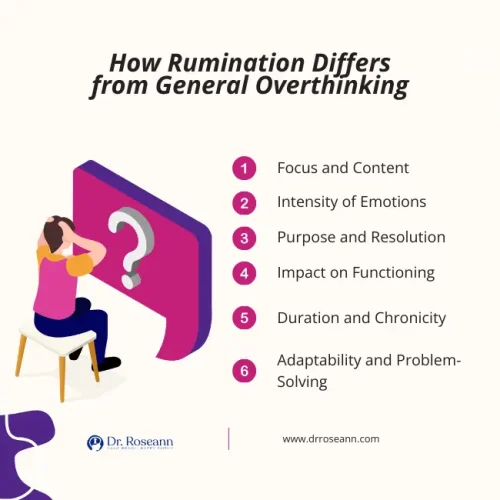
How Does Rumination OCD Differ from Typical Overthinking?
While overthinking is common, especially among adolescents, Rumination OCD is more intense and disruptive.The key differences
What Kinds of Thoughts Trigger Rumination OCD?
Kids and teens with Rumination OCD don’t just worry—they spiral. Their brains latch onto certain themes, and no matter how much you try to reassure them, the thoughts just keep coming.Here are some common mental loops I see over and over in my practice:
- “What if I’m a bad person?”Your child might obsess over whether they did or could do something wrong—even if it’s totally out of character.
- “Do I really love my best friend/family/pet?”Relationship doubts pop up constantly, even with people they truly care about. They’ll question their feelings again and again.
- “Why are we even here?”Big, existential questions like the meaning of life or their purpose can become overwhelming and all-consuming.
- “Did I mess up back then?”They’ll replay something they said or did weeks—or even years—ago, trying to figure out if they did something “bad” or harmful.
These thoughts feel very real to your child. They’re not trying to be dramatic or difficult—they’re trying to ease the anxiety caused by a dysregulated brain. And the more they ruminate, the more stuck they feel.Take our FREE Brain and Behavior Solution Matcher now so we can recommend the right product and services for your family. It won't take you more than 3 minutes!

How Can I Support My Child Without Reinforcing the OCD Cycle?
When your child is spiraling with worry, your first instinct is to comfort them—and that’s beautiful. But when it comes to Rumination OCD, too much reassurance can actually make things worse (I know, that feels so backwards).It’s all about striking that tricky balance between being there for your child and not accidentally feeding the OCD monster. Here’s how to do that with love:
- Validate their feelingsLet your child know you see their struggle:“I can tell this is really upsetting for you, and I’m here with you.”That’s very different from saying, “Don’t worry, everything’s fine,” over and over—which the OCD brain craves but never believes for long.
- Set gentle boundariesIf they ask the same question 20 times, it’s okay to say:“Sweetheart, I’ve already answered that, and I know your brain is trying to trick you into needing more. Let’s take a breath instead.”This teaches them to tolerate uncertainty without feeding the loop.
- Encourage the right kind of helpA therapist trained in OCD (especially ERP—Exposure and Response Prevention) can give your child tools to manage these thoughts in a healthy way.Let them know it’s okay to ask for help—and that it’s a sign of strength, not weakness.
What Treatments Are Effective for Rumination OCD?
Effective treatments for Rumination OCD often include:
- Cognitive Behavioral Therapy (CBT): Helps identify and challenge unhelpful thought patterns.
- Exposure and Response Prevention (ERP): Involves gradual exposure to anxiety-provoking thoughts without engaging in compulsions.
- Mindfulness-Based Therapies: Teach present-moment awareness to reduce engagement with intrusive thoughts.
Expert Insight:"Refuse to act on an obsession, and it will die of inaction." — Recovery Inc.
How Can I Help My Child Cope with Rumination OCD at Home?
Creating a supportive home environment is crucial.Home Strategies:
- Establish routines: Consistent schedules can provide a sense of stability.
- Promote healthy habits: Encourage regular sleep, nutrition, and physical activity.
- Model coping skills: Demonstrate healthy ways of dealing with stress and uncertainty
Parent Action Steps:
Learn more about OCD by listening to my It’s Gonna Be OK! Podcast and theOCD series.Understand the main distinction between obsessive rumination and general overthinking.Explore natural solutions with OCD specialists and consider non-pharmacological interventions.Acknowledge the potential coexistence of OCD with the symptoms of depression and anxiety disorders.Encourage spending time on healthy habits, stress-reducing activities, and a balanced routine.Check out my Natural OCD Thought Tamer Parent Kit.FAQs
What is the difference between rumination and worry?
Rumination involves dwelling on past events or thoughts, often leading to feelings of guilt or regret. Worry typically focuses on future events and potential negative outcomes.
Can Rumination OCD be cured?
While there is no definitive cure, many individuals experience significant improvement through therapy and coping strategies.
Is medication necessary for treating Rumination OCD?
Medication can be helpful for some individuals, but it’s often most effective when combined with therapy.
How can I differentiate between normal teenage behavior and Rumination OCD?
If your child’s thoughts are persistent, intrusive, and interfere with daily life, it may be indicative of Rumination OCD rather than typical adolescent behavior.
Citations:
- Recovery Inc. (n.d.). Quotations for OCD. Western Suffolk Psychological Services. https://www.wsps.info/quotations-for-ocd
- Manhattan CBT. (2023). Rumination OCD: Do You Get Stuck in Repetitive Thinking? https://manhattancbt.com/rumination-ocd
- Sevita Health. (2025). Rumination in OCD: What It Is and How to Manage It. https://blog.sevitahealth.com/rumination-ocd
Dr. Roseann Capanna-Hodge is a licensed mental health expert that is frequently cited in the media:
- Single Care Controlling the uncontrollable: Living with OCD during a pandemic
- Holistic Counseling Podcast: Effective Treatments for OCD
Epidemic Answers: Neurofeedback for ADHD, anxiety, OCD and moodDisclaimer: This article is not intended to give health advice and it is recommended to consult with a physician before beginning any new wellness regime. *The effectiveness of diagnosis and treatment vary by patient and condition. Dr. Roseann Capanna-Hodge, LLC does not guarantee certain results.
Are you looking for SOLUTIONS for your struggling child or teen?
Dr. Roseann and her team are all about science-backed solutions, so you are in the right place!Take our FREE Brain and Behavior Solution Matcher now so we can recommend the right product and services for your family. It won't take you more than 3 minutes!