%20.png)



Estimated reading time: 9 minutes
Managing emotional dysregulation daily starts with building a rhythm that helps your child’s nervous system feel safe, steady, and supported before emotions become too big. That means:
- using predictable routines
- tracking patterns and triggers
- supporting sleep, food, movement, and sensory needs
- practicing coping skills when your child is calm
- creating a family plan everyone can follow
The goal isn’t to stop every hard moment. Kids will still have big feelings, tough transitions, and days when their nervous system can’t keep up. But with the right daily support, those moments can become less intense, less frequent, and easier to recover from.
I'm Dr. Roseann Capanna-Hodge, and for over 30 years, I've helped families learn how to manage emotional dysregulation with my science-backed Regulation First Parenting™ approach. My experience has shown me that when we calm the brain first, children can focus, learn, and connect—bringing peace back to family life.
In this guide, I’ll walk you through a simple daily plan using routines, trigger tracking, sleep, food, movement, sensory tools, family support, school coordination, and knowing when to seek help.
What Does It Mean to Manage Emotional Dysregulation?
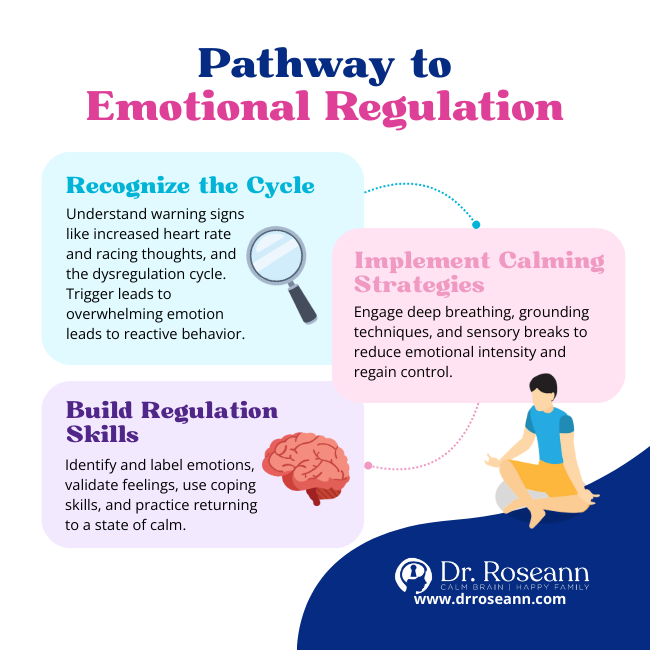
To manage emotional dysregulation means to support your child’s nervous system throughout the day so they are less likely to become overwhelmed by stress, frustration, transitions, disappointment, or sensory overload.
Emotional dysregulation happens when a child has a hard time controlling the intensity of their emotional response. They may cry, yell, shut down, argue, run away, refuse, or melt down over situations that seem small from the outside.
But for your child, those moments don’t feel small.
Their brain and body may be moving into fight, flight, freeze, or shutdown. In those moments, they need less pressure, not more. They need calm support, not lectures.
Daily management is about asking:
“What helps my child stay regulated before the hard moment happens?”
That might include:
- a smoother morning routine
- a protein-rich breakfast
- a sensory break after school
- visual reminders
- earlier bedtime
- movement before homework
- fewer verbal demands during transitions
Managing emotional dysregulation is not about controlling your child. It is about creating daily conditions that make self-regulation more possible.
Managing Emotional Dysregulation vs. Calming a Meltdown
Managing emotional dysregulation is different from calming a meltdown.
Calming a meltdown is what you do when your child is already overwhelmed. You may lower your voice, reduce demands, move them to a quiet space, offer sensory support, or simply stay nearby until their body settles.
Managing emotional dysregulation supposedly happens before that point.
It is the daily prevention plan.
Meltdown Plan VS Daily Regulation Plan
A meltdown plan asks, “What does my child need right now?”
A daily regulation plan asks, “What does my child need today so we reduce the chances of reaching that point?”
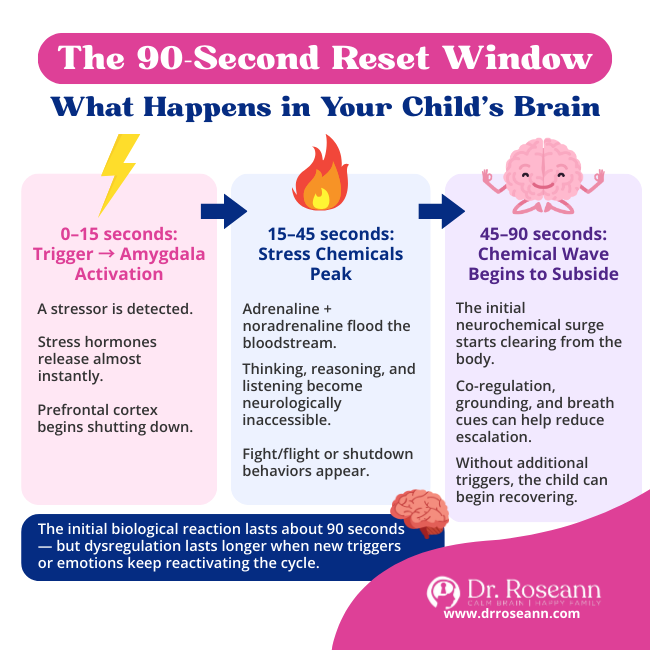
This matters because many parents try to teach coping skills during the meltdown itself. But when your child is already dysregulated, their thinking brain is not fully online. That is not the best time to explain, correct, or problem-solve.
The better time to teach regulation is when your child is calm, connected, and able to listen.
So instead of only preparing for the crisis, build regulation into the day:
- A calmer wake-up
- A predictable morning
- Enough food and hydration
- Movement breaks
- Sensory support
- Transition warnings
- Quiet recovery time
- A consistent bedtime
That is how daily emotional regulation begins.
Step 1: Track Emotional Dysregulation Triggers and Daily Patterns
The first daily step is to notice what sets your child up for dysregulation.
Most emotional outbursts aren’t as random as they feel in the moment. They often follow patterns—but when you’re in the middle of the yelling, tears, shutdowns, or refusal, it’s hard to step back and see what came before it.
You’re just trying to get through it, and that makes so much sense.
Start tracking simple details each day.
You can write down:
- What time the dysregulation happened
- What happened right before it
- How much sleep your child got
- When they last ate
- Whether there was screen time
- Whether there was a transition
- Whether there was sensory overload
- How long it took them to recover
You don’t need a perfect tracker. A short note in your phone is enough.
For example:
“Meltdown at 4:30 after school. No snack yet. Loud car ride. Homework mentioned. Took 45 minutes to recover.”
That one note gives you clues. Maybe the issue wasn’t homework alone. Maybe it was after-school exhaustion, hunger, noise, and the demand of homework all stacking together.
Over time, look for patterns:
- Does dysregulation happen more in the morning?
- After school?
- Before meals?
- During transitions?
- After screen time?
- At bedtime?
- On school nights?
- During homework?
Also track recovery time. If your child takes a long time to return to baseline, their nervous system may need more protection and support during the day.
This daily tracking helps you stop guessing and start planning.
Step 2: Create Predictable Daily Routines for Emotional Regulation
Predictable routines are one of the most powerful daily tools for managing emotional dysregulation.
Children who struggle with regulation often have a harder time with uncertainty. When they don’t know what is coming next, their brain can become anxious, resistant, or reactive.
The American Academy of Pediatrics notes that predictable routines give children a sense of stability and connection.
Start with the parts of the day that create the most stress:
- Morning routine
- Leaving for school
- After-school transition
- Homework
- Dinner
- Bath time
- Bedtime
Keep routines short, clear, and repeatable.
Instead of saying:
“Get ready because we’re late and you still haven’t brushed your teeth or packed your bag.”
Try:
“First clothes. Then breakfast. Then teeth. Then backpack.”
For kids with emotional dysregulation, fewer words often work better. Visual schedules, written checklists, timers, and simple choices can reduce arguments because your child doesn’t have to process as much verbal information.
A daily routine might look like:
- Wake up
- Bathroom
- Get dressed
- Breakfast
- Brush teeth
- Backpack
- Leave for school
After school, your child may need a decompression routine before demands begin:
- Snack
- Quiet time
- Movement
- Connection
- Homework
- Dinner
This is especially important because many dysregulated kids hold it together at school and fall apart at home. They may not be “being difficult.” They may finally be releasing the stress they carried all day.
A predictable daily rhythm helps your child’s nervous system know, “I am safe. I know what comes next.”
Step 3: Support Sleep, Food, Movement, and Sensory Needs
A dysregulated brain is often an under-supported body.
Sleep, food, movement, and sensory input are daily foundations for emotional regulation. They don’t solve everything, but when these needs are off, emotional control becomes much harder.
Start with sleep.
A tired child has less capacity to handle frustration, transitions, disappointment, and demands. Research has linked bedtime routines with better child mood and emotional-behavioral regulation, and the CDC also emphasizes that children need enough sleep for good mental and physical health (Mindell & Williamson, 2019)
A regulation-friendly bedtime routine may include:
- Same bedtime most nights
- Dim lights
- Reduced screens before bed
- A warm bath or shower
- Quiet reading
- Calming music
- Deep pressure
- A predictable goodnight routine
Food matters too.
Some children become more emotionally reactive when they go too long without eating or start the day with very little protein. Build food into the daily regulation plan, especially during high-risk times like mornings, after school, and before activities.
Helpful daily food supports include:
- Protein at breakfast
- Regular meals
- Balanced snacks
- Water throughout the day
- An after-school snack before homework
- Less sugar when your child is already dysregulated
Movement is another daily regulation tool. Children and adolescents ages 6 to 17 need at least 60 minutes of physical activity each day, according to the CDC.
For dysregulated kids, movement doesn’t have to mean formal exercise. It can be:
- Jumping
- Walking
- Climbing
- Bike riding
- Dancing
- Animal walks
- Heavy work
- Pushing a laundry basket
- Wall pushes
- Outdoor play
Sensory support is just as important.
Some children are overwhelmed by noise, lights, clothing textures, smells, crowds, or touch. Others need more sensory input to feel organized in their body.
Daily sensory supports may include:
- Noise-canceling headphones
- A quiet corner
- Weighted blanket or lap pad
- Fidgets
- Chewy snacks
- Movement breaks
- Dim lighting
- Compression clothing
- Deep pressure
- A calm-down space
When you support your child’s sleep, food, movement, and sensory needs every day, you lower the stress load on their nervous system.
Step 4: Teach Regulation Skills When Your Child Is Calm
Regulation skills should be practiced when your child is calm, not when they are already overwhelmed.
This is where many parents accidentally get stuck. They wait until the meltdown and then say, “Use your breathing,” or “Calm down,” or “Tell me what you need.”
But in the middle of dysregulation, your child may not be able to access those skills yet.
Instead, build regulation practice into calm parts of the day.
You might practice:
- Before school
- After dinner
- During bedtime routine
- While playing
- During a calm car ride
- After a successful transition
Keep the skills simple.
Try:
- Taking three slow breaths
- Pushing hands against the wall
- Naming one feeling
- Squeezing a pillow
- Using a feelings scale
- Asking for a break
- Going to a calm space
- Shaking out the body
- Taking a sensory break
You can say:
“Let’s practice this now so your body remembers it when things feel hard.”
Or:
“When your body starts feeling hot, tight, or fast, that can be your signal to take a break.”
The goal is not to make your child perfectly calm on command. The goal is to help them notice their body signals earlier.
You are teaching them:
“What does my body feel like when I’m getting upset?”
“What helps my body slow down?”
“What can I do before I explode?”
These skills need repetition. The more your child practices them during calm moments, the more available they become during harder moments.
Step 5: Build a Family Regulation Plan for Hard Moments
A family regulation plan gives everyone a clear daily response when emotions start to rise.
Without a plan, parents may react differently each time. One parent may lecture. Another may give in. Siblings may get involved. The child may feel more overwhelmed because the environment becomes unpredictable.
A family regulation plan keeps everyone on the same page.
It should answer:
- What are our child’s early warning signs?
- What usually triggers dysregulation?
- What helps our child calm?
- What makes things worse?
- Where can our child go to reset?
- What should siblings do?
- What should parents say?
- What happens after everyone is calm?

The plan should be simple enough to use on a hard day.
You can also create a parent regulation plan. This matters because dysregulated kids often pull parents into dysregulation too.
Your plan might include:
- Pause before responding
- Lower your voice
- Use fewer words
- Step away for one minute if safe
- Ask another adult to take over
- Come back for repair later
A daily family regulation plan is not about being perfect. It is about creating a calmer pattern everyone can return to.
Step 6: Partner With School
If your child struggles with emotional dysregulation at school, the daily plan needs to extend beyond home.
School can be full of triggers: noise, transitions, social stress, academic pressure, unstructured time, bright lights, and long periods of sitting. A child who seems “fine” in class may still come home completely depleted.
Start by sharing what you are noticing with your child’s teacher, counselor, or school support team.
You might say:
“We are working on a daily regulation plan at home. We’ve noticed that transitions, hunger, and noise are big triggers. Can we talk about what support might help during the school day?”
Helpful school supports may include:
- Visual schedules
- Transition warnings
- Movement breaks
- Sensory tools
- A quiet reset space
- Check-ins with a trusted adult
- Reduced overwhelm during difficult tasks
- Support during lunch or recess
- A calm arrival or dismissal plan
- Homework adjustments when needed
The CDC describes schools as an important setting for supporting children’s health and mental well-being, and notes that healthy routines such as sleep, activity, and nutrition matter for children’s mental and physical health.
The goal is not to remove every challenge from your child’s day. The goal is to reduce unnecessary overload so your child has more capacity to learn, participate, and recover.
When home and school use similar language and strategies, your child gets a more consistent message:
“We understand what helps your body feel safe and ready.”
When to Seek Professional Support
A daily regulation plan can help, but if your child’s emotional dysregulation is frequent, intense, unsafe, or disrupting home, school, or friendships, it may be time to seek professional support.
Professional help may be needed if your child:
- Has daily or near-daily meltdowns
- Takes a long time to recover
- Becomes aggressive or unsafe
- Avoids school because of overwhelm
- Struggles with intense anxiety or irritability
- Can’t use coping skills even with support
Depending on your child’s needs, support may include parent coaching, CBT, therapy, occupational therapy, school evaluation, neurofeedback, or a medical evaluation.
Getting help does not mean you failed. It means your child’s nervous system needs more support than your current plan is giving them.
And with the right daily structure, support, and guidance, children can learn to feel calmer, safer, and more in control over time.
Frequently Asked Questions
What is the difference between emotional dysregulation and a tantrum?
A tantrum is a normal developmental stage, especially in toddlers, and is usually a brief outburst when a child is frustrated. Emotional dysregulation is a more persistent difficulty in managing emotions that is not age-appropriate, leading to intense, prolonged reactions that significantly impact a child's daily life and relationships.
Can emotional dysregulation be cured?
While there isn't a "cure," emotional dysregulation is highly manageable. Through brain-based therapies like neurofeedback and learning practical skills from approaches like DBT and CBT, individuals can significantly improve their ability to regulate their nervous system and manage emotions effectively. With the right support, many people, especially children, can learn to thrive.
What is the first step I should take to help my child?
The very first step is to regulate yourself. Your child's nervous system looks to yours for cues. By staying calm, you can share your calm and help them co-regulate. Once the storm has passed, you can focus on understanding the root cause of the behavior and seeking professional guidance. Behavior is communication. Listen to our podcast on co-regulation.
How do I know if my child's emotional outbursts are a sign of ADHD?
Emotional dysregulation is a core symptom of ADHD, but it can also be a sign of other conditions like anxiety, PANS/PANDAS, or trauma. The key is a comprehensive evaluation. A QEEG brain map can show us exactly what's happening in the brain, helping to differentiate between conditions and create a targeted treatment plan. Learn more about ADHD symptoms.
What is the best daily routine for a dysregulated child?
The best daily routine is simple, predictable, and flexible. Focus on calm mornings, regular meals, movement breaks, after-school decompression, and a steady bedtime routine.
Citations
Mindell JA, Williamson AA.(2019). Benefits of a bedtime routine in young children: Sleep, development, and beyond. Sleep Med Rev, 40:93-108. https://doi.org/10.1016/j.smrv.2017.10.007
Always remember… “Calm Brain, Happy Family™”
Disclaimer: This article is not intended to give health advice and it is recommended to consult with a physician before beginning any new wellness regime. *The effectiveness of diagnosis and treatment vary by patient and condition. Dr. Roseann Capanna-Hodge, LLC does not guarantee certain results.
Are you looking for SOLUTIONS for your struggling child or teen?
Dr. Roseann and her team are all about science-backed solutions, so you are in the right place!