%20.png)



Estimated reading time: 6 minutes
ADHD mood swings are sudden, intense shifts in emotion that can flip from calm to explosive — or happy to devastated — in a matter of minutes.
Here's a quick snapshot of what parents need to know:
- What they are: Rapid emotional shifts driven by how the ADHD brain processes feelings — not defiance or bad parenting
- How common: 25–45% of children with ADHD experience emotional dysregulation; that number rises to around 70% in adults
- Key triggers: Frustration, transitions, perceived rejection, hyperfocus being interrupted
- How long they last: Minutes to hours — unlike bipolar disorder, which lasts weeks or months
- What helps: Calm co-regulation, structured routines, and targeted brain-based strategies
One moment your child is laughing. The next, they're in tears — or in a full meltdown — over something that seems tiny to you. If you've ever thought, "Where did that come from?", you're not alone.
Think of the ADHD brain like a traffic light that skips yellow and goes straight from green to red. There's no warning. No slow build. Just an instant flood of emotion that overwhelms everything else.
That's not a behavior problem. That's a brain difference.
Behavior is communication. When a child with ADHD erupts, their nervous system is telling you it's overwhelmed — not that they're choosing to be difficult. Understanding that distinction changes everything about how you respond.
Roughly 30 to 70% of people with ADHD report significant difficulty keeping emotions in check. So if your child struggles with this, know that it is one of the most common — and most exhausting — parts of living with ADHD.
You are not failing. And your child is not broken.
I'm Dr. Roseann Capanna-Hodge, a licensed professional counselor and board-certified neurofeedback practitioner with over 30 years of clinical experience helping children and families navigate ADHD mood swings and emotional dysregulation. In this guide, I'll walk you through exactly what's happening in your child's brain — and what you can actually do about it.

ADHD mood swings vocab explained:
- definition of emotional dysregulation
- emotional regulation techniques
- cognitive behavioral therapy ADHD
The Science and Symptoms of ADHD Mood Swings
When we talk about ADHD mood swings, we are really talking about emotional dysregulation. While the DSM-5 focuses heavily on inattention and hyperactivity, those of us in the trenches know that the emotional piece is often the most debilitating. Scientific research on 30-70% of adults with ADHD (Beheshti et al., 2020) shows that struggle with emotional control is a core feature of the disorder, not just a "side effect."
In the ADHD brain, the "emotional thermostat" is broken. Specifically, we look at the relationship between the amygdala and the prefrontal cortex. The amygdala is the brain's alarm system—it processes emotions like fear and anger. In a typical brain, the prefrontal cortex (the "CEO") steps in to say, "Hey, it’s just a spilled glass of milk, no need to scream."
But in a child with ADHD, that CEO is often taking a nap. This leads to emotional dysregulation, where the child feels "flooded" by an emotion so large it drowns out rational thought. This is why moodiness and anger can appear so suddenly; the brain simply lacks the executive function "brakes" to slow the emotional momentum.
Why ADHD Mood Swings Happen: Brain Chemistry and RSD
It isn't just about "willpower." There are deep-seated biological reasons why these flares happen. First, there is a chronic dopamine deficiency. The ADHD brain is constantly seeking stimulation to "wake up," and sometimes, a high-conflict argument provides that stimulation, even if it’s negative.

Furthermore, neuroimaging studies (especially in ADHD) on maturational delays show that the circuits connecting the emotional centers to the thinking centers develop up to three years behind their peers (Ágrez et al., 2025). Your 10-year-old might have the emotional regulation skills of a 7-year-old.
We also have to talk about Rejection Sensitive Dysphoria (RSD). Children with ADHD are more likely to react strongly to peer feedback (Babinsky et al., 2020) or perceived criticism. If they think they’ve failed or been rejected, the pain is physically overwhelming. This can lead to internalized shame or externalized rage. If you check an ADHD Symptoms Checklist, you’ll see that these emotional responses are often triggered by hyperfocus interruptions—like being told to stop a video game—which feels like a physical jolt to their nervous system.
Differentiating ADHD Mood Swings from Bipolar Disorder
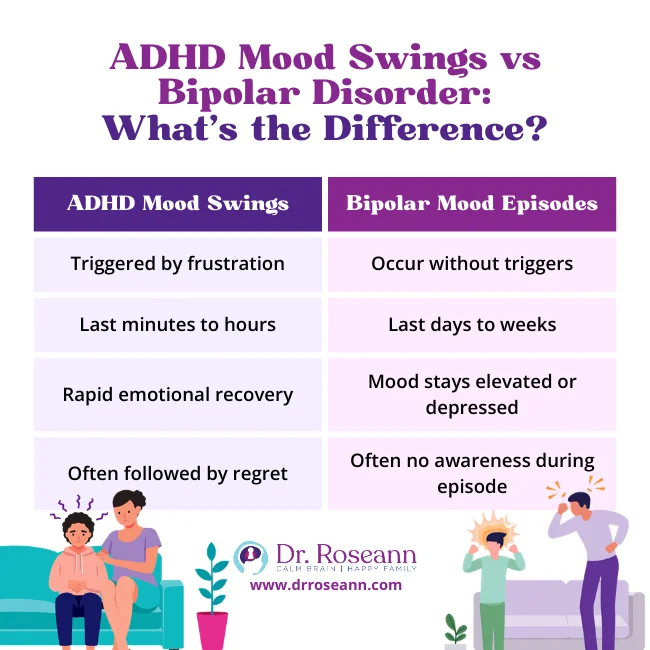
One of the biggest fears parents have is whether their child's ADHD mood swings are actually a sign of bipolar disorder. It is vital to get diagnostic clarity because the treatments are very different.
Children with bipolar disorder and mania experience prolonged periods of elevated mood that are "out of character" and last for days or weeks. In contrast, ADHD swings are situational. If your child is screaming one minute and happily eating a cookie ten minutes later, that points toward ADHD. If you are wondering, Beyond ADHD: Why Your Child’s Explosive Behavior Might Be a Mood Disorder is a great resource to help you distinguish between these complex presentations, including cyclothymia.
Actionable Strategies to Manage Emotional Dysregulation
Managing these outbursts starts with calming the nervous system—both yours and theirs. You cannot reason with a child whose brain is in "red light" mode. We need to implement strategies that support prefrontal cortex function through sleep (Anastasiades et al., 2024) and physical regulation.
One of our favorite tools is the 24-hour rule. This is an agreement that during a high-emotion moment, no major decisions or "consequences" are handed out for 24 hours. This creates an emotional pause. It allows the thinking brain to come back online. When we look at Mood Treatment, we focus on lifestyle interventions first. A nutrient-dense diet and regular physical exercise aren't just "good advice"—they are biological imperatives for a dysregulated brain. If you're seeing constant flares, consider these 17 Reasons a Child Has Mood Swings to see if underlying triggers like hunger or fatigue are the real culprits.
.jpg)
Quick Tips and Long-Term Tools for Stability
When the "flood" happens, try these immediate de-escalation tips:
- Don’t Overreact: Your "big" reaction adds fuel to their fire. Stay "boringly calm."
- Reflective Listening: Say, "I see you are really frustrated that the Wi-Fi cut out." This validates the feeling without excusing the behavior.
- Use Visuals: ADHD kids struggle with the concept of time. Use visual timers to warn them of upcoming transitions.
For long-term success, we use tools like the BRIEF inventory to track executive function deficits. We also know that children with ADHD thrive in structured environments and routines (Harris et al., 2014). Predictability is the antidote to anxiety.
At our centers in Ridgefield, CT, and through our worldwide remote programs, we offer game-changing solutions like neurofeedback and biofeedback that actually "train" the brain to stay in a calm, focused state. If you feel like you've tried everything and nothing is working, it's time to Calm the brain with our expert support. We focus on the root cause—the brain's electrical patterns—rather than just masking symptoms.
Managing ADHD mood swings isn't about "fixing" your child—it's about understanding their unique brain wiring and providing the right scaffolding. Let’s calm the brain first. When the nervous system is regulated, the behavior follows. You’re not alone in this journey, and there are science-backed ways to bring peace back to your home.
Frequently Asked Questions
Can ADHD cause extreme mood swings?
Yes, ADHD causes intense emotional reactions because the brain struggles to filter and modulate feelings. This "emotional flooding" occurs because the prefrontal cortex fails to inhibit the amygdala's signals. This can lead to sudden, disproportionate outbursts in response to minor triggers like frustration, boredom, or perceived rejection.
What is the 24-hour rule for ADHD?
The 24-hour rule is a strategy where an individual (or a parent-child duo) commits to waiting a full day before acting on a strong emotion, responding to a perceived slight, or making a major decision. This allows the "emotional brain" to cool down and the "thinking brain" to regain control, preventing impulsive words or actions that lead to regret.
Can ADHD turn into bipolar disorder?
No, ADHD and bipolar disorder are distinct neurological conditions with different biological origins. While they can co-occur (comorbidity), one does not "turn into" the other. ADHD mood shifts are usually brief, reactive to the environment, and happen throughout the day. Bipolar involves prolonged manic or depressive episodes that last weeks or months and are often independent of daily events.
Why does my child get so angry when I tell them to stop playing games?
This is often due to "hyperfocus interruption." When a child with ADHD is hyperfocused, their brain is finally getting the dopamine it craves. Forcing them to shift to a non-preferred task (like homework) feels like a physical withdrawal. Using transition cues and validation can help bridge this gap.
Are ADHD mood swings different for girls?
Yes, often. Hormonal fluctuations during puberty and the menstrual cycle can significantly worsen ADHD mood swings in girls. Estrogen levels affect dopamine production, meaning that during certain times of the month, ADHD medications may feel less effective and emotional sensitivity may skyrocket.
Citations
Ágrez, K., Vakli, P., Weiss, B., Vidnyánszky, Z., & Bunford, N. (2025). Assessing the association between ADHD and brain maturation in late childhood and emotion regulation in early adolescence. Translational Psychiatry, 15, 185. https://doi.org/10.1038/s41398-025-03411-6
Anastasiades, P. G., de Vivo, L., Bellesi, M., & Jones, M. W. (2022). Adolescent sleep and the foundations of prefrontal cortical development and dysfunction. Progress in Neurobiology, 218, 102338. https://doi.org/10.1016/j.pneurobio.2022.102338
Babinski, D. E., Kujawa, A., Kessel, E. M., Arfer, K. B., & Klein, D. N. (2019). Sensitivity to peer feedback in young adolescents with symptoms of ADHD: Examination of neurophysiological and self-report measures. Journal of Abnormal Child Psychology, 47(4), 605–617. https://doi.org/10.1007/s10802-018-0470-2
Beheshti, A., Chavanon, M.-L., & Christiansen, H. (2020). Emotion dysregulation in adults with attention-deficit/hyperactivity disorder: A meta-analysis. BMC Psychiatry, 20, 120. https://doi.org/10.1186/s12888-020-2442-7
Harris, A. N., Stoppelbein, L., Greening, L., Becker, S. P., Luebbe, A., & Fite, P. (2014). Child routines and parental adjustment as correlates of internalizing and externalizing symptoms in children diagnosed with ADHD. Child Psychiatry & Human Development, 45(2), 243–253. https://doi.org/10.1007/s10578-013-0396-4
Renk, K., White, R., Lauer, B.-A., McSwiggan, M., Puff, J., & Lowell, A. (2014). Bipolar disorder in children. Psychiatry Journal, 2014, Article 928685. https://doi.org/10.1155/2014/928685
Always remember… “Calm Brain, Happy Family™”
Disclaimer: This article is not intended to give health advice, and it is recommended to consult with a physician before beginning any new wellness regimen. *The effectiveness of diagnosis and treatment varies by patient and condition. Dr. Roseann Capanna-Hodge, LLC, does not guarantee specific results.
Are you looking for SOLUTIONS for your struggling child or teen?
Dr. Roseann and her team are all about solutions, so you are in the right place!