%20.png)



Estimated reading time: 10 minutes
How to help a child with ADHD without medication involves supporting the brain and nervous system with proven approaches like neurofeedback, behavioral supports, consistent routines, executive functioning strategies, movement, and healthy lifestyle habits that can improve attention, impulse control, emotional regulation, and overall well-being.
If your child’s behavior feels out of control, you’re not alone.
Many parents of kids with ADHD feel exhausted, frustrated, and unsure what to try next. You’ve done the charts, routines, maybe even medication—but your child still struggles.
One simple shift—calm the brain first—can change everything you try next.
Here’s the truth: it’s not about willpower or bad behavior. It’s about a dysregulated brain that needs help finding calm before it can focus or learn.
I'm Dr. Roseann Capanna-Hodge, and for over 30 years I've helped families find effective ways to support children with ADHD using both traditional and natural approaches. While medication can be helpful for some children, many families also benefit from building stronger regulation skills, improving brain health, and addressing the root causes that contribute to ADHD symptoms.
In this guide, you’ll learn:
How to help a child with ADHD without medication using simple, science-backed strategies that calm the nervous system first
What “Regulate First” Means for ADHD
ADHD is often a dysregulated nervous system—not laziness. We start with Regulate → Connect → Correct.
Calm the brain first. Then skills stick. Then school and home run smoother.
Do this in order:
- Regulate: short breathwork, movement, sensory tools, your calm tone.
- Connect: one validating line (“I’ve got you.”), eye contact, then a cue.
- Correct: one-step instruction, visual support, short work bursts.
Parent snapshot:
Cindy, mom of a 10-year-old, tried a 60-second “reset”—box breathing together, shoulder squeeze, one-step direction. Homework battles dropped fast.
Takeaway: “When I calm, he can.”
“Kids do well if they can.” — Ross W. Greene, PhD, author of The Explosive Child
How to Help a Child With ADHD Without Medication
You asked for simple and doable. Here’s a 7-day starter that respects your energy.
The 7-Day Starter Plan
- Move before tasks: 10–15 minutes of cardio or trampoline before school.
- Work in sprints: 20 minutes focus / 5–10 minutes movement or sensory break.
- Make it visual: checklist, “done bin,” timer.
- Three-second pause: cue → wait three seconds → give the direction.
- Protein every 3–4 hours: eggs, Greek yogurt, nuts, beans.
- Evening wind-down: screens off 60 minutes; dim lights or audiobooks.
- Connection ritual: 10 minutes of play or a walk together.
Parent snapshot:
Owen’s dad added “bike before bus” and a visual checklist. Mornings stopped derailing.
Takeaway:
Tiny structure = big win.
How to Build Executive Function at Home Without Battles
Kids with ADHD don’t see the “micro-steps.” We must teach the sequence and show the result.
Make It Visual and Concrete
- Outcome first: “This is what the clean desk looks like.” Show a photo.
- Chunk tasks: 3 steps on a sticky note.
- Externalize time: timer + “beat the buzzer.”
- Rehearse when calm: practice, don’t rescue.
“ADHD is not a disorder of knowing what to do; it’s a disorder of doing what you know.” — Russell A. Barkley, PhD
Executive Function at Home
Which Natural Tools Are Actually Backed by Research?
Let’s align hope with evidence. These options are non-med and studied.
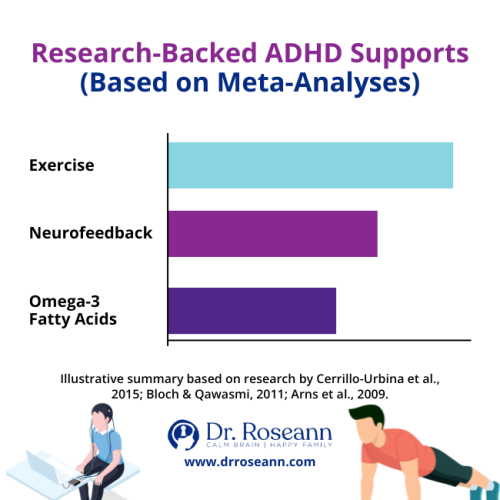
Movement/Aerobic Exercise
Randomized studies show moderate-to-large benefits of exercise on core ADHD symptoms and executive function (Cerrillo-Urbina et al., 2015). Add short cardio bursts before school or homework.
“Exercise is like Miracle-Gro for the brain.” — John J. Ratey, MD, author of Spark
Omega-3 Fatty Acids
A meta-analysis found small-to-moderate improvements in ADHD symptoms with EPA/DHA, especially higher EPA formulas (Bloch & Qawasmi, 2011). Discuss dosing with your clinician.
Neurofeedback
A meta-analysis reported notable reductions in inattention and impulsivity after neurofeedback training (Arns et al., 2009). It teaches the brain a calm–alert state through feedback.
How to Handle Big Emotions in the Moment
Behavior is communication. It isn’t bad parenting—it’s a dysregulated brain. Let’s calm first.
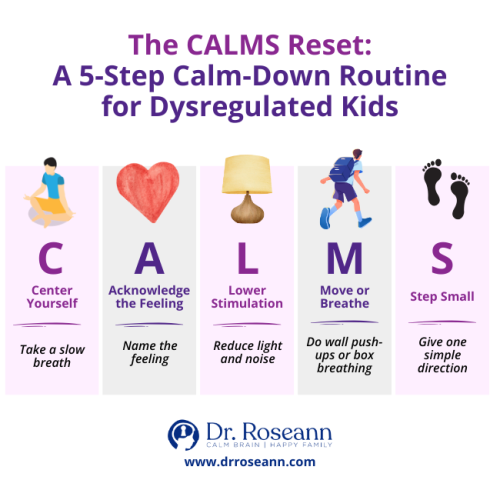
The CALMS Reset
- Center yourself: one slow exhale.
- Acknowledge: “You’re frustrated, and I’m here.”
- Lower stimulation: reduce light/noise; consider headphones or a hoodie.
- Move or breathe: wall push-ups, box breathing, 30-second shake-out.
- Step small: one-step direction + choice of two.
Parent snapshot:
Maya’s 8-year-old melted during transitions. She dimmed the lights, used a weighted lap pad, and whispered a one-step cue. Meltdowns shortened.
Takeaway:
Less talk, more regulate.
What School Supports and 504/Iep Accommodations Truly Help?
You need supports that target attention and regulation.
High-Impact Supports
- Movement breaks and flexible seating (wobble cushion, standing desk).
- Visual schedules, chunked assignments, and extended time.
- Quiet testing, noise-reduction tools, and check-ins before transitions.
- Token systems for task initiation and completion.
How to Start the Conversation
- Share strengths + what works at home.
- Ask for a trial of 2–3 supports for 6–8 weeks.
- Consider a 504 Plan or IEP if academics or behavior are impacted.
Parent snapshot: Sam’s teacher added a standing desk and two scheduled stretch breaks. Work completion rose. Takeaway: movement feeds focus.

What Lifestyle Basics (Sleep, Nutrition, Detox) Move the Needle?
Small shifts. Big wins. Start here.
Sleep
- Same bed/wake within 30 minutes daily.
- Morning sunlight sets the circadian rhythm.
- Screens off 60 minutes; swap to audiobooks.
Nutrition
- Protein every meal; add healthy fats.
- Consider magnesium for ADHD and omega-3 with your provider.
- Use a powered-up smoothie after school.
Gentle Detox & Inflammation Support
- Hydrate. Move daily. Sweat through play.
- Favor whole foods; cut ultra-processed to steady blood sugar.
Neurofeedback or Therapy—How to Choose
If daily tools help but struggles persist, add brain-based support.
Neurofeedback
- Helpful for persistent inattention, impulsivity, and sleep issues.
- Look for QEEG-guided protocols and board-certified providers.
- Evidence points to improvements in inattention/impulsivity (Arns et al., 2009).
Therapy Options
- CBT for negative thinking and skill-building.
- Parent training to reduce friction and increase follow-through.
- Biofeedback for stress regulation and focus.
“External supports make the invisible work of executive skills visible.” — Peg Dawson, EdD, co-author of Smart but Scattered
Will This Work if My Child Is “More Hyper” or “More Spacey”?
Yes. Overactive or underactive—both are dysregulation. You still regulate → connect → correct, but you tune inputs:
- Overstimulation: reduce noise/light, slow breath, heavy work (wall push-ups).
- Understimulation: brisk movement, hydration, upbeat music to spark alertness.
In the middle of your week, if you wonder how to help a child with ADHD without medication, return to the basics. Calm first. Then skills, school, and relationships follow.
Before You Go: Calm First, Then Everything Follows
You did great work today. You learned why we regulate → connect → correct. You saw how short movement, simple visuals, and steady sleep make real change.
You got school supports to ask for. You met research-backed options like exercise, omega-3s, magnesium, CBT, biofeedback, and neurofeedback. Small steps. Big wins.
Need a nudge on what to do next? Use the Free Solutions Matcher: Get a personalized plan in minutes—no judgment, just clear next steps.
You’re not alone. Behavior is communication. Let’s calm the brain first. It’s gonna be OK.
FAQs
How fast will we see change without ADHD Medication?
Some families see calmer mornings within a week with movement and visuals. Brain-based tools may take several weeks. Small steps add up.
Which ADHD supplement should we try first?
Talk to your provider. Many start with omega-3 and magnesium. Track changes for 4–6 weeks.
What if my ADHD child refuses all non-medication interventions?
Start with co-regulation. Lower demands, do one calming activity together, then one tiny step. Offer a choice of two.
How can I help my child with ADHD without medication?
You can help a child with ADHD without medication by focusing on regulation, structure, movement, nutrition, sleep, and executive functioning supports. Consistent routines create a strong foundation.
Are there natural ways to manage ADHD symptoms?
Yes, natural ADHD strategies can include exercise, mindfulness, sensory regulation, behavioral support, and healthy lifestyle habits. These approaches help many children function more effectively.
What daily routines help children with ADHD?
Visual schedules, predictable routines, checklists, and regular movement breaks help children with ADHD stay organized and reduce overwhelm.
Can exercise improve ADHD symptoms naturally?
Yes, exercise can improve ADHD symptoms naturally by supporting attention, mood, emotional regulation, and overall brain health.
How important is sleep for children with ADHD?
Sleep is extremely important for children with ADHD because poor sleep can worsen focus, behavior, and emotional regulation difficulties.
What foods support children with ADHD?
Balanced meals with protein, healthy fats, and nutrient-dense foods can support brain function and energy regulation in children with ADHD.
Can executive functioning support reduce ADHD struggles?
Yes, executive functioning support can reduce ADHD struggles by helping children manage planning, organization, time management, and task completion.
What is the most effective non-medication ADHD support?
The most effective non-medication ADHD support combines regulation, connection, skill-building, and consistency. When the nervous system is calm, children are better able to learn and grow.
Terminology
- Dysregulation: The nervous system is over- or under-activated, making focus and emotion control hard.
- Executive function: The brain’s “manager” skills—planning, starting, organizing, finishing.
- Neurofeedback: Training brainwaves with real-time feedback to build a calm–alert state.
- 504/IEP: School plans that provide accommodations (504) or specialized instruction (IEP).
Citations
Arns, M., de Ridder, S., Strehl, U., Breteler, M., & Coenen, A. (2009). Efficacy of neurofeedback treatment in ADHD: The effects on inattention, impulsivity, and hyperactivity: A meta-analysis. Clinical EEG and Neuroscience, 40(3), 180–189. https://doi.org/10.1177/155005940904000311
Bloch, M. H., & Qawasmi, A. (2011). Omega-3 fatty acid supplementation for the treatment of children with attention-deficit/hyperactivity disorder symptomatology: Systematic review and meta-analysis. Journal of the American Academy of Child & Adolescent Psychiatry, 50(10), 991–1000. https://doi.org/10.1016/j.jaac.2011.06.008
Cerrillo-Urbina, A. J., García-Hermoso, A., Sánchez-López, M., Pardo-Guijarro, M. J., Santos Gómez, J. L., & Martínez-Vizcaíno, V. (2015). The effects of physical exercise in children with attention deficit hyperactivity disorder: A systematic review and meta-analysis of randomized control trials. Child: Care, Health and Development, 41(6), 779–788. https://doi.org/10.1111/cch.12255
Always remember... “Calm Brain, Happy Family™”
Disclaimer: This article is not intended to give health advice, and it is recommended to consult with a physician before beginning any new wellness regimen. The effectiveness of diagnosis and treatment varies from patient to patient and condition to condition. Dr. Roseann Capanna-Hodge, LLC, does not guarantee specific results.
Are you looking for SOLUTIONS for your struggling child or teen?
Dr. Roseann and her team are all about science-backed solutions, so you are in the right place!
©Roseann Capanna-Hodge