%20.png)


Estimated reading time: 6 minutes
Imagine a subtle, mobile tool that gently calms your child's brain when the storm of dysregulation hits—this blog will show you exactly how a pemf device can become that beacon of calm and science-backed support.
As a mom and mental-health clinician, I’ve seen how pemf devices, when used wisely, alongside solid parenting can support kids whose brains feel like chaotic radios searching for signal.
In this article, you’ll learn what PEMF is, how it can help with conditions like ADHD, anxiety, and OCD, how to choose the safest device, and families’ real stories showing how it quietly changes the game.
https://youtu.be/LECzdbLZ9Tw
What conditions can PEMF therapy help with?
Research and clinical practice have shown that PEMF therapy supports a range of challenges common to dysregulated kids:
- ADHD, anxiety, OCD, PANS/PANDAS, depression, ASD, and mood instability —
PEMF gently calms the nervous system and improves cellular communication, helping the brain shift from survival to learning mode.
Early pediatric research has shown feasibility and positive trends in children with cerebral palsy (Pulay, et al.,2024) and autism spectrum disorder (Pietramala, et al., 2024).
- Emotional dysregulation and tantrums —
Families often share that low-frequency PEMF helps their children feel calmer and more regulated, though pediatric-specific data are still emerging.
- Sleep struggles and fatigue —
Adult studies show PEMF can improve sleep quality and reduce insomnia symptoms (Liao, et al., 2023), offering promising support for children who have trouble winding down.

How do I choose the best PEMF device for my child?
Look for options that balance safety, efficacy, and practicality:
- Portable (e.g., CALM PEMF™) vs. mats vs. in-center machines. Portables allow at-home use and gentle protocols; mats offer full-body benefits; in-center machines require appointments but provide close supervision.
- Frequency range: Lower frequencies (1–99 Hz) are ideal for deep calming and healing.
- Certifications: Choose devices that are FDA-registered or CE-certified—this ensures quality and compliance.
- Protocols tailored to needs: Some portables offer presets for attention, stress, sleep, or detox—allowing customization for a child’s symptoms.
- Ease of use and comfort: Kids should find it simple and non-intimidating—portables in fanny-pack formats often work best
Is PEMF therapy safe for kids?
Yes, when used appropriately:
- Generally well tolerated—PEMF is low-intensity and non-invasive.
- Minimal contraindications: Children growing normally are typically safe—but always consult your pediatrician if your child has implants or growth concerns
- Emerging evidence supports its safety even for mood and emotional issues—offering a medication-free option many families appreciate
What kinds of PEMF devices are available?
Parents often see three main types:
- PEMF Mats – Flat mats for full-body use. Adjustable frequencies (1–99 Hz), helpful for pain and inflammation. Kids can lie or even sleep on them.
- In-Center Machines (BRT) – Clinic-based, with sensors and feedback. Relaxed, monitored sessions—great when clinical oversight is needed (e.g., Ridgefield center example).
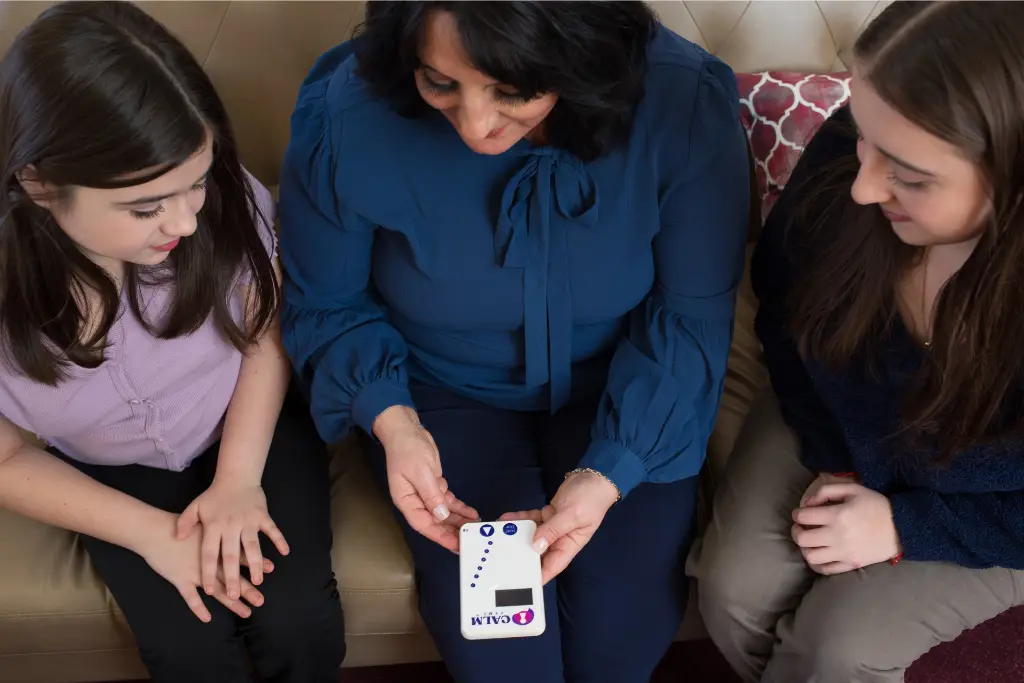
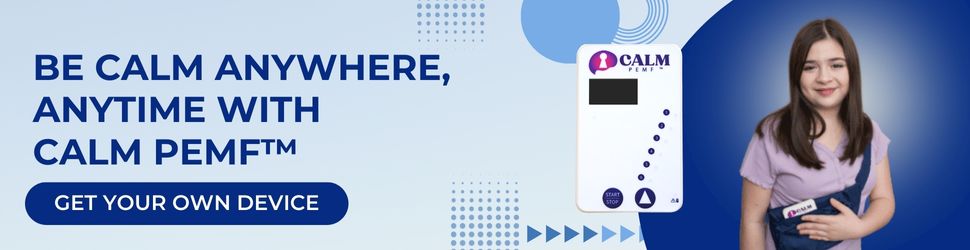
- Portable PEMF Devices (e.g., CALM PEMF™) – Small, discreet, with targeted protocols for attention, anxiety, sleep, PANS/PANDAS, and executive functioning. Use for hours anywhere—schoolbus, bedtime, outings
Brain Science Spotlight
Recent research reveals that low-frequency PEMF boosts nitric oxide production, improving circulation and calming the nervous system—quieting that overwhelmed brain in a non-invasive way. According to Dr. Roseann’s calibrated protocols, “When cellular communication is restored, behavior improves naturally.” It’s not magic—it’s neurobiology.
What this means for your family: You’re offering your child a tool to recalibrate from the inside out—quiet, gentle, and empowering.
Read more: PEMF Therapy Devices: What You Need to Know About Electromagnetic Healing
Dr. Roseann's Therapist Tip
In my 30+ years of clinical practice, I’ve learned that true calm starts with supporting the nervous system first.
Here’s what I tell parents: Pair a PEMF session with a soothing bedtime routine—quiet music, deep breaths, and a reassuring touch.
Try this today: Use the “Calm Brain” protocol on your portable device for 20 minutes before sleep, while reading quietly together.
Why it works: The PEMF prepares the brain to downshift, and bedtime rituals anchor that peace in your child’s rhythm.
Remember: Behavior is communication, not defiance—and it’s gonna be OK.
FAQs
What’s the difference between EMF and PEMF?
EMF is often a constant magnetic field (like from electronics). PEMF uses pulsed frequencies to gently “recharge” cells—making it safe and healing.
How often should we use a portable PEMF device?
Start with short sessions (20–30 minutes), once or twice daily, and adjust based on your child’s response and protocols available.
Can PEMF reduce my child’s reliance on medication?
Many families report symptom improvement that helps reduce medication needs—but PEMF should be an adjunct, under professional guidance, not a standalone treatment.
Are there risks if my child is still growing?
While PEMF is generally safe, if your child has a growth-related condition or metallic implants, please consult your physician first.
Can different PEMF devices be used together?
Yes—portable sessions can complement mat use or in-clinic BRT; just avoid overuse and keep an eye on how your child responds.
Citations:
Liao, J., Wang, s., Zhou, B., Liang, W., Ma, P., Lin, M., Lin, W., Li, C., Zhang, X., Li, H., Cui, Y., Hu, J., Qin, Y., Deng, Y., Fu, A., Zhu, T., Zhang, S., Qu, Y., Xing, L., Li, W., Feng, F., Yao, X., Zhang, G., and Pan, J. (2023). Efficacy and safety of pulse magnetic therapy system in insomnia disorder: a multicenter, randomized, double-blind, placebo-controlled trial. Psychiatry Investig., 20(6):559-566. https://doi.org/10.30773/pi.2022.0362.
Pietramal, K., Greco, A., Garoli, A., and Roblin, D. (2024). Effect of extremely low-frequency electromagnetic field treatment on ASD symptoms in children: a pilot study. Brain Sci., 14(12)1293. https://doi.org/10.3390/brainsci14121293.
Pulay, M., Kornis, K., Dornyei, G., Szabo, E., Horvath, M., Matiscsak, A., Nyakas, C., Zsebe, A., Vissi, T., Mayer, A., and Turi, I. (2024). Feasibility of using pulsed electromagnetic field therapy to improve the dynamic postural balance of children with cerebral palsy: a randomized, sham-controlled pilot study. J Clin Med., 14(1):192. https://doi.org/10.3390/jcm14010192.
Dr. Roseann Capanna-Hodge is a licensed mental health expert that is frequently cited in the media:
- Different Thinking Different Learning How Low Demand Parenting Can Reduce Stress and Support Neurodivergent Youth with Dr. Roseann Capanna-Hodge
- Parade 6 Definitive Traits of a Middle Child, According to Psychologists
- The Experience Miracles (Podcast) Why Traditional Discipline Fails Dysregulated Kids (And What Actually Works)
Disclaimer: This article is not intended to give health advice and it is recommended to consult with a physician before beginning any new wellness regime. *The effectiveness of diagnosis and treatment vary by patient and condition. Dr. Roseann Capanna-Hodge, LLC does not guarantee certain results.
Are you looking for SOLUTIONS for your struggling child or teen?
Dr. Roseann and her team are all about science-backed solutions, so you are in the right place!
©Roseann Capanna-Hodge
Meet the Expert
Licensed Therapist | Certified School Psychologist
Board Certified in Neurofeedback (BCN) | 30+ Years Clinical Experience
Expert in Emotional Dysregulation in Children and Nervous System Regulation
Host, Dysregulated Kids Podcast | Author, The Dysregulated Kid
Dr. Roseann Capanna-Hodge is a licensed therapist, certified school psychologist, and leading expert in emotional dysregulation in children and nervous system regulation. With over 30 years of clinical experience and having analyzed more than 10,000 brain maps, she helps families understand what behavior is really signaling—and how to calm the nervous system first so real change can happen.
She is the creator of Regulation First Parenting™ and the CALMS Protocol™, host of the top 1% podcast Dysregulated Kids, and author of The Dysregulated Kid.