



When kids struggle with focus, meltdowns, and follow-through, teaching executive functioning skills—not pushing harder—is what changes everything.
If your child’s mornings feel like a tornado of reminders, tears, and lost homework, you’re not alone. These are common signs of poor executive functioning in children, and they can make everyday routines feel exhausting.
Below, I’ll show you what are the 12 executive functioing skills that children should essentially have, how to spot gaps, reduce stress, and build the brain skills that make daily life smoother.
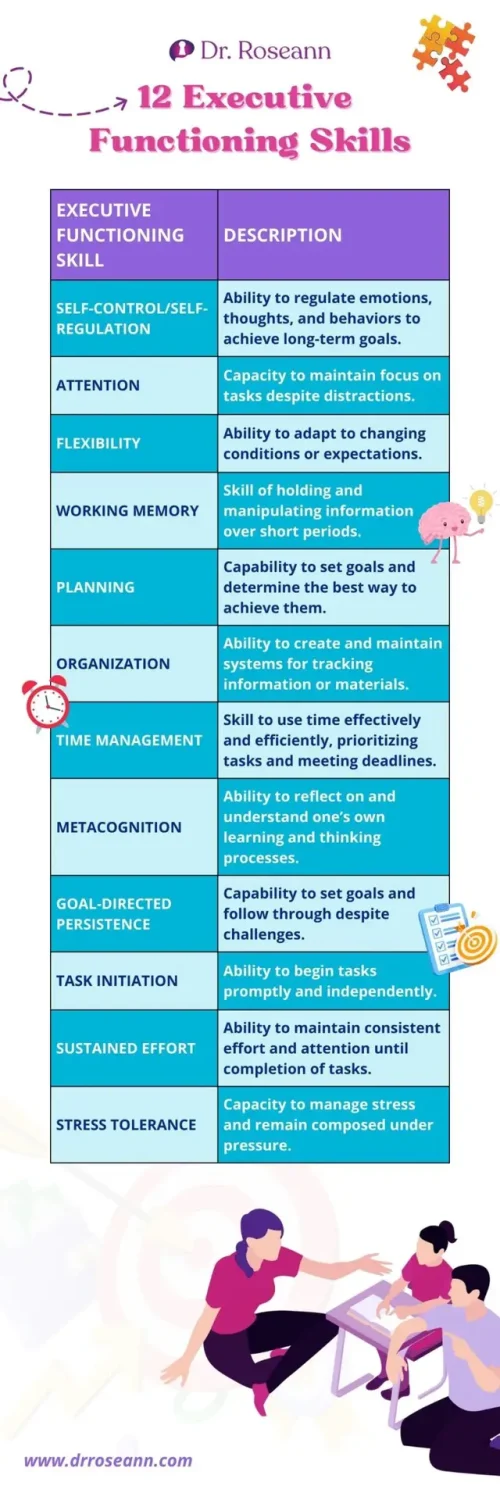
12 Executive Functioning Skills—and Why They Matter
The 12 skills most families need to understand are:
- Self-regulation (inhibitory control)
- Attention
- Flexibility (cognitive flexibility)
- Working memory
- Planning
- Organization
- Time management
- Metacognition
- Goal-directed persistence
- Task initiation
- Sustained effort
- Stress tolerance
They draw on core processes—inhibitory control, working memory, and shifting/flexibility. These are shown across decades of research (Miyake et al., 2000; Diamond, 2013; Best & Miller, 2010).
Big takeaway:
If your child struggles with these skills, it isn’t about laziness—or your parenting. It’s about a brain that’s having a hard time regulating. Once we calm the brain, skills like attention, organization, and planning naturally resurface. That’s when kids can finally start, stay with, and finish tasks.
Signs of Weak Executive Functioning Skills
Weak executive functioning skills often show up in everyday behaviors that can be mistaken for laziness or defiance—but they’re actually poor executive functioning symptoms that point to specific skill gaps.
Instead of labeling your child as “unmotivated,” look for patterns that signal executive functioning challenges:
- “Can’t get started,” even on simple tasks → task initiation challenge
- Trouble following multi-step directions or missed steps → working memory weakness
- Frequently forgetting instructions, homework, or belongings → working memory / organization gaps
- Starts tasks but gets stuck or doesn’t finish → sustained effort breakdown
- Easily distracted or unable to stay focused → attention control difficulty
- Messy backpack, room, or workspace → organization struggles
- Always late, rushing, or losing track of time → time management difficulty
- Big emotional reactions or low frustration tolerance → emotional regulation / stress tolerance challenges
- Difficulty shifting between tasks or handling changes → cognitive flexibility issues
- Gives up quickly or avoids challenging tasks → goal-directed persistence weakness
👉 Think of this as a simple executive functioning checklist—not to label your child, but to understand where support is needed.
Here’s how each executive functioning skill—and its weaknesses—show up at home and at school:
| Executive Functioning Skill | What Weak Skills Look Like | Home Examples | School Examples |
|---|---|---|---|
| Task Initiation | Can’t get started | Stands in front of homework for 10 minutes saying “I don’t know what to do” even when it’s familiar | Sits staring at worksheet while others begin, needs teacher to prompt first step |
| Working Memory | Forgets steps or directions | You say “brush teeth, put on pajamas, then pack your bag” → only does the first step | Forgets multi-step instructions and asks “What are we doing?” after directions were just given |
| Sustained Attention | Easily distracted | Starts cleaning room but ends up playing with toys or walking away halfway | Zones out during lessons, misses key parts of instructions |
| Organization | Disorganized materials | Homework is crumpled in backpack, can’t find shoes or water bottle every morning | Desk is cluttered, loses worksheets, forgets to turn in completed work |
| Time Management | Poor sense of time | Says “I’ll do it later” then suddenly it’s bedtime and nothing’s done | Runs out of time on tests or assignments, even when they know the material |
| Emotional Regulation | Big reactions, low frustration tolerance | Melts down when asked to stop a game or do a small task | Cries, shuts down, or gets overwhelmed when work feels hard or corrected |
| Cognitive Flexibility | Struggles with change | Gets upset if plans change (e.g., different dinner, unexpected errand) | Has trouble switching subjects or adjusting to new instructions |
| Goal-Directed Persistence | Gives up easily | Says “this is too hard” and walks away after one mistake | Stops working when tasks feel challenging, leaves work unfinished |
| Self-Monitoring | Doesn’t notice mistakes | Says work is “done” without checking, even when answers are incomplete | Turns in work with simple errors they could have fixed if reviewed |
Parent story: Mae’s anxious 10-year-old melted down on school mornings. A fridge-posted “Now → Next → After” strip and a 3-step prompt (“Breathe. Start. Check.”) cut friction in half.
Takeaway: Visuals + co-regulation reduce stress so task initiation can happen.
Executive Functioning Skills at Home vs School
Executive functioning skills can look very different at home versus school because the level of structure and support isn’t the same. When demands change, a child’s ability to use these skills—like attention, organization, and emotional control—can shift too.
| Executive Functioning Skill | At School | At Home |
|---|---|---|
| Attention & Focus | Supported by teacher cues and structured lessons | More distractions, requires self-directed focus |
| Task Initiation | Prompted by teachers and clear instructions | May delay or avoid starting tasks independently |
| Working Memory | Reinforced through repetition and guidance | Expected to remember multi-step directions |
| Organization | Systems and routines are provided | Child must manage materials and space more independently |
| Time Management | Schedule is externally managed | Child must estimate and manage time on their own |
| Emotional Regulation | Often suppressed or managed during the day | Emotions released after school (restraint collapse) |
| Cognitive Flexibility | Transitions are guided and predictable | Shifts between activities can feel harder |
| Self-Monitoring | Teachers provide feedback and correction | Requires internal awareness and self-checking |
Micro-wins That Build Big Skills At Home
Executive functioning in children grows through small, repeated wins—not marathon battles. These everyday executive functioning examples show how simple supports can reduce friction and build skills over time.
Skill-By-Skill Quick Wins
| Skill | Practical Supports & Strategies |
|---|---|
| Self-regulation | 4-7-8 breathing before homework; calm-down corner with sensory tools |
| Attention | 10-minute “beat the buzzer” focus sprints; noise-dampening headphones |
| Cognitive flexibility | Rule-switch games (UNO variants); practice “Plan B” scripts |
| Working memory | 3 steps max; picture checklists; “Say it → Do it → Check it” |
| Planning | Backward-plan on a mini whiteboard; Sunday look-ahead; color-code |
| Organization | Backpack reset at 7 pm; one home for each item; labeled bins |
| Time management | Start alarms (not just due alarms); estimate vs. actual charts |
| Metacognition | Daily “2 wins, 1 tweak”; ask, “What helped you start today?” |
| Goal-directed persistence | Micro-goals (10 mins/day); track streaks; celebrate effort |
| Task initiation | Do the easiest 2 minutes first; “body double” (sit nearby) |
| Sustained effort | Pomodoro (25/5); snack + stretch between rounds |
| Stress tolerance | “Name it to tame it”; daily regulation practices (movement, breath) |
Parent story:
Marcus (12, ADHD) froze on multi-step homework. A “Now/Next/After” board + 10-minute sprints + snack breaks = fewer blow-ups and finished work.
Takeaway:
Visual sequencing + short sprints beat nagging.
How Schools Can Lighten Your Child’s Cognitive Load
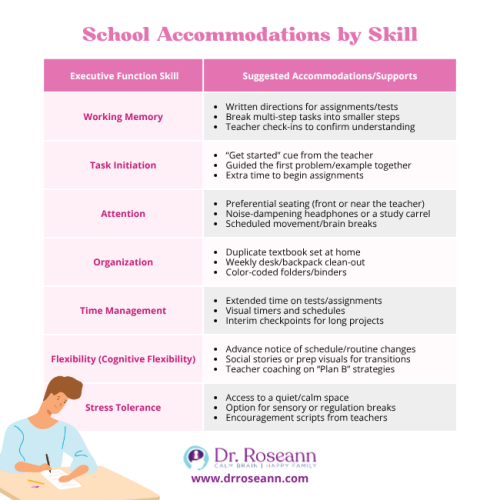
Instead of asking schools to “fix” your child, focus on supports that reduce cognitive load and address real executive functioning challenges—especially as demands increase in middle school and highlight executive functioning problems in teens.
Match Supports to the Skill:
- Working memory: Written directions, chunked tasks, teacher check-ins
- Initiation: “Get-started” prompts; guided first example
- Attention: Preferential seating, movement breaks, noise control
- Organization: Duplicate book set at home; weekly backpack cleanout
- Time management: Visual timers; extended time; interim checkpoints
How to Improve Executive Functioning Skills Naturally
Improving executive functioning skills doesn’t start with pushing harder—it starts with supporting the brain so it can regulate, focus, and follow through more easily. This is especially important for kids with weak executive functioning skills, who need more support—not more pressure.
Here are natural, regulation-first ways to strengthen executive functioning skills in everyday life:
1. Prioritize nervous system regulation
A dysregulated brain can’t plan, focus, or stay organized. Build in daily regulation supports like movement, deep pressure, outdoor time, and calming routines.
2. Create simple, predictable routines
Consistent routines reduce the mental load on executive functioning skills like planning and working memory. Keep steps clear and repeatable.
3. Use external supports
Timers, visual schedules, checklists, and reminders act as a “second brain,” helping kids manage tasks without overwhelm.
4. Break tasks into small, doable steps
Big tasks can shut kids down. Chunking tasks builds confidence and supports task initiation and follow-through.
5. Practice co-regulation before independence
Kids develop executive functioning skills through connection first. When you stay calm and supportive, their brain learns how to do the same.
6. Support sleep, nutrition, and movement
A well-rested, well-fueled brain functions better. Sleep, balanced meals, and regular movement directly impact focus, memory, and emotional control.
7. Teach skills in the moment—not after a meltdown
The best learning happens when a child is calm and receptive. Use real-life moments to model planning, problem-solving, and flexibility.
Executive functioning skills build over time—not overnight. With the right supports in place, kids can strengthen these skills in a way that feels manageable, not overwhelming.
But here’s the piece many parents miss: even the best strategies won’t stick if a child’s brain is overloaded or dysregulated at its core—which is why we need to look closely at the foundational factors that impact regulation every single day.
Why Addressing Stress, Sleep, and Screens Matter More
Executive functions live largely in the prefrontal cortex, which develops across childhood and adolescence. This is why executive functioning skills by age can vary widely—and why younger children need more external support.
Common Drivers of Executive Functioning Struggles:
- Chronic stress, anxiety, or ADHD load
- Poor or inconsistent sleep
- Low physical activity, high screen time
- Mismatch between school demands and child readiness
- Medical/clinical drivers (OCD, ASD, PANS/PANDAS)
What Helps Right Away
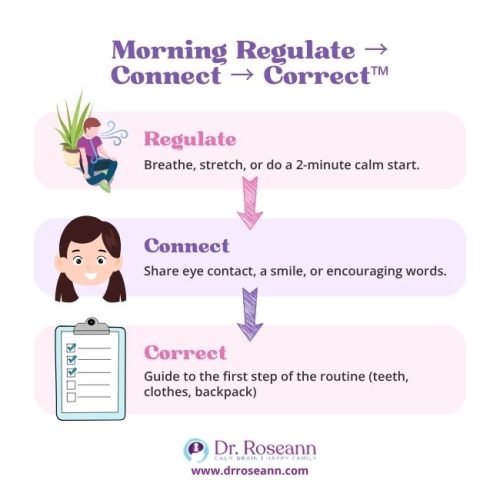
- Regulate → Connect → Correct™: calm the nervous system first, then teach the skill
- Predictable routines and visual schedules
- One-step prompts, task initiation strategies, and movement breaks
- Parent co-regulation (your calm fuels their calm)
“It’s important to recognize both the unity and diversity of executive functions.” —Akira Miyake, Ph D (2000)
When to Call Professional Help
Seek an evaluation when daily life, learning, or mood stays hard despite home and school supports. A clinician can assess EF skills and screen for ADHD, anxiety, mood, OCD, ASD, or PANS/PANDAS. This way, you target the root cause.
Parent story:
Priya’s teen was bright but chronically behind. After an evaluation confirmed ADHD with anxiety, targeted supports + regulation-first routines reduced overwhelm.
Takeaway: Name the pattern → pick the right supports.
How to Track Progress Without Adding Pressure
EFs grow across childhood and adolescence. Its progress accelerates when stress lowers and routines are consistent (Diamond, 2013; Best & Miller, 2010).
Track it like a scientist (but keep it simple)
- Pick 1–2 skills (e.g., task initiation, time management)
- Define success: “Starts homework within 5 minutes with 1 reminder.”
- Track daily checkboxes; review weekly
- Keep what works; tweak one thing at a time
Hope and Action: Moving Forward With Executive Functioning Support
What are the 12 Executive Functioning Skills? They’re the everyday brain tools that help kids start, stick with, and finish tasks—even under stress.
Remember: behavior is communication. When we calm the brain first, then teach one micro-skill at a time, kids and families change.
You’re doing better than you think. If you want a guided path, check out the Executive Functioning Parent Toolkit to see where to start.
Read more about: Children’s Executive Functioning: Hidden Keys to Calm and Success
Frequently Asked Questions
What are signs of poor executive functioning?
Signs of poor executive functioning include difficulty starting tasks, forgetting instructions, poor time management, emotional outbursts, and disorganization—these are common poor executive functioning symptoms in children and teens.
What causes executive functioning problems?
Executive functioning problems are often caused by a combination of brain-based factors like ADHD, anxiety, or developmental delays, along with stress, poor sleep, and environmental demands that overwhelm a child’s ability to regulate.
Is executive functioning the same as ADHD?
No, executive functioning is not the same as ADHD, but ADHD is one of the most common causes of executive dysfunction, affecting skills like attention, task initiation, and impulse control.
Can executive functioning skills improve?
Yes, executive functioning skills can improve with consistent support, practice, and regulation-first strategies that help strengthen the brain’s ability to plan, focus, and manage behavior over time.
At what age do executive functioning skills develop?
Executive functioning skills develop gradually from early childhood through young adulthood, with significant growth during the teen years, which is why executive functioning skills by age can vary widely.
Will my kid grow out of his executive function struggles?
Most kids don’t simply outgrow executive function struggles on their own—executive functioning challenges tend to improve with development, but they need the right support, structure, and skill-building to truly strengthen over time.
Citations
Diamond, A. (2013). Executive functions. Annual Review of Psychology, 64, 135–168.https://doi.org/10.1146/annurev-psych-113011-143750
Miyake, A., Friedman, N. P., Emerson, M. J., Witzki, A. H., Howerter, A., & Wager, T. D. (2000). The unity and diversity of executive functions and their contributions to complex “frontal lobe” tasks: A latent variable analysis. Cognitive Psychology, 41(1), 49–100. https://doi.org/10.1006/cogp.1999.0734
Best, J. R., & Miller, P. H. (2010). A developmental perspective on executive function. Child Development, 81(6), 1641–1660.https://doi.org/10.1111/j.1467-8624.2010.01499.x
©Roseann Capanna-Hodge
For parents who want a deeper understanding of why dysregulation happens—and what actually helps—Dr. Roseann explores these strategies in The Dysregulated Kid.
Always remember… “Calm Brain, Happy Family™”
Disclaimer: This article is not intended to give health advice and it is recommended to consult with a physician before beginning any new wellness regime. The effectiveness of diagnosis and treatment vary by patient and condition. Dr. Roseann Capanna-Hodge, LLC does not guarantee certain results.
Are you looking for SOLUTIONS for your struggling child or teen?
Dr. Roseann and her team are all about science-backed solutions, so you are in the right place!
Meet the Expert
Licensed Therapist | Certified School Psychologist
Board Certified in Neurofeedback (BCN) | 30+ Years Clinical Experience
Expert in Emotional Dysregulation in Children and Nervous System Regulation
Host, Dysregulated Kids Podcast | Author, The Dysregulated Kid
Dr. Roseann Capanna-Hodge is a licensed therapist, certified school psychologist, and leading expert in emotional dysregulation in children and nervous system regulation. With over 30 years of clinical experience and having analyzed more than 10,000 brain maps, she helps families understand what behavior is really signaling—and how to calm the nervous system first so real change can happen.
She is the creator of Regulation First Parenting® and the CALMS Protocol™, host of the top 1% podcast Dysregulated Kids, and author of The Dysregulated Kid.