



Estimated reading time: 9 minutes
The way to calm the limbic system is by using simple, body-based strategies—like slow breathing, movement, and co-regulation—that signal safety to the brain.
If your child’s big feelings seem to hijack their brain, you’re not alone. When the limbic system runs hot, thinking shuts down and fight-or-flight takes over.
An overactive limbic system can make it hard for your child to stay calm or feel in control. That’s why calming the nervous system first is key—so their brain can settle, think clearly, and regain control.
What You'll Learn:
- How the limbic system overrides thinking during stress.
- Why logic and discipline fail during emotional overload.
- Simple ways to calm the brain and body quickly.
What Is the Limbic System—And Why Is Your Child So Reactive?
The limbic system helps us detect threats and feel emotions. The amygdala shouts “danger,” while the prefrontal cortex is the “brakes” that help kids pause, think, and choose.
Under stress, those brakes go offline. That’s why logic or lectures fall flat mid-meltdown.
When this system becomes overactive, it leads to nervous system dysregulation, where the brain struggles with proper nervous system regulation and stays stuck in a stress response.
Parent story:
Sarah, a teen in our , felt like her “amygdala was on fire.” Small frustrations felt huge. When we calmed her brain first, thinking skills came back—and so did hope.
Big takeaways
- You can’t teach a dysregulated brain. Regulate → Connect → Correct™.
- It’s not bad parenting—it’s a dysregulated brain.
How to Know if Your Child’s Limbic System Is Overactive
Look for fight/flight/freeze patterns: explosive anger, panic, perfectionism, avoidance, or shutdown—especially after long school days, transitions, or sensory overload.
Limbic Clues and First Steps
| Trigger | What You Might See (+ Brain Clue) | Try This First |
| Noisy cafeteria | Tears, “I can’t” → means sensory overload | Grounding: 5 things you see |
| Homework after school | Yelling/avoidance → means cognitive fatigue | Snack + 10-min movement |
| Social stress | Stomach aches → means threat detector “on” | Co-regulate + slow exhale |
| Bedtime | Restless/not tired → means limbic > frontal brain | Dim lights + 4-7-8 breathing |
How To Calm Your Nervous System Fast
In the heat of big feelings, go bottom-up (body first), then top-down (thinking). Here’s a quick sequence families love.
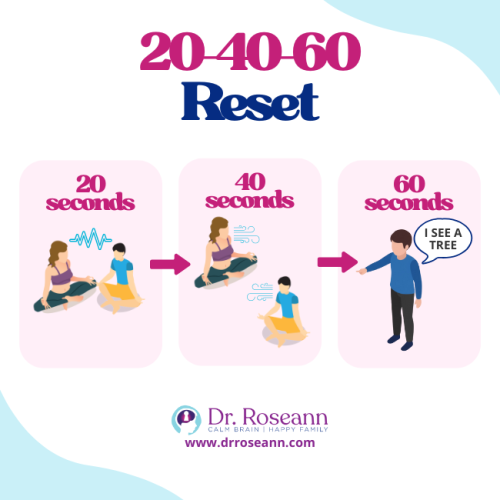
The 20–40–60 Reset (2 Minutes Total)
- 20 seconds: Hum (long “mmm”). Vibration cues the vagus nerve that it’s safe.
- 40 seconds: 4-7-8 breathing (inhale 4, hold 7, exhale 8). Exhale longer than inhale.
- 60 seconds: Grounding (5-4-3-2-1 senses) to bring attention to the present.
“Co-regulation is a biological imperative.” — Stephen Porges, Ph D
Translation for parents: Your calm body helps your child borrow calm.
Parent story:
Mateo freezes at the bus. His mom stands behind him, hands on his shoulders, they hum together and do one round of 4-7-8. His jaw unclenches. Then they can talk. Co-regulation first.
Does Sleep Really Lower Emotional Reactivity
es. Even one short night amps up amygdala reactivity. It means touchier moods and weaker impulse control the next day (Yoo et al., 2007). When you protect sleep, you dial down limbic “heat.”
Do this tonight:
- Keep consistent bed/wake times (±30 minutes).
- Dim lights and screens 60 minutes before bed.
- Use 4-7-8 or gentle humming if worries spike.
“Sleep is emotional first aid. ”
— Matthew Walker, Ph D (sleep scientist)

Will Movement Help Your Anxious or ADHD Child
Movement is medicine for mood. Aerobic exercise improves attention and emotion regulation. And over time, strengthens connections between the frontal “brakes” and limbic regions that drive reactivity (Mandolesi et al., 2018).
Try “movement snacks” (5–15 minutes)
- Brisk walk or scooter loop before homework
- Heavy work: wall push-ups, carry laundry, animal crawls
- Cross-lateral play: march with the opposite elbow to the knee
Parent story:
Sam used to melt down when homework came first. Dad added a 10-minute scooter ride. Fewer fights. Faster work. That’s limbic before logic.
Read more: 101 Self-Regulation Strategies That Actually Work
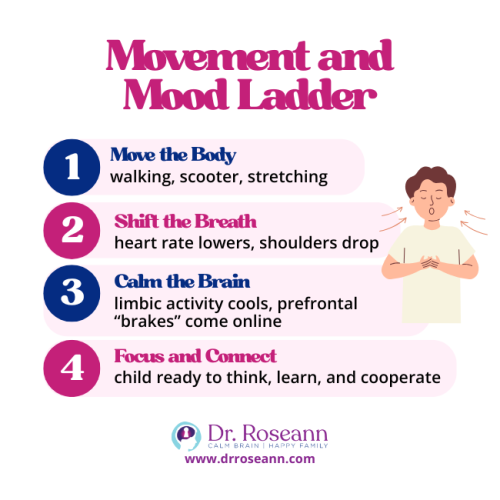
Daily Habits That Steadily “Cool” the Limbic System
You might notice clear signs of a dysregulated nervous system, like irritability, shutdown, anxiety, or difficulty focusing. These are often paired with survival mode symptoms, where the brain is constantly scanning for danger and struggling to feel safe.
Think of gentle nudges you repeat. Small, steady inputs change the brain.
1) Breath + Mindfulness (2–3 Minutes, Twice Daily)
- Pair humming or box breathing with a visual timer.
- Works for anxious and sensory-sensitive kids.
These simple techniques act as powerful vagus nerve exercises, helping signal safety to the brain and calm the nervous system more quickly.
2) Movement Snacks Across the Day
- Short cardio bursts lift mood and reduce stress hormones.
Movement is one of the fastest ways to shift out of fight or flight symptoms and bring the body back into a regulated state.
3) Food That Steadies Energy
- Protein + fiber at breakfast and lunch.
- Keep after-school blood sugar dips from feeding meltdowns.
The right kind of diet and nutrition supports nervous system regulation, helping the brain move out of stress and into safety.
4) Tech and Light Hygiene
- Dim lights at night; daylight in the morning.
- Move devices out of bedrooms.
Less screen time prevents emotional dysregulation by keeping the nervous system untriggered and calm.
5) Home Therapies Parents Ask About
- Neurofeedback for anxiety: trains calmer, more flexible brain states; great with skills work.
- QEEG brain map: shows over/under-activation so you can target supports.
- PEMF therapy for stress/pain: some families use as an adjunct for calm and comfort.
Over time, these strategies don’t just reduce stress—they teach your brain and body how to regulate your nervous system more effectively. That’s how lasting change happens.
When Do We Need Professional Help—And What Should We Ask For?
Reach out now if you see:
- Meltdowns most days that disrupt home or school
- Self-harm talk/behavior (safety first)
- Intense anxiety, rituals, or mood swings
- No progress after 4–6 weeks of steady basics
Ask providers about:
- A Regulation-First plan (co-regulation + sensory supports + sleep + school accommodations)
- QEEG-guided neurofeedback if anxiety and reactivity are stuck
- Screening for ADHD, anxiety, OCD, ASD, or PANS/PANDAS with a nervous-system lens
Parent story:
Keira’s panic spiked at practice. After four weeks of sleep support, breath-before-bus, and a QEEG-informed plan, she stayed for full practices. Same kid. Calmer brain.
One Small Daily Shift That Changes Everything
You don’t need to overhaul your whole routine to help your child feel calmer—you just need one small, consistent step. The brain learns safety through repetition, not perfection.
Start with these tiny, doable habits:
- Morning: 90 seconds of humming + 4-7-8 breathing to set a calm tone.
- After school: A 10-minute movement break to shake off stress before homework.
- Evening: Lights dimmed and screens off one hour before bed for deeper rest.
Each time you choose calm over chaos, you’re rewiring your child’s nervous system for resilience. These small, steady actions build emotional strength, focus, and connection.
This is the heart of how to calm the limbic system—not with force or fear. But through gentle repetition, co-regulation, and hope.
Your calm presence teaches your child that they’re safe, seen, and capable of change. You’re not failing. You’re healing—together. It’s gonna be OK.
FAQs
How long does it take to calm the nervous system and see changes?
When you consistently support nervous system regulation, many families notice small improvements in 1–2 weeks, with more meaningful shifts in emotional dysregulation over 4–8 weeks.
What if my child refuses breathing exercises to calm the nervous system?
If your child resists breathing exercises, focus on co-regulation to calm the nervous system—model it yourself and offer simple choices like movement to gently support nervous system regulation.
Are these strategies only for anxiety, or do they help other conditions too?
No, these strategies go beyond anxiety—they help with ADHD, OCD, ASD, and PANS/PANDAS by addressing nervous system dysregulation and reducing fight or flight symptoms.
Are PEMF and neurofeedback safe for nervous system regulation?
When used with trained providers and proper screening, PEMF and neurofeedback can support nervous system regulation and reduce signs of a dysregulated nervous system, especially when paired with core habits like sleep and movement.
What are signs of an overactive limbic system?
Signs of an overactive limbic system include anxiety, irritability, emotional outbursts, and difficulty focusing, all of which reflect nervous system dysregulation and being stuck in a stress response.
How do I calm my child’s nervous system quickly?
To calm your child’s nervous system quickly, focus on slow breathing, gentle movement, and sensory strategies, which help shift the body out of stress and support nervous system regulation.
What causes the limbic system to become overactive?
The limbic system becomes overactive due to chronic stress, trauma, sensory overload, or lack of regulation skills, all of which can lead to ongoing emotional dysregulation.
Can stress keep you stuck in fight or flight?
Yes, chronic stress can keep you stuck in fight or flight, leading to persistent fight or flight symptoms like anxiety, hypervigilance, and difficulty calming down.
What are the best vagus nerve exercises for calming down?
The best vagus nerve exercises for calming down include deep breathing, humming, cold exposure, and gentle movement, all of which help calm the nervous system and restore balance.
Terminology
- Limbic system: Emotion/survival network (amygdala, hippocampus).
- Amygdala: Threat detector; fires fast under stress.
- Prefrontal cortex: “Brakes” for focus and self-control.
- Co-regulation: Your calm helps your child’s body calm.
- Vagus nerve: A Pathway that slows heart rate and supports calm.
- QEEG: Brain map showing activation patterns.
- Neurofeedback: Training the brain to spend more time in calm, focused states.
Citations
Yoo, S.-S., Gujar, N., Hu, P., Jolesz, F. A., & Walker, M. P. (2007). The human emotional brain without sleep—A prefrontal amygdala disconnect? Current Biology, 17(20), R877–R878. https://www.cell.com/current-biology/fulltext/S0960-9822(07)01783-6
Mandolesi, L., Polverino, A., Montuori, S., Foti, F., Ferraioli, G., Sorrentino, P., & Sorrentino, G. (2018). Effects of physical exercise on cognitive functioning and wellbeing. Frontiers in Psychology, 9, 509. https://www.frontiersin.org/articles/10.3389/fpsyg.2018.00509/full
Quevedo, K., Teoh, J. Y., Engstrom, M., Wedan, R., Santana-Gonzalez, C., Zewde, B., Porter, D., & Cohen Kadosh, K. (2020). Amygdala circuitry during neurofeedback training and symptom change in adolescents with depression. Frontiers in Behavioral Neuroscience, 14, 110. https://www.frontiersin.org/articles/10.3389/fnbeh.2020.00110/full
©Roseann Capanna-Hodge
For parents navigating ADHD challenges, The Dysregulated Kid provides specific guidance on supporting neurodivergent brains through practical regulation strategies.
Always remember… “Calm Brain, Happy Family™”
Disclaimer: This article is not intended to give health advice and it is recommended to consult with a physician before beginning any new wellness regime. The effectiveness of diagnosis and treatment vary by patient and condition. Dr. Roseann Capanna-Hodge, LLC does not guarantee certain results.
Are you looking for SOLUTIONS for your struggling child or teen?
Dr. Roseann and her team are all about science-backed solutions, so you are in the right place!
Meet the Expert
Licensed Therapist | Certified School Psychologist
Board Certified in Neurofeedback (BCN) | 30+ Years Clinical Experience
Expert in Emotional Dysregulation in Children and Nervous System Regulation
Host, Dysregulated Kids Podcast | Author, The Dysregulated Kid
Dr. Roseann Capanna-Hodge is a licensed therapist, certified school psychologist, and leading expert in emotional dysregulation in children and nervous system regulation. With over 30 years of clinical experience and having analyzed more than 10,000 brain maps, she helps families understand what behavior is really signaling—and how to calm the nervous system first so real change can happen.
She is the creator of Regulation First Parenting® and the CALMS Protocol™, host of the top 1% podcast Dysregulated Kids, and author of The Dysregulated Kid.