%20.png)



Estimated reading time: 9 minutesHave you been up late googling ways to help your child calm down, focus better, or finally get some sleep?I talk to parents every single day who feel like they’ve tried everything—routines, therapies, reminders—and still their child’s brain just won’t settle. The meltdowns, the restless nights, the constant worry… it can feel exhausting and lonely.One of the questions I hear most often is: “Which magnesium supplement should I try—magnesium threonate or magnesium glycinate?” And it’s a smart question, because magnesium is one of the body’s natural calming minerals.Magnesium plays a huge role in regulating mood, focus, and sleep. But here’s the tricky part: not all forms of magnesium work the same way. Threonate and glycinate are two of the most popular types, especially for kids with ADHD, anxiety, OCD, mood struggles, or sleep issues—and each one has its own strengths.In this article, you’ll learn:
- The difference between magnesium threonate and glycinate
- Which form may be best for sleep, focus, and emotional regulation
- How magnesium supports the dysregulated brain
- A real-life parent story that shows what a difference the right supplement can make
What is Magnesium and Why Does the Brain Need It?
Magnesium is often called the “calming mineral” because it helps regulate brain activity, stress hormones, and nervous system balance.
- Supports neurotransmitters (brain messengers) like serotonin and dopamine
- Calms overactive fight-or-flight responses
- Helps with sleep regulation and muscle relaxation
- Plays a role in learning, focus, and memory

“Magnesium can help with keeping our neurotransmitters from over‑firing and making anxiety worse… it does this by blunting the release of glutamate…and helping release GABA, the inhibitory neurotransmitter. In some ways, magnesium can mimic what some of our anxiety medications do.” - Dr. Joseph Austerman
What is Magnesium Threonate?
Magnesium threonate is a newer form of magnesium known for its ability to cross the blood-brain barrier—meaning it directly impacts brain cells.Benefits parents notice:
- Supports memory and learning
- Reduces anxious thinking
- May improve focus and mental clarity
What is Magnesium Glycinate?
Magnesium glycinate is magnesium bound to glycine, an amino acid that has calming and sleep-supportive effects.Benefits:
- Relaxes blood vessels promoting optimal blood flow
- Helps kids fall and stay asleep
- Supports insulin sensitivity – vital for maintaining a healthy blood sugar level and overall metabolic function
- Reduces muscle tension and physical restlessness
- Calms “wired but tired” nervous systems
This form is highly bioavailable, meaning the body absorbs it well, and it’s gentle on the stomach compared to other forms.
💡 Clara’s Story — The Struggle
Clara’s story comes to mind when I think about how beneficial magnesium is. Clara is a mom of a 9-year-old with ADHD who was at her wit’s end with bedtime battles. Every night ended in tears—hers and her son’s. He’d toss, turn, and resist sleep, sometimes until midnight. Doctors told her to “just be consistent,” but routines alone weren’t enough.
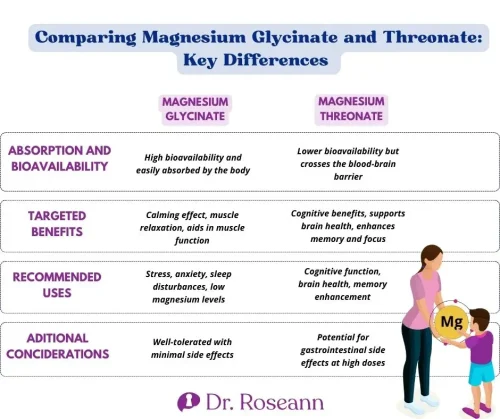
Magnesium Threonate vs. Glycinate: What’s the Difference?
While both support regulation, they serve slightly different needs:
How Magnesium Threonate and Glycinate Work in the Brain and Body
While both forms of magnesium support regulation, they work in slightly different ways:
Magnesium Threonate
- Uniquely able to cross the blood-brain barrier (Slutsky et al., Neuron, 2010), which means it enters brain cells more directly.
- Enhances synaptic plasticity — the brain’s ability to build and strengthen new connections for learning and memory – at the cellular level (Chen et al., 2024)
- Helps regulate NMDA receptors, which play a role in how the brain processes stress and new information.
Recent research shows magnesium threonate may support brain function not only directly via synapses but also through gut-brain communication—by influencing gut bacteria and reducing inflammation that impacts brain health (Wang et al., 2024).As a takeaway, think of threonate as a “brain nutrient” that helps with focus, memory, and calming an anxious mind.
Magnesium Glycinate
- Combines magnesium with glycine, an amino acid that acts as a natural calming signal (Schmidt and Thompson, 2016).
- Boosts GABA activity, the neurotransmitter that tells the brain “it’s okay to rest.”
- Calms muscle activity and reduces the physical tension that often fuels restlessness.
Glycinate works more on the body’s relaxation system, helping kids fall asleep and feel less wound-up.

Which Magnesium is Best for Sleep and Relaxation?
For kids who toss and turn at night, magnesium glycinate is often the winner.
- Reduces bedtime resistance
- Helps calm body tension
- Supports melatonin production indirectly
💡 Clara’s Story — The Turning Point
When Clara learned about magnesium glycinate’s calming properties, she decided to try it—with her pediatrician’s guidance. Within a week, she noticed something different: her son wasn’t fighting sleep. He actually yawned at bedtime.By the second week, meltdowns were rare, and bedtime shifted from a battleground to a predictable, calmer routine.
Which Magnesium is Best for Focus, Learning, and Anxiety?
When parents worry about focus, test anxiety, or racing thoughts, magnesium threonate may be more effective.
- Improves learning capacity
- Helps regulate stress responses
- Supports working memory
How to Choose the Right Magnesium Supplement for Your Child
Every child is unique, so it’s important to consider:
- Main struggle: Is it sleep? Or focus and anxiety?
- Tolerance: Start low and increase slowly.
- Professional guidance: Always consult your child’s provider before starting supplements.
💡 Clara’s Story — The Bigger Impact
With her son getting better sleep, Clara’s mornings changed too. Her son was less cranky, got ready for school without explosive arguments, and even started enjoying breakfast again.Clara described it as “getting our evenings back as a family.” For her, magnesium glycinate wasn’t just a supplement—it was a lifeline that gave everyone in the household a little more peace.Choosing between magnesium threonate vs. glycinate doesn’t have to feel overwhelming.Remember:calm the brain first, and everything else—behavior, learning, family peace—flows from there.And you’re doing a great job seeking out science-backed tools to help your child thrive!
FAQs About Magnesium Threonate vs. Glycinate
Does magnesium really help with child anxiety?
Yes. Magnesium calms the nervous system and can reduce anxious thoughts. It’s not a cure-all but can be a powerful support.
Can I give both magnesium threonate and glycinate together?
Some families use both—one for daytime focus and one for nighttime calm—but always consult your provider.
How long does it take to notice benefits?
Parents usually notice changes within 2–4 weeks, though it may be sooner for sleep.
Is magnesium safe for kids?
Generally yes, but dosage and form matter. Talk to your child’s doctor before starting.
Terminology
- Bioavailability – how easily the body absorbs a nutrient.
- Blood-brain barrier – a filter that protects the brain from toxins, but also limits which nutrients get inside.
- Synaptic plasticity – how brain cells build new connections for learning and memory.
Citations
Chen, F., Wang, J. Cheng, Y., Li, R., Wang, Y., Chen, Y., Scott, T., and Tucker, K. (2024). Magnesium and cognitive health in adults: a systematic review and meta-analysis. J. Adv. Nutrition, 15(8). https://doi.org/10.1016/j.advnut.2024.100272.Schmidt, R. and Thompson, M. (2016). Glycinergic signaling in the human nervous system: an overview of therapeutic drug targets and clinical effects. Ment. Health Clin., 6(6):266-276. https://doi.org/10.9740/mhc.2016.11.266.Slutsky, I., Abumaria, N., Wu, L-J., Huang, C., Zhang, L., Li, B., Zhao, Z., Govindarajan, A., Zhao, M-G., Tonegawa, S., and Liu, G. (2010). Enhancement of learning and memory by elevating brain magnesium. Neuron, 65(2):165-77. https://doi.org/10.1016/j.neuron.2009.12.026.Wang, L., Wei, J., Liu, C., Luo, H., Ruan, Y., Mai, Y., Yu, Q., Cao, Z., Xu, J., Zheng, D., Sheng, Z., Zhou, X., and Liu, J. (2024). Magnesium L-threonate treats Alzheimer’s disease by modulating the microbiota-gut-brain axis. Neur. Reg. Res., 19(10). https://doi.org/10.4103/1673-5374.391310.
Always remember… “Calm Brain, Happy Family™”
Disclaimer: This article is not intended to give health advice and it is recommended to consult with a physician before beginning any new wellness regime. The effectiveness of diagnosis and treatment vary by patient and condition. Dr. Roseann Capanna-Hodge, LLC does not guarantee certain results.
Are you looking for SOLUTIONS for your struggling child or teen?
Dr. Roseann and her team are all about science-backed solutions, so you are in the right place!

© Roseann Capanna-Hodge
Meet the Expert
Licensed Therapist | Certified School Psychologist
Board Certified in Neurofeedback (BCN) | 30+ Years Clinical Experience
Expert in Emotional Dysregulation in Children and Nervous System Regulation
Host, Dysregulated Kids Podcast | Author, The Dysregulated Kid
Dr. Roseann Capanna-Hodge is a licensed therapist, certified school psychologist, and leading expert in emotional dysregulation in children and nervous system regulation. With over 30 years of clinical experience and having analyzed more than 10,000 brain maps, she helps families understand what behavior is really signaling—and how to calm the nervous system first so real change can happen.
She is the creator of Regulation First Parenting™ and the CALMS Protocol™, host of the top 1% podcast Dysregulated Kids, and author of The Dysregulated Kid.