%20.png)



Estimated reading time: 7 minutes
Changes in communication during dysregulation happen because stress shifts how your child’s brain functions in real time.
When the nervous system is overwhelmed, the brain prioritizes survival over connection—so the areas responsible for language, word retrieval, and clear expression (like the prefrontal cortex) go offline, while the emotional brain takes over.
That’s why your child might suddenly stop talking, say “I don’t know,” speak in fragments, or not be able to explain what they’re feeling—even if they usually communicate just fine.
Read about: Signs and Symptoms of a Dysregulated Nervous System
In this post, we’ll break down:
- how stress disrupts speech
- the specific communication changes to watch for
- how you can support your child by calming the nervous system first so their words can come back online

What Is Nervous System Dysregulation?
Nervous system dysregulation happens when a child’s brain and body can’t maintain a sense of internal balance or calm. Their system is stuck in survival mode—fight, flight, or freeze—which hijacks essential brain functions like focus, emotional control, and yes, speech.When the nervous system is overloaded, it becomes harder for a child to access the thinking and language centers of the brain. That’s why some kids go silent, talk too fast, or say things that don’t quite make sense when they’re dysregulated.
What Are Speech and Communication Changes During Dysregulation?
When a child is dysregulated, their nervous system shifts gears and the way they use language can change dramatically.The logical, language-based part of the brain (the prefrontal cortex and Broca’s area) loses priority. Blood flow and resources go instead to areas that handle survival.As a result, your child may go completely silent, or they may talk so fast that their words come out jumbled or hard to follow. You might hear off-topic comments, repeated phrases, or even baby talk. These aren’t just habits—they’re nervous system responses.Instead of expressing, “I’m scared,” your child might:
- Go silent (sudden mutism)
- Whine or cry
- Say words that don’t fit the situation
- Talk excessively fast or repeat phrases
These are all signs that speech and communication is being affected by dysregulation.
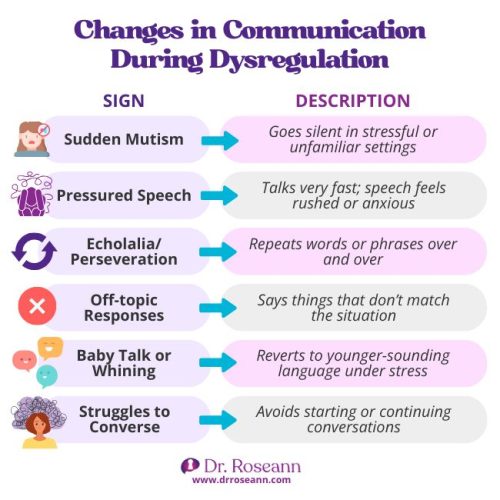
Recognizing Changes in Communication and Speech During Dysregulation
Here are key behaviors that may signal your child’s communication is being disrupted by emotional dysregulation:
- Sudden mutism: Your child goes silent, especially in stressful or unfamiliar settings
- Rapid, pressured speech: Words tumble out quickly, like they’re trying to keep up with their anxiety
- Off-topic comments or echolalia: Repeating phrases, scripting, or saying things that don’t fit the moment
- Whining, baby talk, or yelling: Regression in tone or emotional overflow replaces structured language
- Echolalia/perseveration: Repeating the same words over and over to self-soothe or regain control
- Conversation struggles: Your child may avoid initiating or maintaining a conversation
Why This Happens: The Neurology Behind Speech Shutdown
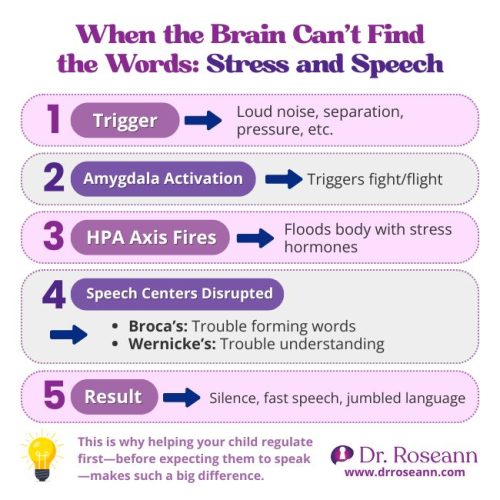
Stress doesn’t just make kids anxious—it changes how the brain functions in real time. When a child experiences emotional dysregulation, several parts of the brain responsible for communication go offline or become less effective:
- Amygdala activation: This is the brain’s threat detector. When activated, it sends out a distress signal that hijacks higher-order brain functions, including speech and reasoning.
- HPA axis response: The hypothalamic-pituitary-adrenal (HPA) axis releases cortisol and other stress hormones that prime the body for fight-or-flight. This hormonal cascade deprioritizes language processing in favor of survival.
- Broca’s and Wernicke’s area inhibition: Broca’s area (speech production) and Wernicke’s area (language comprehension) may become less active or disrupted during high stress, making it hard for kids to formulate or understand speech.
- Reduced vagal tone: The vagus nerve connects the brain to major organs, including those tied to speech and emotional regulation. Low vagal tone is associated with poorer ability to calm oneself and communicate clearly.
Simple analogy: “It’s like a crowded freeway—no smooth passage for the message to travel.” because their brains may have heightened sensitivity to stress, making speech disruptions more common when overwhelmed.
What Research Says
Several scientific studies back up what we see clinically: the nervous system plays a major role in whether a child can access and express language.
- A 2019 study (Walsh et al., 2019) found that children who stutter show consistently higher sympathetic nervous system arousal—even during non-speech tasks—suggesting that stress directly impacts fluency and speech production.
- Another study (Smith and Pollac, 2020) found that chronic HPA axis activation from early stress can actually alter brain regions involved in communication, including the prefrontal cortex, amygdala, and hippocampus.
- In children with autism spectrum disorder, research highlights how dysregulated cortisol levels and autonomic nervous system responses are linked to trouble regulating speech in social situations (Makris et al., 2022)
What Parents Can Do
You don’t need to be a therapist to help your child through speech dysregulation. Here are supportive, research-backed strategies:
1. Co-Regulation Comes First
Your child can't speak clearly if their nervous system isn’t calm. Start here:
- Sit or kneel at their level
- Use a soft voice and slow pace
- Breathe with them to signal safety
2. Teach Simple, Repeatable Phrases
When your child is regulated, practice go-to phrases:
- “I need help.”
- “Can I take a break?”
- “I feel ___.”
Use visuals like feeling charts or emotion cards to support word recall.
3. Use Nonverbal Communication Tools
During dysregulated states:
- Let them point to images
- Offer drawing or writing options
- Try AAC tools if appropriate (low-tech or high-tech options)
4. Focus on Sensory Regulation
Sensory input can reset the system and support verbal access:
- Deep pressure: weighted blankets, firm hugs
- Movement: jumping, swinging, wall pushes
- Fidgets: tactile or oral motor toys
When to Seek Professional Help
If speech issues happen often or interfere with daily life, trust your gut—it’s worth investigating.Some kids need extra support from professionals:
- Speech-language pathologist (SLP): For speech delays, mutism, stuttering, or difficulty expressing/understanding language.
- Occupational therapist (OT): For sensory processing challenges contributing to speech shutdowns.
- Child psychologist or therapist: When anxiety, trauma, or emotional regulation are core contributors.
FAQs
Can stress really cause communication problems in children?
Yes. Stress can absolutely cause communication problems in children because when the nervous system is in fight, flight, or freeze mode, the brain can’t easily access language. It’s not about ability—it’s about overwhelm.
My child talks fine sometimes but goes silent when upset. Is that a red flag?
It can be. When a child talks fine but goes silent when upset, it’s often a sign their nervous system is overwhelmed, not that something is “wrong.” Look for patterns around stress and triggers.
What should I do if I think my child’s communication issues are stress-related?
If communication issues are stress-related, start by calming the nervous system first. Co-regulation, predictable routines, and sensory supports help your child feel safe enough to access their words again.
Will my child outgrow communication struggles during dysregulation, or do I need to get help?
Some kids do outgrow communication struggles during dysregulation, but many need support. If it’s frequent or affecting daily life, getting help early can make a big difference.
What helps kids who freeze or talk too fast when upset?
Kids who freeze or talk too fast when upset need support to slow their nervous system down. Use a calm voice, offer simple words, and add movement or pressure to help them regain control and clarity.
Why does my child say “I don’t know” when I ask what’s wrong?
When a child says “I don’t know,” it usually means their brain is too dysregulated to process and explain feelings. “I don’t know” is often a sign of overwhelm, not avoidance.
Is it normal for kids to lose their words during a meltdown?
Yes, it’s very normal for kids to lose their words during a meltdown. During intense dysregulation, the brain shifts into survival mode, and language temporarily goes offline.
How can I help my child communicate better during emotional outbursts?
To help your child communicate better during emotional outbursts, focus on regulation first, not talking. When the body calms down, communication naturally becomes easier and more accessible.
Citations
Makris, G., Agorastos, A., Chrousos, G., and Pervanidou, P. Stress system activation in children and adolescents with Autism Spectrum Disorder. Front. Neurosci. 13 (15). https://doi.org/10.3389/fnins.2021.756628
Smith, K., and Pollak, S. (2020). Early life stress and development: potential mechanisms for adverse outcomes. J. Neurodev. Dis. 12(34). https://doi.org/10.1186/s11689-020-09337-y
Walsh, B., Smith, A., Christ, S., and Weber, C. (2019). Sympathetic nervous system activity in preschoolers who stutter. Front. Hum. Neurosci. 13. https://doi.org/10.3389/fnhum.2019.00356
Dr. Roseann is a mental health expert in Self-Regulation who frequently is in the media:
- Healthline Understanding Self-Regulation Skills
- HomeschoolOT Therapy Services Understanding Nervous System Dysregulation in Children: A Guide for Homeschool Parents
Always remember… “Calm Brain, Happy Family™”
Disclaimer: This article is not intended to give health advice and it is recommended to consult with a physician before beginning any new wellness regime. *The effectiveness of diagnosis and treatment vary by patient and condition. Dr. Roseann Capanna-Hodge, LLC does not guarantee certain results.
Are you looking for SOLUTIONS for your struggling child or teen?
Dr. Roseann and her team are all about science-backed solutions, so you are in the right place!
Grab your complimentary copy of