%20.png)



Estimated reading time: 10 minutes
To discipline a child with PDA, start by reducing anxiety, keep demands low and flexible, and use calm, collaborative strategies instead of control to prevent power struggles.
If you’re parenting a child with PDA (Pathological Demand Avoidance), I know how exhausting this can feel. You’ve likely tried charts, consequences, and pep talks—and you’re still getting pushback at every turn. You’re not doing anything wrong. Your child’s brain is overwhelmed, and when that happens, they simply can’t access cooperation.
In my 30+ years of working with families, I’ve seen this again and again: when you calm the brain first, behavior starts to shift. That’s the heart of my Regulation First Parenting™ approach—Regulate → Connect → Correct.
In this article, I’ll walk you through:
- what PDA really is
- why traditional discipline often backfires
- what actually works to lower resistance and build cooperation—without constant power struggles
What Are the Top Parenting Tips for Navigating Homework Challenges This Year?
PDA describes a profile—most often within autism—where everyday demands trigger intense anxiety and avoidance. It isn’t a standalone diagnosis in most systems, and the research base is still developing (Kildahl et al., 2021).
It means your child isn’t being “willful;” they’re protecting themselves from overwhelm. When a child’s brain senses danger, rewards and punishments don’t land.
Big takeaway:
Behavior is communication. If we reduce threat and increase safety, cooperation rises.
Parent snapshot (Lena, age 8):
Mornings were chaos. “Put on shoes” led to hiding under the table. When Mom paused, co-regulated with slow breaths, and turned the demand into a choice (“Sneakers first or backpack first?”), Lena moved—no fight. The shift wasn’t magic. It was nervous system science.

How Does Nervous System Dysregulation Drive Pda Behaviors?
A dysregulated nervous system reads normal requests as danger. That sparks fight, flight, or freeze.
In PDA, “flight” can look like a witty deflection, negotiation, or full refusal. You can’t teach or correct a dysregulated brain. We calm first.
- Regulate: co-regulation, breath, movement, sensory input
- Connect: safety language, empathy, collaboration
- Correct: problem-solve and teach skills when calm
“You don’t get to learning until you get to calm.” — Stephen Porges, PhD (polyvagal theory—paraphrased)
How to Discipline a Child With Pda Without Power Struggles
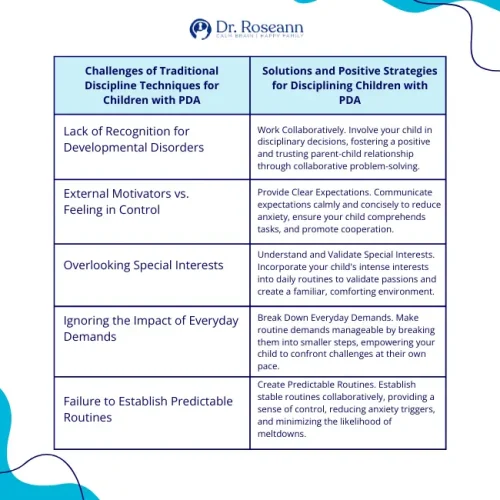
Think “discipline = teach,” not “discipline = punish.” Meet the need for control and hold boundaries.
Do this instead of that
- Swap demands for invitations. “Time for math” → “Want to start with the easy or the tricky problem?”
- Use collaborative problem-solving. “We both need the morning to go smoother. What could help?”
- Offer micro-choices within non-negotiables. “Seatbelt on—front click or top click first?”
- Pre-agree to limits. Co-create a When/Then script: “When toys are in the bin, then we head to the park.”
- Bank regulation. Movement break, heavy work, music, or a quiet nest before
Parent snapshot (Diego, age 10):
Homework was a nightly showdown. His dad added a 10-minute scooter break, then invited Diego to choose the first subject and timer length. Resistance dropped from 10 to 3. Dad kept the limit (homework happens) and honored autonomy.
What Should I Do in the Moment During Meltdowns or Shutdowns?
Short. Simple. Calm. Your job is safety, not lectures.
Ground Rules
- Drop the demand. Say, “We’ll pause. You’re safe.”
- Co-regulate. Soften voice, slower breath, reduce sensory load.
- After-action, not during. Debrief when calm: “What did your body need?”
Script You Can Try
- “I see this is hard. Let’s breathe together.”
- “Do you want a squeeze ball or a blanket?”
- “We can try again in five.”
Parent snapshot (Marie, age 7):
Transitions from the playground were explosive. Mom now gives a two-minute warm-up, offers “piggyback or hand squeeze” on the walk, and saves the lecture for later. Fewer tears. Faster exits.
Bold truth: Consequences during a meltdown teach nothing. Save teaching for the calm brain.
How Can I Set Limits and Still Honor Autonomy?
We aren’t removing boundaries. We are delivering them through safety.
The Autonomy + Limit Formula
- Name the need: “You like to feel in charge.”
- Offer choice inside the limit: “Seatbelt is a must. Climb in yourself or I can help.”
- Narrow the field: Two good options only.
- Use visual menus: Picture cards for “start options,” “break choices,” and “finish choices.”
| Demand Trigger | Likely Brain State | Regulate-First Response | Parent Script |
|---|---|---|---|
| “Put on shoes now.” | Threat/Fight | Choice + countdown | “Boots or sneakers? 10… You pick.” |
| “Homework time” | Flight/Avoid | Move + micro-start | “3 jumping jacks, then 3 problems. Timer or playlist?” |
| “Leave the playground.” | Grief/Overload | Bridge + sensory | “Two more swings, then a piggyback ride or tapping.” |
| “Turn off tablet” | Loss/Anger | When/Then + visual | “When tablet docks, then snack. Want to carry or I carry?” |
What Routines and School Supports Lower Demand Avoidance?
Predictability lowers threat. Build a routine with your child.
Home
- Visual schedule you co-create
- Buffer breaks before transitions
- Morning “regulation sandwich”: movement → task → sensory
School
- Flexible starts, reduced written demands
- Choice-based task entry (e.g., “write, type, or dictate”)
- Safe exit plan: signal + calm corner
- Collaboration meeting with one clear goal for four weeks

Which Therapies Help—And When Should We Get Extra Support?
Look for approaches that calm the brain and build skills, not just compliance.
- Neurofeedback/QEEG-informed care to support regulation
- Occupational therapy for sensory processing
- Collaborative & Proactive Solutions (Ross Greene) for lagging skills and unmet needs
- Family coaching to implement co-regulation and choice-based routines
When everyday life is consistently unsafe or school refusal is entrenched, bring in a clinician who understands PDA-like profiles.
Ask about Regulation First Parenting™ alignment and whether they honor autonomy within limits.
“Kids do well if they can.” — Ross W. Greene, PhD
“Self-regulation is the foundation of learning.” — Stuart Shanker, PhD
You’ve Got This, Parent: Calm First, Change Follows
If you came here wondering how to discipline a child with PDA, take a deep breath. You’re already on the right path.
The truth is simple (but not always easy): reduce threat, build safety, and keep the limit with compassion.
Start small.
- Add one regulation habit today—maybe a breathing break, sensory pause, or micro-choice.
- When meltdowns happen, stay calm and reconnect later.
- Remember: every calm moment rewires your child’s brain for trust and cooperation.
Your child isn’t giving you a hard time—they’re having a hard time. And with a calm-first, connection-centered approach, you’ll see progress—one calm moment at a time.
Want more help building that foundation? If you’re ready for deeper support, explore my — we’ll walk this path together.
Regulate. Connect. Correct.™ It’s not bad parenting—it’s a dysregulated brain. And it’s gonna be OK.
FAQs
How is PDA different from oppositional behavior in children?
PDA is not typical oppositional behavior—PDA is anxiety-driven avoidance, so your child isn’t trying to defy you, they’re trying to feel safe, which is why calming the nervous system works better than punishment.
Should I use rewards when disciplining a child with PDA?
Rewards can help when disciplining a child with PDA, but only after you reduce anxiety—if the nervous system is dysregulated, rewards alone often backfire.
What should I do when my child with PDA refuses everything?
When a child with PDA refuses everything, shrink the demand, offer simple choices, and focus on calming their nervous system first so they can re-engage.
How can I talk to my child’s school about PDA strategies?
When talking to your child’s school about PDA, ask for flexible demands, choice-based tasks, and built-in regulation supports so your child feels safe enough to participate.
Am I being too lenient if I don’t punish my child with PDA?
You’re not being too lenient—disciplining a child with PDA means lowering anxiety first, and that actually leads to more cooperation than punishment ever will.
How do I set boundaries with a child who has PDA without causing meltdowns?
Setting boundaries with a child who has PDA works best when you stay calm, keep limits clear, and offer choices so the boundary doesn’t feel like a threat.
Can a child with PDA learn to follow rules and expectations over time?
Yes, a child with PDA can learn to follow rules, but they do it through safety, trust, and nervous system regulation—not pressure or control.
Terminology
- PDA (Pathological Demand Avoidance): A profile where everyday requests feel threatening, triggering avoidance.
- Dysregulation: The brain and body are out of balance—too revved or shut down.
- Co-regulation: Your calm nervous system helps your child’s calm.
- EDA-Q / EDA-8: Research questionnaires about demand-avoidant behaviors (not diagnosis).
Citations
Kildahl, A. N., Helverschou, S. B., Rysstad, A. L., Wigaard, E., Hellerud, J. M., Ludvigsen, L. B., & Howlin, P. (2021). Pathological demand avoidance in children and adolescents: A systematic review. Autism, 25(8), 2162–2176. https://doi.org/10.1177/13623613211034382
O’Nions, E., Viding, E., Greven, C. U., Ronald, A., & Happé, F. (2014). Development of the ‘Extreme Demand Avoidance Questionnaire’ (EDA-Q). European Child & Adolescent Psychiatry, 23(7), 563–575. https://discovery.ucl.ac.uk/id/eprint/1422617/
National Autistic Society. (n.d.). Demand avoidance. Retrieved 2025, from https://www.autism.org.uk/advice-and-guidance/topics/behaviour/demand-avoidance
Always remember… “Calm Brain, Happy Family™”
Disclaimer: This article is not intended to give health advice, and it is recommended to consult with a physician before beginning any new wellness regimen. The effectiveness of diagnosis and treatment varies from patient to patient and condition to condition. Dr. Roseann Capanna-Hodge, LLC, does not guarantee specific results.
Are you looking for SOLUTIONS for your struggling child or teen?
Dr. Roseann and her team are all about science-backed solutions, so you are in the right place!
© Roseann Capanna-Hodge