%20.png)



Estimated reading time: 11 minutes
The emotion dysregulation meaning is simple: your child has difficulty managing their emotions in a way that fits the situation. Instead of bouncing back from being upset, they might have intense, hours-long meltdowns or shut down completely.
Here’s what emotion dysregulation can look like:
- Intense reactions that seem disproportionate to the trigger.
- Difficulty calming down once upset.
- Rapid, unpredictable mood swings.
- Impulsive behaviors like hitting, throwing things, or running away.
- Trouble identifying their feelings.
This isn’t bad behavior or poor parenting. Emotion dysregulation is a brain-based challenge where the nervous system struggles to manage emotional responses, common in children with ADHD, anxiety, and autism. As Paul Rosen, PhD, has explained, emotional dysregulation is increasingly understood as a core component of ADHD, reflecting real neurobiological differences rather than intentional misbehavior.
The good news is that with the right support, your child can learn to regulate their emotions and thrive. I’m Dr. Roseann Capanna-Hodge, and for over 30 years, I’ve helped children with emotional dysregulation using science-backed, natural solutions. Understanding the emotion dysregulation meaning is the first step to calming your child’s brain and building the skills they need for success.

Simple guide to emotion dysregulation meaning terms:
Understanding the Core of the Struggle: The True Emotion Dysregulation Meaning
The true emotion dysregulation meaning goes beyond moodiness. It’s a persistent pattern of intense, prolonged emotional reactions that don’t fit the situation, impacting a child’s daily life, learning, and relationships (Baroud et al., 2024). Seeing your child struggle with these overwhelming emotions is distressing, but you’re not alone. Understanding the root causes is the first step toward finding effective solutions.
Emotional Dysregulation and State Inflexibility: Why Kids Get “Stuck”
One of the least talked-about—but most important—features of emotional dysregulation is state inflexibility. This refers to the nervous system’s difficulty shifting between emotional and physiological states.
In a regulated brain, emotions rise and fall naturally. Your child may feel frustrated, upset, or anxious—but their nervous system can shift gears and return to baseline once the situation passes. In a dysregulated nervous system, however, the brain gets stuck in a heightened state of activation.
This is why some children:
- stay upset long after the trigger is gone
- escalate over small follow-ups
- seem unreachable with logic or reassurance
- struggle with transitions or “moving on”
This isn’t stubbornness or refusal to cooperate. It’s a nervous system that lacks flexibility—the ability to move smoothly from one state to another.
When a child is stuck in a stress response, their brain is prioritizing survival over learning, reasoning, or emotional insight.
Expecting self-control in that moment is like asking a sprinter to stop mid-race—the system isn’t designed to shift instantly.
Signs and Symptoms: Decoding the Emotion Dysregulation Meaning in Behavior
Recognizing the signs of emotional dysregulation is the first step. These behaviors are often mistaken for defiance, but when we understand the true emotion dysregulation meaning, we see them as cries for help from an overwhelmed nervous system. Behavior is communication.
Common signs include:
- Intense emotional reactions: A small frustration can trigger a huge meltdown, with verbal outbursts or physical aggression.
- Rapid and unpredictable mood swings: A child might go from happy to furious in minutes, creating an emotional rollercoaster.
- Difficulty calming down: Once upset, a child struggles to self-soothe, staying in a heightened state of distress for long periods.
- Impulsive behaviors: When emotions are high, the brain’s “brakes” don’t work, leading to actions like running off or saying hurtful things.
- Frustration intolerance: Minor setbacks feel like major catastrophes, making schoolwork and daily tasks feel impossible.
These signs can appear as “externalizing” (outward) or “internalizing” (inward) behaviors:
- Externalizing Symptoms:
- Tantrums vs. Dysregulation: Unlike typical tantrums, these outbursts are more frequent, severe, and prolonged, often continuing past the toddler years.
- Aggression: Physical or verbal aggression toward self or others.
- Defiance: Oppositional behavior, especially when emotional.
- Internalizing Symptoms:
- Anxiety and Depression: High levels of worry, sadness, or hopelessness.
- Shutting down: Withdrawing, going quiet, or seeming numb to cope with overwhelm.
- Perfectionism: An extreme need for things to be perfect, leading to intense anxiety.
- Difficulty identifying emotions: Struggling to name what they are feeling.
“Deficits in emotion regulation play a central role in internalizing disorders. When children struggle to understand, tolerate, or modulate their emotions, distress is more likely to turn inward—showing up as anxiety, depression, withdrawal, perfectionism, or difficulty identifying what they’re feeling.”
— Judy Garber, PhD, Professor of Psychology and Human Development, Vanderbilt University
The “Why” Behind the Outbursts: Causes and Related Conditions
Understanding the emotion dysregulation meaning involves looking at its complex origins, which often involve a mix of biological and environmental factors.
- Brain Development and Executive Function: The pre-frontal cortex, the brain’s “CEO,” is responsible for impulse control and emotional regulation. Delays in its development, common in conditions like ADHD, can make it hard for a child’s brain to apply the “brakes” on emotions. This is why ADHD symptoms are strongly linked to problems with emotional regulation (Paulus et al., 2021).
- Childhood Trauma and Invalidating Environments: Adverse experiences or growing up in an environment where feelings are consistently dismissed can hinder the development of healthy coping skills. This can make a child hypersensitive to emotional triggers.
- Underlying Conditions: Emotional dysregulation is a common feature across many neurodevelopmental and mental health conditions, including:
- ADHD: Executive dysfunction directly impacts emotional control (Astenvald et al., 2022)
- Autism Spectrum Disorder (ASD): Challenges with processing social and emotional information can make self-regulation difficult (Restoy et al., 2024).
- Anxiety Disorders: Intense worry can lead to emotional overload.
- Mood Disorders (e.g., Depression, Bipolar Disorder): Emotional dysregulation is a core feature (De Prisco et al., 2023).
- Borderline Personality Disorder (BPD): Characterized by chronic emotional dysregulation.
- Disruptive Mood Dysregulation Disorder (DMDD): Defined by severe, recurrent temper outbursts (Treier et al., 2024).
- Complex Post-Traumatic Stress Disorder (C-PTSD): A significant symptom following prolonged trauma.
- PANS/PANDAS: Brain inflammation can cause a sudden onset of severe emotional dysregulation (Han et al., 2025).
Why Recovery Time Matters More Than the Size of the Reaction
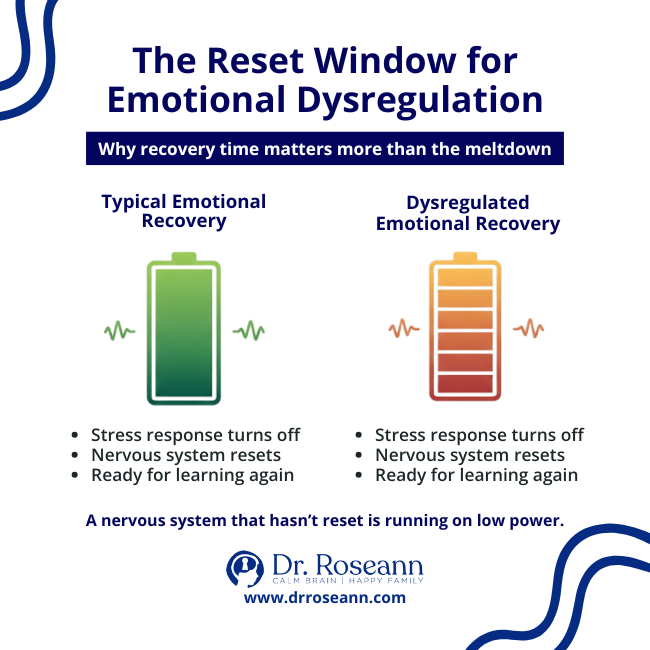
When parents think about emotional dysregulation, they often focus on how big the reaction is. Clinically, however, one of the clearest signs of dysregulation is how long it takes a child to recover.
In a regulated nervous system:
- emotions rise
- peak
- settle
- and return to baseline
In a dysregulated nervous system:
- emotions spike quickly
- take much longer to settle
- and the baseline remains elevated
This prolonged recovery explains why children may:
- have multiple meltdowns in a short period
- seem irritable or fragile for the rest of the day
- fall apart later over something minor
- wake up the next day still emotionally sensitive
The nervous system never fully resets, making the child more vulnerable to the next stressor. Over time, this creates a cycle where reactions appear frequent, intense, and unpredictable—when in reality, the brain is still recovering from the last overload.

This is especially common in children with ADHD, anxiety, autism, trauma histories, or inflammatory conditions like PANS/PANDAS, where the nervous system works harder to regain balance.
Important reframe: Emotional dysregulation isn’t just about the meltdown—it’s about what happens after the meltdown ends.
The Ripple Effect: How Dysregulation Impacts Daily Life
The true emotion dysregulation meaning is clear in its ripple effect across a child’s life.

- School Performance: Difficulty focusing, frustration with schoolwork, and classroom meltdowns can lead to poor grades and low academic self-esteem.
- Friendships and Social Development: Impulsive or intense reactions can strain peer relationships, leading to social isolation.
- Family Stress: The entire family can feel like they are “walking on eggshells.” Sibling relationships may suffer, and parental stress can be immense.
- Long-Term Risks: Without intervention, emotional dysregulation in adolescence is a risk factor for mental health disorders (depression, anxiety, BPD), substance use, self-injury, and other risky behaviors. Early intervention is critical to set your child up for a future where they can thrive.
Your Action Plan: How to Help Your Child Regulate and Thrive
We understand the challenges of emotional dysregulation in children can feel overwhelming, but there is hope. With the right strategies, your child can learn to manage their emotions. At Dr. Roseann, our approach is rooted in the belief that every child can heal and grow.
Calming the Brain: Proven Therapies and Approaches
Dr. Roseann’s signature phrase is, “Calm the brain first and everything else follows.” When a child’s brain is in a constant state of alarm, it can’t learn new skills. We focus on natural, science-backed strategies to bring the nervous system back into balance.
Our BrainBehaviorReset™ Program addresses the root neurological imbalances contributing to emotional dysregulation. We use advanced techniques like neurofeedback and biofeedback to help children build more resilient brain pathways. These “game-changing solutions” empower the brain to regulate itself, creating lasting change.
We also integrate valuable therapeutic skills from Cognitive Behavioral Therapy (CBT) and Dialectical Behavior Therapy (DBT).
- CBT helps children identify and change negative thought patterns that fuel intense emotions.
- DBT is highly effective for emotional dysregulation and teaches four core skills: mindfulness, distress tolerance, emotion regulation, and interpersonal effectiveness.
These tools, combined with our brain-calming strategies, can transform a child’s ability to manage their emotional world. While medication is an option for some, we always start with the least invasive, natural approaches. Learn more about our game-changing solutions for an emotionally dysregulated child.
Strategies for Home and School: Building Your Child’s Regulation Toolkit
You are your child’s most important teacher. Here are practical strategies you can use to build their emotional regulation toolkit.

- Co-regulation: This is the most powerful tool you have. By staying calm yourself, your soothing presence helps your child’s nervous system settle. You are their external regulator until they can do it themselves.
- Mindfulness and Breathing Exercises: Simple practices like focusing on the breath or “belly breathing” can activate the body’s calming response.
- Creating a Calm-Down Corner: Designate a safe space in your home with sensory tools (weighted blankets, fidgets) where your child can go to self-soothe when overwhelmed.
- Consistent Routines: Predictability reduces anxiety and creates a sense of safety, which improves emotional regulation.
- Parent Self-Care: You cannot pour from an empty cup. Managing your own stress is essential to being a patient, regulated parent. Your calm is contagious.
- Empowering Through Our BrainBehaviorReset™ Program: We provide families with tools to integrate brain-calming strategies into daily life and advocate for support in school, ensuring your child’s environment helps them practice new skills.
Building these skills takes time and patience. There will be good days and bad. But with your support and our science-backed strategies, your child can learn to thrive. “You’re not alone.”
Frequently Asked Questions
Is emotional dysregulation the same as a temper tantrum?
No, it’s not the same. While all kids have tantrums, especially when they’re little, emotional dysregulation is a more intense and persistent pattern. Think of it this way: a tantrum is a rain shower, but dysregulation can feel like a constant thunderstorm. It’s when the emotional reaction is much bigger than the situation calls for and happens frequently, interfering with daily life.
Can my child outgrow emotional dysregulation?
With the right support and tools, your child can absolutely learn to manage their emotions effectively. It’s not always something they simply “outgrow” without help, because it often involves how their brain is wired. The key is to calm their nervous system and teach them regulation skills. With consistent practice and support, they can build the pathways in their brain for better emotional control.
Does emotional dysregulation mean my child has ADHD?
Not necessarily, but they are very often linked. Many children with ADHD struggle with emotional dysregulation because the part of the brain responsible for managing focus and impulses also manages emotions. However, dysregulation can also be a sign of anxiety, autism, or the result of trauma. It’s important to look at the whole picture to understand the root cause.
Am I a bad parent if my child is emotionally dysregulated?
Absolutely not. You are not alone, and this is not your fault. A child’s emotional regulation is influenced by their unique brain and nervous system. Your love, support, and willingness to find solutions are what make you a great parent. The most important step is recognizing the struggle and taking action to get your child the help they need to thrive.
What is the first step I should take if I suspect my child is emotionally dysregulated?
The first step is to recognize that behavior is communication. Observe your child’s patterns, stay calm, and seek support from professionals who understand emotional regulation. You’re not alone, and with the right help, your child can learn to thrive.
Citations
Astenvald, R., Frick, MA., Neufeld, J., Bölte, S., and Isaksson, J. (2022). Emotion dysregulation in ADHD and other neurodevelopmental conditions: a co-twin control study. Child Adolesc Psychiatry Ment Health, 16(1):92. https://doi.org/10.1186/s13034-022-00528-0.
Baroud, E., Alrojolah, L., Shamseddeen, W., Ghandour, LA., Elbejjani, M., Barakat, M., Dirani, LA., and Maalouf, FT. (2024). Prevalence and correlates of emotion dysregulation among children and adolescents in Lebanon: results from a National Survey. BMC Psychiatry, 24(1):698. https://doi.org/10.1186/s12888-024-06169-1.
De Prisco M, Oliva V, Fico G, Radua J, Grande I, Roberto N, Anmella G, Hidalgo-Mazzei D, Fornaro M, de Bartolomeis A, Serretti A, Vieta E, Murru A. Emotion dysregulation in bipolar disorder compared to other mental illnesses: a systematic review and meta-analysis. Psychol Med. 2023 Dec;53(16):7484-7503. https://doi.org/10.1017/S003329172300243X.
Han, V.X., Alshammery, S., Keating, B.A. et al. Epigenetic, ribosomal, and immune dysregulation in paediatric acute-onset neuropsychiatric syndrome. Mol Psychiatry 30, 5389–5404 (2025). https://doi.org/10.1038/s41380-025-03127-5
Paulus, FW., Ohmann, S., Möhler, E., Plener, P., and Popow, C. (2021). Emotional dysregulation in children and adolescents with psychiatric disorders. a narrative review. Front Psychiatry, 12:628252. https://doi.org/10.3389/fpsyt.2021.628252.
Restoy, D., Oriol-Escudé, M., Alonzo-Castillo, T., Magán-Maganto, M., Canal-Bedia, R., Díez-Villoria, E., Gisbert-Gustemps, L., Setién-Ramos, I., Martínez-Ramírez, M., Ramos-Quiroga, J. A., & Lugo-Marín, J. (2024). Emotion regulation and emotion dysregulation in children and adolescents with Autism Spectrum Disorder: A meta-analysis of evaluation and intervention studies. Clinical Psychology Review, 109:102410. https://doi.org/10.1016/j.cpr.2024.102410.
Treier, A.-K., Döpfner, M., Ravens-Sieberer, U., Görtz-Dorten, A., Boecker, M., Goldbeck, C., Banaschewski, T., Aggensteiner, P.-M., Hanisch, C., Ritschel, A., Kölch, M., Daunke, A., Roessner, V., Kohls, G., Kaman, A., & ADOPT Consortium. (2024). Screening for affective dysregulation in school-aged children: Relationship with comprehensive measures of affective dysregulation and related mental disorders. European Child & Adolescent Psychiatry, 33(2), 381–390. https://doi.org/10.1007/s00787-023-02166-z
Always remember… “Calm Brain, Happy Family™”
Disclaimer: This article is not intended to give health advice and it is recommended to consult with a physician before beginning any new wellness regime. *The effectiveness of diagnosis and treatment vary by patient and condition. Dr. Roseann Capanna-Hodge, LLC does not guarantee certain results.
Are you looking for SOLUTIONS for your struggling child or teen?
Dr. Roseann and her team are all about science-backed solutions, so you are in the right place!

Meet the Expert
Licensed Therapist | Certified School Psychologist
Board Certified in Neurofeedback (BCN) | 30+ Years Clinical Experience
Expert in Emotional Dysregulation in Children and Nervous System Regulation
Host, Dysregulated Kids Podcast | Author, The Dysregulated Kid
Dr. Roseann Capanna-Hodge is a licensed therapist, certified school psychologist, and leading expert in emotional dysregulation in children and nervous system regulation. With over 30 years of clinical experience and having analyzed more than 10,000 brain maps, she helps families understand what behavior is really signaling—and how to calm the nervous system first so real change can happen.
She is the creator of Regulation First Parenting™ and the CALMS Protocol™, host of the top 1% podcast Dysregulated Kids, and author of The Dysregulated Kid.