%20.png)



Estimated reading time: 8 minutes
To calm emotional dysregulation, start by calming the body before trying to talk, teach, or problem-solve.
When a child is emotionally dysregulated, their nervous system is overwhelmed. They may cry, yell, run away, shut down, become aggressive, or seem unable to listen. In that moment, they don’t need more words. They need safety signals their brain and body can actually receive.

In my 30 years working with dysregulated kids, I always remind parents that the most effective tools are body-based: slow breathing, sensory grounding, movement, deep pressure, reduced stimulation, safe space resets, and calm co-regulation from a steady adult.
In this article, you’ll learn:
- Why calming the body comes before talking, correcting, or problem-solving
- Five nervous system tools that can help calm emotional dysregulation in the moment
- How to build a simple calming plan based on your child’s regulation needs
Why Calming the Body Comes Before Talking
When a child is emotionally dysregulated, the stress response can pull the brain away from calm, reflective thinking and toward fast, protective reactions. Research on adolescents shows that acute stress can dampen prefrontal brain activation—the area involved in planning, judgment, and self-control—making it harder for kids to pause, think, and respond calmly (Uy & Galván, 2017).
That is why logic often doesn’t work during a meltdown.
A child may not be able to answer “Why did you do that?” or respond well to “You need to calm down.” Their body is in alarm mode, and the first job is to help that alarm system settle.
This is why my regulation-first approach matters: calm the brain first, then teach the skill.
Once breathing slows, muscles soften, and sensory overload decreases, your child is more able to listen, reflect, and learn.
Supportive, responsive relationships help buffer a child’s stress response, which is why your calm presence matters so much during emotional dysregulation.
Tool 1: Use Slow Breathing to Signal Safety
Slow breathing can help calm emotional dysregulation because it sends a safety signal to the body. But it works best when it is modeled gently, not demanded.
Instead of telling your child to “calm down,” start breathing slowly yourself. Keep your voice low, your body relaxed, and your words minimal.
The American Academy of Pediatrics includes calming activities that slow breathing and heart rate as part of a healthy stress-management toolbox for children.
If your child is too escalated to breathe, don’t force it. Some kids need body-based input—such as movement, deep pressure, or sensory grounding—before they can slow their breathing (Afif et al., 2022).

Tool 2: Try Sensory Grounding
Sensory grounding helps bring the brain back to the present moment through the senses. This is especially useful when a child is overwhelmed, panicked, stuck in anxious thoughts, or disconnected.
Grounding gives the brain something concrete to focus on instead of staying trapped in the emotional storm.
For younger kids, keep grounding simple. For older kids and teens, make it feel respectful and not babyish.
The goal is not to distract them from their feelings. The goal is to help their body feel steady enough to handle those feelings.
Tool 3: Use Movement or Heavy Work
Some children cannot calm emotional dysregulation by sitting still. Their bodies need to move the stress energy through.
Movement and heavy work can be especially helpful for children with ADHD, anxiety, autism, sensory processing challenges, or chronic stress. Heavy work gives deep input to the muscles and joints, which can help the nervous system feel more organized.
Movement should be safe, structured, and never used as punishment. Think of it as giving the body a healthy outlet.
The AAP also includes movement-based tools such as walking, dancing, stretching, biking, yoga, and sports as physical outlets for stress.
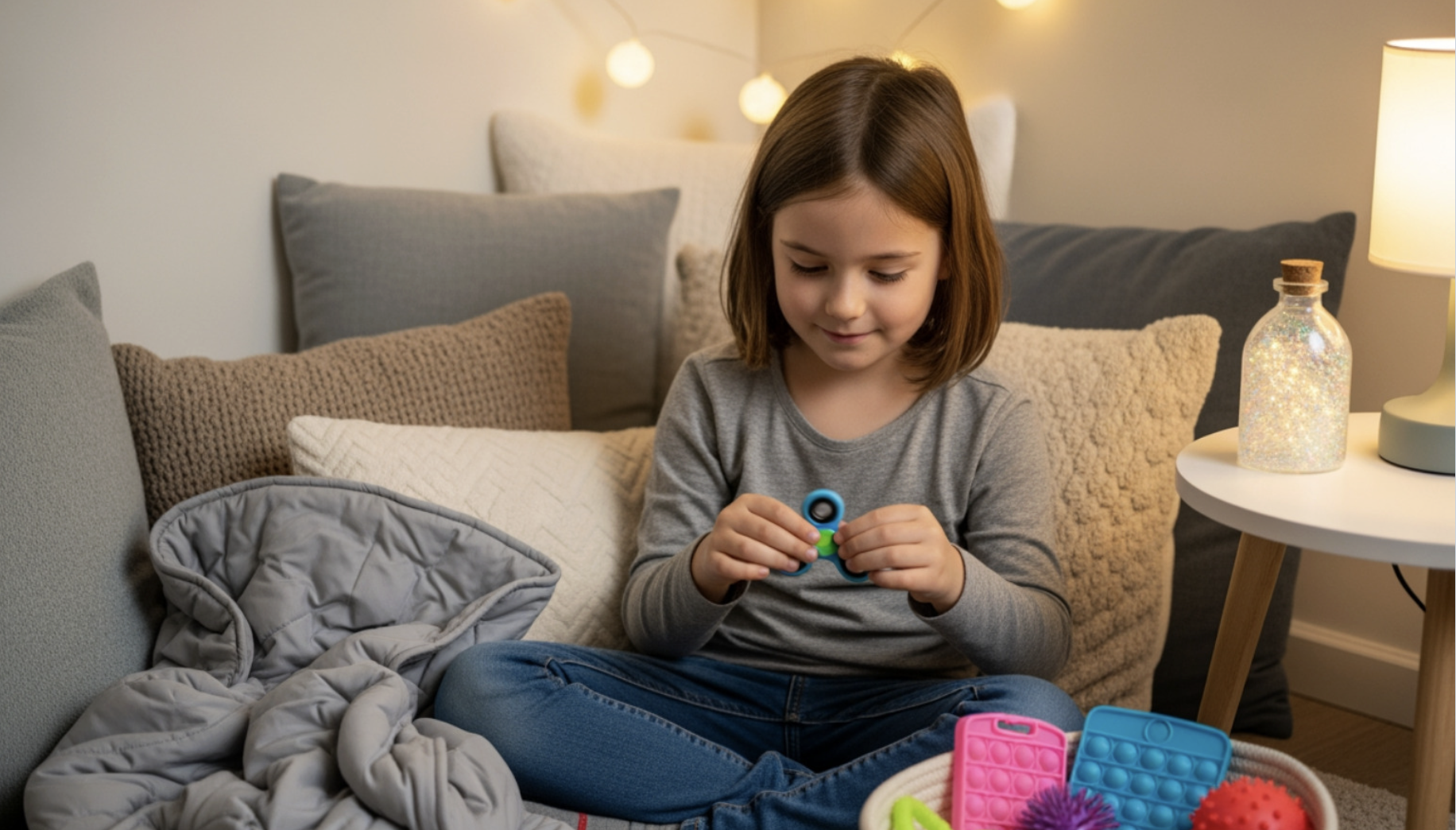
Tool 4: Lower Stimulation in the Environment
A dysregulated child is often already overloaded. More noise, bright lights, clutter, screens, sibling comments, strong smells, or repeated instructions can push the nervous system further into stress.
Before adding more words, remove what you can.
A safe space reset can also help, especially when a child is overwhelmed by noise, light, demands, or big emotions.
Research on sensory rooms in adolescent psychiatric settings suggests that guided use of calming sensory spaces may help reduce distress and support emotional self-regulation. At home, this might look like a cozy corner, quiet bedroom, beanbag, sensory tent, or low-light area with calming tools (West et al., 2017).
ls.The safe space should feel like recovery, not punishment. A dysregulated child needs a place where their nervous system can settle, not a place that feels like shame or isolation.

Tool 5: Use Calm Connection and Co-Regulation
Co-regulation means your child borrows your calm until they can access their own.
This doesn’t mean you have to be perfectly calm. No parent is. It means your voice, face, breathing, body language, and presence communicate safety.
I want parents to remember this: connection doesn’t mean permissiveness. You can be warm, calm, and boundaried at the same time.
That steady presence is what helps your child’s brain begin to settle.
How Do You Build a Calming Plan That Actually Works?
The best calming tools are the ones you practice before your child is fully dysregulated.
When a child is already in a meltdown, it is much harder to introduce a new strategy. That is why I recommend creating a simple regulation plan during calm moments.
You don’t need a complicated system. You just need a few tools your child’s body responds to.
Once you know your child’s pattern, you can respond earlier and with more confidence.
And when you respond earlier, you often prevent emotional dysregulation from becoming bigger, longer, and harder to recover from.
Calming Emotional Dysregulation Starts With the Nervous System
When your child is emotionally dysregulated, the first goal isn’t to explain, correct, or teach. The first goal is to help their brain and body feel safe enough to come back online.
That is why I always start with the nervous system.
Reduce stimulation.
Use movement or pressure.
Try sensory grounding.
Slow the breath.
Offer calm co-regulation.
These tools don’t excuse unsafe behavior, but they do help your child get back to a state where learning, listening, and repair are possible.
Your child isn’t choosing to struggle. Their nervous system is overwhelmed and needs support.
And when we calm the brain first, everything else becomes easier to reach.
FAQs About Calming Emotional Dysregulation
What is the fastest way to calm emotional dysregulation?
The fastest way to calm emotional dysregulation is to lower stimulation and use a body-based tool such as slow breathing, movement, deep pressure, sensory grounding, or co-regulation.
How do you calm an emotionally dysregulated child?
To calm an emotionally dysregulated child, use fewer words, lower your voice, reduce demands, and help the body settle first. Once your child is calm, you can talk about what happened and practice a better coping skill.
Why does my child get more upset when I say “calm down”?
A child may get more upset when told to “calm down” because their nervous system is already in stress mode. Modeling calm usually works better than demanding calm.
What sensory tools help emotional dysregulation?
Helpful sensory tools include headphones, weighted blankets, fidgets, cold water, soft blankets, dim lighting, rocking, calming music, and textured objects.
Is movement better than breathing for emotional dysregulation?
For some children, yes. If a child is highly escalated, movement or heavy work may need to come before breathing because their body has too much stress energy to sit still.
What should I do if my child becomes aggressive?
If your child becomes aggressive, focus on safety first. Create space, move unsafe objects, block harm calmly if needed, and wait until your child is regulated before discussing consequences or repair.
Citations
Uy JP, Galván A. Acute stress increases risky decisions and dampens prefrontal activation among adolescent boys.(2017). Neuroimage, 146:679-689. https://doi.org/10.1016/j.neuroimage.2016.08.067
Afif, I. Y., Farkhan, M., Kurdi, O., Maula, M. I., Ammarullah, M. I., Setiyana, B., Jamari, J., & Winarni, T. I. (2022). Effect of Short-Term Deep-Pressure Portable Seat on Behavioral and Biological Stress in Children with Autism Spectrum Disorders: A Pilot Study. Bioengineering, 9(2), 48. https://doi.org/10.3390/bioengineering9020048
West, M., Melvin, G., McNamara, F., and Gordon, M. (2017). An evaluation of the use and efficacy of a sensory room within an adolescent psychiatric inpatient unit. Australian Occ. Therapy Journal. Retrieved from https://www.academia.edu/101949365/An_evaluation_of_the_use_and_efficacy_of_a_sensory_room_within_an_adolescent_psychiatric_inpatient_unit.
Always remember… “Calm Brain, Happy Family™”
Disclaimer: This article is not intended to give health advice, and it is recommended to consult with a physician before beginning any new wellness regimen. *The effectiveness of diagnosis and treatment varies by patient and condition. Dr. Roseann Capanna-Hodge, LLC, does not guarantee specific results.
Are you looking for SOLUTIONS for your struggling child or teen?
Dr. Roseann and her team are all about science-backed solutions, so you are in the right place!