%20.png)



Estimated reading time: 7 minutes
Teachers help with dyslexia by using multisensory instruction, structured literacy approaches, reading accommodations, assistive technology, and classroom supports that reduce stress and improve learning access. For students with dyslexia, the classroom can quickly become a place of frustration, embarrassment, and emotional overwhelm when reading difficulties are misunderstood.
I’m Dr. Roseann Capanna-Hodge, and for more than three decades I’ve collaborated with families and educators to support children with dyslexia, executive functioning challenges, and learning differences. I know how powerful the right teacher support can be in shaping a child’s confidence and long-term academic success. Small classroom changes can make a tremendous difference in how safe, capable, and engaged a student feels.
What You’ll Learn:
- Classroom strategies that support students with dyslexia.
- How accommodations can reduce reading-related stress and frustration.
- Ways teachers can build confidence and participation in struggling readers.
What Does Dyslexia Look Like in the Classroom?
Dyslexia isn’t about smarts. The National Institute of Neurological Disorders and Stroke (2022) explains that it comes from how the brain processes language.
Picture this: classmates stroll a smooth path, while a child with dyslexia runs the same trail with untied shoelaces. Every step demands more energy, leaving them exhausted before the finish.
Teachers may see:
- Slow, effortful reading
- Letter flips like b/d or p/q
- Trouble following directions
- Avoiding reading aloud
- Meltdowns during literacy work
What looks like misbehavior is really a nervous system on overdrive. Calm the brain first—because behavior is the symptom, and regulation opens the door to learning.
How Can Teachers Create a Dyslexia-Friendly Classroom?
A steady, calm environment sets the stage for learning. You don’t need to reinvent the wheel—small, consistent shifts often create the biggest wins.
Programs like Orton-Gillingham and Wilson give children with dyslexia a clear roadmap instead of leaving them to piece together scattered strategies.
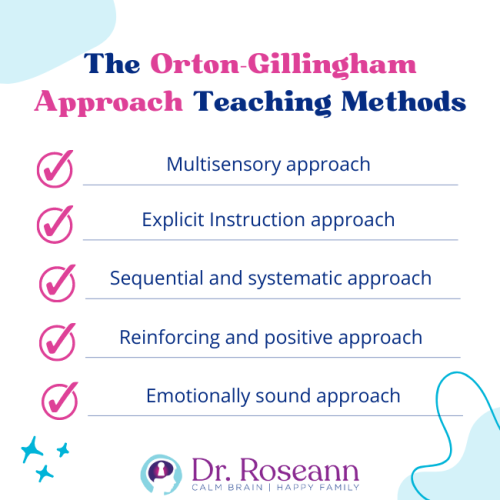
1. Multisensory approach
2. Explicit instruction
- Kids thrive when teachers spell things out: what’s coming, why it matters, and how it will be taught.
- Step-by-step teaching of sounds and word patterns builds skills that last (Al Otaiba et al., 2009).
3. Sequential and systematic
- Imagine building a house—you wouldn’t put the roof on before the walls.
- Programs like OG and Wilson require mastery at each step before moving on, creating a stable foundation for reading (Kelly, 1976).
4. Reinforcing and positive
- Repetition helps, yet encouragement cements the learning.
- Strategies such as pre-teaching or giving choices reduce stress and boost proactive behaviors. As DeHartchuck (2021) notes, small successes build momentum.
5. Emotionally sound
- Confidence grows as children see their progress.
- Instruction that highlights mastery and lowers fear nurtures resilience and self-acceptance, something Astleitner’s (2000) work on emotions in learning supports.
Calm the brain first—because behavior is the symptom, and regulation unlocks learning.
Why Does Regulation Matter for Students With Dyslexia?
Reading needs a calm brain. When a child is stressed, anxious, or overstimulated, their thinking brain goes offline.
That’s why Regulation First Parenting™ works in classrooms too:
- Regulate: calm with breaks, breathing, or sensory tools
- Connect: encourage so the child feels safe
- Correct: once calm, guide reading or writing tasks
You can’t teach a dysregulated brain. Calm first, then learning follows.
Parent Story:
Sarah, a 4th-grade teacher, noticed Noah shut down during read-alouds. Instead of pushing, she gave him a “read-to-self corner” with audiobooks. Within weeks, Noah started volunteering to read short passages—because his brain was calm enough to learn.
Takeaway: Simple shifts rooted in regulation can turn reading into progress, not panic.
What Support Should Parents Ask Teachers For?
Parents often feel unsure what’s “reasonable” to ask for—but you’re not alone, and these supports are not extras; they’re tools that help calm the brain so real learning can happen.
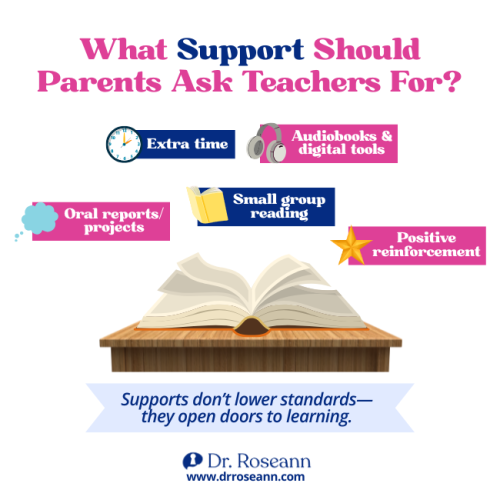
Here are strategies you can confidently bring up in meetings:
- Extra time on tests and assignments
- Alternative ways to show knowledge (oral reports, projects, visuals)
- Access to audiobooks and digital tools
- Small group reading instruction
- Regular feedback and positive reinforcement
These supports don’t lower expectations—they open the door for your child to learn and thrive.

How Can Teachers and Parents Partner Together?
Partnership can shift everything.
When parents and teachers row in the same direction, kids no longer feel tossed around by waves. They start gliding forward in steadier waters. Calm the brain first, and everything else follows.
- Want collaboration that actually sticks? Start simple:
- Share what works at home (movement breaks, calming tools)
- Ask teachers about classroom triggers
- Keep communication open with quick weekly check-ins
- Celebrate progress—big and small—together
You don’t have to carry the weight alone. When home and school team up, a child feels wrapped in support rather than tugged in different directions. That sense of safety is the soil where real learning grows.
What Tools Can Teachers Use Right Away?
Classrooms can feel like pressure cookers for kids with sensitive nervous systems. If you’ve ever felt stuck with a student, you’re not alone.
The good news? Small supports sprinkled throughout the day make a huge difference.
Here are some practical classroom regulation supports:
- Movement breaks (stretching, jumping, wall push-ups)
- Fidgets or stress balls to keep hands busy while listening
- Noise-reducing headphones for quiet focus
- Visual schedules to reduce uncertainty
- Calming routines like deep breathing before tests
None of this requires a fancy budget. It just takes intention, a dash of creativity, and a willingness to see behavior as communication.
Remember: Regulate. Connect. Correct. Because behavior is the symptom, and brain regulation is the solution.
How Do Teachers Help with Dyslexia Beyond Reading?
Support stretches far beyond phonics drills. Kids wrestling with dyslexia often carry cracks in their confidence that can’t be repaired with worksheets alone. Calm the brain first—because only then can true learning take root.
Teachers can help by:
- Highlighting strengths in art, sports, or creativity
- Giving leadership roles that don’t rely on reading
- Using positive feedback to reframe effort as progress
- Encouraging a growth mindset: “Your brain is learning in its own way.”
Parent Story:
Maria, mom of a 9-year-old, shared that her daughter cried daily over spelling tests. Once her teacher replaced weekly spelling drills with project-based assignments, her daughter’s confidence skyrocketed.
Dyslexia-friendly teaching isn’t lowering standards—it’s opening doors and building the confidence that fuels learning.
Read more about: The Neurodivergent Umbrella: A Guide to Understanding and Supporting Neurodiverse Kids
Parent Action Steps
☐ Share what calms your child with teachers Ask for small classroom accommodations Model a growth mindset in daily life Keep communication consistent with school Encourage strengths beyond reading Create calm routines before homework Take our Solution Matcher to get science-backed solutions to help your child today.
FAQs
How do teachers recognize dyslexia in students?
Teachers recognize dyslexia in students by noticing consistent difficulties with reading, spelling, decoding words, reading fluency, and written expression, despite adequate instruction and intelligence.
Can a teacher diagnose dyslexia?
No, a teacher cannot diagnose dyslexia. However, teachers play an important role in identifying early signs of dyslexia and helping families seek a formal dyslexia evaluation from qualified specialists.
How can I talk to my child’s teacher about dyslexia?
You can talk to your child’s teacher about dyslexia by sharing the reading, spelling, or learning challenges you observe at home and asking what dyslexia-related difficulties they see in the classroom. This helps create a collaborative support plan.
What role do emotions play in dyslexia?
Emotions play a significant role in dyslexia because ongoing struggles with reading and schoolwork can lead to frustration, anxiety, and low self-confidence. Supporting emotional regulation can help children with dyslexia learn more effectively.
Do all kids with dyslexia need special education?
No, not all kids with dyslexia need special education. Many children with dyslexia succeed with classroom accommodations, structured literacy instruction, and supportive teaching strategies.
What reading programs help students with dyslexia?
Reading programs that help students with dyslexia typically use structured literacy, explicit phonics instruction, and multisensory teaching methods that strengthen reading and decoding skills.
How does dyslexia affect classroom performance?
Dyslexia affects classroom performance by making reading, spelling, writing, note-taking, and processing written information more difficult, which can impact academic confidence and participation.
Why is early intervention important for dyslexia?
Early intervention is important for dyslexia because identifying and addressing dyslexia early can improve reading skills, reduce academic struggles, and strengthen a child's confidence and emotional well-being.
Citations
Al Otaiba, S., McDonald Connor, C., Foorman, B., Schatschneider, C., Greulich, L., & Sidler, J. F. (2009). Identifying and Intervening with Beginning Readers Who Are At-Risk for Dyslexia. Perspectives on Language and Literacy, 35(4), 13–19. https://www.ncbi.nlm.nih.gov/pmc/articles/PMC4296731/
Astleitner, H. (2000). Designing Emotionally Sound Instruction: The FEASP-Approach. Instructional Science, 28(3), 169–198. https://doi.org/10.1023/a:1003893915778
DeHartchuck, L. (2021, August 3). Positive Behavior Strategies: An Approach for Engaging and Motivating Students. NCLD. https://www.ncld.org/reports-studies/forward-together-2021/positive-behavior-strategies/Dyslexia
National Institute of Neurological Disorders and Stroke. (2022, April 26). Www.ninds.nih.gov. https://www.ninds.nih.gov/health-information/disorders/dyslexia
Kast, M., Meyer, M., Vögeli, C., Gross, M., & Jäncke, L. (2007). Computer-based multisensory learning in children with developmental dyslexia. Restorative Neurology and Neuroscience, 25(3-4), 355–369. https://pubmed.ncbi.nlm.nih.gov/17943011/
Kelly, R. E. (1976). A Systems Approach to Teaching. In ERIC. https://eric.ed.gov/?id=ED124184
Always remember… “Calm Brain, Happy Family™”
Are you looking for SOLUTIONS for your struggling child or teen?
Dr. Roseann and her team are all about solutions, so you are in the right place!