



Estimated reading time: 10 minutes
If you’ve wondered whether a simple mineral could help your autistic child sleep better, stress less, and learn more—this guide is for you.
You’re doing your best. And yes—you’re not alone. Parents ask me every week about magnesium and autism.
I’m Dr. Roseann Capanna-Hodge, and for more than three decades I’ve helped families understand and support children on the autism spectrum by looking beyond labels and focusing on the nervous system.
In this clear, practical guide:
- I’ll explain what the research says about magnesium and autism
- What parents are seeing at home—and why some kids respond while others don’t
- Which forms may help, and how to choose the right type for your child’s needs
- How to use magnesium safely, including dosing basics and what to watch for
- Simple, regulation-first ways to pair magnesium with other supports for better results
- And how to use magnesium inside a Regulation First Parenting™ plan so behavior change actually sticks.
What Do We Actually Know About Magnesium and Autism?
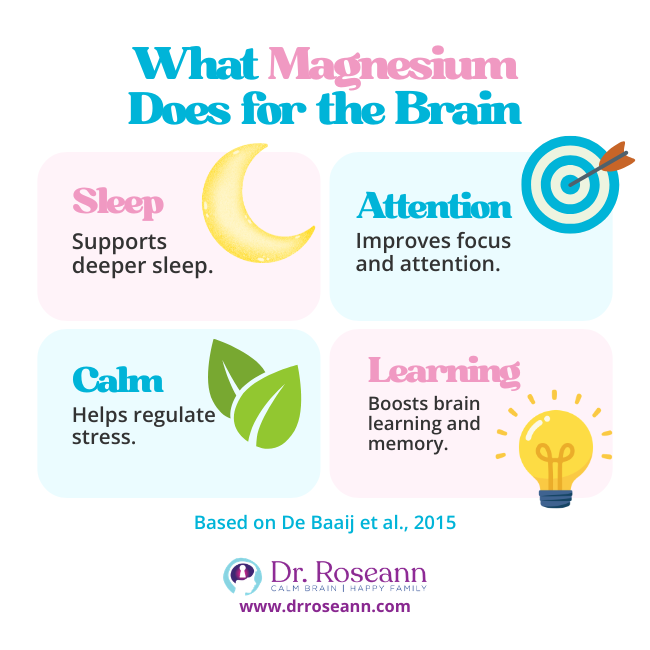
Magnesium is an essential mineral that the brain loves. It helps over 300 body reactions involved in energy, sleep, and calm (De Baaij et al., 2015).
In kids with ASD, several studies connect low magnesium status with more symptoms. They show signals that magnesium (often with B6) may help some children.
“Magnesium is a cofactor in more than 300 enzymatic reactions.” (De Baaij et al., 2015)
Key takeaways
- Signals, not guarantees. Research shows associations and some clinical improvements, but magnesium isn’t a cure. It’s a tool—one piece of a regulation-first plan.
- Safety first. Work with your child’s provider, especially if your child takes meds.
Could Low Magnesium Be Fueling My Child’s Meltdowns or Sleep Issues?
Some children with ASD show lower serum magnesium compared with neurotypical peers (recent clinical data support this pattern). This may relate to irritability, poor sleep, and anxiety-like behaviors (see study summary in ACB, 2024). Parents often describe “restless body, restless brain.”
Real-life example:
Juliet, mom of a 10-year-old, noticed bedtime battles and leg cramps. After her pediatrician okayed magnesium glycinate and a food-first plan, sleep settled within weeks.
Takeaway: Small, consistent steps can calm the nervous system.
Parent Checklist
Night wakings, trouble falling asleep Muscle tension or cramps High reactivity or “short fuse” Low appetite for variety, constipation Anxious or wired-and-tired evenings
Which Magnesium Forms Are Best for Autistic Kids (And Why)?
Different forms do different jobs. The best magnesium for autistic children prioritizes calm + tolerability.
Common Forms Parents Ask About
- Magnesium glycinate (bisglycinate): Gentle on the gut; good for calm and sleep.
- Magnesium citrate: Highly absorbed; may loosen stools—helpful if constipated.
- Magnesium L-threonate: Research signal for cognition in adults/animals; taste can be bitter; costlier.
- Magnesium oxide: Less absorbable; may help with constipation but not ideal for brain effects.
- Magnesium sulfate (Epsom salt bath): Sensory-calming routine; skin absorption varies, but the bath ritual can be regulating.

How Much Magnesium Is Safe—And How Do We Start?
Always check with your child’s healthcare provider. Start low and slow, once daily with food, and track sleep, stools, and mood for 2–4 weeks.
Practical Starting Steps
- Begin at ¼–½ of an age-appropriate daily amount from your clinician.
- If tolerated, increase every 5–7 days to the target dose.
- Pair with B6-rich foods (e.g., salmon, chickpeas, bananas). Several studies paired magnesium with B6 and saw behavior changes (Mousain-Bosc et al., 2006; Rimland et al., 1985).
“Behavioral improvement… with the combination vitamin B6–magnesium in PDD/autism…” (Mousain-Bosc et al., 2006)
Real-life example:
Ryan’s family added nightly magnesium (powder) plus a consistent wind-down routine. Over a month, he slept deeper and tolerated new foods. He was a “failure-to-launch” kid, but with regulation-first tools, he launched—on his timeline.
Takeaway: combine supplements with structure.

Will Magnesium Help With Social Connection and Repetitive Behaviors?
It may help indirectly by calming the brain. Magnesium modulates NMDA and GABA systems involved in learning and inhibition (De Baaij et al., 2015). Calmer body → better attention, more flexibility, and more connection opportunities.
What parents often notice first
- Less evening agitation
- Smoother transitions
- More capacity for social skills practice
- Slightly longer attention windows
Let’s calm the brain first. When a child is regulated, therapies, social coaching, and school supports finally “stick.”
How Long Until We See Changes?
Some families see small wins in 1–3 weeks (sleep, stool regularity, less evening edginess). For behavior and learning, give it 6–8 weeks, and keep your other regulation tools in place.
Risks or Interactions You Must Know
Magnesium is generally well-tolerated, but too much can cause loose stools, nausea, or cramping. It can also lower blood pressure.
Check with your provider if your child:
- Takes stimulants, anticonvulsants, or meds that affect heart rhythm or blood pressure
- Has kidney issues
- Is on multiple supplements (avoid stacking magnesium from powders + multivitamins unintentionally)
Real-life example:
Carlos, a dad of a 7-year-old, noticed diarrhea after switching from glycinate to citrate. They adjusted back to glycinate and split the dose.
Takeaway:
The form matters as much as the dose.
How Does Magnesium Fit Inside Regulation First Parenting™?
Magnesium is not a magic bullet. It’s a calming helper that makes your other strategies work better. Our sequence is always:
Regulate → Connect → Correct.™
- Regulate: Magnesium + routine + sensory supports + breath/movement.
- Connect: Co-regulation, predictable cues, empathy.
- Correct: Coaching skills when the brain is ready to learn.
Supportive Nutrients That Often Pair Well
- Vitamin B6 (often paired in studies)
- Vitamin D (widespread deficiency; talk with your provider)
- Omega-3s (brain and mood support)
Zinc (common gaps in selective eaters)
Hope, Healing, and the Power of Small Steps
When it comes to magnesium and autism, the research—and the real-life stories from families—show one clear message: a calm brain changes everything. Magnesium can gently support better sleep, steadier moods, and sharper focus so your child can learn, connect, and thrive.
Remember, this isn’t about quick fixes. It’s about giving your child’s brain the tools to regulate—through magnesium, routine, co-regulation, and loving consistency.
Behavior is communication, and when we calm the brain first, growth naturally follows.
So take one small step today. Discover how Neurotastic Multi‑Mag Brain® Formula can help. You’re helping your child build calm from the inside out—and it’s gonna be OK.
FAQs
Is magnesium good for autism?
Magnesium can support children with autism by calming the nervous system, improving sleep, and reducing anxiety or irritability, especially when there’s a deficiency.
Which magnesium is best for autism?
Magnesium glycinate and magnesium L-threonate are often the best magnesium forms for autism because they support relaxation, brain function, and are gentle on the digestive system.
How do I pick the best magnesium for my child?
Choose magnesium based on your child’s main need: magnesium glycinate for sleep and calming, magnesium citrate for constipation, and magnesium L-threonate for cognitive support—with guidance from your provider.
Can magnesium replace my child’s therapies?
Magnesium can’t replace therapies; it works best as a support by calming the nervous system so your child can better engage in therapy, learning, and daily routines.
How long should we try magnesium for autism?
Try magnesium for 6–8 weeks while tracking sleep, digestion, and mood, and adjust the form or dose with your healthcare provider based on your child’s response.
Can I use Epsom salt baths for autism?
Epsom salt baths can be helpful for calming and sensory regulation, but oral magnesium may provide more consistent systemic support.
What foods add magnesium?
Magnesium-rich foods like pumpkin seeds, almonds, black beans, spinach, dark chocolate, and oats can support your child’s intake—aim to include at least one daily.
Terminology
- ASD (Autism Spectrum Disorder): Neurodevelopmental differences that affect communication, behavior, and sensory processing.
- Dysregulation: The brain and body are stuck in fight/flight or shut-down—hard to learn or cope.
- NMDA/GABA: Brain receptors that balance excitatory and calming
- Serum magnesium: The level of magnesium measured in blood; not the whole body story, but a clue.
Citations
De Baaij, J. H. F., Hoenderop, J. G. J., & Bindels, R. J. M. (2015). Magnesium in man: Implications for health and disease. Physiological Reviews, 95(1), 1-46. https://doi.org/10.1152/physrev.00012.2014
Mousain-Bosc, M., Roche, M., Polge, A., Pradal-Prat, D., Rapin, J., & Bali, J. P. (2006). Improvement of neurobehavioral disorders in children supplemented with magnesium-vitamin B6. II. Pervasive developmental disorder-autism. Magnesium Research, 19(1), 53-62. https://europepmc.org/article/MED/16846101
Tarleton, E. K., Kennedy, A. G., Rose, G. L., Crocker, A., & Littenberg, B. (2019). The Association between Serum Magnesium Levels and Depression in an Adult Primary Care Population. Nutrients, 11(7), 1475. https://doi.org/10.3390/nu11071475
©Roseann Capanna-Hodge
Always remember… “Calm Brain, Happy Family™”
Disclaimer: This article is not intended to give health advice and it is recommended to consult with a physician before beginning any new wellness regime. The effectiveness of diagnosis and treatment vary by patient and condition. Dr. Roseann Capanna-Hodge, LLC does not guarantee certain results.
Are you looking for SOLUTIONS for your struggling child or teen?
Dr. Roseann and her team are all about science-backed solutions, so you are in the right place!
Meet the Expert
Licensed Therapist | Certified School Psychologist
Board Certified in Neurofeedback (BCN) | 30+ Years Clinical Experience
Expert in Emotional Dysregulation in Children and Nervous System Regulation
Host, Dysregulated Kids Podcast | Author, The Dysregulated Kid
Dr. Roseann Capanna-Hodge is a licensed therapist, certified school psychologist, and leading expert in emotional dysregulation in children and nervous system regulation. With over 30 years of clinical experience and having analyzed more than 10,000 brain maps, she helps families understand what behavior is really signaling—and how to calm the nervous system first so real change can happen.
She is the creator of Regulation First Parenting® and the CALMS Protocol™, host of the top 1% podcast Dysregulated Kids, and author of The Dysregulated Kid.