



Estimated reading time: 9–11 minutes
This guide breaks down the science and the real-life signs so you can quickly spot what’s going on. And take the next right step—without blame or panic.
If your child’s learning feels stuck or school has become a daily battle, you’re not failing. You’re likely seeing a dysregulated brain that needs calm and support before skills can click. Parents ask me all the time, “how do you know if you have a learning disability?”
Today, I’ll show you what to look for—at home, at school, and even in adulthood. And how to move forward with clarity and hope. We’ll keep it simple, science-backed, and action-focused. Regulate. Connect. Correct.™
Signs Your Child, Teen or Adult-Child Has a Learning Disability
You’ll see persistent skill gaps that don’t improve with typical practice. That’s your cue to look deeper, not to push harder.
Common Signs by Stage
Early years (4–7):
- Letter-sound confusion
- Slow word learning
- Mixing word order
- Trouble with rhymes
- Avoids coloring/cutting (fine-motor)
Tweens/teens:
- Slow, effortful reading
- Sloppy or painful handwriting
- Math facts never “stick;” avoids note-taking; executive function struggles (planning, memory)
Adults:
- Reads but avoids dense text
- Misremembers instructions
- Struggles with spreadsheets
- Takes longer to write emails
- And relies on workarounds
Parent story:
Merly, mom of a 10-year-old, said, “Homework takes three hours and ends in tears.” Once we calmed his body (movement breaks + co-regulation), his reading tutoring finally worked.
Takeaway:
Calm brain first → skills land.
What Exactly Is a Learning Disability—And What Isn’t It?
A Specific Learning Disability (SLD) is a neurodevelopmental difference. It makes reading, writing, or math unusually hard despite average or better thinking skills and instruction (American Academy of Pediatrics, AAP, 2011).
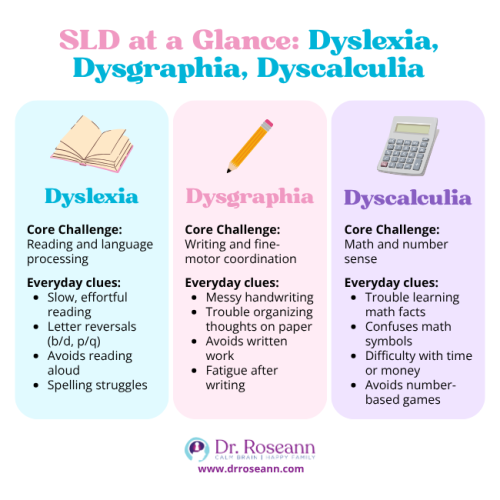
Dyslexia (reading), dysgraphia (writing), and dyscalculia (math) are the most common types (Vellutino et al., 2004; Snowling, 2012). These are not caused by poor vision, low effort, or “bad parenting.”
Think “can’t yet,” not “won’t.” Behavior is communication. A dysregulated nervous system blocks learning until we bring it back to calm.
Quick Myths to Ditch
- Myth: “He’s just lazy.” → Reality: It’s a brain-based efficiency issue.
- Myth: “If she can read some words, it’s not dyslexia.” → Reality: Dyslexia shows up in accuracy, fluency, decoding, and spelling, not IQ.
- Myth: “Vision therapy cures dyslexia.” → Reality: AAP notes dyslexia is language-based; vision fixes don’t treat core reading issues (AAP, 2011).
How Do Schools and Clinicians Identify SLD (Dyslexia, Dysgraphia, Dyscalculia)?
There are three main paths you’ll hear about:
- Response to Intervention (RTI)/MTSS: Shows your child’s progress with targeted instruction.
- Pattern of Strengths and Weaknesses: Looks for specific cognitive/academic patterns.
- Ability–Achievement Discrepancy: Older method; less common now.
A solid evaluation includes achievement testing (reading/writing/math), cognitive processing, speech–language as needed, and classroom data.
Clinically, the DSM-5-TR criteria focus on persistent academic difficulties 6+ months despite interventions. It’s not better explained by other conditions (see APA summary excerpts and standard references; AAP, 2011; Vellutino et al., 2004).
Parent story:
Sam, 7, was labeled “distracted.” Screening showed a phonological weakness; targeted reading instruction and sensory breaks led to steady gains.
Takeaway:
Right ID → right help.
How to Know if You Have a Learning Disability
Look for patterns over time and across settings. Kids work hard to hide struggles. Adults create elaborate workarounds.
Red flags that point to “can’t yet”:
| Observed Behavior | Likely Underlying Issue |
| Meltdowns after school, but not on weekends | Cognitive fatigue |
| “Forgets” multi-step directions | Working memory load |
| Skips reading aloud; writes as little as possible | Avoidance due to difficulty |
| Needs more time on tests or dense reading | Processing speed |
What Helps First—Before Tutoring or Therapy?
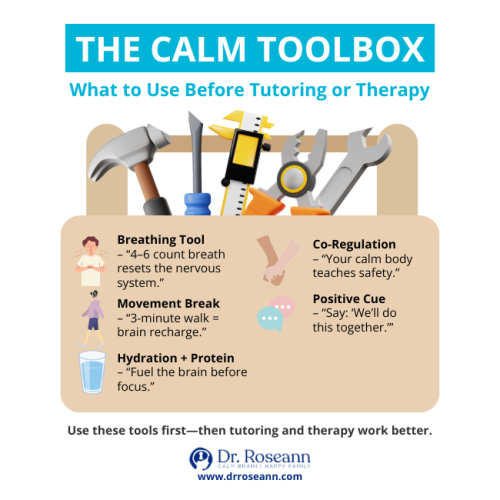
Learning blooms in a regulated nervous system. Let’s calm the brain first, then skills stick.
Regulation First Parenting™ Mini-Plan
- Regulate: movement every 90 minutes, breathing (4-6 count), hydration, protein.
- Connect: eye level, soft voice, co-regulate; “I’m here. We’ll do this together.”
- Correct: once calm, short practice bursts with immediate wins.
Parent story:
Aisha’s teen shut down on writing. We added a 3-minute walk + box breathing before assignments and a speech-to-text tool. Output doubled. Takeaway: regulate → then expect performance.
Read more: How to Help Your Child with Learning Disabilities: 10 Expert Strategies
Getting Tested: What Happens and How to Begin
Start points
- School-age: Email the teacher/case manager to request a special education evaluation. Schools must evaluate and consider services; many offer free testing.
- College/adults: Contact Disability Services for documentation guidelines; seek a neuropsychological or psychoeducational evaluation.
What’s typically included
- Academic achievement tests (reading accuracy/fluency/comprehension; written expression; calculation/problem-solving)
- Cognitive and processing measures (phonological processing, working memory, processing speed)
- Speech–language and OT when indicated
- Classroom/real-world data and prior interventions
What Each Test Answers
| Test Area | Example Measures | What It Tells You |
| Reading (decoding/fluency) | Word reading, nonword reading | Phonological/decoding efficiency |
| Reading comprehension | Passage comprehension | Access to meaning once words are decoded |
| Writing | Spelling, sentence/essay | Transcription vs. idea generation |
| Math | Calculation, applied problems | Facts vs. reasoning |
| Cognitive processes | Working memory, processing speed | Time/steps load and pace |
| Language | Receptive/expressive | Foundation for reading/writing |
Are Learning Disabilities Lifelong, and What Does Progress Look Like?
SLDs are lifelong profiles, but skills improve with targeted instruction and supports. Research shows language-based interventions help, especially when started early (Snowling, 2012; Vellutino et al., 2004).
Adults thrive by pairing strengths with accommodations: audiobooks, speech-to-text, chunked directions, and more time for dense tasks.
“When a teacher sees a child with dyslexia walk in, think: future engineer or entrepreneur.” — Thomas Armstrong, author, The Power of Neurodiversity.
What if It’s More Than Academics—Attention, Anxiety, or Sensory Issues Too?
Co-occurring challenges are common. AAP notes dyslexia and other SLDs reflect brain-based language/learning differences, often with attention or mood layers (AAP, 2011).
When big emotions show up, it’s not defiance—it’s dysregulation.
“Different kinds of minds are needed.” — Temple Grandin, Ph D, autism advocate.
First Aid for School Nights
- Predictable routine and visual schedule
- Movement + protein snack before homework
- Short, timed work sprints with breaks
- Assistive tech: audiobooks, speech-to-text, calculators where appropriate
Read more about: The Neurodivergent Umbrella: A Guide to Understanding and Supporting Neurodiverse Kids
Ready to Take the Next Step Toward Calm and Clarity?
You’ve already done the hardest part—you’ve noticed your child’s struggle and started looking for real answers. Remember, behavior is communication, not defiance. When you calm the brain first, everything else—learning, focus, and confidence—starts to grow.
If you’re still asking yourself, “how do you know if you have a learning disability?”. Then, start by watching the patterns with compassion, requesting a full evaluation, and building regulation into your family’s daily rhythm. Small shifts create lasting calm.
You’re not failing. You’re learning a new way to help your child’s brain and body work with them, not against them. And I promise, it’s going to be OK.
Grab my 147 Therapist-Endorsed Self-Regulation Strategies for Children: A Practical Guide for Parents. And you can also watch my quick video on how structured literacy and regulation work together to help struggling learners thrive.
Because when we calm the brain first… everything else follows.
FAQs
How long does a diagnosis take?
From request to meeting can be weeks to months. Start with the school now while you explore private options. Keep a symptom log.
Can a bright child still have dyslexia?
Yes. Dyslexia spans all IQ levels and typically reflects phonological weaknesses (Vellutino et al., 2004).
Do kids “grow out of it”?
They grow through it with instruction, accommodations, and nervous system regulation. Reading can become functional and even strong.
Is this ADHD or a learning disability?
Both can co-occur. ADHD affects attention/executive function; SLD affects academic skills. Many kids have both—plan supports for each.
Terminology
- Specific Learning Disability (SLD): Brain-based difficulty with reading, writing, or math.
- Dyslexia/Dysgraphia/Dyscalculia: Reading/writing/math subtypes of SLD.
- Executive Function: Mental skills for planning, memory, and pace.
- Phonological Processing: Handling the sounds in language for reading and spelling.
- Accommodation: A support that lets a student show what they know (e.g., extra time).
Citations
American Academy of Pediatrics, Section on Ophthalmology, Council on Children with Disabilities, American Association for Pediatric Ophthalmology and Strabismus, & American Association of Certified Orthoptists. (2011). Learning disabilities, dyslexia, and vision. Pediatrics, 127(3), e818–e856. https://doi.org/10.1542/peds.2010-3670
Vellutino, F. R., Fletcher, J. M., Snowling, M. J., & Scanlon, D. M. (2004). Specific reading disability (dyslexia): What have we learned in the past four decades? Journal of Child Psychology and Psychiatry, 45(1), 2–40. https://doi.org/10.1046/j.0021-9630.2003.00305.x
Snowling, M. J. (2013). Early identification and interventions for dyslexia: A contemporary view. Journal of Research in Special Educational Needs, 13(1), 7–14. https://doi.org/10.1111/j.1471-3802.2012.01262.x

© Roseann-Capanna-Hodge, LLC 2025
Understanding your child's emotional triggers is the first step toward helping them self-regulate. For a comprehensive guide, see The Dysregulated Kid by Dr. Roseann Capanna-Hodge.
Always remember… “Calm Brain, Happy Family™”
Disclaimer: This article is not intended to give health advice and it is recommended to consult with a physician before beginning any new wellness regime. The effectiveness of diagnosis and treatment vary by patient and condition. Dr. Roseann Capanna-Hodge, LLC does not guarantee certain results.
Are you looking for SOLUTIONS for your struggling child or teen?
Dr. Roseann and her team are all about science-backed solutions, so you are in the right place!
Meet the Expert
Licensed Therapist | Certified School Psychologist
Board Certified in Neurofeedback (BCN) | 30+ Years Clinical Experience
Expert in Emotional Dysregulation in Children and Nervous System Regulation
Host, Dysregulated Kids Podcast | Author, The Dysregulated Kid
Dr. Roseann Capanna-Hodge is a licensed therapist, certified school psychologist, and leading expert in emotional dysregulation in children and nervous system regulation. With over 30 years of clinical experience and having analyzed more than 10,000 brain maps, she helps families understand what behavior is really signaling—and how to calm the nervous system first so real change can happen.
She is the creator of Regulation First Parenting® and the CALMS Protocol™, host of the top 1% podcast Dysregulated Kids, and author of The Dysregulated Kid.