





Estimated reading time: 10 minutes
Supplements discussed for neuroinflammation include curcumin, omega-3 fatty acids, probiotics, glutathione, magnesium, bacopa, and cocoa flavanols. The right choice depends on your child’s diagnosis, nutritional needs, and treatment goals. Researchers have studied these ingredients for different outcomes, including inflammation markers, attention, digestive symptoms, and antioxidant support.
When your child is struggling with anxiety, compulsions, or big emotional reactions, you want to know what could help and where to start.
I’m Dr. Roseann Capanna-Hodge, a therapist, certified school psychologist, and mom of two neurodivergent boys. For more than three decades, I’ve helped families understand their children’s challenges and make sense of their options.
My starting point is understanding the child before choosing the supplement. You shouldn’t need an entire kitchen cabinet—or a spreadsheet worthy of a second job—to keep track of your child’s care.
Let’s walk through the research, how to choose supplements thoughtfully, and the everyday changes worth tracking.
What is Neuroinflammation and How Does It Affect Kids?
Neuroinflammation refers to inflammatory activity within the brain or spinal cord. Determining whether it is relevant to a child requires medical assessment of the underlying condition.
Parents may bring concerns such as these to an appointment:
- Sudden or persistent emotional changes
- Difficulty concentrating or remembering
- Disrupted sleep
- Changes in sensory responses
- New or worsening anxiety or compulsive behaviors
The same distinction applies to diagnoses. ADHD, autism, or anxiety does not automatically mean a child has an inflammatory brain condition.
If your child has PANS/PANDAS or another condition being evaluated for immune or inflammatory involvement, ask how nutritional support fits into the treatment plan.
Try:
“What do we know about the cause of these changes, and what are we still investigating?”
You don’t have to solve the mystery yourself. Your observations help the clinician decide what needs closer attention.
Parent Story
Julia, the mother of a 9-year-old with anxiety, reported fewer meltdowns and improved sleep after magnesium and omega-3s were added to her son’s routine.
Those changes mattered to her family.
Keep track of what changes without rushing to explain why. What happened, when it happened, and what else changed are all useful details.
Prefer to listen? Listen to the podcast episode.
Which Micronutrients Actually Support Brain Health?
Vitamins and minerals contribute to normal body function, and nutritional care begins with assessing whether your child is getting what they need.
You may hear neuronutraceuticals used to describe nutritional products studied in relation to brain health. The practical question is what a particular product has been shown to do—and for whom.
An eight-week trial studied a broad vitamin-and-mineral formula in children with ADHD and irritability. Clinician ratings showed greater overall improvement with the formula than with placebo. The main parent-rated composite measure did not differ significantly between groups (Johnstone et al., 2022).
That study supports further investigation of nutritional approaches. It did not identify an individual vitamin as a treatment for neuroinflammation.
Here is how to make a discussion about specific nutrients useful:
| Nutrient | What to review | Question to ask |
| Vitamin C | Dietary variety and ingredients already in supplements | “Is my child getting enough through their usual foods?” |
| Vitamin E | Intake and existing multivitamins or combination products | “Is there a specific reason to add more?” |
| Riboflavin, or B2 | Dietary intake and the purpose of a proposed supplement | “What need would this address?” |
| Vitamin D | Whether the clinician recommends assessing intake or testing | “Would testing change the care plan?” |
For everyday eating patterns that feed the brain, start with foods your child already accepts and changes your family can manage.
Small, workable steps count. Your selective eater does not need an entirely new menu by Monday.
What Are the Best Supplements for Neuroinflammation?
The most appropriate supplement is one selected for a specific need, supported by relevant research, and reviewed for your child’s age and health history. No single combination has been established as best for every child.
The seven options below have been studied in different settings. Look at who participated, what researchers measured, and which formulation they used.
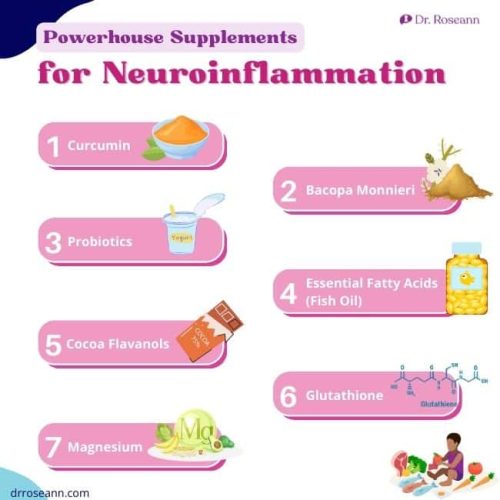
1. Curcumin
Curcumin has been investigated for inflammatory markers and related symptoms, including in a recent pediatric trial.
An eight-week randomized, placebo-controlled trial involving 60 children with autism reported reductions in blood markers of systemic inflammation and a stool marker of intestinal inflammation. Researchers also reported improvements in sensory and gastrointestinal measures (Vergara Serpa & Sumalla Cano, 2026). pubmed.ncbi.nlm.nih.gov
These findings come from one specific trial. Blood and stool markers do not directly measure inflammation inside the brain, and the results do not establish benefit across all children or diagnoses.
What to discuss:
- Does the research apply to my child’s condition?
- What is the specific treatment goal?
- Does the proposed product match the formulation studied?
- What interactions or side effects need review?
Bring the actual label. “Contains curcumin” does not tell your clinician everything they need to know.
2. Bacopa Monnieri
Bacopa has been studied for attention, cognition, mood, and sleep-related outcomes in children.
A randomized, placebo-controlled trial in boys ages 6–14 found improvements on some measures, including cognitive flexibility and sleep routine. It did not find significant differences between groups in the main behavioral outcomes (Kean et al., 2022).
The study tested a specific bacopa extract. It did not establish that bacopa reduced neuroinflammation in children.
Keep the conversation focused:
“Which outcome are we hoping to improve, and does the research support that use?”
Give each recommendation a clear purpose. That makes it easier to recognize whether the plan is helping.
3. Probiotics
Probiotics have been studied for digestive and behavioral outcomes, with findings that depend on the formulation and the children studied.
A six-month trial involving 85 preschoolers with autism compared a particular probiotic formulation with placebo. The groups did not differ on the primary overall autism severity measure.
Exploratory subgroup analyses suggested improvements in certain gastrointestinal, adaptive-functioning, and sensory outcomes (Santocchi et al., 2020).
Start with the concern you want to address. A digestive symptom and an inflammatory brain condition call for different assessments and treatment goals.
Ask:
- “Which strains and formulation are you recommending?”
- “What symptom are we targeting?”
- “Does my child’s medical history affect suitability?”
- “When should we review the response?”
A product labeled “probiotic” is not automatically interchangeable with the one used in a study.

4. Essential Fatty Acids (Fish Oil)
Omega-3 research in children has examined attention and other outcomes, with responses differing between participants.
A 12-week trial involving 92 children and adolescents with ADHD studied an EPA supplement. Some attention measures improved, particularly among participants with lower baseline EPA levels.
Other outcomes were less favorable in participants with higher baseline levels. The study did not find a change in the blood inflammation marker hs-CRP (Chang et al., 2019).
The useful takeaway is to match the recommendation to the child. These findings do not establish that more fish oil produces better attention or less brain inflammation.
Discuss:
- EPA and DHA amounts in the actual product
- The nutritional or clinical goal
- Allergies, medications, and tolerability
- How progress will be assessed
Parent Story
Maria, the mother of a 10-year-old with ADHD, reported better focus and fewer school disruptions after magnesium and fish oil were introduced.
For your child, record concrete observations: fewer classroom calls, easier task initiation, or more comfortable participation.
Those details help the care team understand what is changing.
5. Cocoa Flavanols
Cocoa flavanols have been studied for brain function and cognition, including in older adults.
If cocoa flavanols come up in a recommendation, ask:
“What evidence supports this specific product for my child’s age and needs?”
6. Glutathione
Glutathione is an antioxidant, and oral supplementation has been studied for its effects on glutathione levels in the body.
Clarify the proposed goal:
- What condition or nutritional concern is being addressed?
- What evidence applies to children?
- How will benefit be assessed?
- Which product and formulation are being considered?
A change in an antioxidant measurement and an improvement in daily life are different outcomes. Your clinician can explain which one the proposed plan is intended to address.
7. Magnesium
Magnesium has been studied with other nutrients for emotional and behavioral outcomes in children with ADHD.
An eight-week trial involving 66 children compared magnesium plus vitamin D with placebo and reported improvements in several emotional and behavioral measures (Hemamy et al., 2021).
Because the trial tested a combination, it could not identify magnesium’s individual contribution. It also did not directly establish treatment of inflammation within the brain.
Start with nutritional needs and a specific goal. Restlessness or irritability alone does not tell us that a child needs magnesium.
Ask the clinician to review:
- The magnesium form
- The elemental magnesium amount
- Additional ingredients
- Your child’s medical history and current products
- The follow-up plan
How Do I Know Which Supplement is Right for My Child?
Match a clearly defined need with relevant evidence and your child’s health history. That gives every product a purpose and every follow-up a focus.
You do not need to become a supplement researcher. A few good questions can make the discussion much more useful.
Start With the Concern
Write down what is happening:
- Sleep: When does the difficulty begin, and what does it look like?
- Focus: Which tasks are hardest?
- Emotional responses: What happens before, during, and after a difficult moment?
- Digestion: What symptoms need assessment?
- Daily participation: What is your child missing or avoiding?
Give Each Product a Purpose
Ask:
“What are we hoping this will change, and how will we know whether it’s helping?”
A goal might involve nutritional adequacy, a digestive concern, or another specific symptom. “Brain support” alone is too broad to measure.
Coordinate Changes
Ask the treating clinician whether to introduce one change at a time and how to keep observations consistent.
Discuss changes to prescribed treatment with the prescriber. If your child has PANS/PANDAS, another medical condition, or takes medication, make sure the person recommending supplements has the full history.
You deserve a plan that everyone involved in your child’s care understands.
When Will I See Results From Supplements for Neuroinflammation?
The review timeline depends on the product, the condition, and the outcome being tracked. There is no single timeline for this entire list.
Studies discussed here lasted from several weeks to six months and measured different outcomes. Those study lengths do not predict when an individual child will improve.
Agree on the following before starting:
| What to establish | Example | Why it helps |
| A starting point | Record the current pattern for the chosen symptom. | Gives you something to compare with |
| A specific goal | Improvement in a clinician-identified concern or easier participation in a routine | Keeps expectations clear |
| A review date | Schedule follow-up with the treating clinician. | Creates a point to assess benefit, side effects, and next steps |
Better sleep or fewer meltdowns can be meaningful changes. They do not, by themselves, prove that neuroinflammation has decreased.
Parent Story
David, the father of a 12-year-old with OCD, reported fewer intrusive thoughts and greater willingness to participate in exposure therapy after curcumin and probiotics were introduced.
Participation is worth noticing. Share observations with the therapist and medical clinician so the care team can review them together.
A few consistent notes are enough. You do not need to turn every evening into a research project.
Are Supplements Safe for Kids With Neuroinflammation?
Safety depends on the ingredient, dose, formulation, medical history, and other treatments. A product described as natural still needs an individual review.
Before starting, check:
- Age suitability: Does the evidence or product guidance apply to your child?
- The full label: What else is included?
- Overlapping ingredients: Is the same nutrient in a multivitamin or another product?
- Medication interactions: Does a pharmacist need to review the combination?
- Health conditions: Are there reasons the product may be unsuitable?
- Product quality: What independent testing is available?
- Follow-up: What symptoms should prompt a call, and when will the plan be reassessed?
Independent testing can help assess product quality. It does not establish that a product treats neuroinflammation.
If you are considering my Multi-Mag Brain® Formula, review its current label with your child’s clinician. The studies discussed here should not be read as trials of this particular formula.
The product, purpose, and plan should fit your child.
Parent Action Steps
- Describe the concern: Write down the pattern you want help with.
- Gather the labels: Include medications, vitamins, powders, and gummies.
- Clarify the goal: Ask what each proposed supplement is intended to do.
- Review the evidence: Check whether it applies to your child’s age and condition.
- Agree on monitoring: Know what to record and when to follow up.
- Keep daily support manageable: Choose routines your family can sustain.
Supporting the Whole Day, Not Just One Decision
Supplement choices should be reviewed with a qualified clinician who knows the child’s health history. Families can also support the day-to-day environment around a child with predictable routines, a calmer pace when possible, and opportunities to reconnect after stress.
The Dysregulated Kid offers a practical Regulation First Parenting® framework for parents who want more support with those everyday relationship and routine moments.
You do not have to get every response perfect. Having a few strategies you can return to is a useful place to start.
FAQs
What is the most effective natural way to reduce inflammation?
The most appropriate approach depends on where inflammation is occurring and what is causing it. Begin with medical assessment, then discuss nutrition and supportive habits within that plan.
The studies reviewed here do not identify one natural approach as the most effective treatment for pediatric neuroinflammation.
What vitamin helps reduce inflammation the most?
No single vitamin has been established by these studies as the best choice for reducing neuroinflammation in children. Assessing nutritional needs and addressing a confirmed deficiency is a more useful starting point than ranking vitamins.
Do antioxidants help reduce inflammation?
Antioxidant activity, oxidative-stress measurements, and inflammation are related but distinct outcomes. For example, the glutathione trial reported changes in glutathione stores and an oxidative-stress measure in healthy adults. It did not demonstrate treatment of brain inflammation in children (Richie et al., 2015).
How long does it take to improve neuroinflammation?
The timeline depends on the underlying condition and treatment. Ask the clinician what will be monitored and when to reassess.
A general promise of improvement within a few weeks does not apply to every child or supplement.
Which children are most likely to benefit from neuroinflammation support?
Children with an identified inflammatory or immune-related condition need care matched to that condition. Nutritional assessment may also be useful when intake is restricted or a deficiency is suspected.
ADHD, autism, anxiety, or emotional dysregulation alone does not establish neuroinflammation or identify a particular supplement need.
How do I know if neuroinflammation supplements are working?
Track the goal agreed with your clinician and review both benefits and side effects. Changes in sleep, focus, digestion, or participation can be useful observations, but they do not independently measure inflammation in the brain.
Choosing supplements for neuroinflammation starts with understanding your child’s needs and what the evidence supports. A clear purpose, manageable steps, and regular follow-up make the process easier to navigate.
For additional parenting tools, explore the Self-Regulation Mastery Blueprint.
Calm Brain, Happy Family™
Citations
Brickman, A. M., Khan, U. A., Provenzano, F. A., Yeung, L.-K., Suzuki, W., Schroeter, H., Wall, M., Sloan, R. P., & Small, S. A. (2014). Enhancing dentate gyrus function with dietary flavanols improves cognition in older adults. Nature Neuroscience, 17(12), 1798–1803. https://doi.org/10.1038/nn.3850
Chang, J. P.-C., Su, K.-P., Mondelli, V., Satyanarayanan, S. K., Yang, H.-T., Chiang, Y.-J., Chen, H.-T., & Pariante, C. M. (2019). High-dose eicosapentaenoic acid (EPA) improves attention and vigilance in children and adolescents with attention deficit hyperactivity disorder (ADHD) and low endogenous EPA levels. Translational Psychiatry, 9, Article 303. https://doi.org/10.1038/s41398-019-0633-0
Hemamy, M., Pahlavani, N., Amanollahi, A., Islam, S. M. S., McVicar, J., Askari, G., & Malekahmadi, M. (2021). The effect of vitamin D and magnesium supplementation on the mental health status of attention-deficit hyperactive children: A randomized controlled trial. BMC Pediatrics, 21, Article 178. https://doi.org/10.1186/s12887-021-02631-1
Johnstone, J. M., Hatsu, I., Tost, G., Srikanth, P., Eiterman, L. P., Bruton, A. M., Ast, H. K., Robinette, L. M., Stern, M. M., Millington, E. G., Gracious, B. L., Hughes, A. J., Leung, B. M. Y., & Arnold, L. E. (2022). Micronutrients for attention-deficit/hyperactivity disorder in youths: A placebo-controlled randomized clinical trial. Journal of the American Academy of Child & Adolescent Psychiatry, 61(5), 647–661. https://doi.org/10.1016/j.jaac.2021.07.005
Kean, J. D., Downey, L. A., Sarris, J., Kaufman, J., Zangara, A., & Stough, C. (2022). Effects of Bacopa monnieri (CDRI 08®) in a population of males exhibiting inattention and hyperactivity aged 6 to 14 years: A randomized, double-blind, placebo-controlled trial. Phytotherapy Research, 36(2), 996–1012. https://doi.org/10.1002/ptr.7372
Richie, J. P., Jr., Nichenametla, S., Neidig, W., Calcagnotto, A., Haley, J. S., Schell, T. D., & Muscat, J. E. (2015). Randomized controlled trial of oral glutathione supplementation on body stores of glutathione. European Journal of Nutrition, 54(2), 251–263. https://doi.org/10.1007/s00394-014-0706-z
Santocchi, E., Guiducci, L., Prosperi, M., Calderoni, S., Gaggini, M., Apicella, F., Tancredi, R., Billeci, L., Mastromarino, P., Grossi, E., Gastaldelli, A., Morales, M. A., & Muratori, F. (2020). Effects of probiotic supplementation on gastrointestinal, sensory and core symptoms in autism spectrum disorders: A randomized controlled trial. Frontiers in Psychiatry, 11, Article 550593. https://doi.org/10.3389/fpsyt.2020.550593
Vergara Serpa, J. J., & Sumalla Cano, S. (2026). Curcumin in children with autism spectrum disorder: Systemic inflammation, sensory regulation, and gut-brain interaction disorders. A randomized, double-blind, placebo-controlled clinical trial (CURATEA). Nutrición Hospitalaria. Advance online publication. https://doi.org/10.20960/nh.06516
Always remember… “Calm Brain, Happy Family™”
Disclaimer: This article is not intended to give health advice and it is recommended to consult with a physician before beginning any new wellness regime. The effectiveness of diagnosis and treatment vary by patient and condition. Dr. Roseann Capanna-Hodge, LLC does not guarantee certain results.
Are you looking for SOLUTIONS for your struggling child or teen?
Dr. Roseann and her team are all about science-backed solutions, so you are in the right place!
Meet the Expert
Licensed Therapist | Certified School Psychologist
Board Certified in Neurofeedback (BCN) | 30+ Years Clinical Experience
Expert in Emotional Dysregulation in Children and Nervous System Regulation
Host, Dysregulated Kids Podcast | Author, The Dysregulated Kid
Dr. Roseann Capanna-Hodge is a licensed therapist, certified school psychologist, and leading expert in emotional dysregulation in children and nervous system regulation. With over 30 years of clinical experience and having analyzed more than 10,000 brain maps, she helps families understand what behavior is really signaling—and how to calm the nervous system first so real change can happen.
She is the creator of Regulation First Parenting® and the CALMS Protocol™, host of the top 1% podcast Dysregulated Kids, and author of The Dysregulated Kid.

Want more Regulation First Parenting® guidance from Dr. Roseann? Add us as a preferred source on Google.