%20.png)



Estimated reading time: 8 minutes
When your child struggles socially (e.g. pulling away from others, acting out with peers, or seeming totally unaware of how they come across), it’s easy to assume they just “don’t know how to behave.” But often, it’s not a matter of manners or personality. It’s nervous system dysregulation.
Social challenges of a dysregulated nervous system are the real-life difficulties kids have connecting with others when their brain is in survival mode instead of a calm, social state.
This can look like:
- interrupting constantly
- overreacting to small problems
- missing social cues
- being too rough or too passive in play
- struggling to take turns
- not knowing how to repair after a conflict
That means your child’s brain and body aren’t in a calm, connected state. And when that happens, social situations that require flexibility, empathy, and attention can feel overwhelming.
In our work with families, we often hear stories that start like this:
“He wants friends so badly… but no one wants to play with him.”
“She used to love playdates, but now she hides in her room.”
“The teacher says he can’t get along with anyone at recess.”
Again, these aren’t just social skills problems—they’re signs that the nervous system needs support.
A Real Story: Lincoln’s Recess Struggles
A story that sticks with me is Lincoln's -- a bright, talkative 10-year-old who began every school day in distress. Mornings were rough -- something that many parents like you might relate to.
His stomach hurt, he cried in the car, and by the time he reached the school doors, his nervous system was already in fight-or-flight mode.
That inner chaos followed him onto the playground.
Every recess, Lincoln’s behavior would swing wildly. He’d try to take charge of the game, insisting others follow his elaborate rules. If they didn’t, he’d yell, cry, or storm off. Other times, he’d play completely alone, building imaginary worlds that no one else could enter.
His teachers began to question whether he had any social awareness at all.
But here’s what we uncovered: Lincoln didn’t lack social ability. He lacked nervous system regulation.
Once his brain was supported—through calming strategies, neurofeedback, and parent-based interventions—his social skills began to surface. His true personality shined through, and connection became possible again

Why Social Struggles Are a Symptom, Not the Root
When a child is dysregulated, the brain is in survival mode. That means:
- It’s harder to read facial expressions and tone.
- Flexible thinking goes out the window.
- Small social slights feel like big threats.
- Sharing, waiting, compromising? Nearly impossible.
Instead of seeing your child as oppositional, rude, or awkward, it’s helpful to see these behaviors as protective.
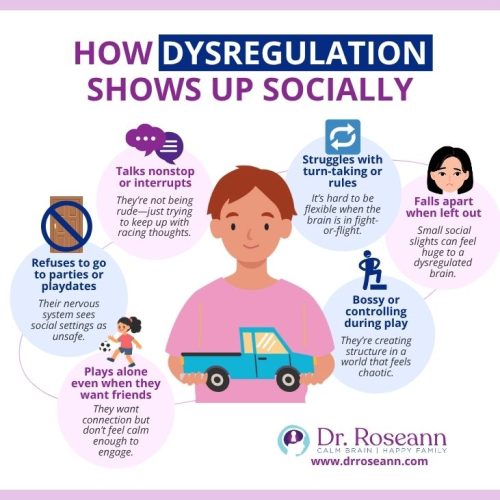
Social Symptoms of A Dysregulated Nervous System
Dysregulated social behaviors often show up at home, school, or in playdates. Some are loud and obvious, while others are quiet and easily missed.
- Social Withdrawal or Avoidance
- Healthline
- Difficulty Taking Turns or Sharing
- Kids with dysregulation often struggle with give-and-take. Waiting their turn, compromising, or losing gracefully may lead to outbursts—or total shutdown.
- Intense Reactions to Peer Rejection
- Even a small social slight—a friend choosing someone else for a partner—can trigger a meltdown or a spiral of self-doubt. They might say, “Nobody likes me” or “I’m stupid.”
- Sudden Changes in Social Behavior
- You might notice your once-social child is now quiet, reserved, or irritable around peers. Or they may become overly dependent on one friend and feel lost without them.
What Dysregulated Social Behavior Looks Like in Real Life
Let’s break down some of the most common patterns we see:
| Behavior | What It Might Mean |
|---|---|
| Constant interruptions | Trouble with impulse control and flexible attention. |
| Oversharing or dominating convo | Social anxiety and overcompensation for feeling "out of sync." |
| Always needing to be in control | Nervous system trying to create predictability in an environment that feels unsafe or overwhelming. |
| Playing too rough or too loud | Sensory overload or difficulty with proprioceptive and body regulation. |
| Appearing “too clingy” | Nervous system seeking co-regulation through proximity to a safe adult. |
| Isolating completely | Brain going into "freeze" mode to avoid emotional overwhelm. |
| Frequent conflicts with peers | Poor frustration tolerance and rigid thinking patterns. |
These are not signs of a “bad kid.” They’re signals from a brain that’s overwhelmed. And the thing is, the more trouble they have regulating their emotions, the more they struggle with connecting socially. This is especially true in children with autism (Davico et al., 2022).
What Happens at School and Why It’s Often Missed
Social dysregulation is often misread by teachers and peers.
For example:
- The quiet kid hiding in the back? Seen as “shy,” when really, they’re in freeze mode.
- The kid who yells when left out? Labeled “aggressive,” when they’re actually terrified of rejection.
- The student who always blurts out answers? Viewed as impulsive, when their brain is racing from anxiety.
That’s why it’s so important for parents and educators to understand the root cause—not just the behavior.
How to Help Your Child Connect Again
If left untreated, children may find it harder to adjust as years go by.
There was a study that followed kids between 7 and 9 years old, and it confirmed what many parents already sense: when a child has trouble managing their emotions, social struggles tend to follow. These weren’t just kids with diagnoses—just typical kids who had a harder time with big feelings. And year after year, those same kids had a harder time keeping friendships (Matchett et al., 2020)
You can’t “teach” social skills to a dysregulated brain without first helping it feel safe. That means focusing on calming the nervous system before expecting connection.
Here’s where to start:
1. Regulate First, Relate Second
Use tools like breathing exercises, movement breaks, or biofeedback to calm the body.
In one trial (Boxmeyer et al., 2023), kids who were quick to anger were taught mindfulness alongside behavioral tools. What happened? Their nervous systems started to calm down—and with that, their outbursts during social situations dropped. When a child feels more in control inside, they can connect more calmly with the world around them.
A calm child can engage. A stressed one can’t.
2. Reduce Demands in Social Settings
Don’t force participation. Instead, prep your child ahead of time and give them an out. Small wins build confidence.
3. Model and Coach Social Interactions
Use role play or narrate social situations at home: “See how I asked if I could join? That helps people feel safe.”
4. Consider Peer-Matched Activities
Therapeutic social groups, low-pressure clubs, or playdates with just one friend can help your child practice safely.
5. Support Through the Right Therapies
Social growth can be made possible with occupational therapy, neurofeedback, parent coaching, and some somatic approaches. These professionally-guided interventions have been known to help regulate the nervous system.

When to Seek Support
If your child’s social difficulties are chronic, intense, or worsening over time, trust your gut. You don’t need to wait until they’re labeled with a diagnosis to get help.
- Start with a consultation with a specialist who understands dysregulation.
- Track when and where the behavior shows up—this helps guide support.
- Don’t assume they’ll “grow out of it.” Some kids need direct nervous system support first.
Your child isn’t broken—they’re dysregulated.
Social challenges are often the first place parents feel something is off. But rather than punishing or pressuring your child to behave “better,” the real path to connection starts with co-regulation.
When the brain feels safe, the child can connect.
When the child feels connected, social growth follows naturally.
And that’s when things begin to change—not just in friendships, but in confidence, communication, and everyday joy.
Parent Action Steps
☐ Consult a regulation expert and get a brain map
☐ Limit Demands in Social Situations (For Now)
☐ Sign up for the Dysregulation Solution
☐ Explore the our program
FAQs
How do I know if my child’s social struggles are from dysregulation—not just behavior or personality?
Social struggles from dysregulation tend to be inconsistent and reactive—your child may do fine one moment, then suddenly shut down, get bossy, cry, or lash out when things feel too fast, loud, or unpredictable.
Why does my child seem okay with friends sometimes—and totally melt down other times?
This happens because your child can handle socializing until their stress builds up—once they’re tired, overstimulated, or hungry, their brain loses the ability to stay flexible and the meltdown comes fast.
Is it normal for a dysregulated child to be clingy, controlling, or withdrawn?
Yes, because when kids feel unsettled inside, they try to create safety outside—this can look like controlling play, sticking to one “safe” person, or avoiding interaction altogether.
Will my child outgrow these social challenges over time?
Some kids improve with maturity, but many need support—without help, they may keep avoiding peers, misreading social cues, or reacting quickly instead of building real connection skills.
Why does my child have trouble making or keeping friends?
Trouble making or keeping friends often comes from interrupting, missing social cues, overreacting to small issues, or not knowing how to recover after a conflict—which can push other kids away.
Why does my child act younger than other kids in social situations?
In social situations, your child may act younger because they fall back on simpler behaviors—like whining, grabbing, or needing constant reassurance—when they feel unsure or overwhelmed.
How can I help my child with social skills when they get overwhelmed easily?
Start small—practice one-on-one playdates, prep them before social situations, and step in to co-regulate when things get hard so they can experience what staying calm with others feels like.
Why does my child avoid group activities or get overwhelmed in social settings?
Group settings can be too much—noise, multiple conversations, and fast transitions can overload your child, leading them to withdraw, cling to you, or act out just to cope.
Citations
Boxmeyer, C., Stager, C., Miller, S., Lochman, J., Romero, D., Powell, N., Bui, C., and Qu, L. (2023). Mindful coping power effects on children’s autonomic nervous system functioning and long-term behavioral outcomes. J. Clin. Med 12(11)3621. https://doi.org/10.3390/jcm12113621
Davico, C., Marcotulli, D., Cudia, V., Arletti, L., Ghiggia, A., Svevi, B., Faraoni, C., Amianto, F., Ricci, F., and Vitiello, B. (2022). Emotional dysregulation and adaptive functioning in preschoolers with Autism Spectrum Disorder or other neurodevelopmental disorders. Front. Psychiatry 13. https://doi.org/10.3389/fpsyt.2022.846146
Dr. Roseann is a mental health expert in Self-Regulation who frequently is in the media:
- Healthline Understanding Self-Regulation Skills
- Scary Mommy What Is Self-Regulation In Children, And How Can You Help Improve It?
- HomeschoolOT Therapy Services Understanding Nervous System Dysregulation in Children: A Guide for Homeschool Parents
Always remember… “Calm Brain, Happy Family™”
Disclaimer: This article is not intended to give health advice and it is recommended to consult with a physician before beginning any new wellness regime. *The effectiveness of diagnosis and treatment vary by patient and condition. Dr. Roseann Capanna-Hodge, LLC does not guarantee certain results.
Are you looking for SOLUTIONS for your struggling child or teen?
Dr. Roseann and her team are all about science-backed solutions, so you are in the right place!