%20.png)



Estimated reading time: 10 minutes
If you want to reset your child’s nervous system, start by calming the brain through simple, repeatable supports:
- co-regulation (your calm helps their calm)
- Movement
- predictable routines
- good sleep
- low-demand moments.
These aren’t quick fixes, but they’re the most reliable way to shift your child out of fight-or-flight and into a state where they can actually think, learn, and cope.
If your child’s behavior feels out of control lately, know that we see this every day: big feelings, school friction, and family stress that can feel nonstop – you’re not alone.
The good news is, when we calm the brain first, everything else gets easier—connection improves, behavior settles, and kids can access their skills again.
In this guide, you’ll learn:
- what a true “nervous system reset” really means
- to clear up common myths
- simple, science-backed steps you can use at home and at school.
What Does “Reset the Nervous System” Mean for Kids?
A full “factory reset” isn’t the goal. A realistic reset means nudging a child’s autonomic nervous system back toward balance so they can think, learn, and connect.
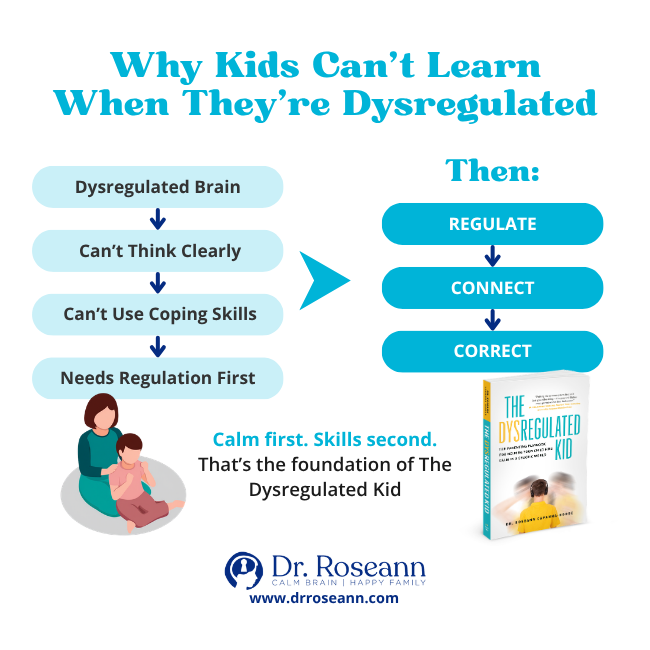
In plain English: calm first, then skills. We regulate → connect → correct. That’s Regulation First Parenting™.
Key ideas:
- Behavior is communication. Meltdowns = overwhelmed brain, not “bad kid.”
- Reset = shift out of fight/flight or shut down into a calmer, parasympathetic state.
- Not a one-and-done. Regulation builds with repetition + co-regulation and the right supports.

How to Know if Your Child Is Dysregulated vs. Just Misbehaving
When a nervous system is on high alert, kids look defiant, silly, or shut down. Notice patterns (time of day, noise, transitions). Your calm is the anchor—co-regulation lowers your child’s stress load.
Watch out for:
- Over-activation (fight/flight): fast talk, arguing, running off, sound/light sensitivity
- Under-activation (freeze): zoning out, “lazy” look, slow response, flat affect
- Body clues: clenched jaw, shallow breathing, tummy aches
Parent example:
Miriam’s 10-year-old with anxiety melted down before school. Instead of lecturing, Miriam sat nearby, breathed slowly, and offered a cold washcloth. Within two minutes, her son’s breathing slowed.
Takeaway: Co-regulation beats correction when the brain is hot.
What Calms a Child Fastest During a Meltdown?
When the brain is flooded, logic won’t land. Use bottom-up regulation first. Then add words.
Try this 90-second “CALMS” reset
- Cool or compress (cold water on hands or face; weighted lap pad)
- Air: slow double exhale breathing (in 4, out 6)
- Low voice + few words (“I’m here. You’re safe.”)
- Move: wall push, chair push-ups, or slow rocking
- See + name 5-4-3-2-1 sensory items to ground attention
“Co-regulation is a biological imperative.” - Stephen Porges, PhD
Bold truths
- You can’t teach skills to a dysregulated brain.
- Less talk, more breath in the heat of the moment.

Can Daily Habits Retrain Your Child’s Brain Over Time?
Yes. Brains love rhythm and repetition. Small, predictable routines build vagal tone and emotional stamina.
Daily rhythm that helps “reset the nervous system” over time
- Sleep: consistent schedule; wind-down with dim lights
- Food: protein + fiber breakfast to steady blood sugar
- Movement: morning vestibular (swinging, gentle spins), after-school heavy work
- Screens: buffer 60 minutes before bed; lower brightness; blue-light blockers
- Connection: 10-minute “special time” daily—no fixing, just attunement
Parent example:
Andre’s 8-year-old with ADHD ping-ponged after school. They added 10 minutes of wall pushes and animal walks before homework. Within two weeks, fewer blowups.
Takeaway:
Body input first; thinking tasks second.

Which Therapies Help Kids Regulate (And Which Are Overhyped)?
Therapies that teach regulation or directly train brain-body balance show promise. Evidence keeps evolving, but some approaches stand out.
What’s Supported by Research
- Parent–child emotion coaching therapies (e.g., PCIT-ED) improve emotion regulation in young kids and reduce symptoms in trials (Luby et al., 2018).
- Emotion regulation–focused interventions for youth show overall benefits across studies and settings (Moltrecht et al., 2020).
- Neurofeedback can yield sustained improvements for some ADHD symptoms at 2–12 months follow-up (Van Doren et al., 2019). Results vary by protocol and training time.
“Emotion regulation is about influencing which emotions we have, when we have them, and how we experience and express them.” (James J. Gross, PhD)
Emerging or Adjunctive
- Breath and HRV training, sensory diets, mindfulness, and OT strategies support regulation skills.
- PEMF and other bio-energetic tools are being explored; evidence in pediatric mental health is still developing—use with clinical guidance.
What to Watch Out For
- One-size-fits-all promises. Kids are unique. Protocols and fidelity matter.
- All talk, no body. Purely cognitive approaches often fail if the nervous system stays dysregulated.
Parent example:
Maya’s teen with OCD used breath pacing + therapist-led exposure after short sensory input. The combo stuck.
Takeaway: Layer bottom-up + top-down for durable gains.
How to Partner With Your Child’s School Without More Power Struggles
Bring a regulation plan to the table. Ask for tiny, doable supports—then measure.
School Supports That Work
- Movement breaks every 30–45 minutes; heavy-work jobs
- Calm corner: noise-reducing headphones, putty, breathing cards
- Predictable transitions: visual schedule, 2-minute warnings
- Ways to repair: short reset walk + return plan (not punishment)
“Connection primes the brain for learning.” (Daniel J. Siegel, MD)
Quick Classroom Regulation Supports
What if Progress Is Slow or Inconsistent?
Healing is not linear. You’ll see dips during growth spurts, illness, or life changes. That isn’t failure—it’s nervous system reality.
Stay the Course
- Track inputs (sleep, food, screens) and outputs (meltdowns, stamina).
- Keep the same few tools. Repetition wires regulation.
- Reframe setbacks: “This is data, not doom.”
When Should You Seek a Professional Evaluation?
Get help if safety is a concern or school avoidance is worsening. Or if anxiety/OCD symptoms dominate daily life.
A multi-modal plan often works best: parent coaching, OT, CBT/ERP for anxiety/OCD, and targeted brain-based tools (e.g., neurofeedback with an experienced provider).
A note on evidence
- Parent–child therapies that coach emotions show benefits in RCTs (Luby et al., 2018).
- Meta-analyses find youth-focused emotion regulation programs improve core skills (Moltrecht et al., 2020).
- Neurofeedback may provide sustained gains for some ADHD presentations when protocols are strong and training is adequate (Van Doren et al., 2019).
The Calm You Create Today Shapes Tomorrow
Every child’s nervous system holds the potential for healing. It just needs the right environment to unfold.
When you calm the brain first, you give your child permission to feel safe, seen, and ready to grow. That’s where real progress begins.
Your calm presence is the medicine your child’s nervous system craves. When you model steadiness, their brain learns balance.
When you bring structure with compassion, their body begins to trust calm as its new normal. That’s how families move from chaos to connection—and how we reset the nervous system for lasting change.
Regulate. Connect. Correct.™ This is how healing begins.
FAQs
How do I fix emotional dysregulation in my child?
Fixing emotional dysregulation starts with calming the nervous system first. When you help your child feel safe and regulated, their brain can actually access coping skills and better behavior.
How long does it take to reset a child’s nervous system and see changes?
Resetting a child’s nervous system can show small changes in just days, but lasting change usually takes weeks to months. Consistency with a few simple tools is what really helps the nervous system reset over time.
Is resetting my child’s nervous system just coddling them?
Resetting your child’s nervous system isn’t coddling—it’s brain-based parenting. When the nervous system is calm, kids are much more able to handle limits, follow directions, and build real coping skills.
What should I do if my child refuses nervous system regulation tools?
If your child refuses nervous system regulation tools, shift to co-regulation and offer simple choices. Practicing regulation tools during calm moments—not just during meltdowns—helps kids feel more open to trying them.
Can I help reset my child’s nervous system at school?
Yes, you can absolutely reset your child’s nervous system at school with simple supports like movement breaks or calming strategies. Partnering with teachers makes it easier to build nervous system regulation into the school day.
How can I reset the nervous system naturally in my child?
You can reset the nervous system naturally through movement, sleep, nutrition, connection, and calming routines. These simple habits support healthy nervous system regulation every day.
How do I know if my child’s nervous system is finally reset and regulated?
You’ll know your child’s nervous system is more regulated when they recover faster from stress, have fewer intense
- Autonomic Nervous System (ANS): Body’s stress and calm system (gas and brakes).
- Sympathetic / Parasympathetic: “Fight/flight” vs. “rest/digest.”
- Co-regulation: Your calm helps your child’s brain calm.
- Vagal tone: Flexibility of the nervous system to shift between arousal and calm.
- Sensory diet: Planned movement/sensory activities to steady the nervous system.
Citations
Luby, J. L., Barch, D. M., Whalen, D., Tillman, R., & Freedland, K. (2018). A randomized controlled trial of parent–child psychotherapy targeting emotion development for early childhood depression. American Journal of Psychiatry, 175(11), 1102–1110. https://doi.org/10.1176/appi.ajp.2018.18030321
Moltrecht, B., Deighton, J., Patalay, P., & Edbrooke-Childs, J. (2020). Effectiveness of current psychological interventions to improve emotion regulation in youth: A meta-analysis. European Child & Adolescent Psychiatry, 29, 1–18. https://doi.org/10.1007/s00787-020-01498-4
Van Doren, J., Arns, M., Heinrich, H., et al. (2019). Sustained effects of neurofeedback in ADHD: A systematic review and meta-analysis. European Child & Adolescent Psychiatry, 28, 293–305. https://doi.org/10.1007/s00787-018-1121-4
Always remember... “Calm Brain, Happy Family™”
Disclaimer: This article is not intended to give health advice, and it is recommended to consult with a physician before beginning any new wellness regimen. The effectiveness of diagnosis and treatment varies from patient to patient and condition to condition. Dr. Roseann Capanna-Hodge, LLC, does not guarantee specific results.
Are you looking for SOLUTIONS for your struggling child or teen?
Dr. Roseann and her team are all about science-backed solutions, so you are in the right place!
©Roseann Capanna-Hodge