%20.png)



Estimated reading time: 6 minutesLiving with anxiety can be challenging, and for those dealing with anxiety disorders, the constant barrage of anxious thoughts can make your kid’s daily life feel overwhelming.To reduce a racing mind and shut your brain off anxiety, your child must engage in activities that shift their focus away from their anxious thoughts like physical exercise, deep breathing, meditation, nature time, scheduling worry time, and journaling.In my BrainBehaviorReset™ Program, I guide parents through proven tools to help their kids feel more calm, focused, and in control.
What Makes Anxiety So Complex?
Anxiety isn’t just worry—it’s your child’s nervous system sounding the alarm. Their brain gets stuck in overdrive, constantly scanning for danger, even when there’s nothing there.This stress response is shaped by a mix of factors:
- Genetics (Gottschalk & Domschke, 2017)
- Environmental stressors
- Lived experiences (trauma or ongoing overwhelm)
And it doesn’t always look how you’d expect. Some kids might show:
- Constant fear or spiraling thoughts
- Sudden panic attacks
- Obsessive behaviors or rituals
- Body symptoms like headaches or stomachaches
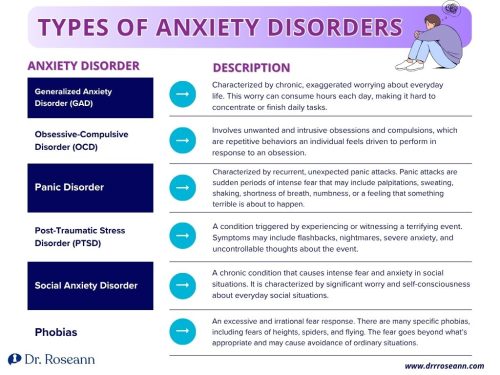
Anxiety disorders can include:
- Generalized Anxiety Disorder (GAD)
- Panic Disorder
- Obsessive-Compulsive Disorder (OCD)
- Post-Traumatic Stress Disorder (PTSD)
In fact, research has shown a strong link between early trauma and anxiety later in life (Huh et al., 2014). This isn’t about blame. It’s about understanding why your child reacts the way they do—and knowing there’s a path forward.Because what you see as behavior? That’s really brain dysregulation. And when we calm the brain first, everything else starts to shift. That’s the heart of what I teach in my BrainBehaviorReset™ Program.
Why Can’t My Child Stop Worrying—and How Do We Break the Cycle?
Racing thoughts are one of the most common—and exhausting—signs of anxiety. The brain gets stuck in a negative feedback loop, where:
- Worry triggers anxious feelings
- Stress builds in the body
- More worry follows, and the cycle keeps repeating
To break the spiral, we have to calm the brain and shift the thinking that fuels it. That’s where Cognitive Behavioral Therapy (CBT) can be a game-changer (Curtiss et al., 2021). It helps kids:
- Spot negative thought patterns
- Challenge irrational fears
- Replace them with calmer, more balanced thoughts
When kids learn how to interrupt the loop, they finally start to feel in control—and their busy minds can begin to rest.
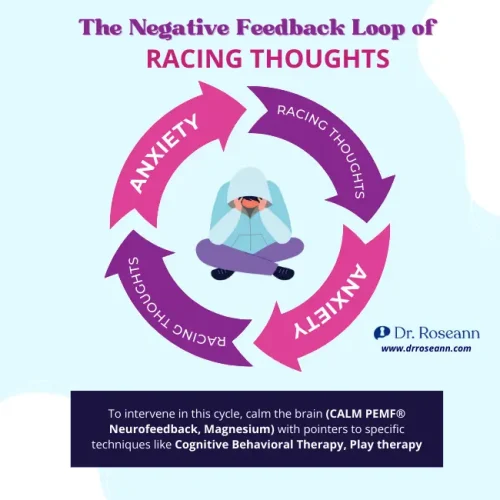
The Negative Feedback Loop of Racing Thoughts"
- Visual Elements: A circular flowchart showing how racing thoughts lead to more anxiety, which in turn leads to more racing thoughts.
- Content: Steps to intervene in this cycle, calm the brain (CALM PEMF® Neurofeedback, Magnesium) with pointers to specific techniques like Cognitive Behavioral Therapy, Play therapy
What’s Keeping My Child Stuck in the Cycle of Anxiety?
When anxiety shows up, it doesn’t just rattle your child in the moment—it can throw off the whole day. What begins as a stressful morning can spiral quickly. By bedtime? They’re still wired, restless, and on edge.Then come the tossing, the turning, and those exhausted tears. And the next day? Even harder.That’s how kids get stuck in the anxiety loop. One rough day rolls into the next until everything feels overwhelming—for them and for you.And this cycle isn’t just emotional. It affects their entire body. Chronic anxiety can show up as:
- A racing heart or tight chest
- Panic attacks or emotional meltdowns
- Muscle tension, stomach issues, or even immune suppression
It’s a brain-body feedback loop—and it has to be interrupted. That’s why calming the nervous system is key. Tools like deep breathing, mindfulness, and relaxation aren’t just soothing—they help pull the brain out of survival mode and guide it back toward calm.Calm the brain first, and everything else starts to shift. That’s the foundation of my BrainBehaviorReset™ Program—and it’s where real change begins.
How Can I Help My Child Stop Worrying About Everything?
Chronic worry doesn’t just wear your child out—it locks their brain in fear gear. When kids constantly imagine what might go wrong, their thoughts spiral fast.One worry leads to another, then another. It’s like their brain is stuck in a mental hamster wheel—spinning but going nowhere.To help calm the chaos, try these three brain-based tools:
1. Practice deep breathing techniques
When kids get anxious, breathing becomes fast and shallow. That tells their body, “Something's wrong!”—even when it’s just a forgotten homework assignment.Deep belly breaths flip that switch and send a signal to the brain that says, “We’re safe now.”Try this: Hand on the belly. Breathe in slow through the nose… then out through the mouth. Repeat a few times to quiet the storm inside.
2. Connect with your body to push down uncomfortable worry
Worried kids live up in their minds—reliving the past or bracing for what’s next.Mindfulness anchors them in now. Feet on the ground. Breath moving in and out. That’s where calm begins.Research shows that mindfulness and meditation can rewire how the brain responds to stress (Goldin & Gross, 2010). Even just five minutes a day can help your child feel more present, centered, and in control.
3. Flip your script and swap negative thoughts with a positive mantra
Try a simple phrase like, “I am safe” or “I can handle this.” Repeating it out loud or in their mind builds new, more calming brain pathways. Over time, those mantras become a kind of emotional armor.What you see as worry? That’s really brain dysregulation. When we calm the brain first, everything else begins to shift.Need more support? Check out the Natural Anxiety Relief Kit.
Parent Action Steps
Build a simple mindfulness routine for your childCreate a predictable daily rhythm to reduce stressModel calm behavior to support co-regulationTake our Solution Matcher to get science-backed solutions to help your child todayLearn more about the BrainBehaviorReset™ ProgramFrequently Asked Questions
How to stop thinking about something?
When thoughts keep circling, the best way to break free is by redirecting your brain. Try doing something active or engaging—like going for a walk or focusing on a creative task.You can also use mindfulness tools like deep breathing to quiet the mental noise and bring your focus back to the present.
What is progressive muscle relaxation?
Progressive Muscle Relaxation (PMR) is a simple but powerful technique where you tense and then relax each muscle group in your body. It’s a great way to release stress that builds up physically.By teaching your body what calm feels like, PMR helps shift your brain out of tension mode and into relaxation.
Can blue light help alleviate anxiety?
Surprisingly, yes—but context matters. Natural blue light from sunlight can boost mood and help regulate sleep-wake cycles.Too much artificial blue light at night (from screens) can disrupt sleep and make anxiety worse. Managing your child’s light exposure—especially before bed—can really help calm their nervous system.
Can a warm bath address chronic pain and promote better sleep?
Absolutely. A warm bath can soothe tense muscles, ease aches, and help your child’s body relax after a long day.The bonus? It also helps regulate body temperature, which naturally preps the brain for sleep. depressionIt’s a simple yet effective way to support better rest and reduce stress.
What happens in the body during physical activity?
Movement is medicine. When your child exercises, their body releases endorphins—those feel-good brain chemicals that reduce stress and boost mood.It also helps burn off extra energy and tension, which is key for anxious or dysregulated kids. Regular movement helps the brain feel calm, focused, and more in control.CitationsCurtiss, J. E., Levine, D. S., Ander, I., & Baker, A. W. (2021). Cognitive-Behavioral Treatments for Anxiety and Stress-Related Disorders. Focus (American Psychiatric Publishing), 19(2), 184–189. https://doi.org/10.1176/appi.focus.20200045Goldin, P. R., & Gross, J. J. (2010). Effects of mindfulness-based stress reduction (MBSR) on emotion regulation in social anxiety disorder. Psycnet.apa.org. https://psycnet.apa.org/record/2010-01983-016Gottschalk, M. G., & Domschke, K. (2017). Genetics of generalized anxiety disorder and related traits. Dialogues in clinical neuroscience, 19(2), 159–168. https://doi.org/10.31887/DCNS.2017.19.2/kdomschke Huh, H. J., Kim, S.-Y., Yu, J. J., & Chae, J.-H. (2014). Childhood trauma and adult interpersonal relationship problems in patients with depression and anxiety disorders. Annals of General Psychiatry, 13(1). https://doi.org/10.1186/s12991-014-0026-yDr. Roseann is a mental health expert in Anxiety who frequently is in the media:
- Break the Rules Podcast Overcoming Anxiety & Mental Health Disorders.
- CBS2 New York (Article) Experts Offer Tips On How To Help Children Deal With Anxiety.
- What if it's Not Depression (Video) Anxiety, OCD and Trichotillomania.
Always remember... “Calm Brain, Happy Family™”
Disclaimer: This article is not intended to give health advice and it is recommended to consult with a physician before beginning any new wellness regime. *The effectiveness of diagnosis and treatment vary by patient and condition. Dr. Roseann Capanna-Hodge, LLC does not guarantee certain results.
Are you looking for SOLUTIONS for your struggling child or teen?
Dr. Roseann and her team are all about science-backed solutions, so you are in the right place!
Grab your complimentary copy of