



Estimated Reading Time: 9 minutes
When kids like Alex are bright, creative, and caring but struggle with things like planning, organizing, starting, or finishing tasks, adults often misinterpret those struggles. Instead of recognizing that these are skill gaps (executive functioning challenges), people may label the child as “lazy” or “unmotivated.”
In reality, your child isn’t lacking effort or interest—they’re lacking certain skills they need to succeed.
If you're wondering how to improve executive function, the most effective approach is to strengthen skills like planning, organization, working memory, self-monitoring, time management, and emotional regulation through consistent practice, targeted supports, and brain-based interventions.
I'm Dr. Roseann Capanna-Hodge, and for over 30 years I've helped children improve executive functioning challenges related to ADHD, anxiety, autism, learning differences, and nervous system dysregulation. Executive functioning skills can be strengthened over time when children receive the right support, strategies, and opportunities to practice these critical life skills.
In this guide, I’ll show you exactly how to improve executive function. I’ll tackle practical, brain-based strategies you can use today at home and school.
What Is Executive Function?
Executive function (EF) is the brain’s “air traffic control.” It coordinates skills like working memory, task initiation, inhibition (impulse control), emotional regulation, planning, time management, and organization.
When a child’s executive functioning is weak, even simple parts of the day can feel like uphill battles—mornings drag on, directions get lost, and frustration builds quickly. It isn’t that they don’t care; their brain is working harder just to keep up.
Key takeaway:
Behavior is communication. Struggles with chores, transitions, or homework usually signal a dysregulated nervous system and lagging skills. It’s not defiance.
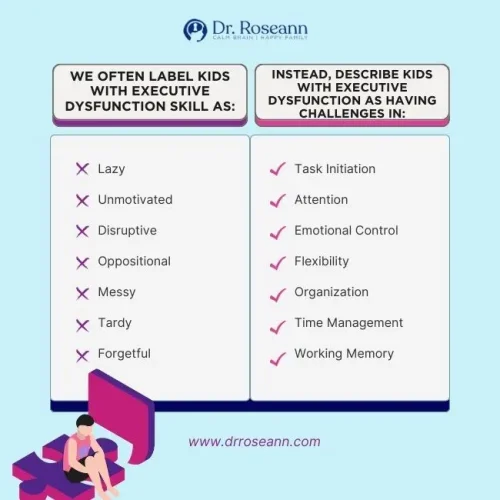
Is Your Child’s Behavior Executive Dysfunction—Not “Bad Behavior”?
When kids are dysregulated, they can’t access higher-level skills. Common signs include:
- Starts but doesn’t finish multi-step tasks
- Loses materials or forgets assignments
- Melts down with transitions or changes in plans
- Procrastinates until overwhelmed
- Hyperfocuses on preferred interests but avoids non-preferred tasks.
Parent story:
Kirsten’s 10-year-old with anxiety “forgets” directions after step one. Once they posted a 3-step visual on the fridge and practiced “say it back,” homework time was cut in half.
Takeaway: Clarity + co-regulation > nagging.
Let’s calm the brain first.
Is it Dysregulation or Defiance?”
| Dysregulation (check all that apply) | Possible Defiance (less common) |
|---|---|
| Fast breathing/tight jaw; covers ears/eyes; shaky or frozen body | Calm/neutral body; steady breathing; able to make eye contact |
| Blank stare or “I don’t know” after directions | Can accurately repeat the rule/expectation |
| Stuck on one idea; repeats “no”; loses words | Goal-seeking (e.g., bargaining for screen time) |
| Triggered by transitions, surprises, or sensory overload (noise, crowd, bright lights) | Happens mainly with one caregiver or when there’s an audience |
| Meltdown → fatigue/remorse; behavior improves with calming supports | No change even after strong regulatory support are offered |
| Forgets multi-step directions just given | Responds predictably to clear limits and logical consequences |
What To Do (60–180 seconds)
| Regulate | Connect | Correct (one next step) |
|---|---|---|
| 4–6 slow belly breaths together; sip water | “Your brain feels loud. I’m here.” | “First shoes, then car.” (one clear action) |
| 30–60 sec movement/sensory reset (wall push-ups, squeeze, shakeout) | Offer two choices for safety/control | Point to visual/timer; break task into micro-steps |
| Lower lights/noise; fewer words; soft tone | Name/validate feeling: “That was a lot.” | Start a 2-minute timer to build momentum. |
Mini Scripts
| Scenario | Script |
|---|---|
| Dysregulation | “Your body’s telling us it’s too much. Let’s breathe, then step one.” |
| Respectful limit | “I won’t let you speak to me that way. We can do A or B. I’m here to help.” |
| Repair | “That was hard. Next time we’ll start smaller. You’re learning.” |
What’s Happening in The Brain – And Can It Change?
The prefrontal cortex (PFC) drives EF and matures into early adulthood. Stress, anxiety, ADHD, OCD, ASD, or PANS/PANDAS can tax this system. This makes it harder to plan, shift, and control impulses.
The hopeful news: the brain is plastic. Skills improve with targeted practice and a regulated nervous system (Diamond, 2013).
In plain language:
- Working memory holds steps in mind.
- Inhibition puts the brakes on impulses.
- Cognitive flexibility helps kids shift when plans change.
- Goal-directed persistence keeps them moving to the finish line.
Parent story:
Marco’s teen with ADHD erupted when schedules changed. Practicing “Plan A/Plan B” scripts and a 2-minute breath break built flexibility; meltdowns dropped by week two.
Takeaway:
It’s not bad parenting—it’s a dysregulated brain. Skills grow when we Regulate → Connect → Correct.™
Where Should Overwhelmed Parents Start (Without A Fight)?
Start small, repeat often, and make regulation the foundation.
Do this first:
- Co-regulate: 4–6 slow belly breaths together; short movement breaks
- Externalize tasks: visual schedules, whiteboards, timers
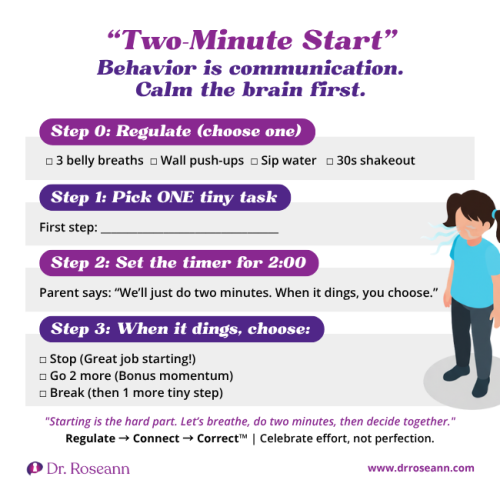
- Shrink the start: ask for two minutes of effort (momentum matters)
- Cue the brain: “Start with the end in mind”—picture the finished task
“Executive functions are essential for success in school and life. These can be improved with practice.” — Adele Diamond, Ph D (Diamond, 2013)
Daily Routines That Build Executive Functioning Skills
Think simple systems that repeat daily. Consistency wires the brain.
Morning Routine
- Lay out clothes/backpack the night before
- Visual checklist on the closet or door
- “Beat the timer” game for shoes/jacket.
Homework Routine
- Same time/place daily
- 5-minute brain-body regulation (breathing, wall push-ups)
- Visual “First-Then”: First math page → Then 10-minute break
- Task chunking: one tiny step at a time
Evening Routine
- Prep for tomorrow (pack, charge, check planner)
- Short stretch or mindfulness; lights down 30–60 minutes before bed
Parent story:
Aisha’s 8-year-old never started chores. They added a “First-Then” chart and a kitchen timer. Two weeks later, chores happened with one reminder.
Takeaway: Structure is compassionate. It lowers stress and raises success.
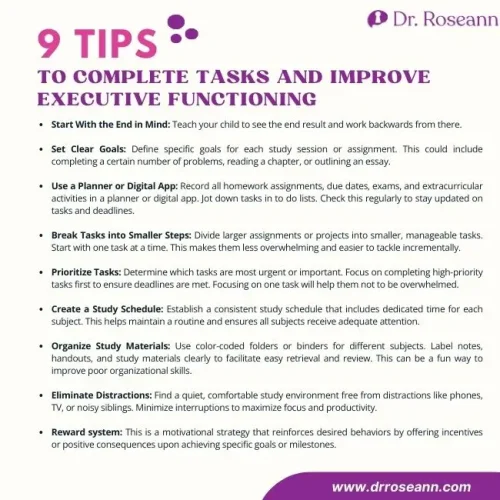
How To Help With Homework, Time Management, and Organization
Here’s a parent-tested toolbox. You can pick one or two to begin.
Task Initiation
- “Just two minutes” rule + visual two-step checklist
- Body double (sit nearby quietly while they begin)
Working Memory
- “Say it back” after directions
- Use sticky notes for sub-steps
Time Management
- Analog clock + Time Timer for visual time
- Estimate → do → compare (“Was that 10 or 20 minutes?”)
Organization
- One binder, color-coded folders; weekly “clean sweep”
- Backpack resets every Sunday
Emotional Control
- Name it to tame it (feelings chart)
- Movement first, then talk about solutions
What should schools do for students with poor executive functioning?
Collaborate with your child’s team and ask for practical support:
- Predictable routines + posted visual schedules
- Chunked directions (1–2 steps at a time) with check-ins
- Extended time and reduced-load assignments when appropriate
- Organizational coaching (weekly planner check, clean-out)
- Assistive tech: reminders, timers, text-to-speech
- Quiet work area or movement break pass
Pro tip: Request that EF goals be behavioral and measurable (e.g., “uses planner to record tasks in 4/5 trials”).
“Executive functions show both unity and diversity—support plans must target the right skills.” — Akira Miyake, Ph D (Miyake et al., 2000)
Read more about: Children’s Executive Functioning: Hidden Keys to Calm and Success
When to Seek Professional Support
Seek help when home strategies aren’t enough or school stress may be escalating. Did you also notice significant anxiety, mood, attention, OCD, or autistic features? A comprehensive evaluation can clarify strengths and needs.
Evidence-informed supports:
- Parent coaching in EF strategies
- Cognitive-behavioral and skills-based therapies
- School accommodations aligned to EF goals
- Brain-based tools: breath, movement, sensory input, neurofeedback (when appropriate)
- Lifestyle pillars: sleep, nutrition, exercise, detox supports
What the research suggests: High-quality interventions that pair self-regulation with academics can improve EF and classroom outcomes (Blair & Raver, 2014).
“Improving self-regulation in early grades leads to better attention and learning.” — Clancy Blair, Ph D (Blair & Raver, 2014)
Bringing It All Together: A Calmer Path Forward
You came here to learn how to improve executive function. Now you have a simple plan: Regulate → Connect → Correct™.
Start with regulation, externalize tasks with visuals and timers, and practice tiny starts every day. Remember, it’s gonna be OK. You’re a good parent, and your child’s brain can grow.
Next step: Download my free Executive Functioning Parent Toolkit and try it today.
FAQs on How To Improve Executive Function
How can executive functioning skills be improved?
Executive functioning skills can be improved through consistent practice, structured routines, visual supports, and activities that strengthen planning and self-regulation.
What are the best strategies for improving executive function in children?
Effective strategies include using checklists, breaking tasks into smaller steps, creating routines, and teaching organizational skills.
Can executive functioning skills improve with age?
Yes, executive functioning skills often improve as children mature, especially when they receive support and opportunities to practice these abilities.
How does exercise help executive functioning?
Exercise supports executive functioning by improving attention, emotional regulation, working memory, and overall brain health.
What role does sleep play in executive functioning?
Quality sleep is essential for executive functioning because it supports focus, memory, decision-making, and emotional regulation.
Can executive functioning exercises help children with ADHD?
Yes, executive functioning exercises can help children with ADHD strengthen organization, impulse control, planning, and task completion skills.
How long does it take to improve executive functioning skills?
Improving executive functioning skills takes time and consistent practice, but small improvements often become noticeable with regular support.
How can parents help improve executive functioning at home?
Parents can help improve executive functioning at home by creating predictable routines, providing visual reminders, and encouraging independence through guided practice.
Citations
Blair, C., & Raver, C. C. (2014). School readiness and self-regulation: A developmental psychobiological approach. Child Development, 85(1), 1–8. https://doi.org/10.1111/cdev.12164
Diamond, A. (2013). Executive functions. Annual Review of Psychology, 64, 135–168. https://doi.org/10.1146/annurev-psych-113011-143750
Miyake, A., Friedman, N. P., Emerson, M. J., Witzki, A. H., Howerter, A., & Wager, T. D. (2000). The unity and diversity of executive functions and their contributions to complex “frontal lobe” tasks: A latent variable analysis. Cognitive Psychology, 41(1), 49–100. https://doi.org/10.1006/cogp.1999.0734
©Roseann Capanna-Hodge
If you're raising a child with frequent meltdowns or intense emotional reactions, The Dysregulated Kid offers practical strategies to help you understand your child's nervous system and create lasting regulation.
Always remember… “Calm Brain, Happy Family™”
Disclaimer: This article is not intended to give health advice and it is recommended to consult with a physician before beginning any new wellness regime. The effectiveness of diagnosis and treatment vary by patient and condition. Dr. Roseann Capanna-Hodge, LLC does not guarantee certain results.
Are you looking for SOLUTIONS for your struggling child or teen?
Dr. Roseann and her team are all about science-backed solutions, so you are in the right place!
Meet the Expert
Licensed Therapist | Certified School Psychologist
Board Certified in Neurofeedback (BCN) | 30+ Years Clinical Experience
Expert in Emotional Dysregulation in Children and Nervous System Regulation
Host, Dysregulated Kids Podcast | Author, The Dysregulated Kid
Dr. Roseann Capanna-Hodge is a licensed therapist, certified school psychologist, and leading expert in emotional dysregulation in children and nervous system regulation. With over 30 years of clinical experience and having analyzed more than 10,000 brain maps, she helps families understand what behavior is really signaling—and how to calm the nervous system first so real change can happen.
She is the creator of Regulation First Parenting® and the CALMS Protocol™, host of the top 1% podcast Dysregulated Kids, and author of The Dysregulated Kid.