%20.png)



Estimated reading time: 8 minutesOne simple shift—calming your child’s brain first—can turn homework battles into calmer, teachable moments.If homework time feels like a meltdown waiting to happen, you’re not alone. I work with overwhelmed parents every day. The good news? With a regulation-first plan, we can lower stress and boost learning.In this post, I’ll share top parenting tips for navigating homework challenges, rooted in brain science and real family life.You’ll learn what really drives nightly battles, how to build a routine that sticks, which brain-based breaks work, and how to partner with teachers without shame or blame.Let’s calm the brain first—then watch skills grow.
What’s Really Behind Nightly Homework Battles?
A lot of “homework problems” are actually nervous system problems. When kids are overwhelmed, under-stimulated, hungry, or tired, the brain shifts into survival mode. Thinking shuts down. That’s why nagging, lecturing, or bribing doesn’t stick.
Quick Wins
- Regulate → Connect → Correct.™ Calm first, then relate, then teach.
- Scan for root causes: sleep, nutrition, movement, sensory load, and task size.
- Say: “I see this is hard. Let’s take 3 calming breaths together.” Behavior is communication.
Real-life example:Nessa, mom of a 10-year-old with anxiety, noticed meltdowns spiked on soccer nights. We moved homework to a lighter day, added a snack, and did 90 seconds of box breathing. Fights dropped fast. The takeaway: adjust the load to the brain your child has today.
How Do I Set a Homework Routine That Actually Sticks?
Kids need predictability. A simple routine can help reduce stress for both of you.
Start Here
- Pick a consistent start time and a quiet, well-lit space. Keep supplies ready in a caddy. KidsHealth echoes these basics and encourages looping in teachers if issues persist.
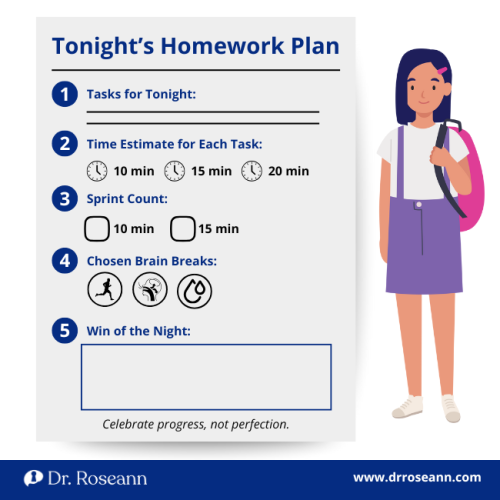
- Use a visual schedule: list tasks, estimate minutes, and check them off.
- Try timed sprints: 10–15 minutes work, 3–5 minutes break.
Pro tip: Keep phones and TV out of sight. Consider a visual timer.
How Can I Help Without Doing the Work for My Child?
Your job is to coach, not be the chief problem-solver. We build independence slowly.
Coach Moves
- Preview the directions together. Ask your child to explain the task in their own words.
- Chunk it: Break big tasks into 3–5 micro-steps.
- Scaffold then fade: Model one item, do one together, then let them try.
- Praise effort, strategies, and calm body—not just grades.
Coach vs. Correct
Which Brain-Based Breaks Improve Focus?
Short, planned movement can boost executive function and attention. Meta-analytic evidence shows that acute aerobic exercise improves executive performance across studies (Hsieh et al., 2021). Take 2–3 minutes; keep it simple.
Science-Backed Break Ideas
- Move it: jumping jacks, wall push-ups, stair laps.
- Reset eyes/body: look far then near; shoulder rolls.
- Breath sets: box breathing 4×4×4×4; longer exhale than inhale.
Keep Breaks Honest
- Set a timer.
- Do the same sequence every time so the brain expects to return to work.

How Do We Handle Homework With ADHD, Anxiety, or Dysregulation?
We regulate first. Then we simplify the plan.
ADHD-Friendly Tweaks
- Front-load tough tasks while energy is highest.
- Use shorter work blocks and frequent micro-breaks.
- Offer limited choices: “Whiteboard or notebook?”
- Keep backup supplies in the backpack and at the desk.
Anxiety-Friendly Tweaks
- Preview one step at a time.
- Replace “What if I fail?” with “What’s my next action?”
- Celebrate micro-wins.
Evidence tie-in: Teaching self-regulation strategies improves performance and motivation (Dignath & Büttner, 2008).Math note: NSF recommends working with teachers on how concepts are taught and approaching them as partners.Real-life example: Ava, 12, ADHD + dysgraphia, unraveled with long writing. We used speech-to-text for the draft, and then she typed the final version. We added 12-minute sprints and a tactile fidget. Her output doubled.Takeaway:Match tools to the nervous system, not the other way around.

How Should I Partner With Teachers When Homework Goes Off the Rails?
Connection is the bridge. A simple email can reset the tone.What to include
- Brief child profile: strengths, current challenges, and what calms them.
- What you’re trying at home (timers, breaks, chunking).
- A request for one reasonable accommodation (e.g., reduced problems, flexible format).
- Agree on a check-in cadence (biweekly is fine).
Two-way family–school communication supports academic and social success; start there and keep it going. “Kids do well if they can.” — Ross W. Greene, Ph.D.“Self-regulation is about managing stress, not self-control.” — Stuart Shanker, Ph.D.
What Are the Top Parenting Tips for Navigating Homework Challenges This Year?
Here’s your regulation-first checklist. Keep it simple. Keep it steady.
Environment
- Quiet, well-lit, clutter-light space; supplies in reach.
- Devices away unless needed for the task. KidsHealth’s core setup guidance aligns here.
Instructions & Pacing
- The child explains the task first.
- Chunk big jobs; estimate time; set a visual timer.
- Use scaffolding (I do → we do → you do).
Brain Hacks
- Move, breathe, hydrate between sprints. Acute activity supports attention (Hsieh et al., 2021).
- Try visual schedules and color-coding for priorities.
- Keep snacks protein-rich; watch sugar crashes.
Motivation & Mindset
- Praise effort, strategies, and a calm body.
- Teach a growth mindset: “Practice builds skills.”
- End with a 30-second win recap.
Monitoring & Communication
- Quick check-ins during work; light review after.
- Email teachers early. Ask about accommodations if needed.
If homework regularly takes too long for the grade level, flag it. Research shows homework effects vary by grade; more isn’t always better (Cooper et al., 2006).
Calm the Chaos: Your Homework Victory Plan
Take a deep breath—you’ve done a lot today.You’ve learned how to regulate first, build a simple routine, and coach instead of correct. And you work with your child’s school, rather than against it.Remember, behavior is communication. When the brain is calm, everything else—from attention to motivation—starts to fall into place.At the end of the day, it’s not bad parenting—it’s a dysregulated brain.You’re not failing; your child’s nervous system just needs support.And that means there’s always a way forward. It’s gonna be OK.
FAQs
How long should homework take?
It varies by grade and teacher. If it routinely exceeds a reasonable window for your child, ask for adjustments. Research finds homework effects differ by age; more time doesn’t always mean more learning (Cooper et al., 2006).
What if my child refuses to start?
Lead with regulation. Three calming breaths + one tiny first step (“Write your name”). Start motion, then momentum.
How do I manage math homework when methods look different?
Ask the teacher how they’re teaching the concept and stick with that approach. Partner, don’t pressure.
When do we seek extra help?
If your child’s stress or workload is hurting their sleep, mood, or family life, talk with their teacher and pediatric provider. You don’t have to handle it alone. Consider tutoring, OT, or a 504/IEP discussion.
Terminology
- Dysregulation: The nervous system is over- or under-activated, making thinking and coping hard.
- Co-regulation: Your calmness helps your child’s brain calm down.
- Executive function: Brain skills for planning, starting, and finishing tasks.
- Scaffolding: Temporary support you fade out as skills grow.
- Chunking: Breaking work into small, doable steps.
Citations:
Cooper, H., Robinson, J. C., & Patall, E. A. (2006). Does homework improve academic achievement? A synthesis of research, 1987–2003.Review of Educational Research, 76(1), 1–62. https://doi.org/10.3102/00346543076001001Dignath, C., & Büttner, G. (2008). Components of fostering self-regulated learning among students: A meta-analysis on intervention studies at primary and secondary school level.Metacognition and Learning, 3(3), 231–264. https://doi.org/10.1007/s11409-008-9029-xHsieh, S.-S., Chang, Y.-K., Fang, C.-L., & Hung, T.-M. (2021). The effects of acute aerobic exercise on executive function: An individual participant data meta-analysis.Neuroscience & Biobehavioral Reviews, 128, 258–269. https://doi.org/10.1016/j.neubiorev.2021.06.014
Always remember… “Calm Brain, Happy Family™”
Disclaimer: This article is not intended to give health advice, and it is recommended to consult with a physician before beginning any new wellness regimen. The effectiveness of diagnosis and treatment varies from patient to patient and condition to condition. Dr. Roseann Capanna-Hodge, LLC, does not guarantee specific results.
Are you looking for SOLUTIONS for your struggling child or teen
Dr. Roseann and her team are all about science-backed solutions, so you are in the right place!
© Roseann Capanna-Hodge
Meet the Expert
Licensed Therapist | Certified School Psychologist
Board Certified in Neurofeedback (BCN) | 30+ Years Clinical Experience
Expert in Emotional Dysregulation in Children and Nervous System Regulation
Host, Dysregulated Kids Podcast | Author, The Dysregulated Kid
Dr. Roseann Capanna-Hodge is a licensed therapist, certified school psychologist, and leading expert in emotional dysregulation in children and nervous system regulation. With over 30 years of clinical experience and having analyzed more than 10,000 brain maps, she helps families understand what behavior is really signaling—and how to calm the nervous system first so real change can happen.
She is the creator of Regulation First Parenting™ and the CALMS Protocol™, host of the top 1% podcast Dysregulated Kids, and author of The Dysregulated Kid.