%20.png)



Estimated reading time: 6 minutes
If your child seems behind on milestones or struggles with communication, you may find yourself wondering—is it developmental delay or autism?
It can feel confusing and even a little lonely at times. Both affect learning, behavior, and connection. Yet, each follows its own unique path that can surprise even the most observant parent.
When we calm the brain first and understand these differences, real growth begins. Let’s explore the key signs to watch for—and the calm-first steps that help your child thrive.
Difference Between Developmental Delay and Autism
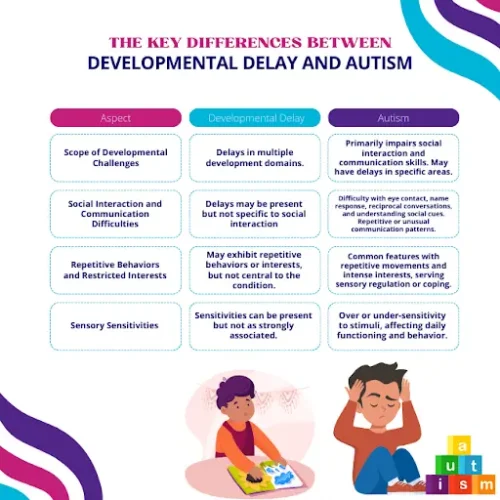
While both developmental delay and autism affect a child’s growth, understanding the differences can make a huge difference in how you support them (Paul et al., 2008). Some kids move slower along familiar tracks, while others take a completely different path that surprises even seasoned parents.
Developmental Delay
Occurs when a child reaches milestones like walking, talking, or playing more slowly than expected—yet still in the typical order. You might notice challenges in:
- Physical coordination
- Thinking and problem-solving
- Social interactions
- Emotional regulation
Many children with developmental delays want to connect, imitate adults naturally, and improve steadily with consistent routines and warm structure (Choo et al., 2019). Think of it as a slow-moving train—it might take longer, but it’s still heading in the right direction.
Autism Spectrum Disorder (ASD)
Autism isn’t just slower development—it’s a different way the brain communicates, processes information, and connects socially. Key traits often include:
- Limited or inconsistent social interest
- Repetitive or highly focused interests
- Heightened sensory sensitivities
Because it’s a spectrum, no two children look alike. The causes are complex and often involve both neurological and environmental factors (Hodges et al., 2020).
A Simple Way to Remember
- Developmental delay = slow track
- Autism = different track
Parent Story:
Sarah, mom of a curious three-year-old, noticed her son loved puzzles but rarely made eye contact. He responded to sounds yet didn’t use gestures or points.
Early testing suggested developmental delay, but later evaluations revealed autism—his brain simply processed social connection in a unique way.
Takeaway:
Once Sarah learned to calm his nervous system first, connection started to bloom.
Causes of Developmental Delay vs Autism
Some causes of developmental delays sneak up quietly.
- Premature birth or tricky delivery complications can set a slow pace
- Genetic conditions like Down syndrome, or subtle hearing and vision challenges, might quietly tip a child off course.
- Environmental stressors or nutritional gaps sometimes add invisible weight along the way.
Autism often takes a different path entirely.
- Neurological and genetic differences shape how the brain talks and listens.
- Inflammation, immune activation, or gut-brain imbalance may quietly influence growth.
- Sensory sensitivities can feel overwhelming, whereas family history or prenatal factors quietly steer development.
- Calming the brain first is key. When the nervous system feels safe and regulated, learning and connection naturally follow.
With steady regulation and loving guidance, children begin to explore, learn, and grow in ways that often feel nothing short of magical.
Early Signs to Watch For
Early detection opens the door to progress—especially when paired with nervous system regulation.
Possible Signs of Developmental Delay
- Late talking or walking
- Limited problem-solving or play skills
- Difficulty with fine motor tasks
- Struggles with following simple instructions

Possible Signs of Autism
- Lack of eye contact or response to name
- Repetitive movements (flapping, spinning)
- Extreme reactions to sound, touch, or change
- Delayed speech with limited gestures
- Preferring objects over people

How Do Professionals Diagnose Developmental Delay vs Autism?
Diagnosis begins with observation and developmental screening—seeing how your child learns, plays, and connects. Common tools include:
- Bayley Scales of Infant Development – to assess general developmental progress
- ADOS-2 – a gold-standard assessment for autism
- Speech, occupational, and neurological evaluations – to explore communication and sensory processing
Sometimes it takes a whole team to untangle overlapping symptoms and see the full picture.
Parent Story:
Marco, age 4, started speech therapy for a developmental delay. Over time, his therapist noticed he avoided peers and fixated on spinning toys—subtle signals pointing toward autism. Early recognition gave his family a head start on sensory and social therapies that rebuilt safety and connection.
Takeaway:
The label matters less than finding the right-fit support early. When we calm the brain first, everything else begins to follow.
Small, steady interventions unlock curiosity, confidence, and growth in ways that truly feel magical.
Can a Child Have Both Developmental Delay and Autism?
Yes. Many children do show this pattern.
- Developmental delay often appears first, offering gentle hints before autism becomes clearer.
- A child may begin early-intervention services under developmental delay and later meet full ASD criteria as social and communication differences unfold.
It’s like watching a puzzle come together—each new piece helping us better understand your child’s unique wiring.
Labels are meant to guide support, not limit potential. When we calm the brain first, every child’s path toward growth and connection becomes clearer.
How Can Parents Support a Child with Developmental Delay or Autism at Home?
Whether it’s delay, autism, or both, the foundation is the same: calm the brain first.
When the nervous system is dysregulated, even the best strategies won’t stick.
Start with Regulation
- Co-regulate. Your calm helps your child’s brain feel safe.
- Create predictable routines. Consistency builds trust.
- Add movement and sensory play. Swinging, crawling, or deep pressure calm the nervous system.
- Use visuals. Picture schedules and “first-then” boards reduce overwhelm.
- Model simple language and praise effort. Small wins wire the brain for success.
Parent Story:
Lena, mom of twins—one neurotypical, one with autism—started using sensory breaks and breathing tools from my CALMS Dysregulation Protocol™. Within weeks, bedtime meltdowns dropped dramatically.
When you calm your own system first, your child learns to follow that calm.
When Should Parents Seek Professional Help?
Trust your instincts—early action really matters. Notice anything off with babbling, first words, or social interest? Don’t wait it out.
Watch for signs like:
- No babbling by 12 months
- No single words by 18 months
- Little response to their name or social cues
- Loss of skills they once had
- Constant meltdowns, rigid routines, or sensory distress
Early intervention literally helps rewire the brain. Pair therapies such as speech, occupational, or social work with regulation tools like:
- Deep breathing
- Co-regulation
- CALM PEMF™
- Sensory integration
Together, these create a foundation for lifelong learning—and calmer, more connected days. When we calm the brain first, every other therapy becomes more effective, and your child’s potential begins to shine through.
Read more about: A Nervous System Approach to Autism Treatment: What Every Parent Needs to Know

Parent Action Steps
Track your child’s development and unique behaviors. If you have concerns, consult with developmental specialists who can provide guidance. If needed, seek early intervention services to support your child’s development. Foster an inclusive and accepting atmosphere for your child. Stay informed about your child’s milestones and monitor progress. Be an advocate for your child, ensuring they get the necessary help and resources. Join support groups to share experiences and learn from others in similar situations. Celebrate your child’s uniqueness and encourage their growth at their own pace. Explore therapies and resources tailored to your child’s needs. Be patient and persistent in helping your child reach their full potential.
FAQs
Is speech delay the same as autism?
Not always. Some children have isolated speech delays but still enjoy social play and eye contact. Autism affects broader social and sensory processing.
Can children outgrow developmental delay?
Many do, especially when therapies and home routines focus on calming the nervous system and building consistent practice.
Does autism always mean intellectual disability?
No. Many autistic children have average or above-average intelligence—their brains simply process and express differently.
Citations
Choo YY, Agarwal P, How CH, Yeleswarapu SP. Developmental delay: identification and management at primary care level. Singapore Med J. 2019 Mar;60(3):119-123. doi: 10.11622/smedj.2019025. PMID: 30997518; PMCID: PMC6441684. https://doi.org/10.11622/smedj.2019025
Hodges, H., Fealko, C., & Soares, N. (2020). Autism spectrum disorder: Definition, epidemiology, causes, and clinical evaluation. Translational Pediatrics, 9(Suppl 1), S55-S65. doi: 10.21037/tp.2019.09.09. PMID: 32206584; PMCID: PMC7082249. https://doi.org/10.21037/tp.2019.09.09
Paul, R., Chawarska, K., & Volkmar, F. (2008). Differentiating ASD from DLD in Toddlers. Perspectives on Language Learning and Education, 15, 101-111. doi: 10.1044/lle15.3.101. PMID: 20852731; PMCID: PMC2940236. https://doi.org/10.1044/lle15.3.101
Always remember… “Calm Brain, Happy Family™”
Disclaimer: This article is not intended to give health advice and it is recommended to consult with a physician before beginning any new wellness regime. *The effectiveness of diagnosis and treatment vary by patient and condition. Dr. Roseann Capanna-Hodge, LLC does not guarantee certain results.
Are you looking for SOLUTIONS for your struggling child or teen?
Dr. Roseann and her team are all about science-backed solutions, so you are in the right place!