%20.png)



Estimated reading time: 9 minutes
This guide shows what AuDHD symptoms look like in real life. And what actually calms the brain so your child can learn.
If your child flips from hyperfocus to shutdown, or from chatty to “I’m done,” you’re not alone.
When autism and ADHD occur together, life gets harder for families. These include sensory, social, and executive-function struggles.
We call that blend AuDHD symptoms. Understanding them is the first step to real support.
You’ll learn how AuDHD shows up day to day and how to lower overload fast. I’ll also show you how to partner with your child’s school using my Regulation First Parenting™ approach: Regulate. Connect. Correct.™
What Is AuDHD, and Why Is Everyone Talking About It?
AuDHD is a community term for when autism and ADHD present together. It isn’t a separate DSM diagnosis.
But it’s a current criterion that allows both diagnoses in the same person. It opens the door to better identification and support (Antshel et al., 2016).
Kids with both often have more intense sensory processing, executive dysfunction, and emotional dysregulation. They also have greater social communication needs than kids with only one diagnosis (Mayes et al., 2012; Grzadzinski et al., 2010).
Real life:
A mom told me, “He can build a LEGO city from memory but can’t finish a worksheet.” That’s the AuDHD paradox—deep interest + difficulty with everyday demands.

AuDHD Symptoms at Home and School
Short answer: in bursts. Your child might be “all gas, no brakes” one minute and “nope” the next.
Common Patterns
- Executive dysfunction (time blindness, task initiation, forgetfulness).
- Sensory overload (noise, lights, textures) and/or sensory seeking (movement, deep pressure).
- Social mix-ups (missing sarcasm, talking over peers, fatigue after groups).
- Emotional waves (big feelings, fast frustration, rejection-sensitive reactions).
- Masking—especially in girls/teens—then a home crash.
Parent snapshot:
Lisa can’t focus on classroom chatter. A simple 504 plan accommodation—noise-canceling headphones—helps her access learning.
Takeaway:
Behavior is communication. Find the trigger in the brain and environment, not “bad choices.”
Is It ADHD, Autism, or Both? (Parent-Friendly Map)
Use this quick table to reduce second-guessing.
Signs to Watch
Why “Regulate → Connect → Correct” works when nothing else does
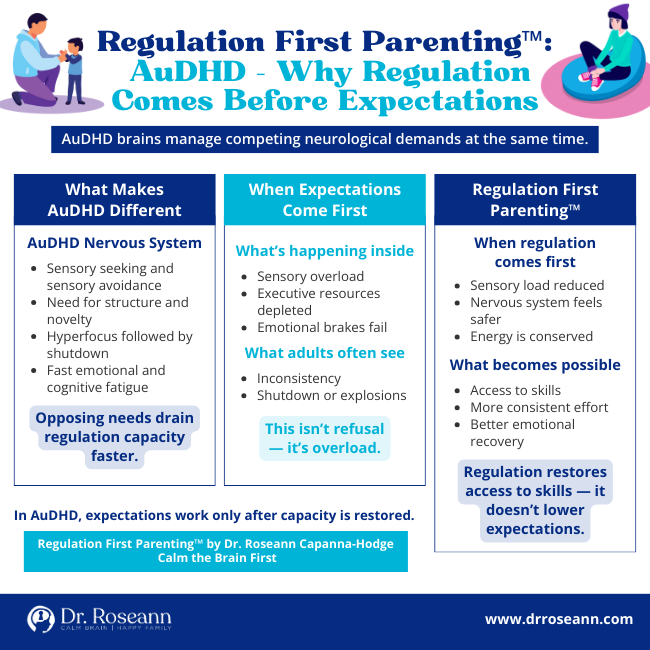
You can’t teach a dysregulated brain. That’s why we start with regulation, then relationship, then skill.
In the moment
- Regulate: Lower lights. Breathe together. Offer deep pressure or a short movement break.
- Connect: “You’re overwhelmed. I’m here.”
- Correct: When calm, teach one tiny skill: “Next time, use the pause card.”
Every child’s nervous system is different. What soothes one may overstimulate another. And that’s why personalizing support matters.
“Clinically, the management strategy for ASD+ADHD depends on a variety of factors… [and] will need to be tailored to the individual child and family.” — Antshel et al., 2016
That’s exactly why Regulate. Connect. Correct.™ works—custom, not cookie-cutter

How to Reduce Sensory Overload and Executive-Function Chaos—Today
Start tiny. Two minutes beats 20 minutes of struggle.
Micro-Tools That Work
- Sensory diet: planned movement, chewable or gum, weighted lap pad, quiet nooks.
- Visual structure: checklists, timers, first–then boards; break tasks into two-minute starts.
- Co-regulation: your calm voice and predictable routine.
- Body-based regulation: wall pushups, paced breathing (4–6 count), outdoor mini-reset.
- Brain-based supports: QEEG brain map + neurofeedback; PEMF therapy for nervous system settling; OT and CBT layered in.
Parent snapshot:
Jamie, 7, can’t wait for his turn in groups. A simple “turn tracker” with a visual timer plus praise for micro-wins builds impulse control over weeks.
“For school-age children, it is to include a school component to effective ASD+ADHD treatment.” — Antshel et al., 2016.
“Disorders of [executive function] create disorders mainly of performance rather than knowledge.” — Russell A. Barkley, PhD.

What Helps at School Right Now? (Iep/504, Teacher Scripts, Simple Tools)
Quick wins to request:
- Preferential seating + noise reduction (headphones or quiet work spot).
- Chunked directions with visual cues; first–then boards.
- Movement minutes between tasks; fidgets with clear usage rules.
- Alternate output: oral response, graphic organizer, or voice-to-text.
- One skill at a time: teach how to wait, ask for help, or use a “pause card.”
Parent snapshot:
Lucy blurts answers and interrupts. Her teacher and I set a discreet hand-to-heart cue meaning “pause.” With practice, she caught herself and felt proud.
Teacher script: “I see your good ideas. Let’s use the pause card so everyone gets a turn.”
“Imperative to include a school component” for ASD+ADHD treatment (Antshel et al., 2016).
How to Get an Accurate Diagnosis Without Getting Lost
Steps that save time and stress:
- Find a clinician experienced in ASD+ADHD co-occurrence and masking in girls.
- Bring real data: teacher notes, home logs, old IEPs, videos of tough moments.
- Ask for a comprehensive eval: developmental history, behavior scales, language/social assessment, executive-function profile; screen for anxiety/OCD, sleep, and learning issues.
- Start supports now: You don’t need to wait for final reports to begin regulation and school accommodations.
Research shows kids with both profiles have overlapping and distinct traits. Accurate identification guides humane, effective supports (Mayes et al., 2012; Grzadzinski et al., 2010).
Calm the Brain, Change the Story
You’ve come a long way just by reading this. I know how hard it is to watch your child struggle and not know what to do next.
You have learned that AuDHD symptoms aren’t bad behavior—they’re signs of a dysregulated brain asking for help. When you start with calm, everything else begins to shift.
Lower the sensory load, build predictable routines, and focus on connection before correction. Small steps truly create big change.
Remember, it’s not bad parenting—it’s a dysregulated brain. Once you calm the brain, your child can learn, grow, and thrive.
Ready for your next step? Download and explore our AuDHD Comprehensive Symptom Tracker and Analyzer. And start supporting your child's actual needs.
FAQs
How common is ASD and ADHD together?
Co-occurrence is substantial and clinically meaningful. Reviews describe rates and management needs for the combined profile (Antshel et al., 2016).
My child “holds it together” at school and melts down at home. Is that AuDHD?
Often. That pattern suggests masking, sensory depletion, and executive fatigue. Start with an after-school reset: snack → movement → quiet → two-minute start on work.
What if ADHD medication helps attention but worsens sensory issues?
This happens for some. Work with your prescriber on timing/dose, and layer OT, co-regulation, and self-regulation strategies. Calming the nervous system helps all tools work better.
How do AuDHD symptoms look in girls and teens?
More masking, people-pleasing, anxiety, and after-school crash. Look beyond grades to energy cost and recovery time.
Terminology
- Executive dysfunction: trouble starting, organizing, or finishing tasks.
- Masking: hiding traits to fit in; exhausting over time.
- Co-regulation: your calm helps your child’s nervous system settle.
- QEEG brain map: brainwave assessment that can guide neurofeedback
- PEMF therapy: pulsed electromagnetic field input used to support nervous system regulation.
Citations
Antshel, K. M., Zhang-James, Y., Wagner, K. E., Ledesma, A., & Faraone, S. V. (2016). An update on the comorbidity of ASD and ADHD: A focus on clinical management. Expert Review of Neurotherapeutics, 16(3), 279–293. https://doi.org/10.1586/14737175.2016.1146591
Grzadzinski, R., Di Martino, A., Brady, E., Mairena, M. A., O’Neale, M., Petkova, E., Lord, C., & Castellanos, F. X. (2010). Examining autistic traits in children with ADHD: Does the autism spectrum extend to ADHD? Journal of Autism and Developmental Disorders, 41(9), 1178–1191. https://doi.org/10.1007/s10803-010-1135-3
Mayes, S. D., Calhoun, S. L., Mayes, R. D., & Molitoris, S. (2012). Autism and ADHD: Overlapping and discriminating symptoms. Research in Autism Spectrum Disorders, 6(1), 277–285. https://doi.org/10.1016/j.rasd.2011.05.009
Always remember... “Calm Brain, Happy Family™”
Disclaimer: This article is not intended to give health advice, and it is recommended to consult with a physician before beginning any new wellness regimen. The effectiveness of diagnosis and treatment varies from patient to patient and condition to condition. Dr. Roseann Capanna-Hodge, LLC, does not guarantee specific results.
Are you looking for SOLUTIONS for your struggling child or teen?
Dr. Roseann and her team are all about science-backed solutions, so you are in the right place!
©Roseann Capanna-Hodge