%20.png)



Estimated reading time: 8 minutes
Does your child seem stuck in a loop of unfinished homework, big feelings, and “I forgot”? Then, this guide shows you how metacognition and executive function work together.
If your child’s daily life feels like a struggle, full of meltdowns and constant reminders—you’re not alone. Many kids who seem “unmotivated” are actually struggling with weak metacognition and executive function—the brain’s tools for planning, organizing, self-regulating, and learning from mistakes.
In this article, I’ll explain why they matter. I’ll share practical, hopeful steps parents can use to build resilience and calm at home.
What Are Metacognition and Executive Functioning?
If your child’s behavior feels all over the place lately, you’re not alone. Metacognition is a child’s ability to think about their thinking—to notice what’s working, adjust when it isn’t, and learn from experience.
Executive function is the brain’s “management system” that helps with planning, working memory, starting tasks, and emotional control. These two are deeply connected; together they drive independent learning and calmer behavior (Roebers, 2017).
Quick takeaway: Behavior is communication. When a child can’t plan, monitor, or self-evaluate, you’ll see avoidance, “I don’t know,” or blowups. This is not due to poor parenting, but rather to
How Do I Know If My Child Lacks Metacognition
Common signs: unfinished work, time blindness, repeated mistakes, poor self-assessment, and trouble shifting strategies. Kids who can’t notice and adjust get stuck.
Parent example:
Rachel, mom of a 8-year-old with anxiety, noticed her daughter reread chapters but still missed quiz questions. When we taught her to pause and ask, “What’s the main idea here?” and “What will the test actually ask?”, scores rose—and anxiety fell.
Takeaway: Metacognitive questions turn studying into learning.

What Helps First – Calming the Brain or Teaching Strategies?
Let’s calm the brain first. A regulated nervous system turns the “front brain” back on so planning and self-reflection can happen.
That’s why we begin with co-regulation, breath, movement, and predictable routines. Then, we layer in planning, monitoring, and evaluation skills. When kids feel safe and steady, metacognition and executive function finally “stick.”
“Metacognition was originally described by Flavell as awareness of one’s own thinking, which we can strengthen through practice.” (Flavell, 1979).
Try this today:
- Co-regulate: Lower your voice, slow your breathing, and sit shoulder-to-shoulder.
- Move first: 2 minutes of wall push-ups or slow toe-touching resets the system.
- Make it predictable: Visual schedules remove guesswork and reduce battles.
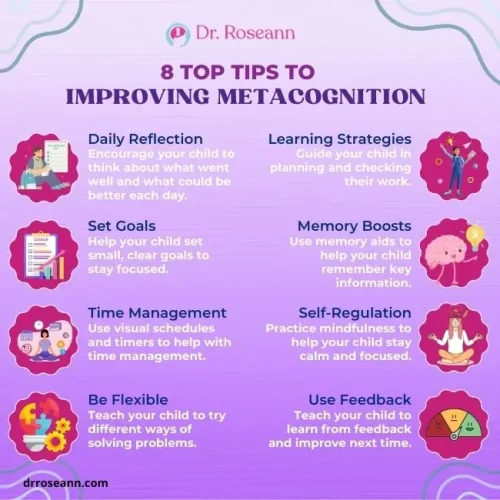
Habits That Improve Metacognition and Executive Function
Think small, repeatable routines.
The Daily REFLECT (2 minutes):
- Recall: “What did I try?”
- Effect: “What worked?”
- Fix: “What will I do differently?”
- List: Write one change.
- Evaluate: “How will I know it worked?”
- Check: Set a reminder.
- Try: Do it at the next opportunity.
Parent example:
Marco, 12, ADHD, ended every homework block with REFLECT. In two weeks, he stopped “disappearing” into his room and started checking his math with a single question: “Where do I usually make errors?”
Takeaway: A 2-minute habit beats a 20-minute lecture.
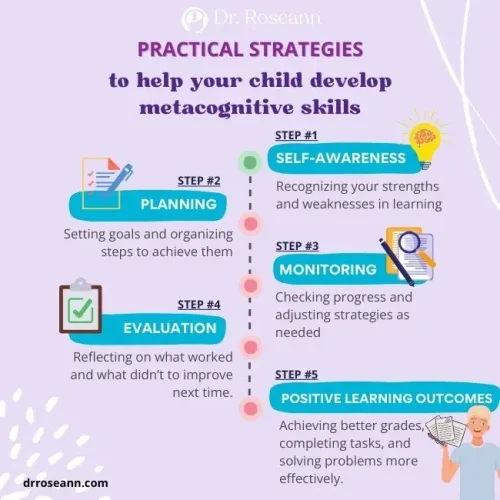
Teach Your Child to Plan, Monitor, and Evaluate Their Own Work
These are the three pillars of metacognition (Schraw & Moshman, 1995):
Tips For When School Demands Outpace My Child’s Skills
Match task load to skill load. Metacognitive and EF skills grow across childhood, and we can intentionally coach them (Roebers, 2017).
Adjust the demand, not the dignity:
- Chunk long tasks into 10–15 minute blocks.
- Scaffold: model, do it together, then fade support.
- Externalize: whiteboard checklists and visible timers reduce working-memory strain.
Parent example:
Sam, 9, became dysregulated after school and had a meltdown over writing. We switched to voice-to-text for drafting, then hand-wrote the final three sentences.
Takeaway: When the method fits the brain, the effort returns.
Coach Your Child Without Nagging
Coach like a calm sports trainer, not a referee.
Use “notice and nudge”:
- Notice: “I see you started right at 4:15. That’s working.”
- Nudge: “What’s your check-in cue if the timer dings and you’re stuck?”
- Name the strategy: “You switched to highlighting—smart move.”

Setting Expectations
Skill-building is gradual and nonlinear. Research shows that strengthening metacognition and executive function improves academic performance and self-regulated learning over time (Schraw & Moshman, 1995; Roebers, 2017).
Celebrate the small victories — they’re proof that progress is happening. When your child starts on time with fewer reminders, catches a mistake they’ve made before, or uses a self-talk strategy on their own, it’s a sign of growth.
Even calmer transitions after a quick movement break show their brain is finding its rhythm. These little wins add up, and each one is a step toward a stronger, more resilient future.
Bringing It All Together: Calm the Brain, Build Resilience
When we calm the brain first, kids can finally use the strategies we teach. By building simple routines for planning, monitoring, and evaluating, you’ll see fewer battles and more wins.
Remember: It’s not bad parenting—it’s a dysregulated brain. You’re not alone, and it’s going to be OK.
Grab your Executive Function Toolkit, take our quick ADHD Quiz, or read my guide on building routines that stick.
Read more: What is Time Blindness? Signs, Causes, and Executive Dysfunction
FAQs About Metacognition and Executive Function
How soon will I see changes?
Small shifts (starting on time, fewer reminders) can appear within 1–2 weeks. However, achieving greater independence requires consistent coaching over several months.
What if my child refuses strategies?
Start with regulation—movement, breath, co-regulation—and shrink the task. Offer choices of strategy, not demands.
Do these ideas work for ADHD, anxiety, or ASD?
Yes. We tailor the load and start with regulation so the brain can engage. Then we teach one metacognitive step at a time.
How do I help without doing it for them?
Model once, do it together, then fade help. Ask coaching questions: “What’s your plan?” “How will you check it?”
Citations
Flavell, J. H. (1979). Metacognition and cognitive monitoring: A new area of cognitive-developmental inquiry. American Psychologist, 34(10), 906–911. https://doi.org/10.1037/0003-066X.34.10.906
Schraw, G., & Moshman, D. (1995). Metacognitive theories. Educational Psychology Review, 7(4), 351–371. https://link.springer.com/content/pdf/10.1007/BF02212307.pdf SpringerLink
Roebers, C. M. (2017). Executive function and metacognition: Towards a unifying framework of cognitive self-regulation. Developmental Review, 45, 31–51. https://doi.org/10.1016/j.dr.2017.04.001
Always remember... “Calm Brain, Happy Family™”
Disclaimer: This article is not intended to give health advice, and it is recommended to consult with a physician before beginning any new wellness regimen. The effectiveness of diagnosis and treatment varies from patient to patient and condition to condition. Dr. Roseann Capanna-Hodge, LLC, does not guarantee specific results.
Are you looking for SOLUTIONS for your struggling child or teen?
Dr. Roseann and her team are all about science-backed solutions, so you are in the right place!
©Roseann Capanna-Hodge