%20.png)


Estimated reading time: 9 minutes
IEP goals for self-regulation are specific, measurable objectives written into a child’s Individualized Education Program (IEP) to help them manage emotions, control impulses, sustain attention, and monitor their behavior in the classroom.
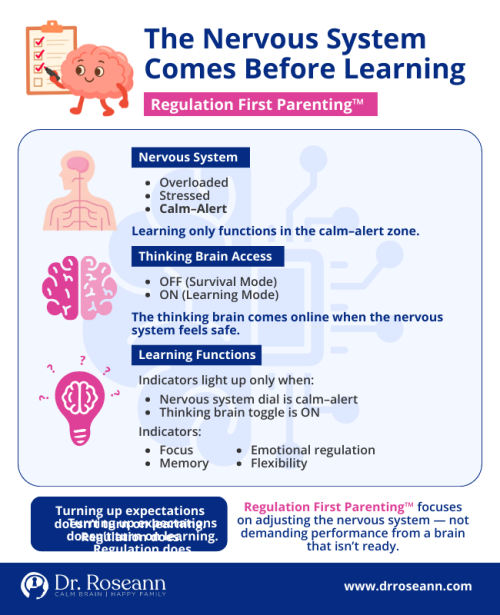
As a licensed mental health expert and founder of Regulation First Parenting®, I’ve worked with thousands of dysregulated children and families for over 30 years. In my clinical experience, the most effective self-regulation IEP goals support the nervous system first — because children cannot access learning, reasoning, or self-control when their brains are stuck in survival mode.
In this guide, you’ll find:
- 15+ fully written SMART self-regulation IEP goals
- ADHD, autism, and anxiety adaptations
- Grade-level examples
- Progress-monitoring strategies
- Practical home and school supports
Whether you’re preparing for an IEP meeting or writing goals professionally, this guide will help you create goals that actually support regulation and learning.
Read about: Special Education for Dysregulated Kids
What Does Self-Regulation Mean for My Child?
Self-regulation is your child’s ability to manage emotions, behaviors, thoughts, and attention so they can function successfully at school and in daily life.
It’s not simply “good behavior.” Self-regulation is a nervous system skill.
Children with strong self-regulation can:
- Recover from frustration
- Shift between activities
- Stay focused long enough to complete tasks
- Express emotions safely
- Pause before reacting impulsively
Children with weak self-regulation often become overwhelmed quickly because their nervous systems struggle to stay calm and flexible under stress.
Research identifies three interconnected areas of self-regulation (Blair & Razza, 2007):
Emotional Regulation
Managing feelings and recovering from emotional stress
- Tolerating disappointment
- Calming after frustration
- Expressing emotions appropriately
Behavioral Regulation
Managing actions and impulses
- Taking turns
- Following routines
- Waiting appropriately
- Controlling physical reactions
Cognitive Regulation
Managing attention and thinking
- Sustaining focus
- Following directions
- Monitoring work
- Problem-solving flexibly
In Regulation First Parenting®, we always begin with the nervous system. A dysregulated child cannot access the thinking brain needed for learning, flexibility, and emotional control.
That’s why effective IEP goals teach regulation skills first — not compliance.
Why Are Self-Regulation Goals Important in My Child's IEP?
No meaningful learning happens when a child’s nervous system is dysregulated.
Research consistently shows that children with stronger self-regulation skills perform better academically, attend school more consistently, and develop healthier peer and teacher relationships (Zelazo & Carlson, 2012).
Self-regulation IEP goals create a structured, legally grounded framework for teaching these skills under IDEA.
IEP goals are not about punishing a child for struggling. They are about explicitly teaching the nervous system skills that make learning possible.
A self-regulation IEP goal might focus on:
- Using a calming strategy when frustrated
- Staying on task during independent work
- Transitioning between activities without meltdowns
- Recognizing emotional triggers before escalation
When done well, self-regulation goals build skills that support children far beyond the classroom.
To meet IDEA requirements, self-regulation IEP goals must be SMART:
- Specific
- Measurable
- Achievable
- Relevant
- Time-bound
They must also connect directly to the student’s Present Levels of Academic Achievement and Functional Performance (PLAAFP). Vague goals like “will improve behavior” are not legally or clinically appropriate.
Strong goals should:
- Align with the child’s PLAAFP
- Address documented educational impact
- Include measurable criteria
- Define how progress will be tracked
- Focus on skill-building rather than punishment
IDEA + PLAAFP Note:
Under IDEA, all IEP goals must directly address needs documented in the student’s PLAAFP.
Self-regulation goals should only be written when evaluations and school data show that dysregulation impacts educational functioning.
For official guidance, visit sites.ed.gov/idea.
Benefits of Self-Regulation IEP Goals
Effective self-regulation goals can help children:
- Stay calm enough to learn
- Reduce emotional outbursts
- Improve focus and task completion
- Build independence
- Strengthen peer and teacher relationships
- Develop lifelong emotional regulation skills
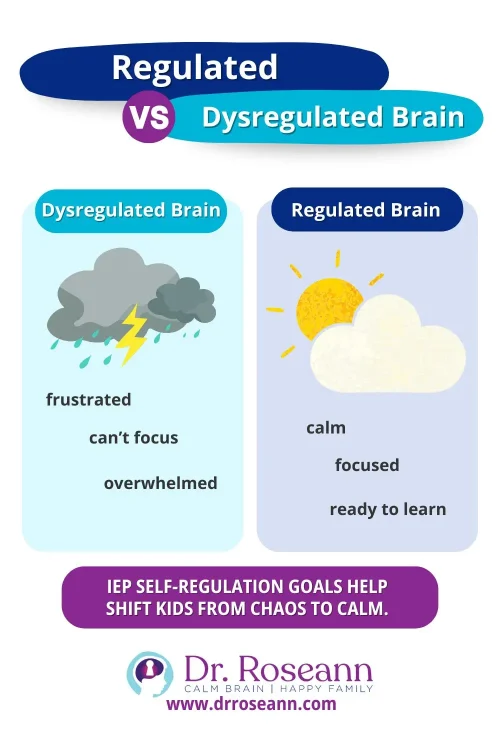
How Can I Tell If My Child Needs Self-Regulation Goals?
If your child...
- Cries, yells, or shuts down when overwhelmed
- Struggles to stay seated or focused
- Has difficulty shifting between tasks or settings
- Overreacts emotionally to small issues
- Brings daily complaints from school
...then they likely need support with self-regulation. These behaviors are clues, not signs of bad parenting or a “difficult child.”
How to Write SMART IEP Goals for Self-Regulation
Strong self-regulation goals focus on teaching skills — not controlling behavior.
The SMART framework helps ensure goals are realistic, measurable, and actionable.
Specific
Name a clear, observable skill.
- Weak: “Will behave better”
- Strong: “Will use a calming strategy when frustrated”
Measurable
Include objective criteria.
Examples:
- “In 4 out of 5 opportunities”
- “80% of observed instances”
- “No more than once per week”
Achievable
Goals should match the child’s current baseline and developmental level.
Relevant
Goals must directly address documented areas of dysregulation impacting school performance.
Time-Bound
Include a clear timeframe.
Examples:
- “By the end of the IEP period”
- “Within 6 months”
Anatomy of a Strong Self-Regulation IEP Goal
Every effective self-regulation IEP goal includes four components:
Component
Question
Condition
When or where does the behavior occur?
Student
Who performs the behavior?
Behavior
What observable skill is expected?
Criterion
How consistently and how well must it occur?
Example SMART Goal:
“When frustrated during academic tasks, [Student] will independently select and use a calming strategy from a visual menu, such as deep breathing, a break card, or a squeeze tool, in 4 out of 5 observed opportunities, as measured by teacher observation data, by [DATE].”
Notice that this goal teaches a replacement skill rather than simply trying to stop a behavior.
That’s the Regulation First® approach.

15+ SMART IEP Goal Examples for Self-Regulation
Category 1: Emotional Regulation IEP Goals
These goals help children identify emotions, recover from frustration, and use calming strategies.
- Calming Strategy Use
“When frustrated or overwhelmed during classroom activities, [Student] will independently select and use a calming strategy (e.g., deep breathing, break card, stress ball) in 4 out of 5 opportunities, as measured by teacher observation, by [DATE].”
- Emotion Identification
“During stressful or upsetting situations, [Student] will verbally identify their emotional state using a feelings chart in 4 out of 5 observed instances, as recorded by the classroom teacher, by [DATE].”
- Reducing Emotional Outbursts
“[Student] will reduce emotional outbursts during class transitions to no more than once weekly, as measured by teacher behavior logs, by [DATE].”
- Requesting a Break Independently
“When feeling overwhelmed, [Student] will independently request a sensory or regulation break in 80% of observed opportunities without prompting, by [DATE].”
- Responding to Feedback Calmly
“When receiving corrective feedback, [Student] will respond with a calm body and appropriate verbal response in 4 out of 5 opportunities, as measured by teacher observation, by [DATE].”
Regulation First Parenting® Tip
Self-regulation goals are far more effective when paired with co-regulation support from adults.
A calm, predictable adult nervous system helps children borrow regulation until they can build it independently.
Category 2: Impulse Control IEP Goals
These goals target blurting, physical impulsivity, and reactive behavior.
- Raising Hand Before Speaking
“During whole-group instruction, [Student] will raise their hand and wait to be called on before speaking in 4 out of 5 opportunities, as measured by teacher tally, by [DATE].”
- Remaining Seated
“[Student] will remain seated during a 20-minute academic activity without leaving their seat more than once per session in 80% of observed instances, by [DATE].”
- Using a Cool-Down Procedure
“When upset or frustrated, [Student] will use a 3-step cool-down procedure before reacting physically or verbally in 4 out of 5 opportunities, as measured by teacher observation, by [DATE].”
- Reducing Blurting
“[Student] will reduce blurting during instruction to no more than twice per class period in 80% of sessions across 4 consecutive weeks, as measured by teacher observation, by [DATE].”
Category 3: Attention and Focus IEP Goals
These goals improve sustained attention, task engagement, and transition recovery.
- Sustained On-Task Attention
“During independent work, [Student] will sustain on-task attention for 15 consecutive minutes with no more than 2 adult redirections in 80% of sessions, by [DATE].”
- Returning to Task After Disruption
“Following a classroom disruption, [Student] will independently return to task within 3 minutes in 4 out of 5 opportunities, by [DATE].”
- Following Multi-Step Directions
“[Student] will complete a 3-step verbal instruction without requesting repetition in 4 out of 5 opportunities, as measured by teacher observation, by [DATE].”
- Completing Transitions Without Prompting
“During activity transitions, [Student] will follow a 3-step transition routine with no more than 1 verbal prompt in 80% of observed transitions, by [DATE].”
Category 4: Self-Monitoring IEP Goals
These goals help children develop awareness of their emotions, behaviors, and regulation needs.
- Self-Monitoring Checklist
“[Student] will use a self-monitoring checklist to track on-task behavior with 80% accuracy compared to teacher ratings in 4 out of 5 observed sessions, by [DATE].”
- Daily Emotion Check-In
“[Student] will accurately identify and record their emotional state during daily check-ins in 4 out of 5 school days weekly, by [DATE].”
- Identifying the Need for Help
“When overwhelmed during academic work, [Student] will identify their need for support and ask for assistance in 3 out of 4 opportunities, by [DATE].”
- Reducing Off-Task Behavior Through Self-Monitoring
“Using a self-monitoring strategy, [Student] will reduce off-task behaviors by 50% from baseline during independent work in 80% of observed sessions, by [DATE].”
Self-Regulation IEP Goal Adaptations by Diagnosis
Self-Regulation IEP Goals for ADHD
Children with ADHD often need movement, visual supports, and external structure built into their goals.
Examples:
- Following visual transition routines
- Using movement breaks proactively
- Sustaining attention with visual timers
- Requesting regulation supports before escalation
The goal is to strengthen internal regulation over time — not force compliance through constant correction.
Self-Regulation IEP Goals for Autism
Children with autism may need goals that explicitly address sensory processing, predictability, and emotional communication.
Examples:
- Using sensory tools before escalation
- Identifying distress levels on a visual scale
- Using calm-down spaces independently
- Tolerating unexpected changes in routine
Visual supports and environmental predictability are essential for success.
Self-Regulation IEP Goals for Anxiety
Children with anxiety benefit from goals that build distress tolerance and reduce avoidance.
Examples:
- Using grounding techniques before tests
- Transitioning without avoidance behaviors
- Starting difficult tasks after calming routines
- Asking for support appropriately
The goal is not to eliminate all anxiety — it’s to help children manage anxiety safely and successfully.
How To Scale Self-Regulation Goals by Grade Level
Early Elementary (K–2)
- Heavy adult support
- Visual cues and sensory tools
- Simpler criteria (60–70%)
- Concrete regulation strategies
Upper Elementary (3–5)
- Gradual fading of prompts
- Increased independence
- Self-monitoring introduction
- Criteria around 75–80%
Middle and High School (6–12)
- Self-advocacy goals
- Generalization across settings
- Higher independence expectations
- Criteria around 80–90%
Always anchor expectations to the child’s current baseline — not to age alone.
The Regulation First® Approach to IEP Goals
Traditional behavior plans often focus on stopping behaviors.
Regulation First Parenting® focuses on supporting the nervous system underneath the behavior.
Traditional Behavior-Focused Goal
Regulation First® Goal
“Student will stop leaving seat.”
“Student will use a movement break card before leaving seat without permission in 4 out of 5 opportunities.”
“Student will stop hitting peers.”
“When overwhelmed, Student will use a calming strategy before reaching behavioral escalation in 4 out of 5 opportunities.”
Children learn best when adults follow this sequence:
Regulate → Connect → Correct
First calm the nervous system.
Then reconnect emotionally.
Only then teach the skill or address the behavior.
That sequence is what makes regulation goals actually work.
How Will Progress Be Measured?
Progress should be tracked with data—not just feelings or general feedback.
Progress Monitoring Might Include:
- Behavior checklists (daily or weekly)
- Teacher observations and notes
- Frequency of strategy use (e.g., how often the child uses a break card)
- Work completion and engagement rates
Ask your IEP team:
- How often will data be collected?
- How will it be shared with me?
- What happens if my child isn’t meeting their goals?
What If My Child Isn’t Making Progress?
If goals aren’t working, it’s not a failure, it’s feedback.
Here’s What You Can Do:
- Request a team meeting to review data
- Re-evaluate goals for specificity and realism
- Check if accommodations are being implemented
- Consider a Functional Behavioral Assessment (FBA)
Parent Reminder:
"Let’s calm the brain first, then we can teach regulation skills."
How Can I Support My Child’s Progress Toward These Goals at Home?
You don’t have to become a therapist, but small things at home can make a huge difference.
At-Home Support Ideas:
- Use visual schedules and timers to reduce transition stress
- Model calming techniques (Box Breathing, Heart Hugs, 5-4-3-2-1 Grounding)
- Build in 10-minute reset breaks after school
- Praise regulation attempts, not just “perfect” behavior
Real-Life Example: Tonya, a mom of a 7-year-old with ASD, started using a “calm corner” with sensory tools at home. After a few weeks, her son began asking to use it when he felt overwhelmed, a huge step forward.
What Accommodations Can Help My Child Achieve Self-Regulation Goals?
IEP accommodations should reduce stressors and create space for your child to practice regulation.
Helpful Accommodations Include:
- Break passes or scheduled movement breaks
- Check-ins with a trusted adult
- Access to sensory tools (fidget, noise-canceling headphones, etc.)
- Clear visual cues or emotion check-ins
- Preferential seating or reduced stimuli environments
Parent Action Tips
- Ask for an IEP Meeting - Don’t Wait
- Use the Solution Matcher to Find the Right Support
- Add One Daily Nervous System Regulating Routine
- Track What’s Working in a Weekly Journal
- If dysregulation continues despite support, consider exploring a QEEG brain map to better understand your child’s brain
FAQs About IEP Goals for Self-Regulation
What’s the difference between emotional regulation and self-regulation?
Self-regulation is the bigger umbrella, while emotional regulation is one part of it—along with behavior, attention, and sensory control. When we build self-regulation skills, we’re helping the whole nervous system function more smoothly.
My child has autism and frequent meltdowns—are self-regulation IEP goals appropriate?
Yes, self-regulation IEP goals are not just appropriate for kids with autism—they’re essential. These goals help reduce meltdowns by teaching your child how to recognize and respond to sensory and emotional triggers.
Can self-regulation skills really be taught to kids?
Yes, self-regulation skills can absolutely be taught with the right support and repetition. Kids learn self-regulation best through co-regulation, practice, and simple, consistent strategies.
Should self-regulation IEP goals include rewards or incentives?
Self-regulation IEP goals should focus on building real skills, not just compliance. Rewards can support motivation, but they should never replace learning how to regulate from the inside out.
What’s a good first step to start talking to the school about self-regulation support?
A great first step is asking how your child is currently supported with self-regulation at school and whether those supports are working. This opens the door to adding meaningful self-regulation IEP goals.
How do I know if my child needs self-regulation IEP goals?
If your child struggles with big emotions, impulsive behavior, or staying calm and focused, they may benefit from self-regulation IEP goals. These challenges are often signs that your child’s nervous system needs more support.
What are examples of self-regulation IEP goals for kids?
Examples of self-regulation IEP goals include learning to use calming strategies, asking for a break, or identifying feelings before they escalate. The best self-regulation IEP goals are specific, measurable, and tailored to your child.
How long does it take to see progress with self-regulation IEP goals?
Progress with self-regulation IEP goals takes time and consistency, but many kids show small improvements within a few weeks. Real change happens as these self-regulation skills are practiced daily across settings.
Can self-regulation IEP goals help kids with ADHD or anxiety?
Yes, self-regulation IEP goals are especially helpful for kids with ADHD or anxiety because they target the root issue—nervous system dysregulation. When regulation improves, focus, behavior, and emotional control follow.
Citations
Dr. Roseann Capanna-Hodge
Capanna-Hodge, R. (n.d.). 504 accommodations for students with OCD. Dr. Roseann. Retrieved April 23, 2025, from https://drroseann.com/504-for-ocd/
National Center for Education Statistics (NCES)
National Center for Education Statistics. (n.d.). Accommodations: Assisting students with disabilities. U.S. Department of Education. Retrieved April 23, 2025, from https://files.eric.ed.gov/fulltext/ED565777.pdf
Individuals with Disabilities Education Act (IDEA)
U.S. Department of Education. (n.d.). Free appropriate public education (FAPE). Retrieved April 23, 2025, from https://en.wikipedia.org/wiki/Free_Appropriate_Public_Education
Dr. Roseann Capanna-Hodge is a licensed mental health expert that is frequently cited in the media:
- Parade Psychologists Reveal: You’ve ‘Succeeded’ as a Parent if Your Adult Child Has These 11 Subtle Habits
- CBS2 New York (Article) Experts Offer Tips On How To Help Children Deal With Anxiety.
- Parade Want to Know How to Overcome Social Anxiety? We've got Help!.
Are you looking for SOLUTIONS for your struggling child or teen?
Dr. Roseann and her team are all about science-backed solutions, so you are in the right place!
Grab your complimentary copy of
©Roseann Capanna-Hodge