

Join the Dysregulation Insider get free calm parenting tips straight to your inbox!
YES, I'M IN!How Not to Be a Fear-Based Parent (Ditch the Scare Tactics and Raise a Resilient, Motivated Kid) | Regulation-First Parenting | E287





Estimated Reading Time: 7 Minutes
Many of us grew up hearing messages like:
- "If you don't study, you'll fail."
- "If you keep that up, you'll never succeed."
- "You better behave or else."
These messages are so common that they can feel normal.
But fear-based parenting doesn't create confidence, resilience, or emotional regulation.
It creates anxiety.
It creates self-doubt.
And it often keeps children focused on avoiding failure rather than pursuing success.
In this episode, I explain how fear-based parenting affects children's nervous systems, why encouragement works better than scare tactics, and how parents can raise resilient, emotionally healthy kids who are motivated from within.
What is fear-based parenting?
Fear-based parenting uses anxiety, shame, guilt, threats, or punishment to influence behavior.
Sometimes it's obvious.
Sometimes it's subtle.
Common Examples
- "If you don't do your homework, you'll never get into college."
- "If you don't behave, we're leaving."
- "You should be ashamed of yourself."
- "You're going to regret this."
Most parents use these phrases because they're worried.
Not because they're trying to hurt their children.
The Problem
Fear is a powerful motivator.
But it's often motivating the wrong thing.
Children learn to:
- Avoid mistakes
- Fear failure
- Doubt themselves
- Focus on outcomes rather than growth
Fear changes behavior temporarily.
Confidence changes behavior long-term.
How does fear-based parenting affect self-esteem?
One of the biggest consequences of fear-based parenting is its impact on self-esteem.
Children begin to internalize messages like:
- "I can't mess up."
- "Mistakes aren't safe."
- "Something is wrong with me."
- "I'm only successful if I perform perfectly."
What Happens in the Brain?
Fear activates the nervous system.
When children constantly feel pressured or threatened:
- Anxiety increases
- Emotional regulation decreases
- Confidence suffers
- Risk-taking becomes harder
The nervous system begins focusing on protection instead of growth.
Real-Life Example
A child hears:
"If you fail this test, you'll ruin your future."
Instead of becoming motivated, they become anxious.
That anxiety often reduces performance.
The very outcome everyone wanted to avoid becomes more likely.
Why does encouragement work better than fear?
One of the most powerful shifts parents can make is replacing fear-based language with encouragement.
Fear-Based Language
Instead of:
"If you don't study, you'll fail."
Encouragement-Based Language
Try:
"When you study, you'll feel more prepared and confident."
This subtle change teaches children:
- Effort matters
- Growth is possible
- Success is earned
- Challenges are manageable
The Goal
We want children to succeed because they believe in themselves.
Not because they're afraid of failing.
That's intrinsic motivation.
And it lasts much longer than fear.
🗣️ "Replacing fear-based language with encouragement is one of the most powerful shifts we can make as parents." — Dr. Roseann
Need help staying calm and confident as a parent?
The Regulation Rescue Kit provides practical Regulation First Parenting® strategies that help reduce stress, strengthen connection, and support emotional regulation. Become a Dysregulation Insider VIP and get your FREE kit today: www.drroseann.com/newsletter
How can I shift from punishment to responsibility?
One of the easiest ways to reduce fear-based parenting is by changing how we communicate expectations.
Traditional Threat
"If you don't finish your homework, no screen time."
Responsibility-Based Approach
"When your homework is finished, you can have screen time."
This simple shift:
- Reduces power struggles
- Encourages responsibility
- Builds independence
- Teaches cause and effect
The child remains accountable.
But the interaction feels supportive rather than threatening.
Real-Life Example
A child procrastinates.
Instead of escalating consequences, the parent focuses on helping the child understand what needs to happen to reach their goal.
That's responsibility.
Not fear.
How does problem-solving build resilience?
One of the biggest gifts we can give children is the ability to solve problems.
Fear-based parenting often solves problems for children.
Resilient parenting teaches children how to solve them themselves.
Instead of Saying:
"If you don't behave, we're not going bowling."
Try Asking:
"If you want to go bowling, what do we need to do to make that happen?"
Now the child begins thinking.
Planning.
Problem-solving.
That's executive functioning in action.
Why This Matters
Children develop confidence when they discover they can solve challenges.
Every problem solved builds resilience.
Every challenge navigated strengthens self-trust.
Why is modeling resilience so important?
Children learn more from what we do than what we say.
When parents respond to challenges with panic, children often learn panic.
When parents respond with calm, children learn calm.
What Resilience Looks Like
- Taking a breath before reacting
- Admitting mistakes
- Solving problems calmly
- Recovering from setbacks
- Trying again after failure
Children need to see resilience modeled.
Real-Life Example
A parent misses a deadline.
Instead of spiraling into self-criticism, they say:
"That didn't go how I wanted. Let's figure out the next step."
That teaches resilience.
How do we build emotional safety?
Children thrive when they feel emotionally safe.
Emotional safety doesn't mean removing all challenges.
It means creating an environment where mistakes, emotions, and growth are allowed.
What Emotional Safety Sounds Like
- "I'm here for you."
- "We'll figure this out together."
- "Mistakes help us learn."
- "You don't have to be perfect."
What Emotional Safety Creates
- Confidence
- Problem-solving
- Resilience
- Healthy risk-taking
- Emotional regulation
When children feel safe, they become more willing to try.
And trying is how growth happens.
Takeaway & What’s Next
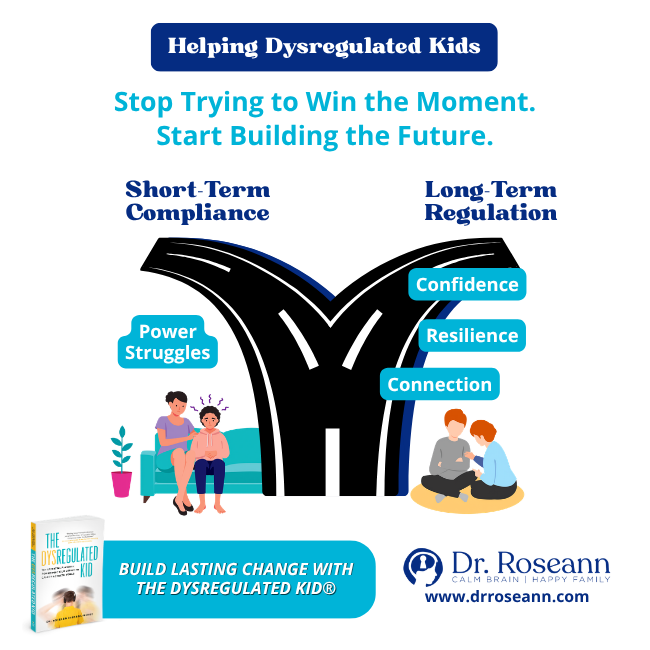
Fear may create short-term compliance.
But confidence creates long-term success.
Your child doesn't need more fear.
They need:
- Emotional safety
- Encouragement
- Support
- Opportunities to problem-solve
- Confidence in their ability to grow
Your child isn't giving you a hard time.
They're having a hard time.
And when we stop parenting from fear and start parenting from connection, resilience grows naturally.
Remember:
- Calm the brain first.
- Encourage growth.
- Focus on responsibility.
- Model resilience.
That's how we raise confident, capable kids.
It's gonna be OK.
Behavior strategies can miss the mark when a child is too dysregulated to access the skills we’re asking for. The Dysregulated Kid® shows you why regulation comes before correction and how to use calm authority, connection, and clear boundaries without escalating the nervous system. Get The Dysregulated Kid® at dysregulatedkid.com.
FAQs
What is fear-based parenting?
Fear-based parenting uses threats, guilt, shame, anxiety, or punishment to motivate behavior. While common, it often increases anxiety and reduces confidence.
Why doesn't fear motivate children long-term?
Fear creates compliance in the moment but often undermines confidence, resilience, and intrinsic motivation over time.
What is intrinsic motivation?
Intrinsic motivation is the desire to do something because it feels meaningful, rewarding, or important—not because of external pressure or fear.
How can I stop using fear-based language?
Focus on encouragement, responsibility, and problem-solving. Replace threats with supportive statements that reinforce effort and growth.
How does emotional safety help children succeed?
When children feel emotionally safe, they become more willing to take healthy risks, solve problems, learn from mistakes, and develop resilience.
Not sure where to start?
Use the Solution Matcher to get personalized recommendations based on your child's emotional and behavioral needs.
Start here:
Dr. Roseann Capanna-Hodge is a licensed therapist, certified school psychologist, and leading expert in emotional dysregulation in children. With over 30 years of experience, she helps parents understand the root causes of meltdowns, anxiety, ADHD, and challenging behavior through the lens of nervous system regulation. Dr. Roseann teaches practical, science-backed strategies for co-regulation and how to calm a dysregulated child using her Regulation First Parenting® approach. She is the host of the Dysregulated Kids Podcast and author of The Dysregulated Kid.
Dr. Roseann Capanna-Hodge
Emotional Dysregulation in Children & Nervous System Expert
Regulation First Parenting® | CALMS Protocol™
Host of the Dysregulated Kids Podcast (Top 1% Globally)
Author of The Dysregulated Kid

Find this helpful? Leave us a review!
Your feedback helps more overwhelmed parents find calm, clarity, and the proven tools that make everyday life easier.
Dr. Roseann Capanna-Hodge: Helping Families of Dysregulated Kids Thrive Through Regulation First Parenting®
As the creator of Regulation First Parenting®, she’s helping families of dysregulated kids discover a compassionate, brain-based path forward. Through The Dysregulated Kids™ Podcast (top 2% globally), she offers practical strategies that help parents understand their child’s brain and support lasting change.
Through The Global Institute of Children’s Mental Health and Dr. Roseann, LLC, she’s created resources like the Neurotastic® Brain Formulas and the Regulation First Parenting® framework—meeting families where they are and supporting them through challenges like ADHD, anxiety, OCD, PANS/PANDAS, and behavioral struggles.
Recognized by Forbes as “a thought leader in children’s mental health,” Dr. Roseann is changing how we understand emotional dysregulation in children—one family at a time.