
Join the Dysregulation Insider get free calm parenting tips straight to your inbox!
YES, I'M IN!Strategies for Failure to Launch Syndrome | Nervous System Strategies | E111





For deeper insight into complex profiles affecting launching, listen to my episode on Gifted and ADHD with Karen or explore The Dysregulated Kid for practical, step-by-step strategies. You’re not alone, and it’s gonna be okay.
FAQs
How do I know if my young adult’s lack of motivation is actually anxiety?
Look for patterns of avoidance, panic, or withdrawal in specific situations. Anxiety-driven inaction often occurs around school, work, or social challenges.
What should I do when my child refuses help?
Start with calm co-regulation, break tasks into small steps, and offer choices. Avoid doing the task for them—this helps build competence and confidence.
What if my child keeps failing at college or jobs?
Evaluate underlying mental health, executive function, and nervous system regulation. Seek structured support and guidance from professionals experienced in failure-to-launch syndrome.
Can therapy alone fix failure to launch?
Therapy helps, but only when paired with nervous system regulation, structure, and parent-guided independence-building.
How long does it take to see improvement?
Results vary, but consistent application of regulation, skill-building, and gradual responsibility typically shows positive change in weeks to months.
Every child’s journey is different.
That’s why cookie-cutter solutions don’t work. Take the free Solution Matcher quiz and get a customized path to support your child’s emotional and behavioral needs—no guessing, no fluff. Start today at www.drroseann.com/help
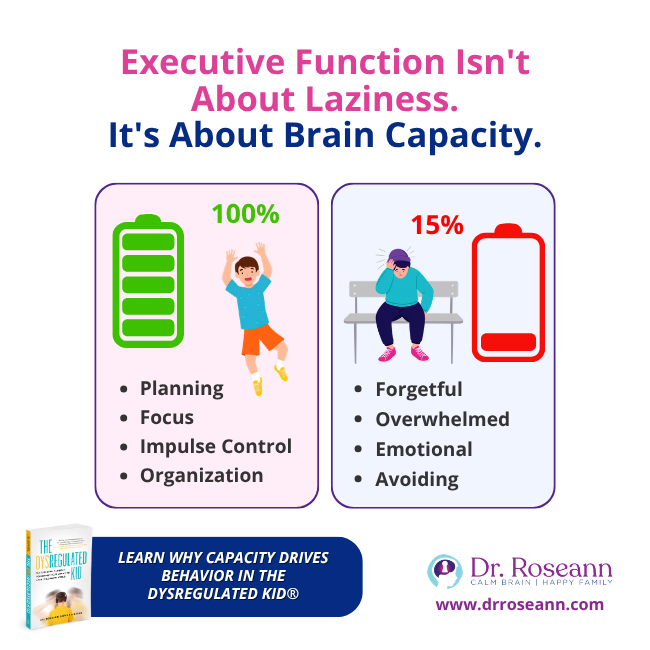
When an older teen or young adult struggles to move forward, it can look like laziness, avoidance, or a lack of motivation. But anxiety, executive functioning challenges, low stress tolerance, and nervous system dysregulation can all make independence feel much harder than it appears from the outside.
In The Dysregulated Kid®, I help parents understand the difference between unwillingness and a brain that lacks capacity in the moment. That Regulation First® perspective helps you support growth without over-functioning for your child or pushing so hard that everyone becomes more stuck. Get The Dysregulated Kid® at dysregulatedkid.com (https://dysregulatedkid.com/).
Dr. Roseann Capanna-Hodge is a licensed therapist, certified school psychologist, and leading expert in emotional dysregulation in children. With over 30 years of experience, she helps parents understand the root causes of meltdowns, anxiety, ADHD, and challenging behavior through the lens of nervous system regulation. Dr. Roseann teaches practical, science-backed strategies for co-regulation and how to calm a dysregulated child using her Regulation First Parenting® approach. She is the host of the Dysregulated Kids Podcast and author of The Dysregulated Kid.
Dr. Roseann Capanna-Hodge
Emotional Dysregulation in Children & Nervous System Expert
Regulation First Parenting® | CALMS Protocol™
Host of the Dysregulated Kids Podcast (Top 1% Globally)
Author of The Dysregulated Kid

Find this helpful? Leave us a review!
Your feedback helps more overwhelmed parents find calm, clarity, and the proven tools that make everyday life easier.
Dr. Roseann Capanna-Hodge: Helping Families of Dysregulated Kids Thrive Through Regulation First Parenting®
As the creator of Regulation First Parenting®, she’s helping families of dysregulated kids discover a compassionate, brain-based path forward. Through The Dysregulated Kids™ Podcast (top 2% globally), she offers practical strategies that help parents understand their child’s brain and support lasting change.
Through The Global Institute of Children’s Mental Health and Dr. Roseann, LLC, she’s created resources like the Neurotastic® Brain Formulas and the Regulation First Parenting® framework—meeting families where they are and supporting them through challenges like ADHD, anxiety, OCD, PANS/PANDAS, and behavioral struggles.
Recognized by Forbes as “a thought leader in children’s mental health,” Dr. Roseann is changing how we understand emotional dysregulation in children—one family at a time.