



One of the most misunderstood parts of the brain is in the frontal lobes where focus and executive functioning are both being managed. Though it may seem difficult to have a deeper understanding as to how executive functioning works, we have to try our best to avoid misdiagnosis.
Most kids experiencing executive functioning issues get misdiagnosed with ADHD and vice-versa. Thus, it’s crucial for us to understand the differences between these two.
People with great executive functioning skills see the end result of everything.
What’s good about having great executive functioning skills is that you get to see the end result of everything. They want a house and they start visualizing what kind of house they’re going to get. When making dinner, they know that it’s a stiry fry because it’s got chicken in it, water, chestnuts, and bamboo shoots. Put a little bok choy in there. They see think, and act with the results in mind.
On the other hand, people with poor executive functioning go into a grocery store, and they don't know what they need to buy. When they throw things in the car and they get home, they realize that they have nothing in their pantry to actually make a meal.
People with ADHD always have executive functioning problems.
When someone is correctly diagnosed with ADHD, it has a lot to do with control, attentional shifting, attentional control, and alerting. You tend to struggle with everything and so it impacts your performance in school, at home or at work. It even creates conflicts in relationships.
Executive functioning is closely intertwined with ADHD. They both deal with sustaining attention, starting tasks, and working memory which are foundational skills of executive function. We must understand that despite being intertwined, they are two separate concepts.
People with ADHD always have executive functioning problems but not everybody with executive functioning problems has ADHD. So why do we misunderstand these two? Why are we really causing this difficulty with parents?
Executive functioning is a set of skills.
Executive functioning is of significant importance because it is a set of skills. Its foundational and advanced skills can be taught and can be learned. In line with this, there are many natural and holistic things that have been shown to dramatically improve attention.
Equally helpful are our own neurofeedback supplements coming out for people with focus problems since there’s nothing in the market that are available and as effective.
And so, we have to understand that these are things that can be taught. If school professionals are not really understanding what executive functioning is and they're doing what they're doing, which is saying, let's start with a checklist. That's not the way you build executive functioning skills.
Executive Functioning Dysfunction
Problems with impulse control arise in small ways even for children younger than 12 years old but it looks different for everybody. Some might experience emotional changes whereas others have more disruptive behaviors.
There are some cases wherein a lovely and cheerful teenager couldn’t focus. You might have a toddler who can't keep his hands to himself. The behavioral changes they show could be ADHD or executive functioning. You often see it as a comorbid thing; something that's there with other things, it can also just be there on its own.
We want to make sure that we understand that these things can co-occur with other things. We don’t want our kids misdiagnosed with ADHD or other mental health illnesses. We don’t want to have to guess whether they need help with executive functioning. But what they don’t need is an ADD pill.
Executive functioning is something that can be taught now when it co-occurs frequently with things like autism.
To reach the root causes, we have to do more things to help the brain be more alert and to support the autistic brain and behavior. Otherwise, if you’re not getting to the root causes, you’re going to be like a spaghetti on the wall or on a rollercoaster that does not end. That’s why we need to have solutions.
There’s no need to fret because executive functioning is something that can be taught now when it co-occurs frequently with things like autism. When looking at an autistic brain through a QEEG, it will look like the most inflexible brain.
That means their communications are stuck. It can be likened to a highway system where there are no other cars and all the exits are taped off and so, you get stuck. Just like what happens in the brain, there’s the presence of rigidity.
What we should then aim for is for us to have flexibility and emotional control. We need to have response inhibition to be able to control our impulses. So there's an overlap between and among these things.
We’ve already talked about how mental health conditions like anxiety, depression, OCD, ADHD, and more affect your focus, attention and your ability to see the end result of completing tasks. It’s going to be a harder for you if you’re struggling with emotions.
That’s why it’s vital for us to do QEEG and brain checks. We don’t want to be left wondering and guessing why these behaviors are happening. For us to be able to help our children, we first need to fully understand what’s going on and what’s causing these behavioral changes.
Difference between ADHD and Executive Functioning in a Nutshell
Executive functioning is a systematic medical process. It is a set of metacognitive skills that can be learned. On the other hand, ADHD is the most common neurodevelopmental disorder of childhood where the brain is viewed as different.
As regards improvement, both can be improved with healthy lifestyle changes coupled with direct teaching and many reinforcements for desired behaviors. We want to shape the behaviors we want.
Catch more of our episodes to help you deal and resolve these parenting struggles!
Links and Resources:
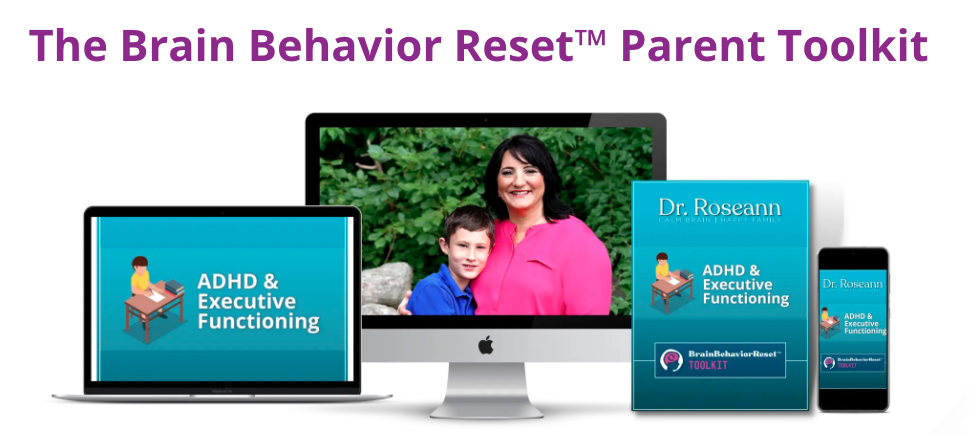
Is your child struggling with attention and executive functioning skills? Learn how to get your kid to listen and finish tasks in 30 days without the constant nagging and fighting. Get the Dr. Roseann's Parenting Toolkit for only $47 today!
➡️ Join our FREE Natural Parenting Community to receive science-backed resources for your child and family. Join here.
➡️ Get help from Dr. Roseann and her team. Apply here.
➡️ “Is it ADHD or something else?” Take the quiz.