



Estimated reading time: 7 minutes
Your child follows every rule, excels in school, and never causes trouble—but something feels off.
A few missed signs of dysregulation include perfectionism, people-pleasing, overthinking, shutting down, and avoiding mistakes at all costs. These behaviors often get praised or overlooked, but they can be signs that your child’s nervous system is working overtime to stay in control.
Recent studies reveal that 73% of parents miss early signs of emotional dysregulation because children’s stress responses don’t always look like meltdowns. Sometimes, dysregulation hides behind compliance and achievement.
The hidden truth?
The most overlooked signs often show up in our “easiest” kids—those who internalize stress instead of expressing it outwardly.
In this blog:
- you'll discover the subtle signs that fly under most parents' radar
- learn practical strategies to support your child's nervous system before small struggles become bigger challenges.
Internalized Behaviors in Children
When we think of childhood dysregulation, we often picture tantrums or defiance. But what about the child who sits quietly in the corner, never asking for help?
Internalized behaviors are the quiet cries for help that often go unnoticed because they don't disrupt family harmony. These children turn their distress inward.
Common internalized behaviors include:
- Excessive worry about disappointing others
- Difficulty expressing needs or preferences
- Over-apologizing for things beyond their control
- Physical complaints (stomachaches, headaches) with no medical cause
- Withdrawal from activities they once enjoyed

Sarah, a mom of 8-year-old Emma, shared: "Everyone commented on how 'easy' Emma was. It wasn't until she started having panic attacks that I realized she'd been carrying enormous stress for months."
Behavior is communication, even when that behavior looks like compliance.
Is People Pleasing a Sign of Emotional Dysregulation?
Yes—excessive people-pleasing can be a nervous system survival strategy. When a child fears disapproval or rejection, they may go to great lengths to avoid conflict, even at the cost of their own needs.
Key indicators:
- Over-apologizing for small mistakes
- Changing opinions to match peers or adults
- Never expressing frustration or disagreement
- Taking on tasks they don’t want just to avoid saying “no”
Why this matters:
Long-term, people-pleasing erodes a child’s sense of self and keeps their stress response active.
Dr. Gabor Maté notes: "Children often suppress their true feelings to remain acceptable or be the 'good kid,' sacrificing authenticity for attachment."

Do You Have a High-Achieving but Anxious Child?
High achievement and anxiety often go hand-in-hand, creating internal pressure that parents frequently miss. These children excel while their nervous systems run on overdrive.
Signs your high-achiever may be struggling:
- Perfectionist paralysis (unable to start tasks unless perfect)
- Meltdowns over small mistakes
- Difficulty sleeping before tests
- Physical symptoms during achievement activities
- All-or-nothing thinking patterns

Psychologist Dr. Jessica Myszak highlights that children who face high expectations or stressful transitions—like tests and performance situations—can experience increased anxiety. She recommends maintaining predictable routines and using reflective listening to help kids express their worries. Supporting children in these ways can ease their internal pressure and help anxious high-achievers manage stress in healthy ways.
Missed Signs of Dysregulation in High-Functioning Children
High-functioning children are master compensators—they manage internal chaos so well that adults rarely suspect they're struggling.
Subtle signs in high-functioning children:
- Emotional regulation that seems "too mature"
- Difficulty with transitions, even positive ones
- Sensory sensitivities that appear suddenly
- Social exhaustion after enjoyable events
- Rigid thinking patterns
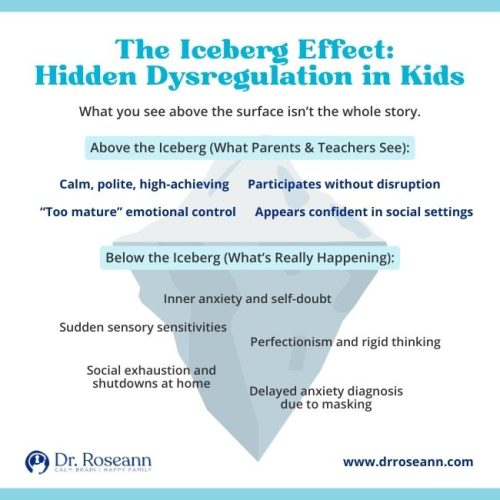
Research shows high-functioning children with anxiety are diagnosed 2-3 years later because their coping strategies mask symptoms effectively.
When Melissa’s 12-year-old son, Ethan, joined the debate team, everyone praised his confidence and poise. But at home, Ethan would retreat to his room for hours, refusing dinner and snapping at his younger sister. Melissa assumed he was just tired from practice—until she learned these “shutdowns” were his way of recovering from the intense stress of holding it together in public.
Brain Science Spotlight
Recent research affiliated with Harvard Medical School reveals that children who internalize stress show different brain activation patterns. Studies indicate that when children regulate or suppress stress responses, their prefrontal cortex—the brain region responsible for cognitive control and emotion regulation—may become more active as it works to maintain balance.
This helps explain why internally dysregulated children sometimes appear mature beyond their years. When their prefrontal cortex is consistently engaged in managing emotions, these children may experience cognitive fatigue and develop perfectionist tendencies.
What this means for your family: Supporting your child's nervous system through calming and grounding activities can help their brain find sustainable balance and reduce stress.
How to Recognize Your Child Masking Stress in Public
Masking is when children present a socially acceptable version while suppressing authentic responses. This helps them navigate expectations but costs their nervous system.
Signs your child may be masking:
- Perfect behavior in public, meltdowns at home
- Extreme fatigue after social events
- Mimicking others' behaviors vs. authentic responses
- Physical symptoms after stressful social situations
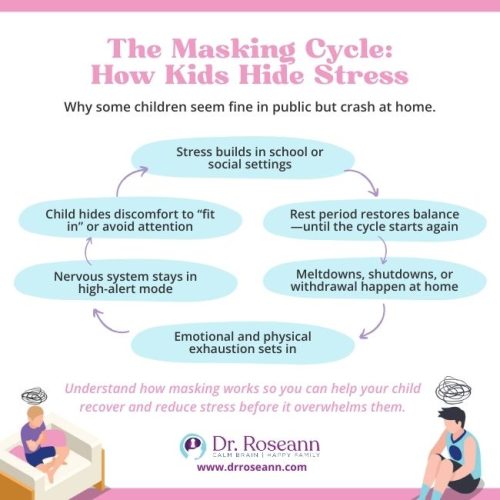
Dr. Michelle Garcia Winner, founder of the Social Thinking® framework, emphasizes that masking to meet social expectations can have significant emotional costs for children, including exhaustion and disconnection from their authentic selves
Jennifer noticed this with 12-year-old Alex: "He'd come home and go straight to his room. I learned he was so drained from masking his autism symptoms that he needed complete sensory rest to recharge."
Dr. Roseann's Therapist Tip
In working with kids for over 30 years, I’ve found that the ones who mask their struggles are often incredibly sensitive and deeply perceptive. But that constant performance, while hiding their true self, keeps their nervous system in chronic stress. This is why I urge parents to focus on the nervous system state, not just the behavior.
Try this today: Create a "decompression ritual" for after school or social events. This might be 20 minutes of quiet time, a warm bath, or simply asking "What did your body feel like today?" instead of "How was your day?"
Why it works: Giving children permission to drop their mask in a safe space helps their nervous system shift from survival mode to connection mode.
Remember: Your child's authentic self—including their struggles—is exactly who they're meant to be. When we create space for their real feelings, we help their brain learn that safety doesn't require perfection.
Does Bedwetting and Stress Have a Connection?
Bedwetting in children over age 6 is often overlooked as dysregulation, especially when other development seems on track. The stress-bladder connection is more significant than parents realize.
Stress-related bedwetting patterns:
- Regression after dry periods
- Bedwetting coinciding with life changes
- Daytime urgency during stressful periods
- Sleep disturbances with bedwetting episodes
VISUAL: Insert chart: "The Stress-Bladder Connection"
Research shows emotional stressors contribute to bedwetting in 40% of cases with no medical condition.
Lisa shared: "Ryan was dry for over a year, then started wetting when he entered a competitive classroom. Once we addressed his school anxiety, bedwetting resolved within weeks."
Early Signs of Emotional Dysregulation Often Overlooked
The earliest signs of dysregulation are often the most subtle, appearing as quirks rather than symptoms. Recognizing these patterns early prevents bigger challenges later.
| Age Range | Possible Early Warning Signs | Clinical Observations |
|---|---|---|
| Toddler (1–3 years) |
• Extreme sensory preferences • Resistance to new foods/clothing • Frequent transition meltdowns |
Sensory exploration is typical, but persistent avoidance or extreme distress may indicate heightened nervous system reactivity. |
| Preschool (3–5 years) |
• Difficulty with routine changes • Heightened reaction to noise/crowds • Trouble winding down for sleep |
Consistent distress with transitions or environmental stimuli suggests challenges with adaptability and self-regulation. |
| Early School Age (6–8 years) |
• Sleep challenges • Digestive issues without medical cause • Withdrawal from favorite activities |
Physical symptoms and withdrawal may reflect underlying stress or anxiety impacting both body and behavior. |
| Tweens (9–12 years) |
• Developmental regression • New sensory sensitivities • Perfectionism or rigid thinking |
Regression can signal nervous system overload; perfectionism may be a coping strategy to maintain a sense of control. |
| Teens (13–18 years) |
• Irritability after social events • Avoidance of new challenges • Ongoing sleep/digestive disruptions |
Stress adaptations may manifest as mood changes but are often rooted in chronic nervous system strain. |
Early intervention with nervous system support can redirect these patterns before they become challenging.
Supporting Your Child's Hidden Struggles
Children who internalize their struggles aren’t “easier”—they’re just showing distress in quieter ways. Compliance, achievement, and people-pleasing can mask deep internal stress.
When we see behavior as communication, even the quiet kind, we can respond with the support our children truly need. Missing these signs isn’t bad parenting—it’s a dysregulated brain coping the only way it knows how.
Your awareness is the first step toward helping your child find true regulation and emotional freedom. You’re not alone, and with the right tools, it’s gonna be OK.
Join our Dysregulation Insider newsletter for weekly science-backed parenting strategies—and get the Regulation Rescue Kit free. This practical toolkit gives you calming techniques, simple scripts, and routines to help your child’s nervous system reset before stress takes over.
FAQs
What's the difference between introversion and internalized dysregulation?
Introversion is a personality trait, while internalized dysregulation is when a child is holding in stress because their nervous system is overwhelmed. Introverted kids can still set boundaries, , but kids with internalized dysregulation often can’t.
At what age should I be concerned about people-pleasing?
You should be concerned about people-pleasing when it starts limiting your child’s ability to express their needs, often around ages 6–8. People-pleasing that shows up with anxiety or physical symptoms is a sign of nervous system dysregulation.
Can high-achieving children have ADHD or anxiety?
Yes, high-achieving children can absolutely have ADHD or anxiety. Strong coping skills can mask ADHD or anxiety, even while the child is struggling with internal dysregulation.
How long until we see improvement with nervous system support?
With nervous system support, some families see improvement in 2–4 weeks, while deeper nervous system dysregulation patterns can take 3–6 months. The goal is steady, lasting regulation, not quick fixes.
Should I worry if dysregulation shows only at home?
Dysregulation showing only at home is actually common and often means your child feels safe enough to release stress. Focus on supporting nervous system regulation at home rather than trying to stop the behavior.
Can perfectionism be a sign of dysregulation in kids?
Yes, perfectionism can be a sign of dysregulation when a child feels unsafe making mistakes. Perfectionism is often the nervous system trying to stay in control, not just a personality trait.
Why does my child people-please even when it makes them unhappy?
People-pleasing happens when your child’s nervous system is trying to avoid stress or conflict. When a child people-pleases, they’re prioritizing safety over their own needs because of dysregulation.
What are subtle signs of dysregulation that parents often miss?
Subtle signs of dysregulation include perfectionism, people-pleasing, overthinking, and shutting down. These quieter behaviors are still signs of nervous system dysregulation, even if they don’t look disruptive.
Related reading: an emotional dysregulation test for children.
Citations
Eisenberg, N., Spinrad, T. L., & Eggum, N. D. (2010). Emotion-related self-regulation and its relation to children’s maladjustment. Annual Review of Clinical Psychology, 6, 235–263. https://doi.org/10.1146/annurev.clinpsy.121208.131208
Graziano, P. A., Reavis, R. D., Keane, S. P., & Calkins, S. D. (2007). The role of emotion regulation in children's early academic success. Journal of School Psychology, 45(1), 3–19. https://doi.org/10.1016/j.jsp.2006.09.002
Zeman, J., Cassano, M., Perry-Parrish, C., & Stegall, S. (2006). Emotion regulation in children and adolescents. Journal of Developmental & Behavioral Pediatrics, 27(2), 155–168. https://doi.org/10.1097/00004703-200604000-00014
©Roseann Capanna-Hodge
Understanding your child's emotional triggers is the first step toward helping them self-regulate. For a comprehensive guide, see The Dysregulated Kid by Dr. Roseann Capanna-Hodge.
Always remember… “Calm Brain, Happy Family™”
Disclaimer: This article is not intended to give health advice and it is recommended to consult with a physician before beginning any new wellness regime. The effectiveness of diagnosis and treatment vary by patient and condition. Dr. Roseann Capanna-Hodge, LLC does not guarantee certain results.
Are you looking for SOLUTIONS for your struggling child or teen?
Dr. Roseann and her team are all about science-backed solutions, so you are in the right place!
Meet the Expert
Licensed Therapist | Certified School Psychologist
Board Certified in Neurofeedback (BCN) | 30+ Years Clinical Experience
Expert in Emotional Dysregulation in Children and Nervous System Regulation
Host, Dysregulated Kids Podcast | Author, The Dysregulated Kid
Dr. Roseann Capanna-Hodge is a licensed therapist, certified school psychologist, and leading expert in emotional dysregulation in children and nervous system regulation. With over 30 years of clinical experience and having analyzed more than 10,000 brain maps, she helps families understand what behavior is really signaling—and how to calm the nervous system first so real change can happen.
She is the creator of Regulation First Parenting® and the CALMS Protocol™, host of the top 1% podcast Dysregulated Kids, and author of The Dysregulated Kid.

Want more Regulation First Parenting® guidance from Dr. Roseann? Add us as a preferred source on Google.