



Estimated reading time: 8 minutes
If your child seems “off” with frequent stomachaches, headaches, trouble sleeping, or constant fatigue, you’re not imagining it. These are common physical symptoms of a dysregulated nervous system, along with things like muscle tension, restlessness, and changes in appetite.
These physical symptoms aren’t random—they’re signs your child’s nervous system is overwhelmed. And once you recognize them for what they are, you can start supporting your child in ways that actually help them feel better.
In this guide, you’ll learn:
- How to spot physical symptoms of a dysregulated nervous system (like stomachaches, fatigue, and sleep issues)
- Why these symptoms happen (an overactive stress response or fight-or-flight)
- How to calm the nervous system with simple, regulation-first strategies
Why Does the Nervous System Get Dysregulated?
Your child’s nervous system is built to keep them safe—but sometimes it gets stuck in overdrive. When that happens, their brain starts sounding alarms over everything, even when there’s no real danger in sight.
Ever seen your child totally melt down over something tiny or freeze up during homework? That’s not misbehavior—it’s survival mode kicking in.
Their brain’s doing its best to protect them, but it’s reacting like there’s a fire… when really, someone just burned the toast.
So what throws the nervous system out of balance in the first place?
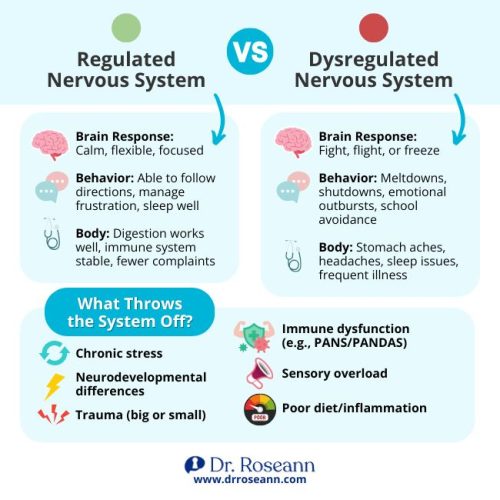
It’s usually not one big thing. It’s layers—stress, wiring, inflammation—that pile up until the system just can’t reset on its own (Elbers et al., 2018).
Common Triggers I See Every Day:
- Chronic stress or anxiety
- Neurodevelopmental differences
- Trauma
- Immune issues, especially in kids with PANS/PANDAS
- Sensory overload
- Poor nutrition or brain inflammation
When the brain’s inflamed or stuck in overdrive, it doesn’t just affect mood or focus—it shows up physically too. That’s why tuning into these symptoms matters so much.
What Are the Physical Symptoms of a Dysregulated Nervous System?
When your child’s nervous system flips into survival mode, their body often starts yelling before their words ever catch up. These signs are easy to miss—or easy to dismiss—but they’re your child’s way of saying, “I’m not okay.”
And let me tell you, it’s not about being dramatic. It’s about a brain that’s stuck in overdrive and a body doing its best to keep up.

Common Physical Symptoms in Kids:
- Chronic fatigue or bursts of hyperactivity
- Headaches or facial tension
- Stomachaches or irregular digestion
- Racing heart or chest tightness
- Trouble falling asleep or staying asleep
- Frequent illness or weak immunity
- Tense muscles or constant fidgeting
- Sensory overload from light noise textures or smells
- Bedwetting or frequent urination
- Low pain tolerance or ongoing discomfort
- “I don’t feel good,” but no fever
- Drained after school despite sleeping well
- Always on edge or overreacts to small things
And when you start recognizing these signs for what they really are? That’s when things begin to shift.
How Can I Tell If My Child’s Physical Symptoms Are From Nervous System Dysregulation?
This is one of the most common questions I hear from parents. “They keep getting stomachaches... Is it stress? Are they just trying to get out of school?”
Here’s how you can start to connect the dots.
Look for Patterns Like These:
- Symptoms flare up during stress—before school, after social events, during transitions
- Medical tests come back “normal” but your child still doesn’t feel well
- Complaints about their body come with mood swings or sudden behavior changes
Rule of Thumb: If your child’s body is often in distress—but doctors can’t find a clear reason—it’s time to look at the nervous system.
Because when the brain feels unsafe, the body reacts loud and clear. That’s not drama—it’s dysregulation.
When Should I Worry About My Child’s Physical Symptoms?
If your child’s symptoms are…
- Getting in the way of school or daily life
- Showing up again and again with no clear medical reason
- Tied to mood swings, meltdowns, or shutdowns
…it’s time to take a closer look.
You’re not overreacting. You’re tuning into your child’s nervous system—and that’s exactly what they need you to do.
How Long Does It Take to Heal a Dysregulated Nervous System?
There’s no one-size-fits-all timeline—but yes, healing is absolutely possible. Even for kids who’ve been stuck in fight, flight, or freeze for years.
What Affects How Long Healing Takes:
1. How long the nervous system’s been dysregulated
The longer it’s been stuck, the more time the brain might need to reset.
2. What’s driving the dysregulation
Things like infections (PANS/PANDAS), trauma, inflammation, or sensory overload can all make healing slower.
3. How consistent the support is
The nervous system doesn’t heal overnight. It needs steady, brain-calming tools—not a quick fix.
What You Might Notice:
- Some kids respond within weeks, especially when you combine:
- Neurofeedback
- Nutrition
- Nervous system retraining (like breathwork or biofeedback)
- Other kids need more time—months or longer— particularly when:
- Immune issues are involved
- There’s a trauma history
- The brain stays inflamed or stuck in high-alert mode
Here’s what I want you to remember: Healing begins when we calm the brain. Once the nervous system feels safe, everything else starts to shift—behavior, sleep, mood, digestion… all of it.
What Helps Calm a Dysregulated Nervous System?
When your child’s nervous system is out of balance, the main goal is to help them feel safe—inside and out. Because when the brain feels safe, regulation follows.
Here are some of the top science-backed tools I use every day with kids in my practice:
1. Neurofeedback
Think of it like physical therapy for the brain. It teaches self-regulation and helps your child move out of survival mode (Abdian et al., 2021), so they can pause and choose instead of react and explode.
2. Biofeedback
This one’s all about awareness. Kids learn how their body reacts under stress—and how they can dial it down in real time using tools like breath and muscle relaxation.
3. Breathwork
Breathing might sound too simple, right? But when done right, it stimulates the vagus nerve and pulls the body out of fight-or-flight faster than you’d think.
4. Nutrition
Food fuels the brain. Cutting back on sugar, dyes, and processed foods can reduce inflammation and improve mood and focus.
5. Supplements (like magnesium and omega-3s)
Support nervous system regulation and help calm an overactive brain.
6. Routine and Co-Regulation
Predictability builds safety. And when your nervous system stays calm, theirs starts syncing up with yours.
That’s the power of co-regulation.
Calm doesn’t start with consequences. It starts with connection and a regulated brain.

Parent Action Steps:
- Track your child’s symptoms and take note of any patterns.
- Learn more about nervous system dysregulation.
- Create a “calm corner” or sensory space in your home.
- Take our Solution Matcher™ to get science-backed solutions to help your child today.
- Explore Calm PEMF to help you and your child lower stress and boost brain function anywhere you go
FAQs
Why does my child seem fine one moment and then suddenly crash?
When your child suddenly crashes, it’s usually because they’ve been using up all their energy trying to stay regulated. That kind of up-and-down is really common with a dysregulated nervous system—it’s not inconsistency, it’s burnout.
Why do these physical symptoms of a dysregulated nervous system show up even when medical tests look normal?
Physical symptoms of a dysregulated nervous system don’t always show up on medical tests because the issue isn’t something structural—it’s how the nervous system is functioning. Your child can look “fine” on paper but still feel really off in their body.
Will physical symptoms of a dysregulated nervous system go away with nervous system support?
Yes—physical symptoms of a dysregulated nervous system can absolutely get better with the right support. When you help calm the brain and support nervous system regulation, the body starts to settle too.
Why does my child complain of stomachaches or headaches with no clear cause?
Stomachaches or headaches with no clear cause are very common physical symptoms of a dysregulated nervous system. When your child is stressed or overwhelmed, their body often shows it through the gut or head.
Can anxiety cause real physical symptoms in my child’s body?
Yes, anxiety can cause very real physical symptoms in your child’s body. A dysregulated nervous system can show up as things like nausea, headaches, or a racing heart—it’s not “in their head,” it’s in their body too.
Why does my child get sick more often when they’re stressed or overwhelmed?
When your child is stressed or overwhelmed, a dysregulated nervous system can make it harder for their body to stay strong. That’s why some kids seem to get sick more often—their system is stuck in survival mode.
How can I tell if my child’s physical symptoms are from nervous system dysregulation?
Physical symptoms from nervous system dysregulation often come and go, especially during stress, and don’t have a clear medical cause. If you notice patterns around overwhelm or transitions, that’s usually a clue.
What can I do at home to help physical symptoms of a dysregulated nervous system?
To help physical symptoms of a dysregulated nervous system at home, focus on calming your child’s body first. Simple things like co-regulation, movement, and predictable routines can really help their system feel safe again.
Citations
Abdian, H., Rezaei, M., Eskandari, Z., Ramezani, S., Pirzeh, R., & Dadashi, M. (2021). The Effect of Quantitative Electroencephalography-Based Neurofeedback Therapy on Anxiety, Depression, and Emotion Regulation in People with Generalized Anxiety Disorder. Basic and clinical neuroscience, 12(2), 281–290. https://doi.org/10.32598/bcn.12.2.2378.1
Elbers, J., Jaradeh, S., Yeh, A. M., & Golianu, B. (2018). Wired for Threat: Clinical features of nervous system dysregulation in 80 children. Pediatric Neurology, 89, 39–48. https://doi.org/10.1016/j.pediatrneurol.2018.07.007
Dr. Roseann is a mental health expert in Self-Regulation who frequently is in the media:
- Healthline Understanding Self-Regulation Skills
- Scary Mommy What Is Self-Regulation In Children, And How Can You Help Improve It?
- HomeschoolOT Therapy Services Understanding Nervous System Dysregulation in Children: A Guide for Homeschool Parents
These strategies form the foundation of the Regulation First approach, which Dr. Roseann details extensively in The Dysregulated Kid.
Always remember… “Calm Brain, Happy Family™”
Disclaimer: This article is not intended to give health advice and it is recommended to consult with a physician before beginning any new wellness regime. The effectiveness of diagnosis and treatment vary by patient and condition. Dr. Roseann Capanna-Hodge, LLC does not guarantee certain results.
Are you looking for SOLUTIONS for your struggling child or teen?
Dr. Roseann and her team are all about science-backed solutions, so you are in the right place!
Meet the Expert
Licensed Therapist | Certified School Psychologist
Board Certified in Neurofeedback (BCN) | 30+ Years Clinical Experience
Expert in Emotional Dysregulation in Children and Nervous System Regulation
Host, Dysregulated Kids Podcast | Author, The Dysregulated Kid
Dr. Roseann Capanna-Hodge is a licensed therapist, certified school psychologist, and leading expert in emotional dysregulation in children and nervous system regulation. With over 30 years of clinical experience and having analyzed more than 10,000 brain maps, she helps families understand what behavior is really signaling—and how to calm the nervous system first so real change can happen.
She is the creator of Regulation First Parenting® and the CALMS Protocol™, host of the top 1% podcast Dysregulated Kids, and author of The Dysregulated Kid.

Want more Regulation First Parenting® guidance from Dr. Roseann? Add us as a preferred source on Google.