



Estimated reading time: 6 minutes
Some of the hidden dangers of ADHD medications don't appear on day one. Appetite loss, sleep disturbances, emotional changes, social withdrawal, and concerns about long-term use may develop gradually, leaving you unsure whether the medication is helping or creating new challenges. Understanding these potential risks allows families to monitor treatment carefully and consider comprehensive approaches that support lasting brain and behavioral health. I'm Dr. Roseann Capanna-Hodge, and after more than 30 years of helping children with ADHD and other neurodevelopmental challenges, I've learned that every child deserves an individualized treatment plan.
What You'll Learn:
- Why medication isn't always the best first step for treating ADHD.
- The hidden risks and side effects parents should understand before starting treatment.
- Evidence-based alternatives that can support attention, behavior, and emotional regulation.
What Are the Hidden Dangers of ADHD Medications?
ADHD meds are often prescribed like a quick bandage, but what parents often aren’t told are the hidden trade-offs.
Sure, they can sharpen focus for a bit, but research shows those same pills almost always bring side effects that ripple through mood, growth, or even brain development (Mosholder et al., 2009). Parents deserve the whole story before making such an important decision.
Top 5 Reasons Why Not To Medicate Your ADHD Child:
- Mood swings and irritability Kids may get more emotional, edgy, or withdrawn.
- Blunted emotions That natural sparkle, creativity, or goofy joy can fade away.
- Appetite suppression Meals shrink, growth slows, like a plant with less water.
- Sleep disruption Nights turn restless, mornings start foggy, and learning takes the hit.
- Long-term brain risks Studies warn of possible impacts on how the brain matures and self-regulates (Volkow
& Swanson, 2013).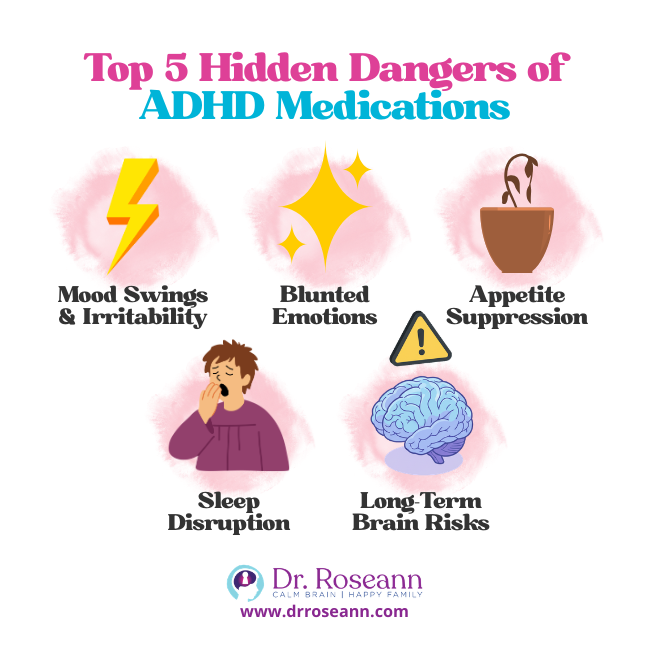
Here’s the thing—behavior is communication, not the root problem.
QEEG brain mapping digs deeper, showing ADHD with up to 89% accuracy versus only 47–58% for traditional rating scales (Kim et al., 2015). Instead of guessing, we can actually watch brainwaves tell their story and then target the treatment where it
counts.
Parents often turn to meds because no one offers another path. Yet stimulants can alter brain chemistry, reinforce dependence, and even raise the risk of later addiction. It’s like patching a leaky pipe with tape—sooner or later, the water bursts through.
Parent Story
Emily, mom of a 9-year-old, thought meds would finally bring peace. And yes, her son sat still in school. At home though, he skipped dinner, snapped easily, and the pounds slipped away. “It felt like we traded one problem for another,” she sighed.
Takeaway: Short-term gains can hide long-term costs. You have choices, and when
we calm the brain first—everything follows.
Read about: Dangers of Medication: Complete Safety Guide for Parents
Why Do Doctors Prescribe ADHD Medications So Often?
Doctors often overprescribe stimulants like Ritalin or Adderall because they can quickly improve focus and reduce impulsivity. But what’s often missed is that these medications don’t treat the root cause—a dysregulated nervous system.
- Meds manage symptoms, not brain regulation.
- Once the medication wears off, behaviors often return.
- Many children cycle through multiple prescriptions, searching for the “right fit.”
Research confirms that while stimulants may reduce core ADHD symptoms in the short term, they don’t address underlying brain regulation—and their effectiveness often fades over time (Molina et al., 2009).
That’s why I remind parents: behavior is communication, and until we calm the brain first, true change can’t happen.
Do ADHD Medications Affect My Child’s Personality?
Yes, for some children. Parents often report their once-joyful child becoming withdrawn, quiet, or even “flat.”
- Loss of creativity – daydreaming and play can decline.
Parent Story
Mark, dad to 12-year-old Ava, noticed she stopped singing and drawing—her favorite outlets—after starting meds. “She was calm, but she wasn’t Ava anymore.”
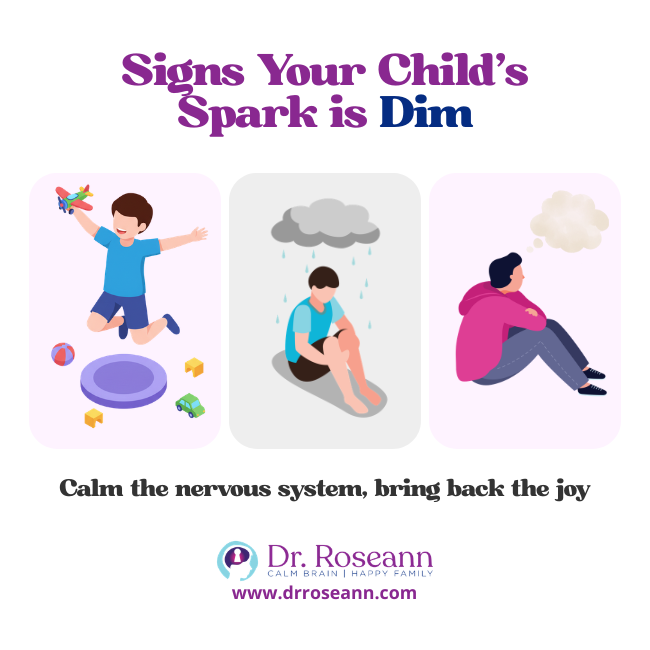
The takeaway? When a child’s spark dims, it’s often a sign of nervous system dysregulation—not misbehavior. Let’s calm the brain first so their true self can shine
again.
Are ADHD Medications Safe Long-Term?
This is one of the most common concerns parents ask me. The truth: We don’t have enough research on the long-term effects.
- Studies also raise concerns about brain development when stimulants are used for years, and the risks of dependency or misuse increase in adolescence (Faraone & Buitelaar, 2010).
The bottom line? Parents deserve the full picture, and there are safe, natural ways to calm the brain first—without relying on long-term medication.
What Are Natural Alternatives to ADHD Medications?
The good news? You have real options. Natural supports can calm the brain, lift mood, and improve focus—without the hidden risks of medication.
Brain-Calming Supports
- Magnesium – the “calm mineral” that eases hyperactivity
- Omega-3s – build brain connections for sharper focus
- Inositol (B8) – balances mood and repetitive thoughts
- Neurofeedback – trains the brain to regulate itself
- Lifestyle pillars – sleep, movement, nutrition, and reducing toxins
ADHD behaviors start in a dysregulated nervous system. Once you understand that, the right tools become clear. Neurofeedback, for example, teaches the brain how to self-regulate with virtually no side effects and has shown measurable benefits in reducing ADHD symptoms (Cortese et al., 2016).
Also, The American Academy of Pediatrics has given Neurofeedback a Level 1 effectiveness rating for ADHD—the same as medication—yet most physicians don’t share this with parents.
At my Ridgefield, CT office—and virtually with families worldwide—we pair nervous system regulation with new learning through tools like Neurofeedback, PEMF therapy, Psychotherapy, Executive Functioning support, and Parent Coaching.
The goal isn’t just to hand parents tools but to teach them how to use them so their child’s brain and body can thrive. This is the foundation of my Brain Behavior Reset™ Program—helping kids reduce symptoms while learning healthier ways to respond.
Food choices matter too.
- Diets high in sugar and processed foods can worsen symptoms, while boosting nutrients or removing irritants often helps the brain settle.
- Lab testing frequently uncovers hidden deficiencies or toxins that disrupt regulation.
Other gentle supports, like homeopathy, may also help. Parents often tell me how even small changes unlocked more calm, creativity, and joy in their child.
Bottom line: Behavior is communication. When we calm the brain first, focus, mood, and learning naturally follow.
How Can I Support My Child Without Relying on Medication?
Parenting a dysregulated child is exhausting, but you’re not failing—your strategies just won’t work until the brain is calm.
Here’s what helps:
- Co-regulation: Your calm is their anchor.
- Structure and routine: Predictability helps ADHD brains thrive.
- Sensory breaks: Movement or breathing resets the nervous system.
- Regulation First Parenting™: Regulate → Connect → Correct.
Sarah, mom of twins with ADHD, added daily "reset breaks" like jumping jacks or short walks. She saw fewer meltdowns and smoother homework time.
The takeaway? When you calm the brain first, everything else—learning, behavior, connection—finally starts to flow.
Parent Action Steps Take our Solution Matcher to get science-backed solutions to help your child
today. Learn more about the Brain Behavior Reset™ Program. Explore brain-based therapies like Neurofeedback and PEMF. Consider parent coaching for guidance and strategy. Schedule short sensory or movement breaks.
FAQs
Do ADHD medications stunt growth?
Yes, ADHD medications can stunt growth in some children by suppressing appetite, which may reduce calorie intake over time. Your child's height, weight, and nutrition should be monitored regularly while taking stimulant medication.
Can my child stop ADHD medication suddenly?
No, your child should not stop ADHD medication suddenly without guidance from a healthcare provider. Stopping medication abruptly may lead to fatigue, mood changes, or a rebound of ADHD symptoms.
Do children's vitamins interfere with ADHD medication?
No, children's vitamins do not typically interfere with ADHD medication. In fact, nutrients such as magnesium, zinc, and omega-3s support brain health, but you should always review supplements with your healthcare provider.
Are natural ADHD treatments safe to use with medication?
Yes, many natural ADHD treatments can be safely used alongside medication when supervised by a healthcare provider. Nutrition, nervous system regulation, neurofeedback, and targeted supplements may complement a comprehensive treatment plan.
Will ADHD go away without medication?
No, ADHD does not go away without medication. However, many children can significantly improve their attention, emotional regulation, and executive functioning through nervous system regulation, behavioral strategies, healthy lifestyle habits, and other evidence-based supports.
Do all children with ADHD need medication?
No, not all children with ADHD need medication. Every child is different, and many benefit from behavioral therapy, parent coaching, school supports, neurofeedback, nutrition, or other interventions that address the root causes of dysregulation.
What are the risks of not treating ADHD?
The risks of not treating ADHD include ongoing struggles with learning, emotional regulation, relationships, self-esteem, and daily functioning. Whether treatment includes medication or not, children benefit from a plan that addresses both symptoms and nervous system health.
When should I consider ADHD medication for their child?
Parents should consider ADHD medication when symptoms significantly interfere with school, home, or social functioning and evidence-based non-medication supports have not provided enough improvement.
Can behavioral therapy help children with ADHD without medication?
Yes, behavioral therapy can help children with ADHD without medication by teaching emotional regulation, organization, coping skills, and positive behavior strategies. Parent involvement makes behavioral therapy even more effective.
How can I tell if my child's ADHD symptoms are severe enough for medication?
A comprehensive ADHD evaluation can determine whether your child's symptoms are severe enough for medication by assessing how much they affect learning, relationships, emotional regulation, and everyday life.
Are there natural ways to support a child with ADHD?
Yes, there are natural ways to support a child with ADHD. Quality sleep, regular exercise, balanced nutrition, nervous system regulation, neurofeedback, and consistent routines can all improve focus, behavior, and emotional regulation.
What questions should I ask before starting ADHD medication?
Before starting ADHD medication, ask about the expected benefits, possible side effects, how your child's growth and progress will be monitored, available non-medication alternatives, and how long medication may be needed.
Citations
Cortese, S., Ferrin, M., Brandeis, D., Holtmann, M., Aggensteiner, P., Daley, D., Santosh, P., Simonoff, E., Stevenson, J., Stringaris, A., Sonuga-Barke, E. J., & European ADHD Guidelines Group (EAGG) (2016). Neurofeedback for Attention-Deficit/Hyperactivity Disorder: Meta-Analysis of Clinical and Neuropsychological Outcomes From Randomized Controlled Trials. Journal of the American Academy of Child and Adolescent Psychiatry, 55(6), 444–455. https://doi.org/10.1016/j.jaac.2016.03.007
Kim, J., Lee, Y., Han, D., Min, K., Kim, D., & Lee, C. (2015). The utility of quantitative electroencephalography and Integrated Visual and Auditory Continuous Performance Test as auxiliary tools for the Attention Deficit Hyperactivity Disorder diagnosis. Clinical neurophysiology : official journal of the International Federation of Clinical Neurophysiology, 126(3), 532–540. https://doi.org/10.1016/j.clinph.2014.06.034
Molina, B. S. G., Hinshaw, S. P., Swanson, J. M., Arnold, L. E., Vitiello, B., Jensen, P. S., Epstein, J. N., Hoza, B., Hechtman, L., Abikoff, H. B., Elliott, G. R., Greenhill, L. L., Newcorn, J. H., Wells, K. C., Wigal, T., Gibbons, R. D., Hur, K., Houck, P. R., & MTA Cooperative Group (2009). The MTA at 8 years: prospective follow-up of children treated for combined-type ADHD in a multisite study. Journal of the American Academy of Child and Adolescent Psychiatry, 48(5), 484–500.
https://doi.org/10.1097/CHI.0b013e31819c23d0
Mosholder, A. D., Gelperin, K., Hammad, T. A., Phelan, K., & Johann-Liang, R. (2009). Hallucinations and other psychotic symptoms associated with the use of attention-deficit/hyperactivity disorder drugs in children. Pediatrics, 123(2), 611–616. https://doi.org/10.1542/peds.2008-0185
Storebø, O. J., Ramstad, E., Krogh, H. B., Nilausen, T. D., Skoog, M., Holmskov, M., Rosendal, S., Groth, C., Magnusson, F. L., Moreira-Maia, C. R., Gillies, D., Buch Rasmussen, K., Gauci, D., Zwi, M., Kirubakaran, R., Forsbøl, B., Simonsen, E., & Gluud, C. (2015). Methylphenidate for children and adolescents with attention deficit hyperactivity disorder (ADHD). The Cochrane database of systematic reviews, 2015(11), CD009885. https://doi.org/10.1002/14651858.CD009885.pub2
Volkow, N. D., & Swanson, J. M. (2013). Clinical practice: Adult attention deficit-hyperactivity disorder. The New England journal of medicine, 369(20), 1935–1944. https://doi.org/10.1056/NEJMcp1212625
Grab your complimentary copy of
Always remember… “Calm Brain, Happy Family™”
Disclaimer: This article is not intended to give health advice and it is recommended to consult with a physician before beginning any new wellness regime. The effectiveness of diagnosis and treatment vary by patient and condition. Dr. Roseann Capanna-Hodge, LLC does not guarantee certain results.
Are you looking for SOLUTIONS for your struggling child or teen?
Dr. Roseann and her team are all about science-backed solutions, so you are in the right place!
Meet the Expert
Licensed Therapist | Certified School Psychologist
Board Certified in Neurofeedback (BCN) | 30+ Years Clinical Experience
Expert in Emotional Dysregulation in Children and Nervous System Regulation
Host, Dysregulated Kids Podcast | Author, The Dysregulated Kid
Dr. Roseann Capanna-Hodge is a licensed therapist, certified school psychologist, and leading expert in emotional dysregulation in children and nervous system regulation. With over 30 years of clinical experience and having analyzed more than 10,000 brain maps, she helps families understand what behavior is really signaling—and how to calm the nervous system first so real change can happen.
She is the creator of Regulation First Parenting® and the CALMS Protocol™, host of the top 1% podcast Dysregulated Kids, and author of The Dysregulated Kid.