%20.png)



Estimated reading time: 7 minutes
Emotional dysregulation is usually not a diagnosis by itself. It means a child has difficulty managing intense emotions, and it may be connected to ADHD, anxiety, autism, trauma, chronic stress, or another underlying condition.
I’m Dr. Roseann Capanna-Hodge, a licensed therapist and certified school psychologist with more than 30 years of experience helping dysregulated kids and overwhelmed parents. In this guide, we’ll clarify whether emotional dysregulation is a disorder, symptom, or pattern, how it differs from a formal diagnosis, and when it may be time to seek support.
In this article, you’ll learn:
- Whether emotional dysregulation is a diagnosis or symptom
- Why the phrase “emotional dysregulation disorder” can be confusing
- What conditions may include emotional dysregulation
- When parents should seek professional support
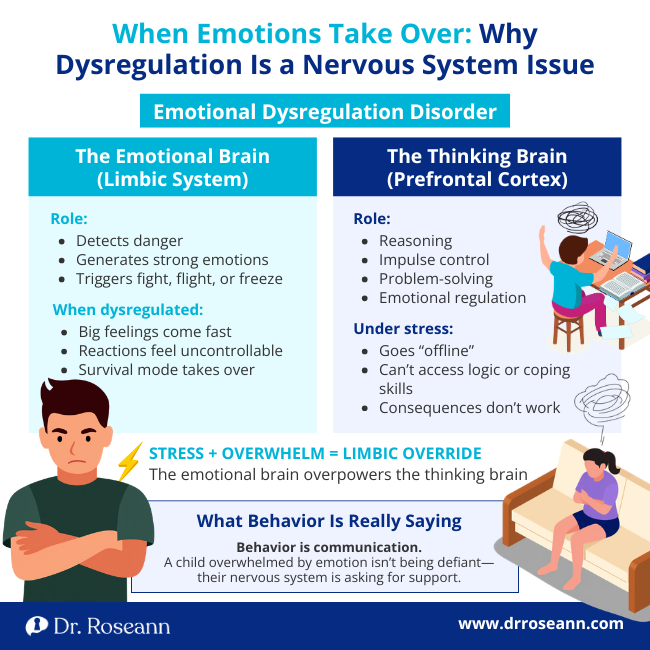
Why the Term “Emotional Dysregulation Disorder” Can Be Misleading
The phrase “emotional dysregulation disorder” is commonly searched online, but it can be misleading because it makes emotional dysregulation sound like one single diagnosis.
In reality, emotional dysregulation can show up in many different clinical and developmental profiles.
For one child, emotional dysregulation may be connected to ADHD impulsivity. For another, it may come from anxiety and fear. For another, it may be related to autism, sensory overload, trauma, depression, learning struggles, or chronic stress.
That’s why the more helpful clinical question isn’t only:
“Does my child have emotional dysregulation disorder?”
The better question is:
“What is my child’s emotional dysregulation telling us?”
That shift matters because the right support depends on understanding what is underneath the behavior.
Is Emotional Dysregulation a Symptom?
Yes. Emotional dysregulation can be a symptom of an underlying mental health, neurodevelopmental, neurological, or stress-related concern.
It may show up in children with:
- ADHD
- Anxiety
- Autism
- OCD
- Depression
- Trauma or PTSD
- Disruptive mood dysregulation disorder, or DMDD
- Oppositional behaviors
- Learning challenges
- Sensory processing difficulties
- Sleep problems
- Chronic stress
- Medical or neurological issues
This doesn’t mean every dysregulated child has a diagnosis. Some children become dysregulated because they are overwhelmed, overtired, overstimulated, under-supported, or still developing emotional regulation skills.
But when emotional dysregulation is frequent, intense, unsafe, or disruptive to daily life, it deserves closer attention.
Is Emotional Dysregulation a Pattern?
Yes. Emotional dysregulation can also be understood as a repeated pattern in how a child’s nervous system responds to stress.
A pattern may include:
- Quick emotional escalation
- Strong fight, flight, freeze, or shutdown responses
- Difficulty using coping skills in the moment
- Long recovery time
- Repeated conflict at home, school, or with peers
- Emotional reactions that interfere with learning or relationships
This pattern gives parents and clinicians important information. It helps answer questions such as:
- What happens before the outburst?
- How long does it last?
- What helps the child recover?
- Does it happen only at home or also at school?
- Is the child anxious, impulsive, sensory overloaded, exhausted, or frustrated?
- Are there signs of ADHD, autism, trauma, mood issues, or learning struggles?
When we study the pattern, we stop treating behavior as random. We begin to understand what the nervous system is communicating.
When Is Emotional Dysregulation Part of ADHD?
For many children with ADHD, emotional dysregulation is part of the picture.
Research shows that working memory challenges and hyperactive/impulsive symptoms can contribute to emotion regulation difficulties, making it harder for kids to pause, tolerate frustration, shift gears, and recover once big emotions take over (Groves et al., 2020).
This isn’t a character issue — it’s a regulation issue.
A child with ADHD-related emotional dysregulation may:
- React before thinking
- Melt down when asked to stop a preferred activity
- Struggle with transitions
- Have low frustration tolerance
- Interrupt, argue, or explode impulsively
- Feel ashamed after losing control
- Calm down slowly once upset
For these kids, the issue isn’t that they don’t care. Their brain may have difficulty pausing, organizing, and regulating in the moment.
When Is Emotional Dysregulation Part of Anxiety?
Anxiety in children doesn’t always look like worry. It can look like irritability, avoidance, crying, anger, shutdown, or refusal.
A child with anxiety-related dysregulation may:
- Melt down before school
- Avoid new situations
- Become angry when pressured
- Panic over uncertainty
- Need excessive reassurance
- Cry or shut down when overwhelmed
- Seem controlling because they are trying to feel safe
When anxiety drives dysregulation, the nervous system is often reacting to perceived threat. The child may not be trying to be difficult. They may be trying to escape a situation that feels too big to manage.
When Is Emotional Dysregulation Part of Autism?
For autistic children, emotional dysregulation is often connected to sensory overload, communication demands, transitions, social stress, masking, or changes in routine.
A child may become dysregulated when:
- The environment is too loud, bright, crowded, or unpredictable
- They can’t communicate what they need
- Their routine changes suddenly
- They are expected to tolerate too much sensory input
- They have been masking all day
- Adults misread overwhelm as defiance
In autism, emotional dysregulation is often a sign of nervous system overload, not intentional misbehavior.
When Is Emotional Dysregulation Part of Trauma or Chronic Stress?
Trauma and chronic stress can make the nervous system more reactive.
A child who has experienced trauma, loss, instability, chronic conflict, bullying, medical stress, or ongoing fear may become more reactive to perceived threat. Their nervous system can move into survival responses such as fight, flight, freeze, or shutdown more quickly, making it harder to pause, think, or calm down in the moment (Marusak et al., 2014).
Trauma-related dysregulation may look like:
- Sudden anger
- Hypervigilance
- Panic
- Emotional shutdown
- Big reactions to reminders of past stress
- Difficulty trusting adults
- Aggression when feeling unsafe
- Trouble calming even after the situation ends
In these cases, behavior may be connected to a nervous system that has learned to stay on alert.
How Clinicians Evaluate Emotional Dysregulation
A good evaluation doesn’t stop at the behavior. It looks at the full picture.
Clinicians may consider:
- Developmental age: Is this reaction expected for the child’s age?
- Frequency: How often does dysregulation happen?
- Intensity: How severe are the reactions?
- Duration: How long do the outbursts last?
- Recovery: How long does it take the child to return to baseline?
- Triggers: What happens before the dysregulation?
- Settings: Does this happen at home, school, socially, or across settings?
- Mood between episodes: Is the child generally calm, anxious, irritable, sad, or reactive?
- Safety: Is there aggression, self-harm, elopement, or property destruction?
- Underlying factors: Could ADHD, anxiety, autism, trauma, sleep, learning, sensory, or medical issues be involved?
This matters because two children can have similar meltdowns for very different reasons.
One child may need ADHD support. Another may need anxiety treatment. Another may need sensory accommodations. Another may need trauma-informed care. Another may need sleep, nutrition, or medical evaluation.
The behavior may look the same, but the root issue can be different.
When Should Parents Be Concerned About Emotional Dysregulation?
Parents should seek support when emotional dysregulation is frequent, intense, unsafe, or interfering with daily life.
It may be time to get help if your child:
- Has outbursts several times a week
- Takes a long time to calm down
- Becomes aggressive or destructive
- Hurts themselves or others
- Talks about self-harm, death, or not wanting to live
- Avoids school or activities because of emotional overwhelm
- Has ongoing friendship or family conflict
- Seems chronically irritable, anxious, or sad
- Can’t use coping skills even with support
- Struggles across home, school, or social settings
If your child talks about self-harm, suicide, or harming others, seek immediate crisis or emergency support.

What Treatment and Protective Factors Help Emotional Dysregulation?
Because emotional dysregulation is usually a symptom or pattern—not a standalone disorder—support should focus on calming the nervous system, building coping skills, and addressing any underlying concerns such as ADHD, anxiety, autism, trauma, or chronic stress.
A comprehensive plan may include:
- Therapy: CBT and DBT-informed strategies can help children build skills for managing big emotions, distress, negative thought patterns, and problem-solving.
- Neurofeedback: This non-invasive, drug-free approach helps train the brain toward better self-regulation, supporting calmer emotional responses over time.
- Parent coaching: Parents learn how to respond with calm, set clear boundaries, validate feelings, and create a more regulated home environment.
- Support for co-occurring conditions: When emotional dysregulation is connected to ADHD, anxiety, trauma, or sensory challenges, addressing the root issue is key.
Protective factors also make a big difference. A secure parent-child bond, predictable routines, healthy sleep, movement, balanced nutrition, coping skills, and supportive school environments can all help a child’s nervous system feel safer and more regulated.
Dr. Roseann’s Therapist Quick Tip:
In my 30+ years of clinical practice, I’ve learned that protective factors—not diagnoses—are often the biggest predictors of whether a child can recover from dysregulation.
What I tell parents:
You don’t have to eliminate every stressor in your child’s life; you need to strengthen the buffers that help their nervous system feel safe, supported, and capable. Consistent relationships, predictable routines, opportunities for regulation, and a calm adult nervous system all act like shock absorbers for big emotions.
Try this today:
Choose one predictable anchor—the same bedtime rhythm, the same morning connection ritual, or a daily check-in—and protect it fiercely for the next week.
Why it works:
Predictability and connection reduce nervous system threat, making it easier for the brain to shift out of survival mode and return to regulation.
Remember:
Every moment of safety you build strengthens your child’s resilience. You’re not just managing behavior—you’re wiring a calmer, more regulated brain over time.
Focusing on these factors builds a strong foundation for emotional well-being, helping children thrive.
The goal isn’t just to stop the outburst. It’s to help the child’s brain and body build the capacity to recover, adapt, and feel more in control.
FAQs About Emotional Dysregulation as a Disorder
Is emotional dysregulation a mental disorder?
Emotional dysregulation is not usually a mental disorder by itself. It is more often a symptom, pattern, or feature that can appear in mental health, neurodevelopmental, stress-related, or medical conditions.
Is emotional dysregulation in the DSM-5?
Emotional dysregulation itself is not typically listed as a standalone diagnosis. However, emotional dysregulation can be part of diagnosed conditions such as ADHD, anxiety disorders, autism, trauma-related disorders, mood disorders, and DMDD.
What disorder causes emotional dysregulation?
Many conditions can involve emotional dysregulation, including ADHD, anxiety, autism, depression, trauma, OCD, and DMDD. A professional evaluation can help determine what may be driving a child’s symptoms.
Is emotional dysregulation the same as DMDD?
No. Emotional dysregulation is a broad symptom or pattern, while DMDD is a specific diagnosis involving chronic irritability and frequent, severe temper outbursts. NIMH describes DMDD as involving severe temper outbursts, persistent irritability, symptoms lasting at least 12 months, and impairment in more than one setting.
Can a child have emotional dysregulation without a diagnosis?
Yes. Some children struggle with emotional regulation because of stress, sleep issues, sensory overload, developmental immaturity, or lack of coping skills. A diagnosis is not always present, but support can still help.
Is emotional dysregulation a symptom of ADHD?
Yes, emotional dysregulation can be part of ADHD for many children. Kids with ADHD may struggle with impulsive reactions, frustration tolerance, transitions, and calming down after becoming upset.
Is emotional dysregulation a symptom of anxiety?
Yes. Anxiety can show up as irritability, avoidance, crying, anger, panic, or shutdown. Some children become dysregulated when their nervous system feels unsafe or overwhelmed.
Can emotional dysregulation look like bipolar disorder?
Sometimes intense mood shifts can raise concerns about bipolar disorder, but many conditions can cause emotional ups and downs. A qualified clinician should evaluate symptoms, duration, mood patterns, age, and family history.
Citations
Groves, NB., Kofler, MJ., Wells, EL., Day, TN., & Chan, ESM. (2020). An Examination of Relations Among Working Memory, ADHD Symptoms, and Emotion Regulation. J Abnorm Child Psychol, ;48(4):525-537. https://doi.org/10.1007/s10802-019-00612-8
Marusak, H., Martin, K., Etkin, A., & Thomason, M. (2015). Childhood trauma exposure disrupts the automatic regulation of emotional processing. Neuropsychopharmacology, 40:1250-1258. Retrieved from https://www.nature.com/articles/npp2014311
Always remember… “Calm Brain, Happy Family™”
Disclaimer: This article is not intended to give health advice, and it is recommended to consult with a physician before beginning any new wellness regimen. *The effectiveness of diagnosis and treatment varies by patient and condition. Dr. Roseann Capanna-Hodge, LLC, does not guarantee specific results.
Are you looking for SOLUTIONS for your struggling child or teen?
Dr. Roseann and her team are all about science-backed solutions, so you are in the right place!